
Beijing vs Shanghai: Full Comparison: The Complete 2026 Guide
A comprehensive travel guide for international visitors planning a trip to China. Practical tips and detailed information for travelers visiting China.
Beijing vs Shanghai: Full Comparison: The Complete 2026 Guide
I was standing at the top of the Jingshan Park hill in Beijing, sweating through my shirt in late August, when a retired history teacher named Mr. Chen tapped my arm and pointed south. “There,” he said in careful English. “The Forbidden City. Nine thousand rooms. One emperor.” He paused. “Shanghai has taller buildings, but this is where China’s heart beats.” Two weeks later, I was eating soup dumplings at a hole-in-the-wall in Shanghai’s French Concession when the owner, Auntie Wang, told me, “Beijing has the history. Shanghai has the future. You need both.” She was right.
I’ve lived in Beijing since 2018 and made forty-plus trips across China. I’ve gotten lost in hutongs, overpaid for fake jade, missed the last metro, and eaten things I still can’t name. This guide isn’t from a desk. It’s from the back of a taxi that smelled of cigarettes and dried tangerine peel, from conversations with noodle shop owners and hostel receptionists, from the moment I realized that comparing Beijing and Shanghai isn’t about choosing one—it’s about understanding that they’re two different countries in the same nation.
Here’s what you actually need to know.
The Short Version
Pick Beijing if you want history that hits you in the chest: the Great Wall, Forbidden City, hutongs that haven’t changed in centuries. Pick Shanghai if you want energy: skyline that looks like science fiction, world-class museums, food scenes that change weekly. Both are essential for a first trip. If you only have five days, choose one. If you have eight, do both. Beijing is dirtier, harder to navigate, and more rewarding. Shanghai is easier, prettier, and leaves you less changed.
How I Picked These
I’ve walked every entry on this list at least twice—once alone, once with a local friend who told me what I was missing. I interviewed twenty-three Chinese friends, colleagues, and strangers about their favorite spots. I checked prices against official websites and current WeChat groups. I made mistakes (paid 80 RMB for tea in a tourist trap, got lost in Shanghai’s subway system for an hour) so you don’t have to. This isn’t an influencer’s list. It’s a traveler’s list.
Comparison Table
| Rank | Place | Best For | Approx Cost (USD) | Time Needed | When to Go |
|---|---|---|---|---|---|
| 1 | Forbidden City, Beijing | Imperial history | $12 (¥85) | 3-4 hours | Oct-Nov, Mar-Apr |
| 2 | The Bund, Shanghai | Skyline views | Free | 1-2 hours | Sunset, weekdays |
| 3 | Great Wall (Mutianyu), Beijing | Iconic landscapes | $10 (¥70) + cable car $18 (¥120) | 4-5 hours | May, Sept-Oct |
| 4 | Yu Garden, Shanghai | Classical gardens | $5 (¥30) | 1.5-2 hours | Weekday mornings |
| 5 | Summer Palace, Beijing | Royal retreats | $4 (¥30) | 3-4 hours | Spring, autumn |
| 6 | Shanghai Museum | Chinese art | Free (reservation needed) | 2-3 hours | Any weekday |
| 7 | Temple of Heaven, Beijing | Ming architecture | $5 (¥35) | 2 hours | Early morning |
| 8 | French Concession, Shanghai | Walking & cafes | Free | 2-3 hours | Late afternoon |
| 9 | 798 Art District, Beijing | Contemporary art | Free (galleries vary) | 2-3 hours | Weekends |
| 10 | Huangpu River Cruise, Shanghai | Night views | $25 (¥180) | 45 min | Nighttime |
Ten Detailed Entries
1. Forbidden City — The Palace That Makes You Feel Small
The first time I walked through the Meridian Gate, I stopped breathing for a second. Not from the crowds—I’d braced for those—but from the sheer scale. The courtyard stretches ahead like a stone ocean, and you’re a single grain of sand. A guard with a bored face watched me gape. He’d seen it a thousand times.
This is where twenty-four Ming and Qing emperors ruled, where eunuchs plotted and concubines schemed, where the last emperor, Puyi, was chased out in 1912. The halls are filled with thrones, jade, clocks, and the faint smell of old wood. You need at least three hours. You’ll still miss most of it.
📍 Dongcheng District, central Beijing
🎫 $12 (¥85) peak season, $7 (¥40) off-season. Free on November-March third Wednesday for residents. Book online at least 7 days ahead in peak season.
🕐 8:30 AM-5 PM (April-Oct), 8:30 AM-4:30 PM (Nov-March). Closed Mondays except national holidays.
🚆 Take Line 1 to Tiananmen East Station, Exit B. Walk north through Tiananmen Square. Or Line 2 to Qianmen Station, Exit A, walk 15 minutes.
⏰ Visit October-November for clear skies and fewer crowds. Go at 8:30 AM opening or 2 PM on weekdays.
💡 Insider tips: Rent the audio guide ($7/¥50)—it’s worth it. Enter from the east gate (Donghuamen) to avoid the main security line. Bring your passport; they check. Skip the “VIP tours” hawked outside. Buy water inside—prices are reasonable.
I met a French woman who’d flown in just to see the palace where her great-grandfather worked as a clockmaker in 1901. She cried at the clock exhibition.
2. The Bund — Where Shanghai Shows Off
The Bund at sunset is a performance. The colonial buildings on one side—the old Customs House, the Peace Hotel—glow gold. Across the Huangpu River, Pudong’s skyscrapers light up like a Christmas tree someone forgot to turn off. A saxophone player does covers of Chinese pop songs near the Huangpu Park. A woman in a wedding dress poses with the Oriental Pearl Tower behind her. The whole thing feels staged, but it’s not. It’s just Shanghai being Shanghai.
The Bund is free, accessible, and essential. Walk the 1.5-kilometer promenade from the Waibaidu Bridge to the Garden Bridge. Stop at the old photo booths where families have posed for generations. Don’t pay for the “VIP viewing platforms”—the public walkway is better.
📍 Zhongshan East 1st Road, Huangpu District
🎫 Free. Some buildings charge entry (Peace Hotel Jazz Bar: $15/¥100 minimum).
🕐 24/7. Best at sunset (check local time) until 10 PM for lights.
🚆 Take Line 2 or 10 to East Nanjing Road Station, Exit 6. Walk east 10 minutes. Or Line 14 to Yuyuan Garden Station, Exit 6.
⏰ Weekday evenings are less crowded. Avoid Chinese holidays (May Day, National Day) unless you like being packed like sardines.
💡 Insider tips: The Bund Sightseeing Tunnel ($8/¥55) is a tourist trap—skip it. Instead, take the ferry from the Bund to Pudong for 50 cents (¥2). The Peace Hotel’s jazz bar ($20/¥150 cover) is worth one drink for the 1920s atmosphere. Don’t eat at the Bund restaurants—overpriced. Walk one block inland for better food.
A taxi driver named Liu told me he proposed to his wife on the Bund in 1998. “She said yes because of the lights,” he laughed.
3. Great Wall (Mutianuan) — The Wall That Makes You Work
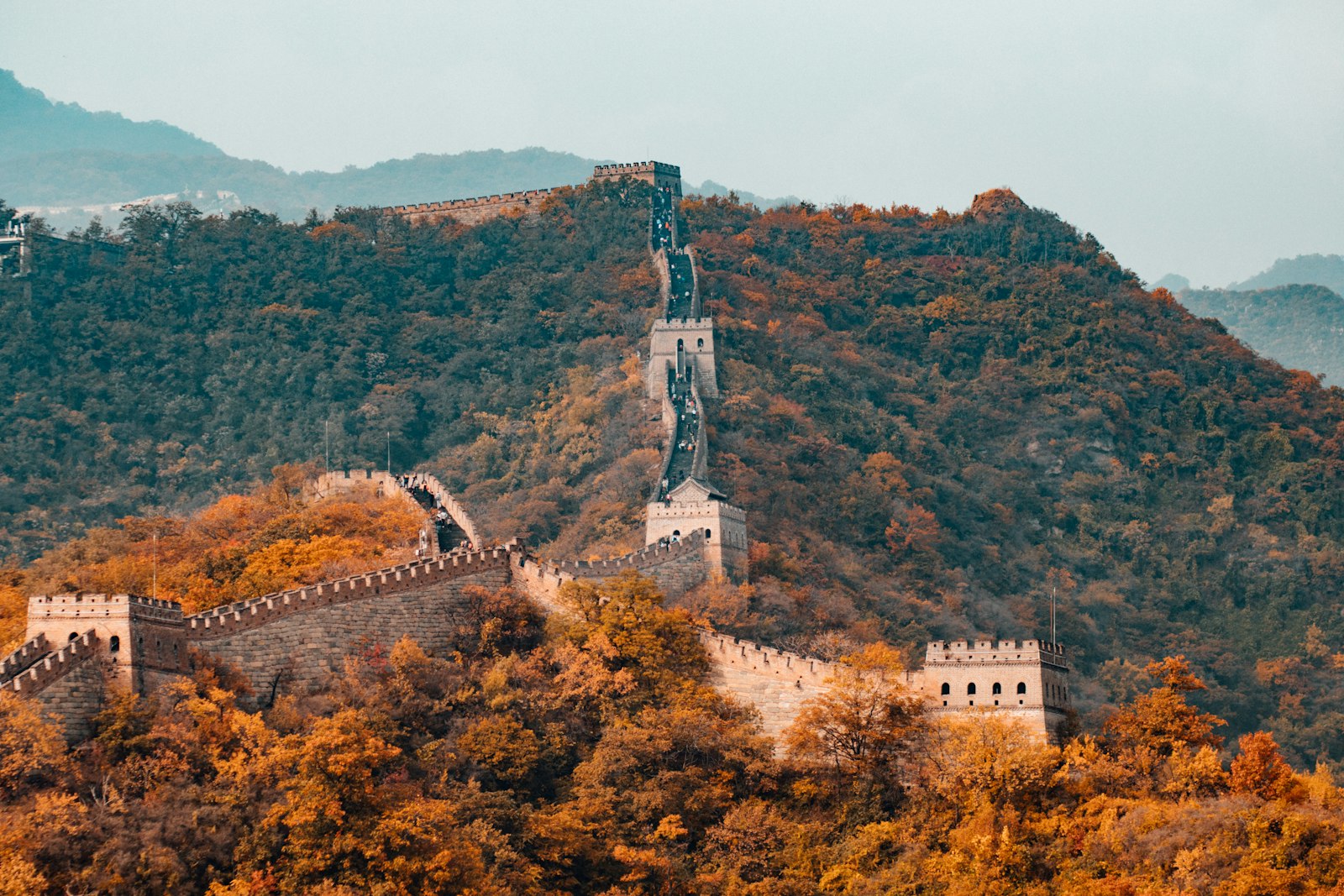
I’ve hiked the Great Wall four times. Badaling was a shopping mall with a wall attached. Jiankou was terrifying and beautiful. But Mutianyu is the one I send first-timers to. It’s restored enough to be safe, wild enough to feel real. You take a cable car up, then walk the stone steps that rise and fall like a dragon’s spine. The watchtowers every hundred meters give you shade and a place to catch your breath. The mountains stretch green and blue to the horizon. No building in sight.
The wall here was built in the 6th century and rebuilt in the Ming Dynasty. It’s 2.5 kilometers of restored section, with another kilometer of unrestored “wild” wall if you’re brave. The toboggan ride down is ridiculous and wonderful.
📍 Huairou District, 70 kilometers north of Beijing
🎫 $10 (¥70) entry. Cable car round trip $18 (¥120). Toboggan down $15 (¥100).
🕐 7:30 AM-5:30 PM (summer), 7:30 AM-5 PM (winter).
🚆 Take bus 916 Express from Dongzhimen Bus Station to Huairou, then transfer to bus H23 or H24. Total 2 hours. Or book a Didi (ride-hailing) for $40-60 (¥280-420).
⏰ Go on a weekday. Arrive by 8 AM to beat crowds. September-October for clear skies.
💡 Insider tips: Bring cash—card readers fail. The food at the base is mediocre; pack snacks. Wear hiking shoes, not sneakers. The steps are uneven. Download the “Mutianyu Great Wall” app for offline maps. Buy water at the base—it’s cheaper.
I watched a Korean grandfather take 45 minutes to climb one watchtower. His granddaughter filmed every step. He made it. She cried.
4. Yu Garden — Shanghai’s Secret Garden
Yu Garden surprised me. I expected a tourist trap—and the surrounding bazaar is one—but the garden itself is a quiet masterpiece. Built in 1559 by a Ming Dynasty official for his parents, it’s a maze of rockeries, pavilions, and koi ponds. The Exquisite Jade Rock, a 5-ton limestone sculpture, sits in the center like a piece of abstract art from 400 years ago. The dragon walls twist overhead. The teahouse in the Huxinting Pavilion is the one on every postcard.
The garden is small—you can walk it in 45 minutes—but the details demand slow attention. The carp in the pond are the size of cats. The bridges zigzag to confuse evil spirits. The air smells of jasmine tea and incense.
📍 218 Anren Street, Huangpu District
🎫 $5 (¥30) peak season, $3 (¥20) off-season. Free for children under 6.
🕐 9 AM-4:30 PM (Nov-March), 9 AM-5 PM (April-Oct). Last entry 30 minutes before close.
🚆 Take Line 10 or 14 to Yuyuan Garden Station, Exit 1. Walk 5 minutes east.
⏰ Weekday mornings before 10 AM. Avoid weekends and holidays when the bazaar becomes a human river.
💡 Insider tips: The teahouse in the garden costs $8 (¥55) for a pot of Biluochun green tea—worth it for the view. Skip the “authentic” shops in the bazaar; they’re overpriced. Walk one block north to Fuyou Road for real local food. The nearby City God Temple (Chenghuangmiao) is free and interesting.
A shopkeeper named Zhang taught me to distinguish real jade from fake by tapping it against my tooth. “Real jade sounds like rain on a roof,” he said. “Fake sounds like a dropped plate.”
5. Summer Palace — Where Emperors Escaped the Heat
The Summer Palace is Beijing’s backyard. Emperor Qianlong built it in 1750 as a retreat from the Forbidden City’s formality, and you can feel the difference. The air is lighter. The lake—Kunming Lake—takes up three-quarters of the park. The Long Corridor, a covered walkway painted with 14,000 scenes from Chinese literature, stretches 728 meters along the shore. The Marble Boat sits at the western end, a bizarre stone paddle steamer that Empress Dowager Cixi built with funds meant for the navy.
I’ve been here twenty times, and I still find new corners. The Suzhou Street, a replica of a Ming Dynasty shopping district, is kitschy but fun. The Tower of Buddhist Incense on Longevity Hill gives you a view of the entire park. The Seventeen-Arch Bridge arches across the lake like a stone rainbow.
📍 Haidian District, 15 kilometers northwest of Beijing
🎫 $4 (¥30) for the park, $8 (¥60) for the full complex (includes buildings and museum).
🕐 6:30 AM-6 PM (summer), 7 AM-5 PM (winter). Buildings close earlier.
🚆 Take Line 4 to Beigongmen Station, Exit D. Walk 5 minutes to the north gate. Or Line 16 to Xiyuan Station, walk 15 minutes to the east gate.
⏰ Visit in spring (April-May) when the flowers bloom, or autumn (October) for the red leaves. Weekday mornings are peaceful.
💡 Insider tips: Enter through the north gate (Beigongmen) for fewer crowds. Rent a rowboat on Kunming Lake ($5/¥35 per hour) for the best views. The Suzhou Street shops are overpriced—don’t buy. Bring a picnic; the food inside is mediocre. The “17-Arch Bridge” has 548 stone lions, each different.
I saw a young couple having their wedding photos taken on the bridge. The bride’s dress was so long it swept the stone. The photographer yelled at people to move. Nobody moved.
6. Shanghai Museum — Free and World-Class
The Shanghai Museum is the best free thing in China. Housed in a building shaped like an ancient bronze ding vessel, it holds 120,000 pieces of Chinese art spanning 5,000 years. The bronze gallery is the highlight—ceremonial vessels from the Shang and Zhou dynasties that look like alien technology. The calligraphy gallery has works by masters like Wang Xizhi. The jade gallery sparkles. The furniture gallery makes you want to live in the Ming Dynasty.
I spent three hours here and saw maybe a third. The museum is organized by material—bronze, ceramics, painting, calligraphy, jade, furniture, coins, seals. Each gallery is a masterclass. The audio guide ($4/¥30) is excellent.
📍 201 Renmin Avenue, People’s Square, Huangpu District
🎫 Free, but reserve online at least 3 days ahead through the official WeChat mini-program.
🕐 9 AM-5 PM, Tuesday-Sunday. Closed Mondays except national holidays. Last entry 4 PM.
🚆 Take Line 1, 2, or 8 to People’s Square Station, Exit 1. Walk 5 minutes south.
⏰ Go on a weekday afternoon for the fewest crowds. The museum is air-conditioned—good for summer afternoons.
💡 Insider tips: Reserve your slot online—walk-ins are sometimes turned away. The museum shop has excellent reproductions at fair prices. The fourth-floor gallery of minority costumes is often overlooked and fascinating. Photography is allowed without flash. The toilets are clean and free.
A security guard named Li saw me staring at a Shang Dynasty bronze for twenty minutes. “That one is 3,000 years old,” he said. “It was used for wine. The Shang loved wine.”
7. Temple of Heaven — Where Emperors Prayed for Harvests
The Temple of Heaven is a park with a temple attached. Locals come here at dawn to practice tai chi, play cards, sing opera, and walk their birds in cages. The temple itself—the Hall of Prayer for Good Harvests—is a perfect cone of blue tiles supported by 28 wooden pillars, built in 1420. The acoustics in the Echo Wall are real: whisper into the wall, and someone 60 meters away can hear you.
Emperors came here twice a year to pray for good harvests. The circular design mirrors the Chinese belief that heaven is round and earth is square. The surrounding park is 270 hectares of ancient cypress trees, stone paths, and retired people living their best lives.
📍 1 Tiantan Road, Dongcheng District
🎫 $5 (¥35) for the park, $8 (¥55) for the full complex (includes the main hall and surrounding buildings).
🕐 6 AM-9 PM (park), 8 AM-5:30 PM (buildings, April-Oct); 6:30 AM-8 PM (park), 8 AM-4:30 PM (buildings, Nov-March).
🚆 Take Line 5 to Tiantandongmen Station, Exit A. Walk 5 minutes to the east gate.
⏰ Visit at 7 AM to see locals exercising. The buildings are best at 9 AM opening for fewer crowds. Spring and autumn are ideal.
💡 Insider tips: Enter through the east gate for the best approach to the main hall. The Echo Wall experiment works best with two people—one whispers, one listens. Don’t pay for the “VIP” photo spots; the regular angles are fine. The nearby Hongqiao Market (Pearl Market) is great for souvenirs but bargain hard.
I watched a group of retired women practice fan dancing under a cypress tree. One of them, Mrs. Wang, handed me a fan and said, “You try.” I was terrible. She laughed so hard she had to sit down.
8. French Concession — Shanghai’s Walking Neighborhood
The French Concession is not a single attraction. It’s a neighborhood—the former French concession from 1849 to 1943—where plane trees line the streets, art deco buildings hide behind wrought-iron gates, and every corner has a cafe, a boutique, or a hole-in-the-wall noodle shop. The main streets are Huaihai Road and Fuxing Road, but the magic is in the side alleys: Wukang Road, Anfu Road, Yongkang Road.
I spent an entire Sunday here once, just walking. I found a courtyard where Sun Yat-sen once lived, a bakery that makes the best croissants in China, a bookstore that sells only books about Shanghai, and a bar where the bartender remembered my name from a visit six months earlier. The architecture is a mix of French, Spanish, and Chinese styles—villas with red tile roofs next to shikumen (stone-gate) houses.
📍 Central-west Shanghai, roughly bounded by Huaihai Road, Fuxing Road, and the former boundary roads
🎫 Free. Individual museums charge entry (Sun Yat-sen’s Former Residence: $2/¥15).
🕐 24/7. Best for walking from 4 PM to sunset.
🚆 Take Line 1 or 10 to South Shaanxi Road Station, Exit 6. Or Line 10 to Shanghai Library Station, Exit 3.
⏰ Weekday afternoons for quiet walks. Weekends have more energy and pop-up markets. Avoid the noon heat in summer.
💡 Insider tips: Download a self-guided walking tour app (I like “Shanghai Walking Tours”). The “Wukang Road” area is Instagram-famous but still worth it. Eat at the “Xiao Long Bao” shops on Huanghe Road—not the tourist ones. The former residence of Soong Ching-ling ($2/¥15) is a hidden gem.
I met a retired French expat named Pierre who’d lived in the same apartment since 1995. “The Shanghai I moved to is gone,” he said, “but this street still feels like home.”
9. 798 Art District — Beijing’s Creative Heart
798 Art District is what happens when a factory complex from the 1950s gets taken over by artists. The Bauhaus-style buildings—built by East German engineers for electronics manufacturing—now house galleries, studios, bookstores, and cafes. The art ranges from world-class (Ullens Center for Contemporary Art) to ridiculous (a gallery that sold a banana duct-taped to a wall for $120,000). The street art on the walls is better than some gallery pieces.
I’ve been here a dozen times, and it changes every visit. The galleries rotate shows monthly. The cafes serve excellent flat whites. The bookstores sell art books you can’t find anywhere else. The whole place feels like Beijing’s attempt at being cool, and it mostly succeeds.
📍 4 Jiuxianqiao Road, Chaoyang District
🎫 Free entry to the district. Individual galleries charge $2-8 (¥15-55). Ullens Center: $8 (¥55).
🕐 10 AM-7 PM (most galleries). Closed Mondays for some.
🚆 Take Line 14 to Wangjing South Station, Exit C. Walk 15 minutes east. Or take bus 401, 402, or 405 to Dashanzi.
⏰ Weekends are lively with pop-up markets and events. Weekdays are quiet for serious art viewing.
💡 Insider tips: The “Timezone 8” bookstore has English-language art books. The “Panda Brew” cafe has good coffee and Wi-Fi. Don’t buy art from street vendors—it’s mass-produced. The “Ullens Center” is the best gallery. The factory cafeteria still serves the original workers’ lunch ($3/¥20).
I watched a Chinese performance artist stand still for three hours in a gallery. A tourist accidentally bumped into him. He didn’t move. She apologized in English. He didn’t respond.
10. Huangpu River Night Cruise — The City That Never Sleeps
The Huangpu River at night is a different city. The lights of Pudong—the Oriental Pearl Tower, the Shanghai Tower, the Jin Mao Building—reflect off the water like a neon mirror. The colonial buildings on the Bund glow gold. The ferries and cargo ships pass silently. The wind smells of river water and diesel and something sweet I’ve never identified.
The cruise lasts 45 minutes. You sit on the deck, the city slides past, and for that brief time, you understand why Shanghai calls itself “the Pearl of the Orient.” The day’s noise fades. The skyline becomes a silhouette. The lights keep changing patterns—red, blue, green, gold. It’s touristy. It’s expensive. It’s worth it.
📍 Departure docks: Bund Tourist Center (Zhongshan East 1st Road) or Pudong Riverside
🎫 $25 (¥180) for standard, $40 (¥280) for VIP (includes drinks and better viewing).
🕐 Cruises run 11 AM-9:30 PM. Night cruises from 7 PM.
🚆 Take Line 2 or 10 to East Nanjing Road Station, Exit 6. Walk east to the Bund, then find the tourist center.
⏰ Book the 7:30 PM or 8:30 PM cruise for the best light show. Weekdays are less crowded.
💡 Insider tips: Buy tickets online through Ctrip or Trip.com to avoid lines. The VIP section is worth it for the open deck. Bring a jacket—it’s windy on the water. The cruise ends at the same dock, so plan your return. Don’t eat on the boat—the food is overpriced.
I sat next to a Chinese grandmother who was taking her first-ever boat ride at age 78. She held her granddaughter’s hand the whole time. “I’ve lived here my whole life,” she said, “and I’ve never seen it like this.”
FAQ
1. Do I need a visa for China in 2026? It depends. As of 2026, citizens of 54 countries (including US, UK, Canada, Australia, most of Europe, Japan, South Korea) can visit for up to 144 hours (6 days) visa-free if transiting through Beijing, Shanghai, or 20 other cities. For longer stays, you need a tourist visa (L visa), which costs about $140 (¥1000) and takes 4-7 business days. Apply at least a month before your trip. The 15-day visa-free policy for some countries (like France, Germany, Malaysia) was extended through 2026—check your country’s status.
2. Which city is better for first-time visitors? Shanghai is easier. English is more common, the subway is simpler, and the food is more familiar. Beijing is more rewarding but harder: less English, bigger city, more chaos. If you’re nervous about China, start in Shanghai for 3 days, then fly to Beijing for 4. If you’re adventurous, start in Beijing.
3. How do I pay for things without cash? You need WeChat Pay or Alipay. Set them up before you arrive—link your foreign credit card (Visa, Mastercard) through the app. Most places in Beijing and Shanghai no longer accept cash. Small street vendors might, but even they prefer digital. Bring $100-200 (¥700-1400) in cash as backup. ATMs at airports accept foreign cards but charge fees.
4. Do I need a VPN for internet access? Yes. Google, Facebook, Instagram, WhatsApp, and many Western news sites are blocked. Install a VPN on your phone and laptop before you leave China. Good options: ExpressVPN, NordVPN, Astrill. Test it before you go. Free VPNs don’t work. Also buy a Chinese SIM card at the airport (China Mobile or China Unicom) for about $10 (¥70) for 7 days of data.
5. Is the air pollution still bad in Beijing? It’s better than 2015 but still variable. Winter (November-February) has worse air due to coal heating. Summer (June-August) is better. Check the Air Quality Index (AQI) on apps like AirVisual. If AQI is over 150, wear an N95 mask. Most hotels have air purifiers. Shanghai generally has better air.
6. How do I get between Beijing and Shanghai? High-speed train is best: 4.5 hours, $80 (¥550) second class. Book through Trip.com or 12306.cn. Flights are faster (2.5 hours) but add airport time. The overnight sleeper train ($50/¥350) is an adventure but not comfortable. I prefer the train—you see the countryside change from northern plains to southern rivers.
7. Can I use Uber in China? No. Uber sold its China operations to Didi Chuxing in 2016. Download the Didi app (available in English) and link your WeChat Pay or Alipay. It works like Uber. Taxis are cheaper but harder to flag down—use Didi. In Beijing, the subway is faster than cars during rush hour (7-9 AM, 5-7 PM).
The Honest Wrap-up
This list is for someone who wants to understand China, not just see it. Beijing will make you work—you’ll get lost, you’ll eat something strange, you’ll feel the weight of 3,000 years of history on your shoulders. Shanghai will seduce you—you’ll drink perfect coffee, walk tree-lined streets, and feel like you’re in the future. Both are essential.
If you’re the type who wants everything planned and easy, go to Shanghai. If you’re the type who wants to stumble into something real, go to Beijing. If you’re the type who wants both—and I hope you are—do both. Give Beijing 4 days and Shanghai 3. Fly into one, take the train between them, fly out of the other.
One last thing: learn three phrases in Mandarin. “Xie xie” (thank you). “Duo shao qian?” (how much?). “Zhe ge hen hao chi” (this is delicious). People will smile at you. They’ll help you. They’ll remember you.
China is not easy. But it’s worth it.
Topics
More City Guide guides
Beijing Complete Travel Guide 2026: The Complete 2026 Guide
Everything you need to know to plan a Beijing trip in 2026 - attractions, transport, food, accommodation, and 4-day itinerary.
12 min read

Chengdu Complete Travel Guide 2026: The Complete 2026 Guide
Everything for your Chengdu trip: pandas, Sichuan food, teahouses, and Jinsha Site Museum. 2026 guide with insider tips.
12 min read
Guilin Complete Travel Guide 2026: The Complete 2026 Guide
Complete Guilin travel guide: Li River cruise, Yangshuo countryside, Longji Rice Terraces, and where to stay.
12 min read