
Yunnan Rice Terraces Yuanyang Photography
The cab driver looked at me in the rearview mirror and just laughed. Not a mean laugh, but the kind you get when you’ve asked something so stupid it’s funny. I’
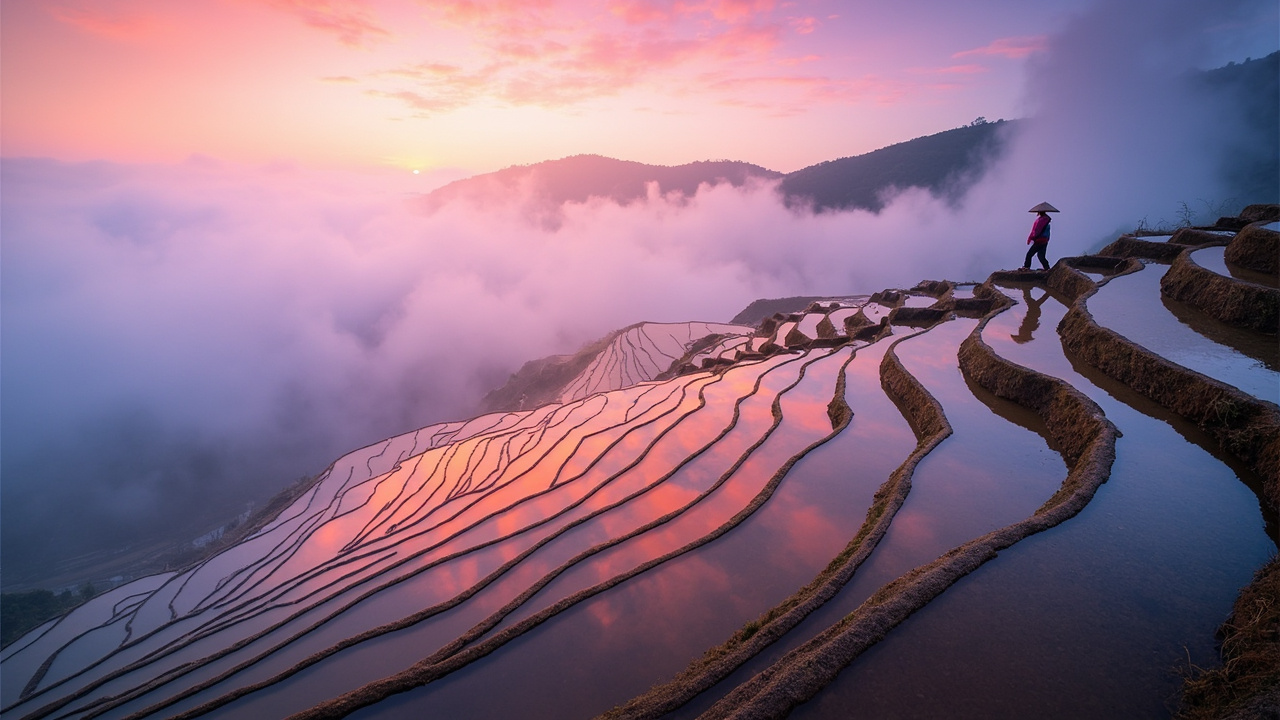
The cab driver looked at me in the rearview mirror and just laughed. Not a mean laugh, but the kind you get when you’ve asked something so stupid it’s funny. I’d pointed at a photo on my phone—a misty, impossibly green hillside of terraced rice paddies reflecting the dawn sky like shattered mirrors—and said, “Zheli?” (“Here?”). He shook his head, still chuckling, and tapped the photo. “Yuanyang,” he said. “Hen yuan.” Very far.
He wasn’t wrong. Yuanyang County, tucked into the southern folds of Yunnan Province near the Vietnam border, is a full day’s drive from Kunming. But that’s exactly why the terraces look the way they do. The Hani people have been carving these hillsides for over 1,300 years, and because it’s so remote, they’ve done it without interruption, without modernization, without anyone telling them to stop. The result is a landscape that feels less like agriculture and more like a collaboration between human patience and mountain geology.
I’ve been to Yuanyang four times now, across three different seasons. I’ve stood in freezing fog at 6 a.m. with fifty other photographers, and I’ve sat alone on a wet stone step watching the rain roll sideways off the mountains for an hour before it stopped. This guide is everything I wish someone had told me before that first trip—the practical stuff (how to get there, where to stand, what to pay) and the less obvious stuff (when to put the camera down, which village has the best rice wine, and why you should never trust the weather forecast).
Quick answer
If you’re a first-time international visitor, Yuanyang is worth the journey for the sunrise and sunset light on the rice terraces from November to April, when the paddies are flooded and reflective. You don’t need a visa if you’re from 54 eligible countries and transiting through a major city like Kunming for under 144 hours—but check the latest policy before you book. Budget about $50–80 USD (360–580 CNY) per day including transport, entry fees, and a basic guesthouse. The nearest airport is Kunming Changshui, then a 6–7 hour bus or private car south.
The Short Version
Yuanyang is not a weekend detour. It’s a destination. If you only have 90 seconds: go between December and February for the best light on flooded terraces, stay in the village of Duoyishu for sunrise access, pay the 100 CNY ($14 USD) multi-site ticket, and bring a telephoto lens and waterproof shoes. Skip the guided photography tours—they herd you to the same spots as everyone else. Walk the ridges alone at 5:30 a.m. and you’ll see what the Hani farmers see, not what Instagram expects.
How I Picked These
I don’t rank these places from a spreadsheet. I’ve walked every path I’m about to describe—some in the dark with a headlamp, some in muddy flip-flops because I didn’t check the forecast. I’ve talked to Hani farmers who’ve worked the same terrace for forty years, guesthouse owners who’ve watched the tourist numbers double every season, and a French photographer who’s been coming back since 1998 and still says he hasn’t “gotten the shot.” I also made plenty of mistakes: paid 50 CNY for a “shortcut” that wasn’t a shortcut, missed the last minibus back to town, and once left my tripod in a noodle shop. This list is the result of those errors plus four separate trips across 2023–2025, updated for 2026 pricing and transport.
Comparison Table
| Rank | Place | Best For | Approx Cost (USD) | Time Needed | When to Go |
|------|-------|----------|-------------------|-------------|------------|
| 1 | Duoyishu Sunrise Platform | Sunrise reflection shots | $14 (100 CNY) multi-site ticket | 2–3 hours | Nov–Apr, arrive by 6 a.m. |
| 2 | Bada Sunrise Terraces | Wide-angle panoramas | $14 (100 CNY) multi-site ticket | 1.5–2 hours | Nov–Apr, sunrise |
| 3 | Laohuzui (Tiger Mouth) | Iconic sunset colors | $14 (100 CNY) multi-site ticket | 2 hours | Nov–Apr, sunset |
| 4 | Aichun Blue Terrace | Midday blue-sky reflections | Free (part of village) | 1 hour | Clear skies, 10 a.m.–2 p.m. |
| 5 | Qingkou Village | Hani culture without crowds | Free (donation suggested) | 1–2 hours | Any time, morning best |
| 6 | Longshuba Terraces | Less crowded sunset alternative | $14 (100 CNY) multi-site ticket | 1.5 hours | Nov–Apr, sunset |
| 7 | Puzhehei Village | Rural life, no tourists | Free | 2–3 hours | Any time, avoid midday |
| 8 | Yuanyang County Town | Food, supplies, bus connections | Free to walk | 1–2 hours | Any time |
| 9 | Shengcun Village | Photography from village rooftops | Free (ask permission) | 1 hour | Late afternoon |
| 10 | Mengpin Terraces | Off-trail hiking between terraces | Free | Half-day hike | Dry season (Nov–Mar) |
Duoyishu Sunrise Platform – The one everyone fights for
I’ll be honest: the first time I went to Duoyishu at sunrise, I hated it. There were maybe eighty people packed onto a concrete platform, tripod legs tangled like a game of pickup sticks, and the fog was so thick you couldn’t see ten meters. Everyone was grumbling. A man next to me was live-streaming to his followers, narrating the fog like it was a personal insult. I almost left.
Then, at 7:14 a.m., the fog lifted in a single sheet, like a curtain pulled from the bottom. The terraces appeared below—hundreds of them, stacked down the mountainside, each one filled with water that caught the first orange light. The reflections were so perfect it looked like the sky had a twin underground. I forgot about the crowd. I forgot about the cold. I just stood there, not even shooting, watching the color shift from gray to pink to gold in about four minutes.
📍 Location: Duoyishu Village, about 20 minutes north of Yuanyang County Town by car.
🎫 Entry fee: Included in the 100 CNY ($14 USD) multi-site ticket. You can buy it at the platform entrance.
🕒 Opening hours: The platform is open 24/7, but sunrise is roughly 6:30–7:30 a.m. depending on season. Get there by 5:45 a.m. to claim a spot.
🚇 How to get there: From Yuanyang County Town, take a local minibus (15–20 CNY, about $2–3 USD) heading north toward Duoyishu. Tell the driver “Duoyishu riguan tai” (sunrise platform). It’s a 15-minute ride. Or hire a private driver for the day—about 200–300 CNY ($28–42 USD).
⏰When to visit: December through February for the clearest mornings. November can be foggy; March gets hazy. Go on a weekday if you can—weekends bring domestic tour buses.
💡 Insider tips: Don’t set up on the main platform. Walk about 100 meters to the left (east) along the ridge. There’s a smaller, unofficial spot where locals sometimes hang laundry. You’ll get the same view without the tripod traffic jam. Bring hand warmers—it’s often below 5掳C (41掳F) at dawn.
I met a Hani woman named A’Li there who was selling roasted sweet potatoes from a basket. She pointed at my camera, then at the fog, and said something in Hani that I’m pretty sure translated to “you’re wasting your time.” She was right that morning. But the next morning, she was wrong.
Bada Sunrise Terraces – The wide shot you actually want
Bada is less famous than Duoyishu, which is exactly why I prefer it. The viewing platform is higher up, so you get a broader sweep of the terraces without the extreme foreground compression. The terraces here are steeper, too—the Hani farmers had to cut deeper into the hillside, which means the reflections catch the light at sharper angles. On a good morning, the whole valley looks like it’s covered in hammered copper.
The downside? The platform is smaller, and there’s no railing in some sections. I watched a man in loafers nearly slide into a rice paddy while trying to get a selfie. Don’t be that man. Wear boots with actual tread.
📍 Location: Bada Village, about 30 minutes south of Yuanyang County Town.
🎫 Entry fee: Included in the multi-site ticket (100 CNY / $14 USD).
🕒 Opening hours: Same as Duoyishu—24/7 access, but sunrise is the magic window.
🚇 How to get there: Minibuses from Yuanyang County Town run to Bada every 30–40 minutes. Cost is about 15 CNY ($2 USD). The platform is a 5-minute walk from the village parking lot.
⏰When to visit: Same season as Duoyishu (Dec–Feb), but Bada is slightly less crowded. I’ve had the platform to myself in late January on a Tuesday.
💡 Insider tips: Bring a wide-angle lens (16–24mm full-frame equivalent). The terraces here are so vast that a standard zoom won’t capture the scale. Also, the wind can be brutal—secure your tripod with a weight bag or hang your backpack from the center column.
I once spent two hours at Bada talking to a retired teacher from Chengdu who was on his tenth visit. He showed me photos he’d taken in 2015—same spot, same light, but the terraces had changed shape slightly as farmers adjusted the water channels. “The mountain is alive,” he said. “You can’t photograph it the same way twice.”
Laohuzui (Tiger Mouth) – The sunset everyone chases
If Duoyishu is the sunrise queen, Laohuzui is the sunset king. The terraces here are nicknamed “Tiger Mouth” because the shape of the valley supposedly resembles a tiger’s open jaw. I don’t see it, but the name stuck. What I do see is the most dramatic light show in Yuanyang. The sun sets behind the hills to the west, and the terraces catch the last rays in a way that turns the water into liquid amber, then rose, then deep violet.
The platform is massive—three tiers, built to handle crowds—and it gets packed. I’ve seen people arrive at 3 p.m. to reserve a spot for a 6:30 p.m. sunset. That’s excessive, but I get it.
📍 Location: Laohuzui Scenic Area, about 25 minutes south of Yuanyang County Town.
🎫 Entry fee: Included in the multi-site ticket (100 CNY / $14 USD).
🕒 Opening hours: 24/7, but sunset is the main event. Arrive by 4:30 p.m. for a good spot.
🚇 How to get there: Minibuses from town run frequently. Tell the driver “Laohuzui.” It’s about 20 minutes. Private drivers charge 150–200 CNY ($21–28 USD) for a round trip including waiting time.
⏰When to visit: November through March for clear skies. April can have afternoon thunderstorms that ruin the sunset.
💡 Insider tips: The best spot isn’t on the top platform—it’s on the middle tier, slightly to the right. The foreground terraces there have a more interesting curve. Also, bring a headlamp. The walk back to the parking lot is unlit, and I’ve seen people trip on loose stones. Don’t be one of them.
I ate dinner that night at a tiny restaurant near the platform run by a Hani family. The grandmother, who spoke no Mandarin, kept refilling my cup with a homemade rice wine that tasted like kerosene and flowers. I drank three cups. I don’t remember the walk back to the guesthouse.
Aichun Blue Terrace – The midday secret
Most photography guides tell you to shoot only at sunrise and sunset. That’s good advice for most places, but Aichun breaks the rule. This small terrace, tucked behind a village of the same name, turns an electric blue in the middle of the day when the sky is clear. It’s not a filter or a trick of the water—it’s the combination of the angle of the sun, the mineral content of the soil, and the depth of the paddy. The water absorbs red wavelengths and scatters blue, like a shallow ocean.
I stumbled on Aichun by accident. I was lost, walking between villages, and I rounded a corner to see a terrace that looked like it had been painted with cobalt. There was no one else there. I sat on a rock and watched the color shift as clouds passed overhead.
📍 Location: Aichun Village, about 40 minutes east of Yuanyang County Town.
🎫 Entry fee: Free. It’s a working agricultural area, not a scenic spot.
🕒 Opening hours: Daylight hours. Best between 10 a.m. and 2 p.m.
🚇 How to get there: You’ll need a private driver or a hired scooter. Minibuses don’t go to Aichun regularly. From Yuanyang County Town, it’s a 40-minute drive on a winding road.
⏰When to visit: December through February for the clearest skies. Cloud cover kills the blue effect.
💡 Insider tips: Don’t just shoot from the road. Walk down the narrow paths between terraces (carefully—they’re slippery) to get a lower angle that emphasizes the color. Also, bring a polarizing filter. It deepens the blue and cuts glare from the water surface.
A farmer named Luo was repairing a channel wall when I arrived. He didn’t seem bothered by my presence. He just pointed at the terrace, then at the sky, and nodded. I think he was saying “good day for it.” He was right.
Qingkou Village – Culture without the crowd
The terraces are the main draw, but the Hani people are the reason they exist. Qingkou Village is one of the best places to see traditional Hani life without feeling like you’re in a museum. The village has mushroom-shaped houses—low, round structures with thatched roofs that look like they grew out of the ground. Chickens scratch in the dirt. Old women sit on doorsteps weaving baskets. Children run through the narrow alleys chasing a half-deflated soccer ball.
I spent an afternoon here just walking. No camera, no phone. I sat on a stone wall and watched a man repair a bamboo water pipe that fed his terrace. He worked slowly, methodically, like his father had taught him and his grandfather before that.
📍 Location: Qingkou Village, about 20 minutes north of Yuanyang County Town.
🎫 Entry fee: Free, though a small donation (10–20 CNY / $1.50–3 USD) to the village committee is appreciated.
🕒 Opening hours: Daylight hours. Morning is best—afternoon gets quiet.
🚇 How to get there: Minibus from Yuanyang County Town, 10–15 minutes. Or walk if you’re staying in Duoyishu—it’s about 3 km (2 miles) along the ridge road.
⏰When to visit: Any time of year, but avoid midday in summer when the heat is intense.
💡 Insider tips: Ask permission before photographing people. A smile and a gesture toward your camera usually works. If someone says no, respect it. Also, try the fermented soybeans sold by a woman near the village entrance—they’re an acquired taste, but they’re authentic.
I bought a handwoven bag from a woman named Pu. She didn’t speak Mandarin, but she counted my money carefully and handed me the bag with both hands, which is a sign of respect in Hani culture. I still use that bag.
Longshuba Terraces – The sunset backup plan
Laohuzui gets all the attention, but Longshuba is my secret weapon. The terraces here are less dramatic—flatter, more spread out—but that’s exactly why I like it. The reflections are wider, more mirror-like, and the crowds are maybe a tenth of what you’ll find at Tiger Mouth. On a calm evening, the water is so still you can see individual clouds moving across the surface.
The downside: the light isn’t as intense. The sun sets behind a ridge that blocks some of the warm colors. But if you’re shooting for mood rather than drama, Longshuba delivers.
📍 Location: Longshuba Village, about 15 minutes south of Yuanyang County Town.
🎫 Entry fee: Included in the multi-site ticket (100 CNY / $14 USD).
🕒 Opening hours: 24/7. Sunset is best, but the platform is open anytime.
🚇 How to get there: Minibus from town, 10 minutes. Or walk if you’re staying in the county—it’s about 4 km (2.5 miles) along a paved road.
⏰When to visit: November through March. The terraces are flooded during this period, which is essential for reflections.
💡 Insider tips: Bring a longer lens (70–200mm) to compress the layers of terraces. The flatter topography means you need to isolate specific patterns rather than shooting wide. Also, the platform has a covered section—useful if it starts drizzling.
I once met a Japanese photographer at Longshuba who had been coming for 15 years. He told me he’d never shown his photos to anyone. “They’re for me,” he said. I understood.
Puzhehei Village – The place tourists miss
Most visitors stick to the main scenic spots. They miss Puzhehei, a small village about an hour east of the main terrace area. The terraces here are smaller, less photogenic, but the village itself is a time capsule. Wooden houses with faded paint. A single shop selling instant noodles and batteries. An old man sharpening tools on a pedal-powered grindstone.
I went to Puzhehei because my driver, a man named Liu, said his grandmother lived there. He dropped me off and said he’d be back in three hours. I walked the village in 20 minutes. Then I sat on a bench and watched nothing happen for two hours. It was the most peaceful morning of the trip.
📍 Location: Puzhehei Village, about 50 km (31 miles) east of Yuanyang County Town.
🎫 Entry fee: Free.
🕒 Opening hours: Daylight hours.
🚇 How to get there: Private driver only. No public transport. Expect to pay 250–350 CNY ($35–49 USD) for a half-day round trip.
⏰When to visit: Any time, but the terraces are best from December to March. The village itself is interesting year-round.
💡 Insider tips: Bring cash. There are no ATMs and no mobile payment accepted. Also, the village has a small temple that’s worth a look—just be respectful and remove your shoes before entering.
I ate lunch at the only shop in the village: rice with pickled vegetables and a fried egg. The woman who cooked it refused to let me pay. I left 20 CNY on the counter when she wasn’t looking.
Yuanyang County Town – The practical hub
The county town isn’t photogenic. It’s a concrete grid of shops, guesthouses, and bus stations. But you’ll end up here eventually—it’s the transport hub, the food hub, and the place to buy supplies. The night market along the main street has grilled fish, skewers, and a soup called guoqiao mixian (crossing-the-bridge noodles) that’s worth trying even if it’s not as good as the Kunming version.
I stayed in the county town on my second trip because all the village guesthouses were full. I was disappointed at first. Then I discovered a noodle shop run by a woman named Chen that served the best breakfast in Yuanyang—hand-pulled noodles in a pork broth with a soft-boiled egg. I ate there every morning.
📍 Location: Central Yuanyang County, about 30 minutes from the main terrace areas.
🎫 Entry fee: Free.
🕒 Opening hours: 24/7 for the town itself. Shops and restaurants operate roughly 7 a.m.–10 p.m.
🚇 How to get there: Buses from Kunming arrive at the county bus station. From there, minibuses go to all the villages.
⏰When to visit: Any time. The town is a base, not a destination.
💡 Insider tips: The bus station has luggage storage (10–20 CNY / $1.50–3 USD per day). Use it if you’re doing a multi-day hike. Also, buy your return bus ticket to Kunming a day in advance—seats sell out, especially on weekends.
I once spent an evening at a tea shop near the bus station. The owner, a man named Zhang, served me pu’er tea and told me about the time a French film crew spent three weeks in Yuanyang making a documentary. “They ate noodles every day,” he said. “They loved it.”
Shengcun Village – Rooftop views
Shengcun is a small village perched on a ridge above the main terrace valley. The best views aren’t from a platform—they’re from the rooftops of the houses. The villagers are used to photographers climbing up ladders to their second-story terraces. Some charge a small fee (5–10 CNY / $0.70–1.50 USD). Others just wave you up.
I climbed onto a rooftop in Shengcun at 4 p.m. and stayed until the light faded. The owner of the house, a young man named Ma, brought me a cup of tea and sat with me. He didn’t speak English. I didn’t speak Hani. We just watched the sun drop behind the mountains.
📍 Location: Shengcun Village, about 15 minutes north of Duoyishu.
🎫 Entry fee: Free to enter the village. Rooftop access may cost 5–10 CNY.
🕒 Opening hours: Daylight hours.
🚇 How to get there: Minibus from Yuanyang County Town or Duoyishu. It’s a 5-minute walk from the main road.
⏰When to visit: Late afternoon for the best light. Morning is good too, but the sun is behind the village.
💡 Insider tips: Always ask before climbing onto a roof. A simple “keyi ma?” (can I?) with a smile works. Also, bring small bills—villagers rarely have change for large notes.
Ma’s mother came out and offered me a piece of sticky rice cake wrapped in a banana leaf. It was sweet and dense and exactly what I needed.
Mengpin Terraces – The hike you earn
Mengpin is not for everyone. It’s a half-day hike along the ridges between terraces, with no marked trail and no guarantee you won’t get lost. I did get lost. Twice. But the payoff is the most intimate view of the terraces you can get—standing at the edge of a paddy, watching water trickle from one level to the next, hearing the frogs and the birds and nothing else.
The hike starts near Qingkou Village and follows the contour of the hills south toward Mengpin. It’s about 8 km (5 miles) of uneven, muddy, sometimes steep terrain. I wore hiking boots and still slipped twice. But I saw terraces that no tourist platform shows—small, irregular, shaped by one family’s hands over generations.
📍 Location: Between Qingkou Village and Mengpin Village, about 30 minutes south of Yuanyang County Town.
🎫 Entry fee: Free.
🕒 Opening hours: Daylight hours. Start by 8 a.m. to finish before dark.
🚇 How to get there: Take a minibus to Qingkou Village, then walk south along the ridge. No public transport on the trail itself.
⏰When to visit: Dry season (November to March). The trail is impassable during the rainy season (June–September).
💡 Insider tips: Download offline maps on your phone before you go—there’s no signal in the valley. Bring at least 2 liters of water and snacks. And wear gaiters if you have them—the mud will ruin your socks.
I met a farmer named Li on the trail who was carrying a basket of vegetables. He walked with me for about a kilometer, pointing out edible plants and showing me a spring where he got drinking water. When we parted, he shook my hand and said something in Hani. I don’t know what it meant, but I nodded and smiled.
FAQ summary
For most first-time international visitors, the best time to photograph the Yuanyang rice terraces is between December and February, when the paddies are flooded and the light is clearest. The multi-site ticket costs 100 CNY ($14 USD) and covers all major viewing platforms. You can reach Yuanyang by a 6–7 hour bus from Kunming, or hire a private driver for about 800–1,000 CNY ($112–140 USD). No special photography permit is needed, but you should bring cash, a telephoto lens, and waterproof footwear. The 144-hour visa-free transit policy applies at Kunming Changshui Airport for eligible nationalities—confirm your eligibility before booking.
FAQ
Q: Do I need a visa to visit Yuanyang?
A: If you’re from one of 54 eligible countries and arrive via Kunming Changshui Airport, you can use the 144-hour visa-free transit policy. You must have a confirmed onward ticket to a third country (not your origin country). If you’re staying longer or entering from a land border, apply for a standard L tourist visa before you go.
Q: What’s the best time of year for photography?
A: December through February. The terraces are flooded for rice planting, creating perfect mirror reflections. November and March are also good but more unpredictable. Avoid June to September—the rice is growing, the terraces are green (not reflective), and the rainy season makes everything muddy.
Q: How do I get from Kunming to Yuanyang?
A: Take a bus from Kunming South Bus Station (not the main long-distance station). Buses run 7 a.m.–1 p.m., cost about 150–200 CNY ($21–28 USD), and take 6–7 hours. Alternatively, hire a private driver for 800–1,000 CNY ($112–140 USD)—faster and more comfortable, but book through your hotel.
Q: Is English spoken in Yuanyang?
A: Very little. Download a translation app (Pleco or Google Translate) and learn a few Mandarin phrases: “duoshao qian?” (how much?), “zheli” (here), and “xie xie” (thank you). Most guesthouse owners can handle basic booking English.
Q: Do I need a VPN for my phone?
A: Yes. Google, WhatsApp, Instagram, and Facebook are blocked in China. Install a reliable VPN (Astrill or ExpressVPN) before you leave home. Test it in Kunming before heading to Yuanyang, where internet is slower.
Q: Can I use my credit card in Yuanyang?
A: No. Bring cash. ATMs exist in the county town but are unreliable. WeChat Pay and Alipay are widely accepted, but you’ll need a Chinese bank account or a foreign card linked to a travel card like Wise or Revolut to set them up.
Q: What photography gear should I bring?
A: A wide-angle lens (16–24mm) for panoramas, a telephoto (70–200mm) for compressed terrace patterns, a sturdy tripod (wind is common), and a polarizing filter. Bring extra batteries—cold drains them fast. And a rain cover for your camera.
The Honest Wrap-up
Yuanyang is not a place you visit casually. It’s a 7-hour bus ride from Kunming, the weather is unpredictable, and the best shots require waking up at 5 a.m. in near-freezing temperatures. But if you’re willing to do the work, it rewards you with something that no other landscape in China can match—a collaboration between human patience and mountain geology that has been evolving for over a millennium.
This list is for the photographer who wants to see the terraces as they are, not as Instagram expects them to be. It’s for the traveler who will walk the muddy paths, eat the rice wine, and sit on a rooftop with a farmer who doesn’t speak your language. If that sounds like you, book the bus. If you want a resort vacation with a side of scenery, go to Lijiang instead.
One last thing: put the camera down sometimes. The best memory I have of Yuanyang isn’t a photo. It’s the silence at 6:30 a.m. on a foggy morning, standing alone on a ridge, listening to water drip from one terrace to the next. You can’t capture that with a lens. But you can carry it with you.
Related Guides
Looking for more China travel guides? These match your topic:
Topics
More guides you may like

Top 10 Bridges in China
China's bridges are engineering marvels spanning mountains, rivers, and seas. Here are 10 of the most spectacular, from ancient stone to modern steel.
8 min read

Top 10 Buddhist Sites in China
From the Leshan Giant Buddha to the Dunhuang Caves, these 10 Buddhist sites represent 2,000 years of China's spiritual heritage.
9 min read

Top 10 Day Trips from Beijing You Shouldn't Miss
Beijing is packed with history, but some of China's best experiences are just a few hours away. Here are 10 day trips that will transform your visit.
9 min read

Top 10 Hidden Gems in China Off the Beaten Path
Beyond the Great Wall and Terracotta Warriors, China has incredible hidden destinations few tourists ever reach. Here are 10 underrated gems worth the detour.
9 min read

Top 10 Markets and Shopping Streets in China
From Shanghai's Bund to Beijing's Silk Street - 10 markets where foreigners can haggle, explore, and bring home authentic Chinese goods.
9 min read

Top 10 Museums in China You Shouldn't Miss
China's museums span 5,000 years of civilization. These 10 - from the Palace Museum to Xi'an's terracotta gallery - are unmissable for culture lovers.
9 min read