
China Night Food Markets Complete Guide: The Complete 2026 Guide
The first time I truly understood Chinese night markets, I was standing in a drizzle in Chengdu, holding a skewer of rabbit head that I was deeply unsure about.
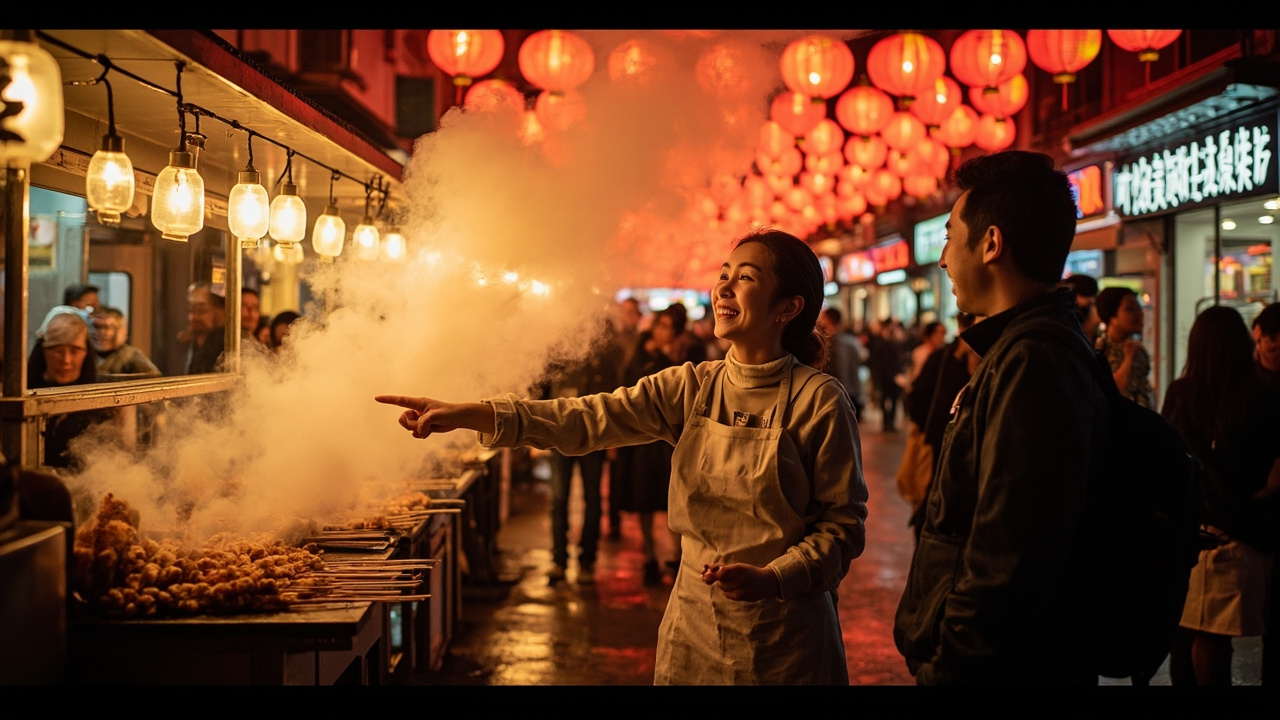
The first time I truly understood Chinese night markets, I was standing in a drizzle in Chengdu, holding a skewer of rabbit head that I was deeply unsure about. The rain came off the eaves in sheets, steam from a dozen wok stations mixed with the smell of cumin and burning chili oil, and a woman next to me—total stranger—tapped my arm and pointed at how I was holding the skewer. Wrong angle. She showed me the right way, nodded, and went back to her own food without a word. That’s the thing about these places. They don’t explain themselves. They just pull you in.
Night markets matter because they’re where China actually happens after dark. The museums close. The temples lock up. But the streets keep cooking until 2 a.m. For a first-time visitor, they’re also the most forgiving introduction to Chinese food—you can point at what you want, buy one thing at a time, and walk away if it’s not for you. No commitment. No menu anxiety. Just food, fire, and noise.
This guide covers ten night markets I’ve visited multiple times across China, with real prices, real transport directions, and the kind of tips you only get from standing in the wrong line a few times. I’ve eaten things I loved and things I’d rather not name. You’ll do the same. That’s the point.
Quick answer
China’s night markets are free to enter, open roughly 5 p.m. to midnight, and you should budget $10–$20 (CNY 70–140) per person for a solid evening of eating. Most vendors now accept WeChat Pay and Alipay, but cash still works at smaller stalls. The best season is spring (March–May) or autumn (September–November) when the weather is comfortable for walking and eating outdoors.
The Short Version
If you only have 90 seconds: Go to a night market on your first evening in China, not your last. Start with Xi’an’s Muslim Quarter for the most dramatic food scene, or Taipei’s Shilin if you’re in Taiwan. Don’t overthink it—walk the full length first, then circle back for what caught your eye. Eat things you can’t identify. Skip the things that look like they’ve been sitting out. Always carry your own napkins. And for the love of good food, don’t fill up on the first three stalls.
How I Picked These
I’ve lived in Beijing since 2019 and have taken 40+ trips around the country, most of them with food as the primary agenda. Every market on this list I’ve visited at least twice—once as a tourist, once as a repeat customer. I talked to vendors, cab drivers, and other travelers. I got food poisoning once (in a city not on this list, and I’m still bitter about it). I also cross-checked prices and hours against local friends who live in each city, because markets change faster than guidebooks admit. This isn’t a ranking of “best” in any objective sense. It’s a list of places I’d actually take a visiting friend.
Comparison Table
| Rank | Place | Best For | Approx Cost (USD) | Time Needed | When to Go |
|---|---|---|---|---|---|
| 1 | Xi’an Muslim Quarter | First-timers, dramatic food scene | $10–15 (CNY 70–105) | 2–3 hours | Evening, spring/autumn |
| 2 | Chengdu Kuanzhai Alley | Sichuan flavors, relaxed vibe | $8–12 (CNY 56–84) | 1.5–2 hours | Weekday evenings |
| 3 | Beijing Wangfujing Snack Street | Tourist-friendly, unusual foods | $10–15 (CNY 70–105) | 1–1.5 hours | Early evening |
| 4 | Shanghai Yuyuan Bazaar | Historic setting, dumplings | $12–18 (CNY 84–126) | 2 hours | Weekday mornings/evenings |
| 5 | Guangzhou Shangxiajiu | Cantonese classics, seafood | $10–15 (CNY 70–105) | 2 hours | Late evening |
| 6 | Wuhan Hubu Alley | Breakfast-style street food | $5–10 (CNY 35–70) | 1–1.5 hours | Early evening |
| 7 | Taipei Shilin Night Market | Taiwan’s best, huge variety | $8–15 (CNY 56–105) | 2–3 hours | After 7 p.m. |
| 8 | Nanjing Confucius Temple | Jiangsu specialties, riverside | $8–12 (CNY 56–84) | 1.5–2 hours | Evening, avoid weekends |
| 9 | Qingdao Beer Street | Seafood + beer combo | $15–25 (CNY 105–175) | 2 hours | Summer evenings |
| 10 | Kunming Night Market | Yunnan minority cuisine | $8–12 (CNY 56–84) | 1.5 hours | Spring/summer evenings |
Xi’an Muslim Quarter — Where the Crowd Becomes the Show
I remember the first time I walked into the Muslim Quarter and a vendor handed me a free piece of persimmon cake before I’d even asked a question. That doesn’t happen in Beijing. The hospitality here is immediate and unpretentious, and the crowd is part of the experience—shoulder to shoulder, Chinese tourists and foreigners alike, all moving in the same hungry current.
This is the most dramatic night market in China, and the most accessible for first-timers. The food is heavily influenced by Hui Muslim culture, which means lamb dominates and pork is absent. You’ll find roujiamo (Chinese hamburger, essentially), yangrou paomo (lamb soup with bread), and the famous biangbiang noodles—wide, hand-pulled, and served with enough chili oil to make your eyes water.
📍 Location: Beiyuanmen Street, just north of the Drum Tower in central Xi’an 🎟️ Entry fee: Free 🕒 Opening hours: Roughly 5 p.m. to midnight, but some stalls open earlier and close later 🚇 How to get there: Take Metro Line 2 to Zhonglou Station, Exit C. Walk north toward the Drum Tower, then continue through the archway into the market street. About 10 minutes on foot. 📅 When to visit: Spring and autumn evenings are ideal. Weekdays are more comfortable than weekends, when the crowds can be genuinely overwhelming. 💡 Insider tips:
- Try the persimmon cakes (shizibing) from the stall near the north end—they’re fried fresh and better than the ones near the entrance
- Don’t eat at the first roujiamo stall you see. Walk 10 minutes in and find the one with the longest local line
- Bring small bills. Some vendors won’t break large notes
- The lamb skewers are best eaten immediately, standing at the stall, not carried around
- If you’re vegetarian, the cold noodles (liangpi) are your friend
I once spent 20 minutes watching a vendor hand-pull noodles and still couldn’t figure out how he got them that thin. He saw me staring, laughed, and handed me a free bowl. I didn’t even order.
Chengdu Kuanzhai Alley — Sichuan Without the Chaos
Chengdu’s Kuanzhai Alley is technically three parallel streets—Kuanzhai, Zhaizhai, and Jingzhai—and it’s more polished than a traditional night market. But that’s not a bad thing. The food is still properly Sichuan, and the layout means you can actually breathe while you eat.
The standout here is the chuanchuanxiang—skewers of meat and vegetables cooked in a bubbling pot of spicy broth at your table. You pay by the stick, and the bill is calculated by weighing the leftover skewers. It’s a genius system that keeps prices honest and makes you feel like you’re gaming the system even though you’re not.
📍 Location: Kuanzhai Alley, Qingyang District, central Chengdu 🎟️ Entry fee: Free 🕒 Opening hours: 10 a.m. to 10 p.m. for shops, but food stalls often run until 11 p.m. 🚇 How to get there: Metro Line 4 to Kuanzhai Alley Station, Exit B. The entrance is directly ahead—you can’t miss the crowds. 📅 When to visit: Weekday evenings are far less crowded. Avoid weekend afternoons entirely. 💡 Insider tips:
- The dan dan noodles at the stall in the middle section are the best I’ve found in the city
- Order the “micro-spicy” (weila) option if you’re not used to Sichuan heat. “Medium” here is what most of the world would call “emergency”
- Try the sweet water noodles (tianshui mian)—they’re a good palate cleanser between spicy dishes
- The tea houses along the side streets are worth a stop if you need a break
- Don’t skip the fried stinky tofu. It smells terrible. It tastes incredible.
I made the mistake of ordering “medium” spice on my first visit. The vendor looked at me, looked at my pale foreigner face, and quietly changed it to mild. I’m grateful to this day.
Beijing Wangfujing Snack Street — Tourist Central, But Worth It
I’ll be honest: Wangfujing Snack Street is the most touristy night market in China, and plenty of locals avoid it. But for a first-time visitor, it’s also the easiest introduction to the concept. The food is arranged on sticks, the prices are posted in English, and the vendors are used to confused foreigners pointing at things.
The famous scorpion skewers are here, along with starfish, seahorses, and other things that look more like a biology display than dinner. They’re mostly a gimmick for tourists, and the vendors know it. The real food is the jianbing (savory crepes), the lamb skewers, and the sugar-coated hawthorn berries on sticks.
📍 Location: Wangfujing Street, Dongcheng District, central Beijing 🎟️ Entry fee: Free 🕒 Opening hours: Roughly 10 a.m. to 10 p.m., with the food stalls most active from 5 p.m. 🚇 How to get there: Metro Line 1 to Wangfujing Station, Exit A. Walk north for about 5 minutes; the snack street is on your right. 📅 When to visit: Early evening, before the crowds peak around 7–8 p.m. 💡 Insider tips:
- Skip the scorpions. They’re for photo ops, not eating
- The jianbing stall near the north entrance is legitimately good
- Prices here run 20–30% higher than elsewhere in Beijing. That’s the tourist tax
- If you want the real Beijing experience, walk 15 minutes east to Donghuamen Night Market instead
- The fried yogurt (zha suan nai) is a local specialty worth trying
I watched a German tourist buy a starfish skewer, take one bite, and hand it to his friend with a look of pure regret. The vendor didn’t even blink. This is a place where you pay for the story, not the meal.
Shanghai Yuyuan Bazaar — Dumplings and History
Yuyuan Bazaar sits right next to the famous Yu Garden, and the whole area feels like a Ming dynasty movie set that someone forgot to strike. The buildings are traditional, the lanterns are red, and the crowds are relentless. But the food is genuinely good, especially the xiaolongbao—soup dumplings that are the city’s signature dish.
The most famous spot is Nanxiang Steamed Bun Restaurant, which has been making xiaolongbao since 1900. The line looks intimidating, but it moves fast. Order the crab roe version if you’re feeling indulgent.
📍 Location: Yuyuan Bazaar, Huangpu District, near the Yu Garden 🎟️ Entry fee: Free to enter the bazaar; the Yu Garden itself charges about $4 (CNY 30) 🕒 Opening hours: Shops open around 9 a.m., food stalls run until 9–10 p.m. 🚇 How to get there: Metro Line 10 to Yuyuan Garden Station, Exit 1. Walk east for about 8 minutes through the old town streets. 📅 When to visit: Weekday mornings are best for the bazaar itself; evenings are better for the night market vibe. 💡 Insider tips:
- The xiaolongbao from Nanxiang are best eaten immediately, but let them cool for 2 minutes first—the soup inside is boiling
- Try the stinky tofu from the stall near the main entrance. It’s the best in Shanghai
- The candied fruit vendors near the garden walls sell better quality than the ones in the main square
- Watch your pockets in the crowds. Pickpockets work this area
- The nearby City God Temple is worth a quick visit if you’re already there
I ate six xiaolongbao in about four minutes and burned the roof of my mouth. The old woman at the next table laughed at me, then showed me the proper technique: bite a small hole, sip the soup, then eat the rest. I’ve never burned my mouth since.
Guangzhou Shangxiajiu — Cantonese Classics and Late Nights
Guangzhou’s Shangxiajiu Pedestrian Street is less a single night market and more a whole district that comes alive after dark. The food here is Cantonese through and through—dim sum, roast goose, congee, and seafood that was swimming hours ago.
The street itself is covered, which means you can eat here even when it’s raining, and it runs for about a kilometer with food stalls and restaurants packed along both sides. This is where you come to understand why Cantonese people argue that their food is the best in China.
📍 Location: Shangxiajiu Pedestrian Street, Liwan District, Guangzhou 🎟️ Entry fee: Free 🕒 Opening hours: Shops open around 10 a.m., food stalls run until midnight or later 🚇 How to get there: Metro Line 1 to Changshou Lu Station, Exit D. Walk south for about 5 minutes to reach the pedestrian street. 📅 When to visit: Late evening, after 8 p.m., when the crowds thin out and the food is still fresh 💡 Insider tips:
- The roast goose at the restaurant near the east end is worth the wait
- Try the cheung fun (rice noodle rolls) from a street cart—they’re better than most restaurant versions
- The sugarcane juice vendors squeeze fresh cane while you wait. It’s the perfect drink for the humid climate
- Bring cash for the smaller stalls; some don’t take mobile payments
- If you see a line, join it. Guangzhou locals don’t queue for mediocre food
A vendor once refused to let me pay for my congee, insisting it was “on the house” because I was the only foreigner who’d tried to order in Cantonese that week. My pronunciation was terrible. She didn’t care.
Wuhan Hubu Alley — Where Breakfast Meets Night
Hubu Alley is famous as a breakfast street, but the evening scene is just as good and far less crowded. The specialty here is hot dry noodles (re gan mian), a Wuhan institution that locals eat for breakfast, lunch, and dinner. The sesame paste sauce is rich, the noodles are chewy, and the chili oil is optional but recommended.
The alley is short—maybe 150 meters—but it packs in dozens of stalls. You can eat your way through the entire thing in an hour and still have room for more.
📍 Location: Hubu Alley, Wuchang District, Wuhan 🎟️ Entry fee: Free 🕒 Opening hours: 6 a.m. to 10 p.m., with the evening rush from 5–8 p.m. 🚇 How to get there: Metro Line 4 to Fuxing Road Station, Exit C. Walk north for about 10 minutes to reach the alley. 📅 When to visit: Early evening, before the stalls start closing around 9 p.m. 💡 Insider tips:
- The hot dry noodles from the stall at the north end are the most authentic
- Try the doupi—a savory rice and bean pancake filled with meat and mushrooms
- The mianwo (fried dough rings) are a local specialty you won’t find elsewhere
- Don’t be afraid to ask for less chili. The default is genuinely spicy
- The alley gets crowded with students from nearby Wuhan University in the evenings
I asked a vendor what the difference was between two noodle dishes. She looked at me for a long moment, then said, “One is spicy. One is also spicy.” She wasn’t wrong.
Taipei Shilin Night Market — Taiwan’s Best, Full Stop
Shilin is the night market that all other night markets get compared to in Taiwan, and it earns the reputation. It’s massive—covering multiple streets and an indoor food court—and the variety is staggering. You’ll find Taiwanese classics like oyster omelets and stinky tofu alongside Japanese-influenced snacks and creative fusion dishes that wouldn’t exist anywhere else.
The atmosphere is different from mainland markets. It’s more organized, cleaner, and the vendors are more patient with foreigners. English is more commonly spoken here than anywhere else on this list.
📍 Location: Shilin District, Taipei, near the Jiantan MRT station 🎟️ Entry fee: Free 🕒 Opening hours: 4 p.m. to midnight, with peak hours from 7–10 p.m. 🚇 How to get there: Take the Taipei MRT Tamsui-Xinyi Line to Jiantan Station, Exit 1. The market is directly across the street. 📅 When to visit: After 7 p.m., when all the stalls are open and the energy peaks 💡 Insider tips:
- The fried chicken cutlet (jipai) is the size of your face. Share it or skip dinner beforehand
- The oyster omelet at the stall near the south entrance is the best version I’ve found
- Try the pepper buns (hujiao bing) from the clay oven stall—they’re worth the wait
- The indoor food court has seating, which is rare for night markets
- Bring cash. Many smaller stalls don’t take cards or mobile payments
I once saw a group of Taiwanese teenagers help a confused American tourist order stinky tofu, then cheer when he took his first bite. He didn’t love it. They loved that he tried.
Nanjing Confucius Temple — Jiangsu Specialties by the River
The Confucius Temple area in Nanjing is beautiful in a way that feels almost staged—traditional architecture, lantern-lit walkways, and the Qinhuai River reflecting everything back at you. The night market here is smaller than others on this list, but it’s one of the most atmospheric places to eat in China.
The food is Jiangsu cuisine, which means it’s lighter and more refined than Sichuan or Hunan cooking. Salted duck is the local specialty, along with duck blood soup and a type of fried dumpling called tangbao that’s similar to Shanghai’s xiaolongbao but with a thicker skin.
📍 Location: Confucius Temple area, Qinhuai District, Nanjing 🎟️ Entry fee: Free to walk around; some temple attractions charge entry 🕒 Opening hours: Shops open around 9 a.m., food stalls run until 10 p.m. 🚇 How to get there: Metro Line 3 to Fuzimiao Station, Exit 2. Walk south for about 5 minutes to reach the temple square. 📅 When to visit: Weekday evenings. Weekends are packed with domestic tourists. 💡 Insider tips:
- The salted duck from the shop near the east gate is the best I’ve had in Nanjing
- Try the duck blood soup (yaxue fensi) if you’re adventurous—it’s a local favorite
- The river cruise is worth the $8 (CNY 56) if you want to see the area from the water
- The tangbao here are served with a straw for the soup. Use it
- Avoid the restaurants directly on the square; walk one street back for better quality and lower prices
I sat by the river eating tangbao and watching the boats go by, and for a moment I understood why Nanjing has been a capital city so many times. The place just feels important.
Qingdao Beer Street — Seafood and Suds
Qingdao’s Beer Street is exactly what it sounds like: a street dedicated to beer, specifically the local Tsingtao brand. But it’s also a seafood night market, with stalls grilling oysters, clams, and squid right on the sidewalk. The combination is unbeatable.
The beer is served fresh from the brewery in plastic bags with straws—a Qingdao tradition that looks ridiculous and tastes perfect. The seafood is priced by the kilo, and the vendors are used to negotiating.
📍 Location: Dengzhou Road Beer Street, Shibei District, Qingdao 🎟️ Entry fee: Free 🕒 Opening hours: 11 a.m. to midnight, with peak hours from 6–10 p.m. 🚇 How to get there: Metro Line 2 to Taidong Station, Exit A. Walk north for about 10 minutes to reach Beer Street. 📅 When to visit: Summer evenings, when the outdoor seating is in full swing 💡 Insider tips:
- The fresh beer in plastic bags is a must-try, even if it feels strange
- Order the grilled oysters with garlic—they’re the best thing on the street
- Negotiate the seafood prices before you order. The first price is always too high
- The clams in white wine sauce are a local specialty worth seeking out
- Go with a group if you can. The seafood portions are designed for sharing
I once spent an hour at a Beer Street stall with a retired fisherman who insisted on teaching me the proper way to eat grilled squid. His English was as bad as my Chinese, but we communicated fine through beer and seafood.
Kunming Night Market — Yunnan’s Minority Flavors
Kunming’s night market scene is less famous than the ones in eastern China, but it’s worth seeking out for the Yunnan minority cuisine you won’t find anywhere else. The food draws on the province’s 25 ethnic minority groups, which means mushrooms, wild herbs, and preparations that feel completely different from mainstream Chinese cooking.
The market itself is smaller and more local than the others on this list. You’ll see more residents than tourists, and the vendors are less used to foreigners. Bring your translation app and a sense of adventure.
📍 Location: Near the Green Lake area, Wuhua District, Kunming 🎟️ Entry fee: Free 🕒 Opening hours: 5 p.m. to midnight, with peak hours from 7–10 p.m. 🚇 How to get there: Metro Line 3 to Wuyi Road Station, Exit B. Walk north for about 15 minutes to reach the Green Lake area. 📅 When to visit: Spring and summer evenings, when the weather is mild 💡 Insider tips:
- Try the wild mushroom hotpot—it’s a Yunnan specialty and the mushrooms are incredible
- The grilled cheese (ru shan) is a local snack made from yak milk. It’s salty and chewy
- The cross-bridge rice noodles (guoqiao mixian) are served with a boiling broth and raw ingredients you cook yourself
- English is rarely spoken here. Download a translation app before you go
- The flower cakes (xianhua bing) are a Yunnan specialty made with edible flowers
I ordered what I thought was a mushroom dish and received a plate of fried insects instead. The vendor saw my face, laughed, and brought me the mushroom dish anyway. She let me keep the insects.
FAQ summary
China’s night markets are free to enter, typically open from 5 p.m. to midnight, and most vendors accept WeChat Pay or Alipay, though cash is still useful for smaller stalls. Budget $10–$20 (CNY 70–140) per person for a full evening of eating. The best season is spring or autumn, and the most accessible markets for first-time visitors are Xi’an’s Muslim Quarter and Beijing’s Wangfujing Snack Street. Download a translation app and set up mobile payment before you go—both will make your experience significantly easier.
FAQ
Q: Do I need cash or can I use my phone to pay at night markets? A: Most vendors accept WeChat Pay and Alipay, but some smaller stalls only take cash. Set up both apps before your trip and link your international card. Carry about $20 (CNY 140) in small bills as backup.
Q: Is the food at night markets safe for foreigners to eat? A: Generally yes, especially if you stick to stalls that are busy and cook food fresh in front of you. Avoid anything that’s been sitting out for a while. I’ve gotten sick once in seven years, and it was from a stall that was clearly not busy.
Q: What if I don’t speak Chinese? A: You’ll manage. Most vendors are used to pointing and gesturing. Download a translation app like Pleco or Google Translate (with Chinese downloaded offline) before you go. In major tourist markets like Wangfujing, some vendors speak basic English.
Q: Do I need a VPN for my phone in China? A: Yes. Google, WhatsApp, Instagram, and many other Western apps are blocked. Download a reliable VPN before you arrive and test it before you land. A local SIM card with data is also essential—China Mobile and China Unicom both offer tourist SIMs at the airport.
Q: What’s the best time to visit a night market? A: Go early, around 5–6 p.m., when the stalls are just opening and the food is freshest. The crowds peak between 7–9 p.m., and some stalls start running out of popular items after 10 p.m.
Q: Are night markets open year-round? A: Most are, but outdoor markets are less pleasant in winter, especially in northern cities like Beijing and Xi’an. Some smaller markets close during the Chinese New Year period (late January to mid-February).
Q: What should I definitely try on my first night market visit? A: Start with lamb skewers, dumplings, and noodles—they’re the safest and most representative options. Then work up to the more adventurous stuff like stinky tofu and grilled seafood. Save the insects and scorpions for your second visit, if you’re brave enough.
The Honest Wrap-up
This list is for travelers who want to eat well without overthinking it. It’s not for food critics or people who need every meal to be a life-changing experience. If that’s you, skip the night markets and book a table at a proper restaurant instead.
My final advice: go hungry, go early, and go with an open mind. The best night market experiences I’ve had weren’t the ones where I found the perfect dish. They were the ones where I tried something weird, made a mess, and ended up talking to a stranger about it. That’s the real product here. The food is just the excuse.
And bring your own napkins. Seriously. You’ll thank me.
Topics
More guides you may like

Top 10 Bridges in China
China's bridges are engineering marvels spanning mountains, rivers, and seas. Here are 10 of the most spectacular, from ancient stone to modern steel.
8 min read

Top 10 Buddhist Sites in China
From the Leshan Giant Buddha to the Dunhuang Caves, these 10 Buddhist sites represent 2,000 years of China's spiritual heritage.
9 min read

Top 10 Day Trips from Beijing You Shouldn't Miss
Beijing is packed with history, but some of China's best experiences are just a few hours away. Here are 10 day trips that will transform your visit.
9 min read

Top 10 Hidden Gems in China Off the Beaten Path
Beyond the Great Wall and Terracotta Warriors, China has incredible hidden destinations few tourists ever reach. Here are 10 underrated gems worth the detour.
9 min read

Top 10 Markets and Shopping Streets in China
From Shanghai's Bund to Beijing's Silk Street - 10 markets where foreigners can haggle, explore, and bring home authentic Chinese goods.
9 min read

Top 10 Museums in China You Shouldn't Miss
China's museums span 5,000 years of civilization. These 10 - from the Palace Museum to Xi'an's terracotta gallery - are unmissable for culture lovers.
9 min read