
Best China Souvenirs Under 0 Gifts: The Complete 2026 Guide
The title in the article body should be exactly: "Best China Souvenirs Under $50 Gifts: The Complete 2026 Guide".
The title in the article body should be exactly: “Best China Souvenirs Under $50 Gifts: The Complete 2026 Guide”
Best China Souvenirs Under $50 Gifts: The Complete 2026 Guide
I was standing in a narrow hutong in Beijing, rain dripping off a faded red doorframe, when a shopkeeper named Auntie Chen pushed a cup of jasmine tea into my hands and refused to let me pay for the porcelain tea set I’d been eyeing. “You take,” she said, waving off my wallet. “You come back tomorrow, buy more.” That’s the thing about Chinese souvenir shopping—it’s rarely just a transaction. It’s negotiation, conversation, and occasionally a cup of tea you didn’t ask for.
China is overwhelming for first-time visitors. The Great Wall, the Forbidden City, the terracotta warriors—they’re all worth the jet lag. But the souvenirs you bring home? Those are what keep the trip alive months later. The problem is that most tourists end up with the same mass-produced junk: plastic fans, cheap jade pendants from shops that definitely don’t sell real jade, and t-shirts that say “I Climbed the Great Wall” in English that no Chinese person would ever wear.
I’ve lived in Beijing for seven years and traveled through China more than forty times. I’ve bargained in Yunnan’s night markets, watched silk being spun in Suzhou, and accidentally bought a “vintage” Mao watch that was clearly made last Tuesday. This guide is the result of all those trips—the good purchases, the bad ones, and the ones I still regret not making.
By the end of this, you’ll know exactly what to buy, where to find it, how much to pay, and how to spot the fakes. You’ll also know what to skip, because honestly, some of this stuff isn’t worth the suitcase space.
Quick answer
The best China souvenirs under $50 include hand-painted porcelain from Jingdezhen, Yunnan pu’er tea cakes, silk scarves from Suzhou, handmade paper umbrellas, and personalized name seals (chops). Most are available in major cities like Beijing, Shanghai, and Xi’an, with prices ranging from $5 to $45 (CNY 35-320). For 2026, most visitors from the US, UK, and EU can enter China visa-free for up to 30 days, so you’ll have plenty of time to shop without rushing.
The Short Version
If you only have 90 seconds, here’s the deal: skip the airport gift shops and the tourist-trap markets near major attractions. Head to specialty shops and local markets instead. Buy tea, silk, porcelain, and handcrafted items—not the “I Love China” t-shirts. Expect to bargain in markets (start at 50% of the asking price) but pay full price in fixed-price shops. And whatever you do, don’t buy “jade” from street vendors. It’s almost certainly glass.
How I Picked These
I didn’t research this from a desk. I walked through the fabric markets of Hangzhou, haggled with tea sellers in Yunnan, and watched porcelain being painted in Jingdezhen. I’ve bought these items myself, gifted them to friends back home, and received the honest feedback that follows. I’ve also made mistakes—like the time I paid $60 for a “hand-painted” vase that turned out to be printed with a decal. This list reflects what I’d actually buy again, what locals buy for their own gifts, and what survives the flight home without breaking.
Comparison Table
| Rank | Place | Best For | Approx Cost (USD) | Time Needed | When to Go |
|---|---|---|---|---|---|
| 1 | Jingdezhen Porcelain | Ceramics, tea sets | $15-$45 | Half day | Year-round |
| 2 | Yunnan Pu’er Tea | Tea cakes, loose leaf | $10-$40 | 1-2 hours | Spring/Fall |
| 3 | Suzhou Silk | Scarves, fabric | $20-$45 | 2-3 hours | Any season |
| 4 | Handmade Paper Umbrellas | Decorative art | $15-$35 | 1 hour | Rainy season |
| 5 | Name Seals (Chops) | Personalized gifts | $10-$30 | 30 minutes | Any time |
| 6 | Cloisonné (Jingtailan) | Jewelry, vases | $15-$40 | 1-2 hours | Any time |
| 7 | Chinese Calligraphy | Scrolls, framed art | $20-$45 | 1 hour | Any time |
| 8 | Embroidered Shoes | Traditional footwear | $10-$25 | 30 minutes | Any time |
| 9 | Peking Opera Masks | Wall decor, costumes | $5-$20 | 30 minutes | Any time |
| 10 | Chinese Knots & Tassels | Small gifts, keychains | $2-$10 | 15 minutes | Any time |
The Ten Best Souvenirs Under $50
1. Jingdezhen Porcelain — The Real Deal, Not the Tourist Version
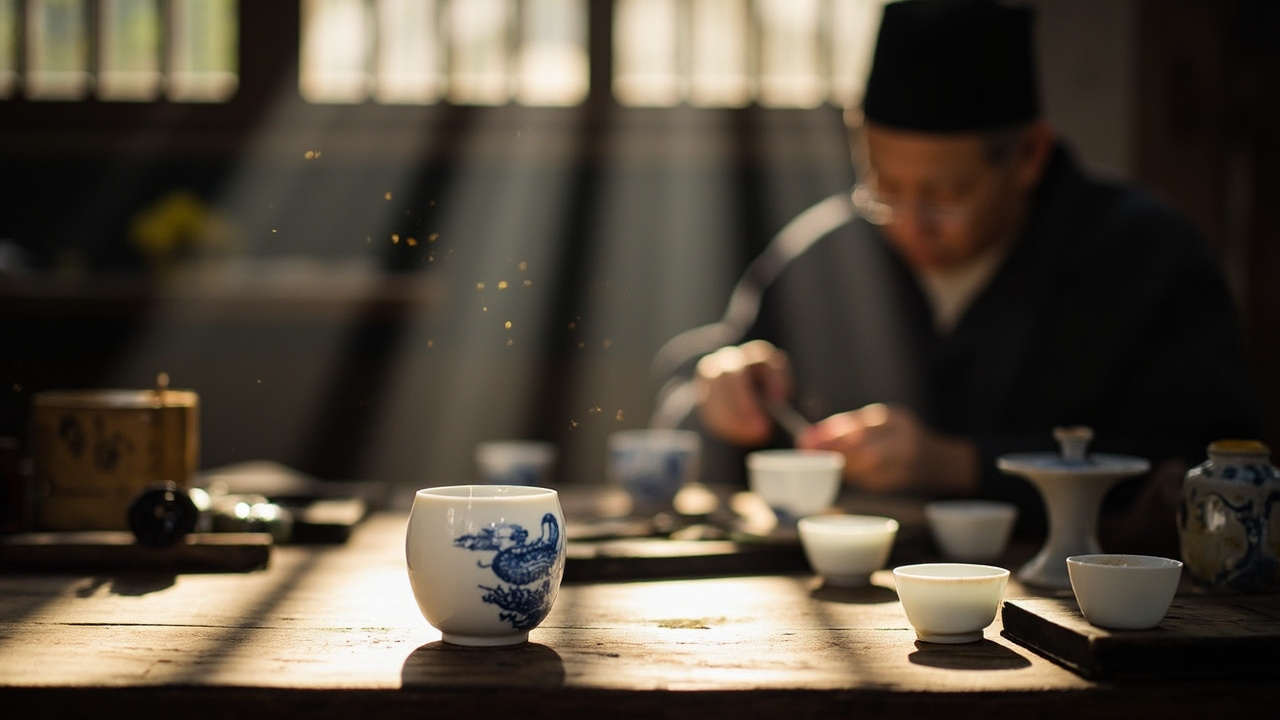
The first time I visited Jingdezhen, I expected to see rows of identical blue-and-white vases. Instead, I found a city of workshops where painters spend decades perfecting a single brushstroke. The porcelain here isn’t just a product—it’s a craft that’s been refined for over a thousand years.
The difference between the porcelain you’ll find in Jingdezhen and the stuff sold near the Forbidden City is like comparing a hand-stitched suit to something off a rack. The glaze is smoother, the painting is finer, and the clay has a certain weight to it. You can feel the difference even before you see it.
** Location:** Jingdezhen, Jiangxi Province. The main shopping area is around Taoyang Road and the Jingdezhen Ceramic Art Museum.
** Entry fee:** Free to browse workshops. Museum entry is about $5 (CNY 35).
** Opening hours:** Most workshops open 9:00 AM to 6:00 PM daily. Some close for lunch between 12:00 and 2:00.
** How to get there:** Take a high-speed train from Shanghai (about 3 hours, $60/CNY 430) or fly into Jingdezhen Luojia Airport. From the train station, take a taxi to Taoyang Road (about 15 minutes, $3/CNY 20).
?When to visit: Weekday mornings are best. The workshops are quieter and you can watch the artists without crowds.
** Insider tips:**
- Look for the “Jingdezhen” stamp on the bottom of pieces. That’s a sign of authenticity.
- Ask to see the artist’s hands. Real painters have calluses and paint-stained fingers.
- Don’t buy the first piece you like. Prices vary wildly between workshops.
- If you’re buying a tea set, ask about the clay. Porcelain from Jingdezhen is known for its whiteness and thinness.
I once watched a woman paint a dragon on a vase for three hours. She didn’t look up once. When she finished, she handed it to me and said, “This is my best work today.” I bought it for $40 (CNY 290). It’s still the centerpiece of my living room.
2. Yunnan Pu’er Tea — A Gift That Ages Like Wine
I’ll be honest: I didn’t understand pu’er tea for years. It tastes like dirt, I thought. Then a tea master in Kunming sat me down and explained that the “dirt” flavor is actually a complex blend of earth, wood, and something almost sweet. He brewed the same tea three different ways, and each cup tasted completely different. That’s when I got it.
Pu’er is unique because it’s fermented and aged, like wine or cheese. A good cake can cost hundreds of dollars, but you don’t need that. A solid entry-level cake from a reputable shop will run you $15-$30 (CNY 110-220) and will age beautifully for years.
** Location:** Yunnan Province, especially Kunming and Xishuangbanna. In Beijing, try the Maliandao Tea Market (马连道) in Xicheng District.
** Entry fee:** Free to browse. Tea tastings are often free if you’re a serious buyer.
** Opening hours:** Most tea shops open 10:00 AM to 8:00 PM.
** How to get there:** In Beijing, take Metro Line 7 to Wanzi Station (湾子), Exit A, and walk 5 minutes east to Maliandao. The market is a maze of shops—just wander in and follow your nose.
?When to visit: Any time, but mornings are quieter and shopkeepers are more willing to chat.
** Insider tips:**
- Ask for a tasting before buying. Any reputable shop will happily brew you a cup.
- Look for cakes that are compressed into a disc shape. These are easier to transport than loose leaf.
- Don’t buy tea that’s already broken into pieces. Whole cakes keep better.
- If you’re buying as a gift, ask for a cake with a nice wrapper. Presentation matters in Chinese gift culture.
I once spent an entire afternoon in a tea shop in Maliandao, tasting six different pu’ers while the shopkeeper told me about his grandfather’s tea plantation in Yunnan. I walked out with a cake that cost $25 (CNY 180) and a new understanding of what “terroir” means for tea.
3. Suzhou Silk — The Fabric That Feels Like Water
Suzhou has been China’s silk capital for centuries, and walking into a silk shop here is like stepping into a different world. The scarves feel impossibly soft, almost liquid. The colors are deep and rich, not the washed-out pastels you see in tourist shops.
The first time I bought a silk scarf in Suzhou, I thought I was getting a bargain at $15 (CNY 110). Then a local friend pointed out that the scarf was actually a blend—70% silk, 30% polyester. The real stuff, she explained, should be 100% silk, and you can test it by burning a loose thread. Real silk burns with a smell like burnt hair. Polyester melts.
** Location:** Suzhou, Jiangsu Province. The best shopping is around Guanqian Street (观前街) and the Suzhou Silk Museum.
** Entry fee:** Free to browse. The Silk Museum charges about $3 (CNY 20).
** Opening hours:** Shops open 9:30 AM to 9:00 PM. The museum closes at 5:00 PM.
** How to get there:** From Shanghai, take the high-speed train to Suzhou (about 30 minutes, $15/CNY 110). From Suzhou Station, take Metro Line 4 to Leqiao Station (乐桥), Exit 3, and walk 10 minutes to Guanqian Street.
?When to visit: Weekdays are better. Weekends get crowded with domestic tourists.
** Insider tips:**
- Ask for “100% silk” (纯丝) and check the label. Don’t be shy about asking to see the fabric’s weave.
- The burn test works: pull a loose thread and light it. Real silk smells like burnt hair; synthetic smells like plastic.
- Scarves are the easiest gift. They’re lightweight, pack well, and come in a huge range of colors.
- If you’re buying fabric by the meter, expect to pay $10-$20 (CNY 70-140) per meter for good quality.
I bought a deep burgundy scarf for my mother in Suzhou, and she still wears it every winter. It’s the kind of gift that doesn’t just say “I went to China”—it says “I paid attention.”
4. Handmade Paper Umbrellas — Art You Can Hang on a Wall
I didn’t expect to fall in love with paper umbrellas. They seemed fragile, almost useless for actual rain. But then I saw one being made in a small workshop in Hangzhou, and I understood. These aren’t umbrellas—they’re paintings that happen to have handles.
The frames are made from bamboo, the paper is hand-painted with scenes of mountains, rivers, and birds. When you hold one up to the light, the colors glow like stained glass. They’re not practical for keeping you dry, but they’re beautiful on a wall or propped in a corner.
** Location:** Hangzhou, Zhejiang Province. Look for shops near West Lake, especially around the Hefang Street (河坊街) area.
** Entry fee:** Free to browse. Workshops may charge a small fee for demonstrations.
** Opening hours:** Most shops open 9:00 AM to 8:00 PM.
** How to get there:** From Hangzhou East Station, take Metro Line 1 to Longxiangqiao Station (龙翔桥), Exit C, and walk 15 minutes to Hefang Street.
?When to visit: Spring and autumn are best. Summer is hot and crowded.
** Insider tips:**
- Check that the paper is actually hand-painted, not printed. Run your finger over the surface—real paint has texture.
- The bamboo frame should be smooth and free of splinters.
- Ask about the number of ribs (the bamboo spokes). More ribs mean a sturdier umbrella.
- If you’re worried about damage in transit, ask the shop to wrap it in bubble wrap. They’re used to tourists buying them as souvenirs.
I bought a small umbrella with a painting of a fisherman on a lake. It cost $20 (CNY 145) and survived the flight back to Beijing in my carry-on. It now hangs above my desk, and every time I look at it, I’m back on the shores of West Lake.
5. Name Seals (Chops) — The Most Personal Souvenir You Can Buy
If you want a souvenir that’s uniquely yours, get a name seal. These small stamps, carved from stone, have been used in China for centuries to sign documents and artwork. You can have your name carved in Chinese characters, or just get a seal with a design that speaks to you.
The process is simple: you choose a stone (soapstone is affordable; jade and other materials cost more), and a carver engraves your name or a phrase. The whole thing takes about 30 minutes and costs $10-$30 (CNY 70-220), depending on the stone.
** Location:** Available in most cities. In Beijing, try the Liulichang Cultural Street (琉璃厂) in Xicheng District.
** Entry fee:** Free to browse. Carving fees vary by stone and complexity.
** Opening hours:** Shops open 9:00 AM to 6:00 PM.
** How to get there:** In Beijing, take Metro Line 2 to Hepingmen Station (和平门), Exit C, and walk 5 minutes south to Liulichang.
?When to visit: Any time. Weekday mornings are quieter.
** Insider tips:**
- Bring your name in English and ask the carver to translate it phonetically into Chinese characters.
- Soapstone is the best value. It’s soft enough to carve but durable enough to last.
- Ask for a small container of red ink paste (印泥) so you can actually use the seal.
- If you’re buying as a gift, the seal comes in a nice box that’s ready for wrapping.
I had a seal carved with my Chinese name, which my friends gave me after I moved to Beijing. It’s a small thing, but it made me feel like I belonged. Every time I use it, I remember that.
6. Cloisonné (Jingtailan) — The Art of Metal and Glass
Cloisonné is one of those crafts that looks impossibly complicated, because it is. The process involves shaping copper wire into patterns, filling the spaces with colored enamel, and firing the piece multiple times. The result is a piece of art that’s both delicate and durable.
I first saw cloisonné in a workshop in Beijing, and I was skeptical. It looked too shiny, too perfect. But then I watched an artisan spend an hour on a single flower petal, and I realized this was real craftsmanship, not factory production.
** Location:** Beijing, especially around the Liulichang Cultural Street and the Beijing Enamel Factory.
** Entry fee:** Free to browse. Factory tours may cost $5 (CNY 35).
** Opening hours:** Shops open 9:00 AM to 6:00 PM.
** How to get there:** In Beijing, take Metro Line 2 to Hepingmen Station, Exit C, and walk 5 minutes south to Liulichang.
?When to visit: Any time. The factory is quieter on weekdays.
** Insider tips:**
- Look for pieces where the enamel is smooth and even. Bubbles or cracks indicate poor quality.
- Small items like jewelry boxes and earrings are the best value under $50.
- Ask about the copper base. Real cloisonné uses copper, not plastic or resin.
- If you’re buying a vase, check that the bottom is flat and stable.
I bought a small cloisonné jewelry box for my sister, and she uses it to store her earrings. It’s the kind of gift that looks far more expensive than it actually was.
7. Chinese Calligraphy — Art You Can Read (Even If You Can’t)
I can’t read Chinese characters, but I can appreciate the beauty of calligraphy. There’s something about the brushstrokes, the way they flow and pause, that feels like music made visible. A well-executed calligraphy scroll is a piece of art that works on multiple levels.
The best place to buy calligraphy is from a working artist, not a souvenir shop. You can watch them write, choose the characters you want, and take home something that’s genuinely one-of-a-kind.
** Location:** Available in most cities. In Beijing, try the 798 Art District or Liulichang.
** Entry fee:** Free to browse. Commissioned pieces start at $20 (CNY 145).
** Opening hours:** Varies by artist. Most are available 10:00 AM to 6:00 PM.
** How to get there:** In Beijing, take Metro Line 14 to Jiangtai Station (将台), Exit C, and walk 15 minutes to 798 Art District.
?When to visit: Weekends are livelier, but weekdays allow more time with the artists.
** Insider tips:**
- Choose characters with positive meanings: 福 (fortune), 爱 (love), 家 (home).
- Ask the artist to sign and stamp the work. This adds authenticity and value.
- Scrolls are easier to transport than framed pieces. They roll up compactly.
- If you’re buying as a gift, ask for a certificate of authenticity.
I commissioned a calligraphy piece with the character for “journey” (旅) from an artist in 798. It cost $35 (CNY 250), and it’s one of my most treasured possessions.
8. Embroidered Shoes — Traditional Footwear with a Modern Twist
I’ll be honest: I didn’t think I’d ever wear embroidered shoes. They seemed too traditional, too costume-like. But then I tried on a pair in a small shop in Chengdu, and they were surprisingly comfortable. The fabric is soft, the soles are flexible, and the embroidery is genuinely beautiful.
These shoes have been worn in China for centuries, and they’re still made by hand in many places. The patterns vary by region—flowers in the south, geometric designs in the north.
** Location:** Available in most cities. In Chengdu, try the Jinli Ancient Street (锦里).
** Entry fee:** Free to browse.
** Opening hours:** Shops open 9:00 AM to 9:00 PM.
** How to get there:** In Chengdu, take Metro Line 3 to Gaoshengqiao Station (高升桥), Exit D, and walk 15 minutes to Jinli.
?When to visit: Any time. Spring and autumn are best for outdoor shopping.
** Insider tips:**
- Try them on before buying. Sizes run small, so you may need to size up.
- Look for shoes with thick, sturdy soles. Thin soles wear out quickly.
- The best quality shoes are made entirely by hand. Machine-made versions are cheaper but less durable.
- If you’re buying as a gift, ask about the recipient’s shoe size before you go.
I bought a pair of embroidered shoes with a dragon pattern for my brother. He thought they were ridiculous until he wore them to a costume party and got compliments all night.
9. Peking Opera Masks — Bold, Colorful, and Unmistakably Chinese
Peking opera masks are one of those souvenirs that scream “China” without needing a label. The bold colors, the dramatic expressions, the intricate patterns—they’re instantly recognizable. And they’re surprisingly affordable.
The masks come in different sizes, from small keychains to full-face masks that you can hang on a wall. The colors have meanings: red for loyalty, black for integrity, white for cunning. You can even have a mask painted with your own design.
** Location:** Available in most cities. In Beijing, try the Liulichang Cultural Street or the Qianmen area.
** Entry fee:** Free to browse.
** Opening hours:** Shops open 9:00 AM to 8:00 PM.
** How to get there:** In Beijing, take Metro Line 2 to Qianmen Station (前门), Exit C, and walk 5 minutes to the shopping street.
?When to visit: Any time. Weekday mornings are quieter.
** Insider tips:**
- Small masks (keychain size) cost $2-$5 (CNY 15-35). Full-face masks cost $10-$20 (CNY 70-145).
- Look for masks with hand-painted details. Printed versions are cheaper but less impressive.
- If you’re buying as a gift, ask about the meaning of the colors. It adds a story to the gift.
I bought a red mask representing Guan Yu, the god of war, for a friend who loves history. He hung it in his office and says it’s a great conversation starter.
10. Chinese Knots & Tassels — Small Gifts, Big Meaning
Sometimes the best souvenirs are the smallest ones. Chinese knots (中国结) are traditional decorations made from a single length of cord, tied into intricate patterns. They symbolize good luck, prosperity, and unity. And they cost almost nothing.
I have a collection of Chinese knots that I’ve accumulated over the years—some from markets, some from temples, some from shopkeepers who insisted on giving them to me as gifts. Each one has a story.
** Location:** Available everywhere. Markets, temples, and souvenir shops all sell them.
** Entry fee:** Free to browse.
** Opening hours:** Varies by location.
** How to get there:** If you’re in Beijing, try the Panjiayuan Antique Market (潘家园) on weekends.
?When to visit: Any time. Weekend markets are livelier but more crowded.
** Insider tips:**
- Look for knots made from high-quality silk cord. Cheap plastic versions are everywhere.
- Red is the most auspicious color. It symbolizes happiness and good fortune.
- Small knots make great gifts for coworkers and friends. They’re lightweight and easy to pack.
- If you’re buying at a market, bargain. Prices are often inflated for tourists.
A shopkeeper in Xi’an gave me a small red knot as a gift when I bought a tea set from her. She said it would bring me luck. I still have it, and I’d like to think it’s worked.
FAQ summary
For first-time visitors to China in 2026, the best souvenirs under $50 are handcrafted items like Jingdezhen porcelain, Yunnan pu’er tea, Suzhou silk, and personalized name seals. These are available in major cities, with prices ranging from $5 to $45 (CNY 35-320). Most visitors from the US, UK, and EU can enter China visa-free for up to 30 days. Use WeChat Pay or Alipay for purchases, and expect to bargain in markets but pay full price in fixed-price shops. Avoid buying “jade” from street vendors, as it’s usually glass.
FAQ
Q: Do I need to bargain for souvenirs in China? A: In markets and street stalls, yes—start at about 50% of the asking price and negotiate from there. In fixed-price shops and malls, bargaining is not expected, and trying to haggle may actually be seen as rude.
Q: Can I use my credit card to buy souvenirs in China? A: Credit cards are accepted in large malls and hotels, but most small shops and markets only accept WeChat Pay, Alipay, or cash. Set up WeChat Pay or Alipay before your trip—you’ll need a foreign passport and a bank card to link.
Q: Is it safe to buy “jade” from street vendors? A: No. Most “jade” sold by street vendors is actually glass or plastic. If you want real jade, buy from a reputable jewelry store and ask for a certificate of authenticity.
Q: How do I get souvenirs back home without breaking them? A: Ask shops to wrap fragile items in bubble wrap, and carry them in your carry-on luggage if possible. For larger items, consider shipping them home via international courier services like DHL or FedEx.
Q: What’s the best way to pay for souvenirs if I don’t have WeChat Pay? A: Cash is still accepted everywhere, but you’ll need to exchange money at a bank or airport. ATMs are widely available, and most accept foreign cards. Just make sure your bank knows you’re traveling to China to avoid fraud alerts.
Q: Are there any souvenirs I should avoid buying? A: Avoid anything made from endangered species (ivory, rhino horn, certain woods), as these are illegal to export. Also avoid “antiques” from street markets—they’re almost certainly fakes.
Q: Can I take tea and silk through customs? A: Yes, tea and silk are fine to bring home, as long as they’re properly packaged. Check your home country’s customs regulations for any restrictions on agricultural products.
The Honest Wrap-up
This list isn’t for everyone. If you’re the kind of traveler who likes to buy a magnet from every city and call it a day, that’s fine—you’ll save money and suitcase space. But if you want souvenirs that actually mean something, that carry a story and a craft tradition, then these ten items are worth seeking out.
My final advice? Don’t overthink it. The best souvenirs aren’t the ones you plan for—they’re the ones you stumble upon. A tea set from a shopkeeper who insists on brewing you a cup. A calligraphy scroll from an artist who talks about his craft for an hour. A small red knot from a woman in Xi’an who wishes you luck.
Bring home something that makes you remember not just the place, but the people. That’s what China is really about.
Topics
More guides you may like

Top 10 Bridges in China
China's bridges are engineering marvels spanning mountains, rivers, and seas. Here are 10 of the most spectacular, from ancient stone to modern steel.
8 min read

Top 10 Buddhist Sites in China
From the Leshan Giant Buddha to the Dunhuang Caves, these 10 Buddhist sites represent 2,000 years of China's spiritual heritage.
9 min read

Top 10 Day Trips from Beijing You Shouldn't Miss
Beijing is packed with history, but some of China's best experiences are just a few hours away. Here are 10 day trips that will transform your visit.
9 min read

Top 10 Hidden Gems in China Off the Beaten Path
Beyond the Great Wall and Terracotta Warriors, China has incredible hidden destinations few tourists ever reach. Here are 10 underrated gems worth the detour.
9 min read

Top 10 Markets and Shopping Streets in China
From Shanghai's Bund to Beijing's Silk Street - 10 markets where foreigners can haggle, explore, and bring home authentic Chinese goods.
9 min read

Top 10 Museums in China You Shouldn't Miss
China's museums span 5,000 years of civilization. These 10 - from the Palace Museum to Xi'an's terracotta gallery - are unmissable for culture lovers.
9 min read