
Shanghai Street Food Guide
TODO: Extract from article (100-160 chars)
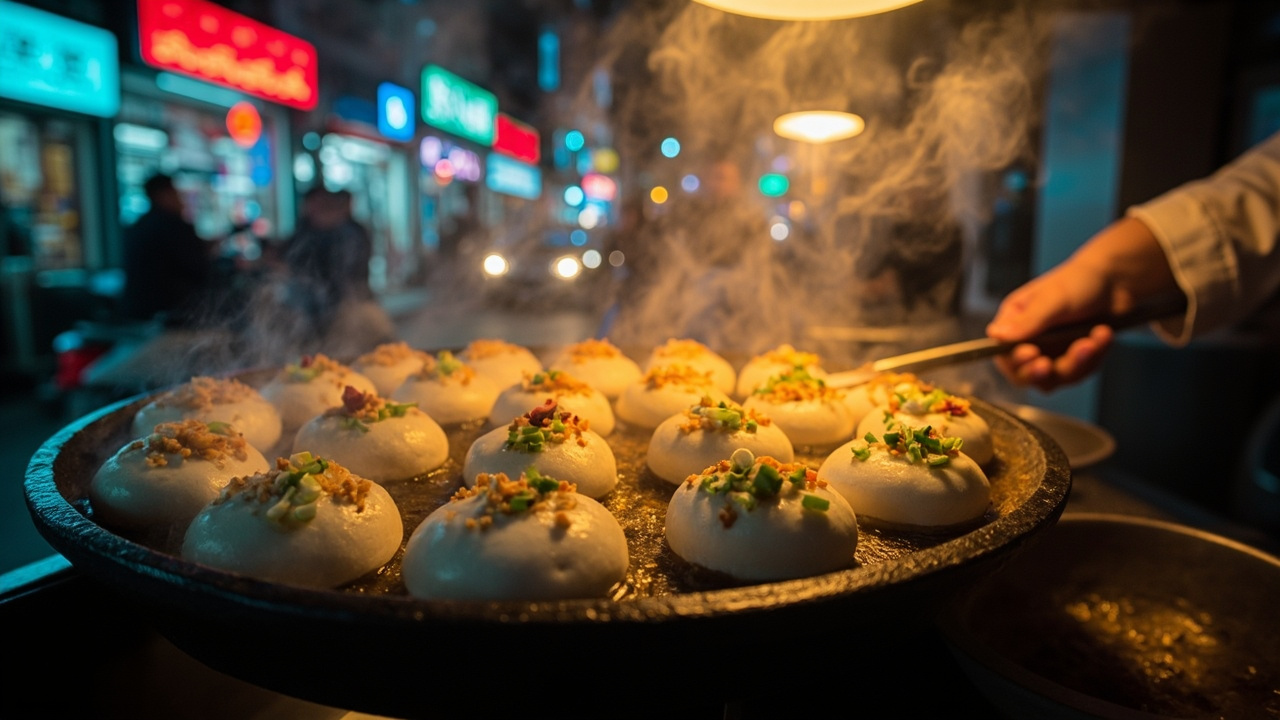
The cab dropped me at the corner of Yunnan Road and Ningbo Road at 6:40 on a Tuesday evening, and I nearly walked straight into a wall of steam. A man in a stained white apron was flipping sheng jian bao in a black iron pan the size of a car tire, the oil hissing and spitting, the bottoms of the buns turning a deep, angry gold. A woman next to him was rolling out dough with a rhythm that hadn’t changed in decades. Nobody looked at me. Nobody cared that I was a foreigner with a phone in one hand and a small notebook in the other. They just kept feeding the city.
That’s the thing about Shanghai street food. It’s not a performance for tourists. It’s the city’s actual circulatory system, the way millions of people have started their mornings and ended their nights for generations. The lanes and alleys around the old French Concession and the old city aren’t preserved for show; they’re lived in, cooked in, argued over. This guide is the result of seven years of eating my way through those lanes, getting lost, ordering the wrong thing, and occasionally being laughed at by grandmothers who knew exactly what I should have ordered.
You’ll get specific streets, specific stalls, specific dishes, and the exact way to order them without looking like a complete fool. I’ll tell you what’s worth the queue and what’s only worth it if you’re already standing there. And I’ll be honest about what you can skip.
Quick answer
Shanghai’s street food scene is best experienced in the old city lanes around Yunnan Road, the French Concession’s small alleys, and the breakfast stalls that appear before 9 AM. Most snacks cost between $1 and $5 (7–35 CNY), and you can eat very well for under $10 (70 CNY) total. The city is part of China’s visa-free transit program for many nationalities (240 hours), and every stall accepts Alipay or WeChat Pay, though cash still works at the smallest places. Go hungry, go early, and don’t be afraid to point at what the person in front of you is eating.
The Short Version
If you have 90 seconds: eat sheng jian bao (pan-fried pork buns) at Yang’s Fried Dumplings on Huanghe Road, xiaolongbao at Jia Jia Tang Bao, and walk Yunnan Road at night eating skewers until you hate yourself. Skip the “snack streets” like Chenghuang Miao’s main tourist drag; the food there is for people who don’t know better. Carry small bills or have Alipay set up before you arrive. And for the love of god, don’t ask for chopsticks at a dumpling stall; they’ll think you’re a tourist. (You are a tourist. But you don’t have to act like one.)
How I Picked These
I didn’t consult a listicle. I asked taxi drivers, hostel receptionists, and a retired English teacher who lives above a noodle shop in Jing’an. I ate at every place on this list at least twice, once alone and once with a Shanghai friend who corrected my ordering technique. I also ate at roughly forty places that didn’t make the cut, including one that gave me food poisoning so bad I still can’t look at cold noodles without flinching. These ten are the ones I’d take my own mother to, and I say that knowing she’s a picky eater who once sent back a steak in Paris.
Comparison Table
| Rank | Place | Best For | Approx Cost (USD) | Time Needed | When to Go |
|---|---|---|---|---|---|
| 1 | Yang’s Fried Dumplings | Sheng jian bao | $2–4 (15–30 CNY) | 20 min | Before 10 AM or after 4 PM |
| 2 | Jia Jia Tang Bao | Xiaolongbao | $3–6 (20–45 CNY) | 30 min | Weekday mornings |
| 3 | Yunnan Road Night Market | Variety, late night | $5–10 (35–70 CNY) | 1–2 hours | 6–10 PM |
| 4 | Da Hu Chun | Breakfast classics | $2–5 (15–35 CNY) | 30 min | 7–9 AM |
| 5 | Wang Jia Sha | Tangyuan, dim sum | $3–7 (20–50 CNY) | 45 min | Mid-morning |
| 6 | Lao Shanghai Snacks | Jian bing, street snacks | $1–3 (7–20 CNY) | 15 min | 8–11 AM |
| 7 | Tian Zi Fang Alleys | Jian bing, stinky tofu | $2–5 (15–35 CNY) | 1 hour | Late afternoon |
| 8 | South Bund Fabric Market Stalls | Skewers, grilled items | $3–6 (20–45 CNY) | 45 min | 5–8 PM |
| 9 | Xinjiang BBQ Street | Lamb skewers | $4–8 (30–60 CNY) | 1 hour | Evenings |
| 10 | The Breakfast Cart at West Nanjing Road | Jian bing on the go | $1–2 (7–15 CNY) | 10 min | 7:30–9 AM |
Yang’s Fried Dumplings — the one with the permanent queue
I’ve stood in this line at 9 AM on a Tuesday, at 3 PM in August rain, and at 11 PM on New Year’s Eve. It never gets shorter. The first time I tried Yang’s, I burned the roof of my mouth because I was too impatient to wait for the soup inside to cool. That’s not a warning; that’s a rite of passage.
The sheng jian bao here are the standard against which I measure every other pan-fried bun in China. The bottoms are crisp and almost caramelized, the tops are soft and sprinkled with sesame and scallion, and the filling is a hot, porky broth that demands respect. Order eight (they come in batches of four) and eat them at the standing counter with a bottle of soy milk.
- 📍 Location: 97 Huanghe Road, near the intersection with Fengyang Road, in the Huangpu district. It’s about a 10-minute walk from People’s Square.
- 🎫 Entry fee: None. You pay per order: $2–3 (15–20 CNY) for four buns.
- 🕒 Opening hours: Daily, roughly 6:30 AM to 8 PM. They close occasionally for holidays, but I’ve never caught them closed.
- 🚕 How to get there: Take Metro Line 1 or 2 to People’s Square Station, Exit 11. Walk north on Huanghe Road for about 8 minutes. The queue is visible from the street.
- 📅 When to visit: Weekday mornings before 10 AM are the least chaotic. Weekends are a zoo.
- 💡 Insider tips: Order at the counter first, get your receipt, then queue at the pickup window. Don’t try to pay at the pickup window; they’ll wave you away. Eat immediately, standing at the counter. The soup will burn you if you’re careless. Bite a small hole in the bun first, blow on it, then eat.
- I once watched a Shanghai grandmother correct a French tourist’s technique with a series of hand gestures so precise that no translation was needed. The Frenchman bowed. She nodded. The buns were eaten.
Jia Jia Tang Bao — the xiaolongbao that ruined me for all others
I have a theory that Jia Jia Tang Bao is the reason Michelin inspectors started paying attention to Shanghai’s hole-in-the-wall scene. The restaurant is tiny, the queue is legendary, and the xiaolongbao are so delicate that picking one up with chopsticks feels like a surgical procedure. The crab roe and pork version, available in season, is worth the pilgrimage alone.
The trick here is to order the “pure pork” and “crab roe” varieties and eat them in that order. The pure pork is clean and savory; the crab roe is richer, almost decadent. Both require the same careful bite-the-top, slurp-the-soup, then-dip-in-vinegar technique. The vinegar here is a house blend, slightly sweet, and you should not ask for black vinegar instead. Trust the house.
- 📍 Location: 90 Huanghe Road, just a few doors down from Yang’s. The two places are a five-minute walk apart, which means you can do a dumpling crawl.
- 🎫 Entry fee: None. Xiaolongbao run $3–6 (20–45 CNY) per basket of six to eight.
- 🕒 Opening hours: Daily, roughly 7 AM to 7 PM. They close when they run out of filling, which happens earlier on weekends.
- 🚕 How to get there: Same as Yang’s: People’s Square Station, Exit 11, walk north on Huanghe Road. It’s on the left side of the street.
- 📅 When to visit: Weekday mornings, ideally 8–9 AM, before the lunch rush. The queue moves fast, but it’s better to queue early.
- 💡 Insider tips: Get a number first, then find a seat. The staff will call your number in Chinese, so listen for the number, not your name. If you can’t read Chinese numbers, show your receipt to a staff member and they’ll help. Don’t order the “soup dumplings” without specifying xiaolongbao; you’ll get something else entirely.
- I once sat next to a local man who ate three baskets of crab roe dumplings without saying a word, then stood up, nodded at me, and left. I’ve never seen a more efficient use of 20 minutes.
Yunnan Road Night Market — where the city actually eats
Yunnan Road is not a tourist market in the way that Chenghuang Miao is. It’s a working street where locals come for dinner, for late-night snacks, and for the kind of food that doesn’t photograph well but tastes like a hug. The street runs for about a kilometer, and every stall has its specialty: grilled oysters with garlic, lamb skewers, stinky tofu that will clear a radius, and a dozen variations on noodles.
The best approach is to walk the entire street first, note what looks good, and then commit. Don’t order from the first stall that catches your eye; the best stuff is usually in the middle, where the queues form. And don’t be afraid to order small portions at multiple stalls. That’s the point.
- 📍 Location: Yunnan Road, between Fuzhou Road and Yan’an East Road, in the Huangpu district. It’s a 10-minute walk from the Bund.
- 🎫 Entry fee: None. Individual items range from $1–5 (7–35 CNY).
- 🕒 Opening hours: Most stalls open around 5 PM and run until midnight or later. A few open earlier for lunch.
- 🚕 How to get there: Take Metro Line 2 to Nanjing East Road Station, Exit 4. Walk south on Fujian Road for 5 minutes, then turn right onto Yunnan Road.
- 📅 When to visit: Evenings, 6–10 PM. The street is busiest around 8 PM, which is also when the best stalls have the shortest queues.
- 💡 Insider tips: Bring your own napkins; most stalls don’t provide them. If you see a stall with a queue of locals, join it. If the queue is all tourists, walk past. And if you’re sensitive to spice, say “bu la” (no spice) when ordering; the default is often spicy.
- I watched a group of four Chinese office workers share a single plate of grilled oysters and then argue over who got the last one. The argument lasted a full minute. The loser paid for the next round.
Da Hu Chun — breakfast the way it’s supposed to be
Da Hu Chun is a Shanghai institution, a sit-down restaurant that serves the breakfast classics: soy milk (both sweet and savory), fried dough sticks, and the legendary “four happiness” soup dumplings. The name translates roughly to “big pot spring,” and the place has been running since the 1950s. The interior is no-frills, the service is brisk, and the food is exactly what it should be.
The savory soy milk here is the real deal: a bowl of hot, slightly thickened soy milk with pickled vegetables, dried shrimp, and a splash of chili oil. It’s an acquired taste, but once you acquire it, you’ll never look at sweet soy milk the same way. Pair it with a fried dough stick, tear the stick into pieces, and dunk it in the soy milk. That’s the move.
- 📍 Location: 14 Yunnan Road, near the intersection with Ningbo Road. It’s at the northern end of the Yunnan Road food street.
- 🎫 Entry fee: None. A full breakfast of soy milk, dough stick, and a few dumplings runs $3–5 (20–35 CNY).
- 🕒 Opening hours: Daily, roughly 6 AM to 2 PM. They close in the afternoon, so don’t come for dinner.
- 🚕 How to get there: Take Metro Line 2 to Nanjing East Road Station, Exit 4. Walk south on Fujian Road, then turn right onto Yunnan Road. It’s about a 10-minute walk.
- 📅 When to visit: 7–9 AM on weekdays. The crowd is mostly locals grabbing breakfast before work, and the atmosphere is genuinely local.
- 💡 Insider tips: The menu is in Chinese only. If you can’t read it, point at what the person next to you is eating. The savory soy milk is the house specialty; don’t leave without trying it. If you want it less spicy, say “shao la” (a little spice).
- A retired man at the next table saw me struggling with chopsticks and silently demonstrated the correct way to tear a dough stick. He didn’t say a word. He just nodded when I got it right.
Wang Jia Sha — for when you want something sweet
Wang Jia Sha is a century-old shop that specializes in tangyuan, the glutinous rice balls filled with black sesame paste, peanut, or pork. The sweet ones are the draw here, served in a light ginger syrup that cuts through the richness. The shop also does a solid line of dim sum and rice cakes, but the tangyuan are the reason to come.
The black sesame filling here is the benchmark: smooth, nutty, and just sweet enough. The texture of the rice ball itself is soft and slightly chewy, a contrast that works better than it has any right to. Order a bowl of four, eat them slowly, and let the ginger syrup warm you from the inside.
- 📍 Location: 805 Nanjing West Road, near the intersection with Taixing Road, in the Jing’an district. It’s in a shopping complex, not a standalone shop.
- 🎫 Entry fee: None. A bowl of tangyuan runs $3–5 (20–35 CNY).
- 🕒 Opening hours: Daily, roughly 10 AM to 9 PM. The shop is busiest in the afternoon.
- 🚕 How to get there: Take Metro Line 2 to Nanjing West Road Station, Exit 1. Walk east on Nanjing West Road for about 5 minutes. The shop is inside the Shanghai Meilongzhen Plaza.
- 📅 When to visit: Mid-morning or mid-afternoon, when the lunch and dinner crowds have cleared.
- 💡 Insider tips: The pork-filled tangyuan are savory and served in a clear broth. They’re an acquired taste; the sweet ones are safer for first-timers. The shop also sells frozen tangyuan to take home, which is a great souvenir if you have access to a kitchen.
- I brought a friend from Texas here, and he ordered the sweet sesame tangyuan, ate one, and then ordered a second bowl before finishing the first. The waitress laughed and brought him two more.
Lao Shanghai Snacks — the jian bing stand that got it right
Jian bing, the savory Chinese crepe, is a breakfast staple across China, but Shanghai’s version has its own character: thinner, crispier, and often with a sweeter sauce. Lao Shanghai Snacks is a small stand near the entrance to a residential complex, and it’s where I go when I need a jian bing fix that doesn’t involve a tourist queue.
The woman who runs the stand has been doing this for over a decade. She spreads the batter with a wooden tool that looks like a tiny rake, cracks an egg onto the surface, sprinkles scallions and cilantro, brushes on the sauce, and folds it into a neat rectangle. The whole process takes about two minutes, and the result is a breakfast that costs less than a dollar and tastes like a million.
- 📍 Location: On the corner of Taixing Road and Fengxian Road, in the Jing’an district. It’s a street cart, not a permanent structure.
- 🎫 Entry fee: None. A jian bing with egg runs $1–2 (7–15 CNY). Add crispy wonton skin for an extra $0.30 (2 CNY).
- 🕒 Opening hours: Roughly 7 AM to 11 AM, or until she runs out of batter. She’s usually sold out by 10:30.
- 🚕 How to get there: Take Metro Line 2 to Nanjing West Road Station, Exit 2. Walk north on Taixing Road for about 8 minutes. The cart is on the left side of the street.
- 📅 When to visit: Weekday mornings, 8–9 AM. The cart is busiest around 8:30 when office workers stop by on their way to work.
- 💡 Insider tips: Ask for “jia dan” (add egg) if you want an extra egg. Ask for “la” if you want chili sauce. The default is mild. Don’t ask for cheese; she’ll look at you like you’ve lost your mind.
- The woman running the cart recognized me after my third visit and started adding extra scallions without asking. That’s the moment I knew I’d made it.
Tian Zi Fang Alleys — food between the souvenir shops
Tian Zi Fang is a maze of lanes in the former French Concession, and it’s mostly known for its boutique shops and art galleries. But tucked between the souvenir stalls and the overpriced cafes are a few genuine food stalls that serve the neighborhood’s original residents. The jian bing here is good, but the stinky tofu is the real draw.
Stinky tofu is an acquired taste, and I’m not going to pretend otherwise. The smell is… assertive. But the version here, fried until the outside is crisp and the inside is almost custardy, served with a sweet chili sauce, is the best I’ve had in the city. If you’re brave enough to try it, do it here.
- 📍 Location: Tian Zi Fang, 210 Taikang Road, in the Huangpu district. The food stalls are in the lanes, not on the main street.
- 🎫 Entry fee: None for the lanes. Stinky tofu runs $2–3 (15–20 CNY) per portion.
- 🕒 Opening hours: The lanes are open daily, roughly 10 AM to 9 PM. Food stalls operate during those hours.
- 🚕 How to get there: Take Metro Line 9 to Dapuqiao Station, Exit 1. Walk south on Taikang Road for about 5 minutes. The entrance to Tian Zi Fang is on the right.
- 📅 When to visit: Late afternoon, 4–6 PM, when the day-trip crowds have thinned out.
- 💡 Insider tips: The food stalls are in the residential parts of the lanes, not the main tourist drag. If you see a stall with no tourists, that’s the one. Don’t buy the “stinky tofu” from the shops on the main street; it’s not the real thing.
- I brought a colleague from London here, and he tried stinky tofu for the first time. He went pale, chewed slowly, and then asked for a second piece. He now claims it’s his favorite Chinese snack.
South Bund Fabric Market Stalls — a detour worth taking
The South Bund Fabric Market is famous for custom suits and dresses, but the food stalls outside are where the real action is. After a morning of haggling for a tailored coat, you’ll need a break, and the skewers and grilled items here hit the spot. The lamb skewers are the standout, seasoned with cumin and chili and cooked over charcoal.
The market itself is a maze of fabric stalls, and the food is at the edges, in the alleys that ring the main building. It’s not the most atmospheric place to eat, but it’s real, and it’s a good way to refuel before tackling the fabric market’s chaos.
- 📍 Location: South Bund Fabric Market, 399 Lujiabang Road, in the Huangpu district. The food stalls are in the alleys around the main building.
- 🎫 Entry fee: None. Lamb skewers run $0.50–1 (4–7 CNY) each. A full meal of skewers and a drink runs $4–8 (30–60 CNY).
- 🕒 Opening hours: The market is open daily, roughly 9 AM to 6 PM. Food stalls operate during those hours, with the busiest time around noon.
- 🚕 How to get there: Take Metro Line 9 to Xiaonanmen Station, Exit 1. Walk east on Lujiabang Road for about 10 minutes. The market is on the left.
- 📅 When to visit: Late morning or early afternoon, when you’re taking a break from fabric shopping.
- 💡 Insider tips: The skewers are sold by the stick, and you can order as few or as many as you want. The lamb is the safe bet; the chicken hearts are an adventure. If you’re not sure what something is, ask. The vendors are used to foreigners.
- I once spent an hour haggling for a cashmere coat and then ate four lamb skewers while the tailor measured me. The tailor didn’t blink. I think he respected the efficiency.
Xinjiang BBQ Street — for serious carnivores
This stretch of road near the Shanghai Railway Station is where the city’s Xinjiang community gathers, and the lamb skewers here are the real deal: big chunks of meat, heavy on cumin, cooked over open flames. The atmosphere is loud, smoky, and unapologetically meat-focused. If you’re a vegetarian, skip this one.
The skewers are sold by the stick, and the standard order is ten. You’ll also find whole roasted lamb, hand-pulled noodles, and a sweet, milky tea that cuts through the richness. This is not a place for subtlety; it’s a place for eating until you can’t move.
- 📍 Location: Along Qilianshan Road, near the intersection with Zhidan Road, in the Putuo district. It’s a bit out of the way, but worth the trip.
- 🎫 Entry fee: None. Lamb skewers run $0.50–1 (4–7 CNY) each. A full meal runs $5–10 (35–70 CNY).
- 🕒 Opening hours: Most stalls open in the late afternoon and run until midnight or later.
- 🚕 How to get there: Take Metro Line 7 to Changshou Road Station, Exit 5. Walk north on Changshou Road, then turn right onto Qilianshan Road. It’s about a 10-minute walk.
- 📅 When to visit: Evenings, 7–10 PM. The street is busiest and best around 8 PM.
- 💡 Insider tips: Order by pointing at the skewers and holding up the number of fingers you want. The vendors speak Mandarin and Uyghur, not much English. Don’t ask for a fork. Eat with your hands.
- The first time I came here, I ordered five skewers and the vendor laughed at me. He pointed at the table next to us, where a family of four was working through a stack of fifty. I ordered ten more.
The Breakfast Cart at West Nanjing Road — the $1 breakfast
Not all street food requires a pilgrimage. Some of the best jian bing I’ve had in Shanghai came from a cart that sets up on the corner of West Nanjing Road and Maoming Road, right outside the metro station. It’s there most mornings, and it serves the office workers who stream out of the station between 7:30 and 9 AM.
This is street food at its most functional: quick, cheap, and exactly what you need to start the day. The jian bing here is solid, the soy milk is fresh, and the whole thing costs less than a dollar. If you’re staying in the Jing’an area, this is your breakfast.
- 📍 Location: Corner of West Nanjing Road and Maoming Road, in the Jing’an district. It’s right outside Nanjing West Road Station.
- 🎫 Entry fee: None. A jian bing with egg runs $1–2 (7–15 CNY).
- 🕒 Opening hours: Roughly 7 AM to 9:30 AM, or until the cart runs out of batter.
- 🚕 How to get there: Take Metro Line 2 to Nanjing West Road Station, Exit 3. The cart is on the corner, visible from the exit.
- 📅 When to visit: 7:30–8:30 AM on weekdays. The cart is busiest around 8 AM.
- 💡 Insider tips: The cart doesn’t have a name or a sign. Look for the queue of office workers in suits. If you’re not sure what to order, just say “jian bing” and point at the egg. The vendor will handle the rest.
- I once saw a woman in a designer suit eat a jian bing while walking to work, holding it with one hand and scrolling through her phone with the other. She didn’t spill a single crumb. I’ve been trying to replicate that skill for years.
FAQ summary
Shanghai street food is affordable, widely accessible, and best experienced in the old city lanes and residential neighborhoods rather than tourist-focused snack streets. Most stalls accept Alipay or WeChat Pay, and cash is still accepted at smaller vendors. The city is covered by China’s 240-hour visa-free transit policy for many nationalities, making it easy to visit for a short food-focused trip. Key dishes to try include sheng jian bao, xiaolongbao, jian bing, and lamb skewers, with most meals costing between $1 and $5 (7–35 CNY).
FAQ
Q: Is Shanghai street food safe for tourists to eat? A: Yes, generally. Stick to stalls with high turnover (lots of customers) and food that’s cooked fresh in front of you. Avoid anything that’s been sitting out for a while. I’ve eaten street food in Shanghai for seven years and only had one bad experience, which was my own fault for choosing a stall with no queue.
Q: Do I need to speak Chinese to order street food? A: No, but it helps to know a few phrases. “Zhe ge” (this one) and pointing at what you want works at most stalls. Many vendors in tourist areas understand basic English, but in residential neighborhoods, you’ll rely on gestures and translation apps. Download a translation app before you go.
Q: How much money should I budget for street food in Shanghai? A: Most snacks cost between $1 and $5 (7–35 CNY). A full day of eating, with three meals and snacks, will run you $15–25 (105–175 CNY) per person. That’s cheaper than a single meal at a mid-range restaurant.
Q: What’s the difference between sheng jian bao and xiaolongbao? A: Sheng jian bao are pan-fried, with a crisp bottom and a thicker, yeast-based wrapper. Xiaolongbao are steamed, with a thinner wrapper and more soup inside. Both are filled with pork and broth, but they’re distinct dishes. Try both.
Q: Do street food stalls accept credit cards? A: No. Most stalls only accept Alipay, WeChat Pay, or cash. Set up Alipay before you arrive and link it to your international credit card. It’s the most reliable payment method for street food. Cash works, but you’ll need small bills; vendors rarely have change for large notes.
Q: Is it okay to eat while walking in Shanghai? A: Yes, but be prepared for a culture that’s more relaxed about eating in public than some Western countries. Locals often eat while walking, especially breakfast items like jian bing. Just don’t drop anything on the street; the cleaning staff works hard enough.
Q: What’s the best time of day for street food in Shanghai? A: Breakfast (7–9 AM) is best for jian bing, soy milk, and sheng jian bao. Lunch (11 AM–1 PM) is good for noodles and rice dishes. Dinner and late night (6 PM–midnight) is when the skewer stalls and night markets come alive. Plan your eating around these windows.
The Honest Wrap-up
This list isn’t for everyone. If you need white tablecloths and a wine list, you’ll be uncomfortable at most of these places. If you’re not willing to eat with your hands or point at things you can’t pronounce, you’ll miss the point. But if you’re the kind of traveler who believes that the best way to understand a city is through its food, Shanghai will reward you in ways that no restaurant guide can capture.
My final piece of advice: go early, go hungry, and don’t be afraid to make mistakes. Order the wrong thing. Burn your mouth on a dumpling. Ask a grandmother what she’s eating. She might just teach you something. And when you’re back home, weeks later, you’ll close your eyes and taste that first bite of sheng jian bao, and you’ll already be planning your return.
More guides you may like
Top 10 Bridges in China
China's bridges are engineering marvels spanning mountains, rivers, and seas. Here are 10 of the most spectacular, from ancient stone to modern steel.
8 min read

Top 10 Buddhist Sites in China
From the Leshan Giant Buddha to the Dunhuang Caves, these 10 Buddhist sites represent 2,000 years of China's spiritual heritage.
9 min read

Top 10 Day Trips from Beijing You Shouldn't Miss
Beijing is packed with history, but some of China's best experiences are just a few hours away. Here are 10 day trips that will transform your visit.
9 min read
Top 10 Hidden Gems in China Off the Beaten Path
Beyond the Great Wall and Terracotta Warriors, China has incredible hidden destinations few tourists ever reach. Here are 10 underrated gems worth the detour.
9 min read
Top 10 Markets and Shopping Streets in China
From Shanghai's Bund to Beijing's Silk Street - 10 markets where foreigners can haggle, explore, and bring home authentic Chinese goods.
9 min read
Top 10 Museums in China You Shouldn't Miss
China's museums span 5,000 years of civilization. These 10 - from the Palace Museum to Xi'an's terracotta gallery - are unmissable for culture lovers.
9 min read