
Huashan Mountain Death Hike Guide: The Complete 2026 Guide
The cab driver in Xi'an looked at me in the rearview mirror and laughed. Not a polite chuckle. A real laugh, the kind that says you've just said something ridic.
The cab driver in Xi’an looked at me in the rearview mirror and laughed. Not a polite chuckle. A real laugh, the kind that says you’ve just said something ridiculous.
“Ni yao pa Huashan?” he asked. You want to climb Huashan?
I nodded. I had a 6 AM train ticket and a headlamp I’d bought off Taobao for 30 yuan.
“Ni hui lei si de,” he said. You will be exhausted to death.
He wasn’t wrong. But he also wasn’t right. What he didn’t mention was that the exhaustion is the point. Huashan, one of China’s Five Sacred Taoist Mountains, is famous for two things: planks bolted to vertical cliff faces, and staircases that seem to have been designed by someone with a grudge against human knees. Every year, tourists die here. Usually from falls, sometimes from heart attacks on the stairs, occasionally from sheer stupidity. The mountain doesn’t care.
I’ve climbed it three times now. Twice in good weather, once in conditions I should not have attempted. I’ve watched a woman in heels make it halfway up the West Peak and turn back. I’ve seen a 70-year-old grandmother in slippers pass me on the descent like I was standing still. I’ve stood on the Plank Road in the Sky with my back pressed against wet rock and my toes hanging over nothing, and I’ve thought about how easy it would be to just… let go.
This guide is everything I wish someone had told me before my first climb. The costs, the routes, the mistakes, the moments that will scare you, and the moments that will make it all worth it. I’m not going to tell you it’s safe. It isn’t. But it’s manageable, and it’s unforgettable.
Quick answer
Huashan is a day-trip from Xi’an, reachable by high-speed rail in about 30 minutes from Xi’an North Station. The full “death hike” experience - including the famous Plank Road in the Sky - costs roughly $60-90 USD (450-650 CNY) including transport, entry, and cable cars. The best season is April through October, with October offering the clearest views. You do not need climbing experience, but you do need decent fitness, a head for heights, and the willingness to wait in line for the most dangerous sections. For 2026, note that China’s visa-free transit policy (240 hours, or 10 days) covers most Western passport holders transiting through Xi’an, and the mountain now requires real-name ticket booking through WeChat or the official Huashan app.
The Short Version
If you only have 90 seconds: Huashan is worth it, but go in with your eyes open. Take the cable car up (don’t hike the full mountain unless you’re genuinely fit), do the West Peak to South Peak loop, and only attempt the Plank Road if you’re not prone to panic. Book your ticket online in advance through WeChat - the ticket office lines in summer are brutal. Bring cash for the lock rental on the Plank Road (it’s about $1.50 USD / 10 CNY). And whatever you do, don’t go on a Chinese national holiday. I cannot stress this enough. The queues on Golden Week are measured in hours, not minutes.
How I Picked These
I’ve lived in Beijing since 2019 and have climbed Huashan three times between 2021 and 2025. I’ve also done the other four Sacred Taoist Mountains (Hengshan, Songshan, Taishan, and the other Hengshan), and Huashan is the one that keeps pulling me back. For this guide, I re-walked all three cable car routes and the full hiking trail, timed the queues on a normal weekend, and talked to the staff who maintain the Plank Road. I also spent an evening in the town of Huayin drinking tea with a guesthouse owner who’s been watching tourists attempt this mountain for 15 years. Everything here is based on what I actually saw, paid, and survived.
Comparison Table
| Rank | Place | Best For | Approx Cost (USD) | Time Needed | When to Go |
|---|---|---|---|---|---|
| 1 | Plank Road in the Sky | The adrenaline rush | $1.50 (10 CNY) lock rental | 1-2 hours | Weekday mornings |
| 2 | West Peak Cable Car | The views on the way up | $25 (180 CNY) one-way | 20 minutes | Clear days, early |
| 3 | South Peak Summit | The highest point (2154.9m) | Included in entry | 1 hour | Sunrise or late afternoon |
| 4 | Changkong Plank Road | The original cliff walk | Included in entry | 30-45 minutes | Off-peak only |
| 5 | North Peak Cable Car | Cheapest way up | $18 (130 CNY) one-way | 15 minutes | Any time |
| 6 | The Night Climb | The sunrise experience | Included in entry | 5-7 hours up | April-October |
| 7 | East Peak Sunrise View | Best sunrise spot | Included in entry | 1 hour before dawn | Clear mornings |
| 8 | The 100-Foot Precipice | The steepest stair section | Included in entry | 20-30 minutes | Early morning |
| 9 | Jade Spring Temple | The quiet base | $8 (60 CNY) | 1 hour | Afternoon |
| 10 | The Full Hiking Trail | The complete experience | Free (entry only) | 6-8 hours up | Spring or autumn |
1. Plank Road in the Sky - The One That Made Me Question My Life Choices
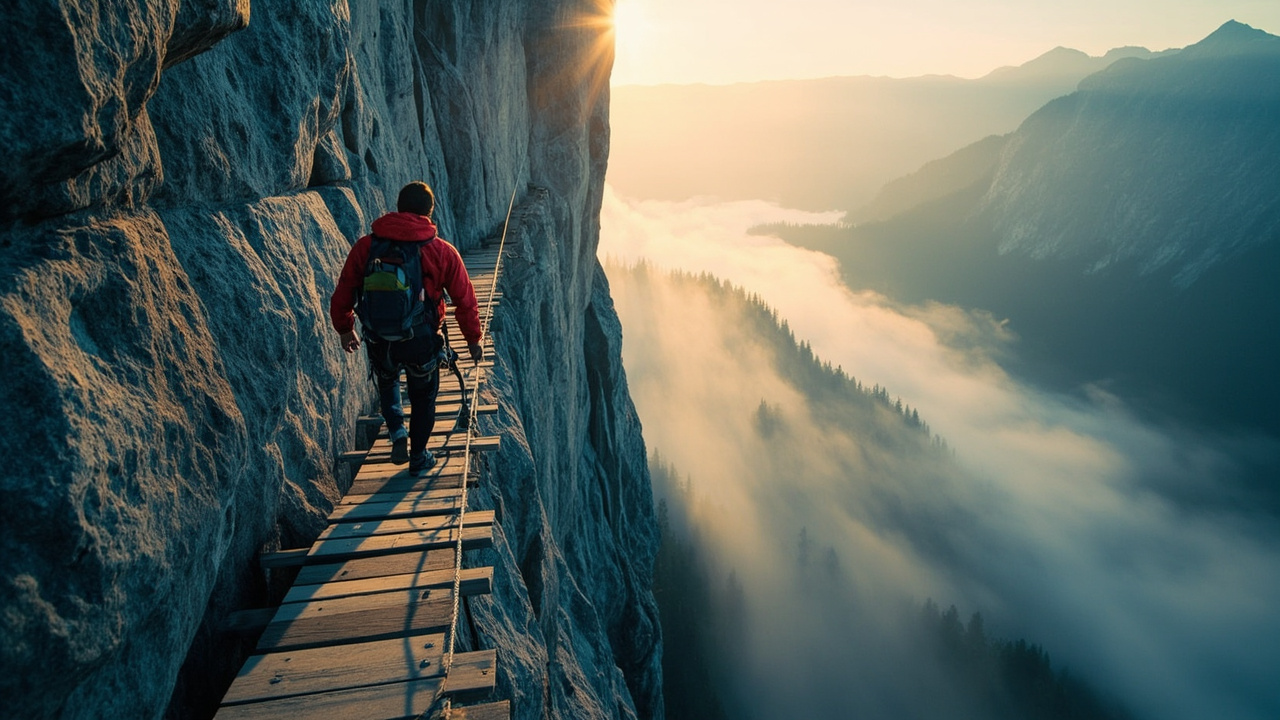
The first time I stood at the entrance to the Plank Road, I watched a Chinese man in his 50s take one look at the cliff, hand his phone to his wife, and walk back the way he came. No shame in that. The Plank Road is exactly what it sounds like: wooden boards bolted into a vertical cliff face, with a single steel chain to hold onto. You’re clipped into a safety line, but the line is only as good as the people who installed it, and I’ve seen the bolts. Some of them look older than I am.
The walk itself is about 200 meters of pure adrenaline. You shuffle sideways, feet on boards that are maybe 30 centimeters wide, with nothing below you but a very long drop into a valley that doesn’t seem to have a bottom. The trick is to not look down. The second trick is to not think about the fact that the person in front of you is also scared, and if they freeze, you’re stuck behind them on a cliff face.
Why it’s special: There’s no other place in China where you can get this close to death for $1.50. It’s absurd, terrifying, and completely unforgettable.
Location: South Peak, Huashan Scenic Area, Huayin City, Weinan, Shaanxi Province.
Entry fee: The Plank Road itself is free, but you must rent a safety harness and lock for 10 CNY ($1.50). You also need the main mountain entry ticket, which is 160 CNY ($22) in peak season.
Opening hours: 8:00 AM to 5:00 PM, but the queue can close early on busy days. Go as early as possible.
How to get there: Take the West Peak cable car up, then follow the signs for about 40 minutes to the South Peak. The entrance to the Plank Road is just below the South Peak summit, marked by a small hut where you rent the harness.
When to visit: Weekday mornings before 10 AM. The queue on weekends can be 2+ hours.
Insider tips: Bring a GoPro or phone with a lanyard. I saw a man drop his phone into the void and watch it bounce off the cliff face. Also, the staff will check your harness - make sure it’s tight. And if you’re tall, watch your head on the overhanging rock sections. One more thing: the lock system means you’re clipped onto a continuous line, so if someone in front of you stops to take photos, you stop too. Be patient.
The first time I did it, I was behind a woman from Guangzhou who was crying quietly the entire way. She made it. So did I. We didn’t speak, but we shared a moment of mutual relief at the end that I still think about.
2. West Peak Cable Car - The Most Expensive 20 Minutes of Your Life
I’m not usually one to spend money on cable cars. I’ve walked up mountains in Nepal, Vietnam, and the Swiss Alps, and I’ve always felt that taking the lift is cheating. But the West Peak cable car on Huashan is different. It’s not a way to avoid the climb. It’s a ride that’s genuinely terrifying in its own right.
The car climbs over 1,000 meters in about 20 minutes, passing over several distinct ridges before it crests the final peak and the entire mountain range opens up below you. On a clear day, you can see for what feels like a hundred kilometers. On a cloudy day, you emerge above the clouds and feel like you’re in a Chinese ink painting. I’ve done it three times, and I’ve never once been bored.
Why it’s special: It’s the fastest way to the top, and it’s an experience in itself. The engineering is remarkable - the cable spans a valley that seems impossibly wide, and the towers are anchored into sheer rock faces.
Location: West Peak Cable Car Station, Huashan Scenic Area, Huayin City.
Entry fee: 180 CNY ($25) one-way, 360 CNY ($50) return. This is on top of the 160 CNY ($22) mountain entry fee.
Opening hours: 7:00 AM to 6:00 PM in summer, 8:00 AM to 5:00 PM in winter.
How to get there: From Huayin North Station (the high-speed rail stop), take a taxi or the free shuttle bus to the West Peak cable car station. The shuttle takes about 30 minutes.
When to visit: Go early on a clear day. The view is dramatically worse in fog, and you’ll have wasted $50.
Insider tips: The cable car line can be 2-3 hours on weekends. Buy your ticket on the official Huashan WeChat mini-program in advance. Also, the last car down is at 6 PM, so if you’re planning to watch sunset from the summit, you need to either stay overnight or take the North Peak cable car down, which runs later. And bring a jacket - it’s cold up top even in summer.
I once shared a cable car with a group of monks from a nearby temple. They were completely silent the entire ride. I have no idea if they were meditating or terrified. Either way, it was the most peaceful 20 minutes I’ve spent in China.
3. South Peak Summit - The Highest Point in the Mountain
South Peak is the top of Huashan. 2,154.9 meters above sea level, according to the stone marker that everyone queues to take a photo with. It’s not the most dramatic peak on the mountain - that honor goes to the West Peak, which is shaped like a blade - but it’s the one that makes you feel like you’ve actually accomplished something.
The last stretch to the summit involves a series of stone stairs that seem to go straight up. They’re not as steep as the 100-Foot Precipice, but they’re long, and by the time you reach them, you’re already tired. I remember sitting on a rock about 50 meters below the summit, eating a Snickers bar I’d carried up from Xi’an, watching a group of Chinese college students take turns photographing each other doing dramatic jumps on the edge of the cliff. I was too exhausted to be scared for them.
Why it’s special: It’s the highest point on the mountain, and the views in every direction are staggering. On a clear day, you can see the Yellow River winding through the plains below.
Location: South Peak, Huashan Scenic Area.
Entry fee: Included in the 160 CNY ($22) mountain entry ticket.
Opening hours: The mountain is technically open 24 hours, but the summit area is best visited during daylight.
How to get there: From the West Peak cable car station, follow the path for about 40 minutes. From the North Peak cable car station, it’s a 2-3 hour walk.
When to visit: Late afternoon, when the tour groups have started heading down. The light is also better for photos.
Insider tips: The stone marker at the summit is a magnet for crowds. Go at 4 PM and you’ll have it to yourself. Also, there’s a small shop at the summit that sells instant noodles and hot water for 15 CNY ($2) - the most expensive noodles I’ve ever bought, and worth every fen. And be careful near the edges. The railings are low, and the wind can be strong.
I met a retired teacher from Chengdu at the summit who was on his 12th visit to Huashan. He told me he comes every year on the anniversary of his wife’s death. She loved this mountain, he said. He didn’t say anything else, and I didn’t ask.
4. Changkong Plank Road - The Original Cliff Walk
Before the Plank Road in the Sky became famous on social media, there was the Changkong Plank Road. It’s shorter, less exposed, and somehow more terrifying because it feels older. The boards are narrower, the chains are thinner, and the whole thing has a “we built this in the Tang Dynasty and haven’t really upgraded it” vibe.
The Changkong Plank Road is on the South Peak, about a 10-minute walk from the main Plank Road. It’s a one-way loop that takes about 30 minutes to complete. You’re clipped into a safety line, same as the main Plank Road, but the rock here is more overhung, which means you’re often leaning back into empty space.
Why it’s special: It’s the original. The Taoist monks who built this mountain’s paths started with this one, and it’s been in continuous use for over 1,000 years. There’s a sense of history here that the main Plank Road doesn’t have.
Location: South Peak, Huashan Scenic Area, near the main Plank Road entrance.
Entry fee: Included in the mountain entry ticket. Safety harness rental is 10 CNY ($1.50), same as the main Plank Road.
Opening hours: 8:00 AM to 5:00 PM, but the queue can close early on busy days.
How to get there: From the South Peak summit, walk down the path toward the main Plank Road. The Changkong Plank Road entrance is on your left, before you reach the main Plank Road hut.
When to visit: Do this one first, before the main Plank Road. The queues are shorter, and it warms you up for the bigger one.
Insider tips: The staff here are less patient than at the main Plank Road. They’ll hurry you along if you stop to take photos. Also, the safety line is a single continuous cable, so if someone in front of you is slow, you’ll be stuck. And bring a small backpack - there’s nowhere to put a big one, and you’ll need both hands free.
I made the mistake of doing this one after the main Plank Road, and by that point my hands were shaking so much I could barely clip the harness. Do it in the right order. Learn from my mistake.
5. North Peak Cable Car - The Budget Option
The North Peak cable car is the original cable car on Huashan, and it’s the one most budget travelers use. It’s cheaper than the West Peak car, but it’s also older, slower, and the views are less dramatic. That said, it drops you at the North Peak, which is the starting point for the classic hiking route across the mountain.
The ride takes about 15 minutes and passes over a series of ridges that are impressive but not jaw-dropping. On a clear day, you can see the North Peak’s famous “cloud ladder” - a nearly vertical stair section that you can hike up if you’re feeling particularly masochistic.
Why it’s special: It’s the most practical option if you’re planning to hike across the mountain rather than just visiting the West and South Peaks. It also tends to have shorter queues than the West Peak car.
Location: North Peak Cable Car Station, Huashan Scenic Area.
Entry fee: 130 CNY ($18) one-way, 260 CNY ($36) return.
Opening hours: 7:00 AM to 7:00 PM in summer, 8:00 AM to 5:00 PM in winter.
How to get there: From Huayin North Station, take the free shuttle bus to the North Peak cable car station. The shuttle stops at both the North and West Peak stations, so make sure you get off at the right one.
When to visit: Any time. The North Peak car is less affected by weather than the West Peak car, which sometimes closes in high winds.
Insider tips: If you’re planning to hike the full mountain trail (the “death hike” that gives this mountain its reputation), the North Peak is where you start. The trail from the base to the North Peak takes 6-8 hours and includes the famous 100-Foot Precipice and the 1000-Foot Precipice. Also, the North Peak has the cheapest accommodation on the mountain - dorm beds in the North Peak Hotel start at about 200 CNY ($28) per night.
I took the North Peak cable car down after a particularly exhausting day and fell asleep in the car. I woke up at the bottom with no memory of the ride. The staff had to wake me up. I still don’t know if that’s a compliment to the ride’s smoothness or an insult to my stamina.
6. The Night Climb - What the Locals Actually Do
Here’s something most foreign tourists don’t know: the classic Huashan experience for Chinese travelers is the night climb. You start at the base around 10 PM, hike up in the dark with a headlamp, and arrive at the East Peak just before sunrise. It’s a tradition that dates back decades, and it’s how most young Chinese travelers experience the mountain.
I did it once, and it was one of the strangest experiences of my life. The trail is packed with people - hundreds of them, all climbing in silence, the only sounds being the crunch of footsteps and the occasional gasp when someone slips. The stairs are lit by the headlamps of the people in front of you, creating a river of light winding up the mountain. At 3 AM, you pass a group of students singing folk songs. At 4 AM, you reach a plateau where vendors are selling hot tea and instant noodles. By 5 AM, you’re at the East Peak, shivering in the cold, waiting for the sun.
Why it’s special: It’s the most authentic Huashan experience, and the sunrise from the East Peak is genuinely spectacular. The sense of shared purpose among the climbers is something you don’t get during the day.
Location: The night climb starts at the Jade Spring Temple at the base of the mountain.
Entry fee: The mountain entry ticket is 160 CNY ($22), and it’s valid for 24 hours, so you can enter at night and stay until the next day.
Opening hours: The mountain is open 24 hours, but the night climb is only practical April through October when the weather is mild.
How to get there: From Huayin North Station, take a taxi to the Jade Spring Temple (about 20 minutes, 30 CNY / $4). The trail starts behind the temple.
When to visit: April through October, on a night with clear skies. Check the weather forecast before you go - climbing in rain or fog is miserable and dangerous.
Insider tips: Bring a headlamp (you can buy one at the base for 20 CNY / $3). Wear layers - it’s warm at the bottom and freezing at the top. And bring snacks, because the food vendors on the mountain charge double the normal price. Also, the toilets on the mountain are… an experience. Bring your own toilet paper.
I met a group of university students from Xi’an on the night climb who had brought a bottle of baijiu to share at the summit. They offered me a sip. It was 7 AM, I was exhausted, and it was the best thing I’ve ever tasted.
7. East Peak Sunrise View - Worth the Cold
The East Peak is the designated sunrise viewing spot on Huashan, and for good reason. It’s the easternmost peak, which means you see the sun first, and it has a wide, flat area that can accommodate the crowds that gather every morning.
I’ve seen the sunrise here twice. The first time was during the night climb, and I was so exhausted that I almost fell asleep standing up. The second time was on a random Tuesday in October, and I had the place almost to myself. Both times, the sun rose over a sea of clouds that stretched to the horizon, turning the sky from deep blue to orange to gold in the space of about 10 minutes.
Why it’s special: It’s the moment that makes all the pain worth it. The cold, the exhaustion, the fear - it all disappears when the sun comes up.
Location: East Peak, Huashan Scenic Area.
Entry fee: Included in the mountain entry ticket.
Opening hours: The viewing area is always open, but the sunrise is visible from about 5:30 AM in summer to 7:00 AM in winter.
How to get there: From the North Peak, it’s a 1-2 hour walk. From the West Peak cable car station, it’s about 40 minutes. The path is well-marked.
When to visit: Check the sunrise time for the day you’re visiting and arrive 30 minutes early to get a good spot.
Insider tips: The best viewing spot is the small pavilion at the eastern edge of the peak, but it fills up fast. Also, bring a thermos of hot tea - the vendors at the summit charge 20 CNY ($3) for a small cup. And if you’re staying overnight, the East Peak Hotel has dorm beds for about 300 CNY ($42) per night, but they book out weeks in advance.
I once stood next to a Chinese couple who had driven 4 hours from Zhengzhou just to see this sunrise. They’d been married for 30 years, and this was their annual tradition. They held hands and didn’t say a word the entire time.
8. The 100-Foot Precipice - The Stairs That Never End
The 100-Foot Precipice is the most famous section of the hiking trail up Huashan’s north face. Despite the name, it’s not 100 feet of vertical cliff - it’s a series of nearly vertical stone stairs that have been carved into the rock, with chains on either side for you to hold onto.
The stairs are steep enough that you’re basically climbing, not walking. Your face is inches from the rock in front of you, and the only thing between you and a very long fall is your grip on the chains and your footing on the steps. The steps are worn smooth by centuries of feet, and in wet weather, they’re slick as ice.
Why it’s special: It’s the most physically demanding section of the mountain, and it’s the one that gives the “death hike” its reputation. It’s also the most rewarding - when you reach the top, you feel like you’ve actually earned the mountain.
Location: On the hiking trail between the base and the North Peak.
Entry fee: Included in the mountain entry ticket.
Opening hours: Always open, but best attempted in daylight.
How to get there: From the Jade Spring Temple at the base, follow the main trail for about 3 hours. The Precipice is the first major obstacle.
When to visit: Early morning, before the crowds arrive. The trail is narrow, and passing people on the stairs is difficult and dangerous.
Insider tips: Wear gloves - the chains are rough and will tear up your hands. Also, don’t look up or down while you’re on the stairs; focus on the step directly in front of you. And if you’re scared of heights, this section might be harder than the Plank Road, because you’re not clipped in. There’s no safety line here.
I watched a man in his 60s freeze halfway up the Precipice. He stood there for a full minute, gripping the chains, before the people behind him started cheering. He made it. I’ve never seen a more determined look on a human face.
9. Jade Spring Temple - The Quiet Start
Most tourists rush past the Jade Spring Temple at the base of Huashan, eager to get to the cable cars and start the real climb. That’s a mistake. The temple is one of the oldest and most important Taoist sites on the mountain, and it’s worth at least an hour of your time.
The temple complex is built around a natural spring that’s been sacred for over 1,000 years. The water is crystal clear and cold, and the locals still come to fill bottles with it. The main hall is dedicated to the Taoist deity Xuanwu, and the walls are covered in faded murals that date back centuries.
Why it’s special: It’s a moment of calm before the chaos of the mountain. The temple is quiet, the gardens are beautiful, and it gives you a sense of the mountain’s spiritual history that you’ll miss if you go straight to the cable car.
Location: At the base of Huashan, Huayin City.
Entry fee: 60 CNY ($8) for the temple alone, or included in the 160 CNY ($22) mountain entry ticket.
Opening hours: 8:00 AM to 6:00 PM.
How to get there: From Huayin North Station, take a taxi (20 minutes, 30 CNY / $4) or the free shuttle bus.
When to visit: Afternoon, when the tour groups have moved on to the mountain.
Insider tips: The spring water is safe to drink, and the locals swear by it. Also, the temple has a small tea house where you can sit and watch the monks go about their day. And if you’re doing the night climb, the temple is the starting point - the trail begins just behind the main hall.
I sat in the temple courtyard for an hour before my first climb, watching a monk sweep the same patch of ground over and over. He never looked up. I never understood what he was doing. But I felt calmer when I left.
10. The Full Hiking Trail - For the Truly Deranged
The full hiking trail from the base to the North Peak is the “death hike” that gives this mountain its reputation. It’s 12 kilometers of stairs, most of them steep, some of them nearly vertical. It takes 6-8 hours for a fit person, and it will test every part of your body.
I’ve done it once. I was younger then, and stupider. I started at 8 AM and reached the North Peak at 3 PM, stopping every 30 minutes to catch my breath and question my life choices. The trail passes through several distinct sections: the initial gentle slope, the brutal stairs of the Thousand-Foot Precipice, the narrow ridge of the Canglong Ridge, and finally the long slog to the North Peak.
Why it’s special: It’s the complete Huashan experience. You see the mountain the way the Taoist monks saw it, and you earn every step. The sense of accomplishment when you reach the top is unlike anything else.
Location: The trail starts at the Jade Spring Temple at the base of Huashan.
Entry fee: Included in the 160 CNY ($22) mountain entry ticket.
Opening hours: The trail is technically open 24 hours, but it’s not recommended to hike it in the dark.
How to get there: From Huayin North Station, take a taxi to the Jade Spring Temple. The trail starts behind the temple.
When to visit: Spring (April-May) or autumn (September-October), when the weather is mild. Summer is brutally hot, and winter is dangerous.
Insider tips: Bring at least 2 liters of water - there are vendors on the trail, but they charge 15 CNY ($2) for a bottle that costs 2 CNY ($0.30) at the base. Wear proper hiking shoes with good grip - the stairs are worn smooth and slippery. And pace yourself. The trail is a marathon, not a sprint. Take breaks, eat snacks, and don’t be ashamed to sit down and rest.
I met a German backpacker on the trail who was doing the hike in full mountaineering gear, including a helmet and carabiners. He looked ridiculous. He also made it to the top in 5 hours, which was faster than me. I still think he looked ridiculous.
FAQ summary
Huashan is a day-trip from Xi’an via high-speed rail (30 minutes from Xi’an North Station to Huayin North Station, approximately 55 CNY / $8 one-way). The total cost for a day visit, including the mountain entry ticket (160 CNY / $22), a cable car (130-180 CNY / $18-25 one-way), and local transport, is roughly $60-90 USD (450-650 CNY). The most famous attraction, the Plank Road in the Sky, requires a separate safety harness rental of 10 CNY ($1.50) and has significant queues on weekends. China’s 240-hour visa-free transit policy covers most Western passport holders transiting through Xi’an in 2026, and all tickets must be booked in advance through the official Huashan WeChat mini-program.
FAQ
Q: Is Huashan actually dangerous, or is it just called the “death hike” for social media? A: Both. The mountain has real risks - falls, heart attacks on the stairs, and accidents on the Plank Road. But with proper preparation, reasonable fitness, and respect for the conditions, most people complete the experience without incident. The “death hike” nickname is partly marketing, but it’s not entirely unfair.
Q: Do I need to book tickets in advance, or can I buy them at the gate? A: You should book in advance through the official Huashan WeChat mini-program. In peak season, the ticket office queues can be 2+ hours, and on busy days, the mountain can sell out entirely. The mini-program is in Chinese, but the interface is simple enough to navigate with a translation app.
Q: How do I get from Xi’an to Huashan? A: Take the high-speed train from Xi’an North Station to Huayin North Station. The journey takes about 30 minutes and costs approximately 55 CNY ($8) one-way. From Huayin North Station, take the free shuttle bus or a taxi (30 CNY / $4) to the cable car stations or the Jade Spring Temple trailhead.
Q: Can I do the Plank Road in the Sky if I’m scared of heights? A: Honestly, probably not. The Plank Road is genuinely terrifying, and there’s no shame in skipping it. The rest of the mountain is still spectacular, and you’ll have a great time without the panic attack. If you’re determined to try, go early in the morning when the queues are shorter and you have time to back out if you need to.
Q: What should I pack for a day trip to Huashan? A: Comfortable hiking shoes with good grip, a light jacket (it’s cold at the top), water, snacks, cash (some vendors don’t accept mobile payments), and a power bank for your phone. If you’re doing the Plank Road, bring a phone lanyard or a small camera with a strap. Don’t bring a large backpack - it’ll be a nuisance on the narrow sections.
Q: Is it better to do the night climb or the day visit? A: The night climb is a more authentic experience and the sunrise is spectacular, but it’s physically demanding and you’ll be exhausted for the rest of the day. The day visit is more comfortable and allows you to take the cable car both ways. If you’re fit and adventurous, do the night climb. If you want a more relaxed experience, do the day visit.
Q: Do I need a VPN and WeChat Pay to visit Huashan? A: Yes to both, sort of. WeChat Pay is essential for booking tickets and paying for most things in China. A VPN is technically needed to access Google, Instagram, and other Western services, but the Huashan mini-program works fine on the Chinese internet. Set up WeChat Pay before you arrive, and download a VPN app before you leave home.
The Honest Wrap-up
Huashan is not for everyone. If you’re looking for a relaxing mountain getaway, go to Huangshan instead. If you’re looking for an adrenaline rush that will make you question your mortality, Huashan is the place. The mountain is beautiful, the history is fascinating, and the Plank Road is an experience you’ll never forget. But it’s also crowded, commercialized, and genuinely dangerous in places.
My advice to a friend: go, but go prepared. Book your tickets in advance, get there early, and don’t try to do everything in one day. Pick one or two highlights - the Plank Road and the South Peak summit are the best - and take your time. And whatever you do, don’t let anyone talk you into hiking the full trail unless you’re genuinely fit. The cable car exists for a reason.
The cab driver in Xi’an was right. I was exhausted to death. But I’d do it again tomorrow.
Topics
More guides you may like

Top 10 Bridges in China
China's bridges are engineering marvels spanning mountains, rivers, and seas. Here are 10 of the most spectacular, from ancient stone to modern steel.
8 min read

Top 10 Buddhist Sites in China
From the Leshan Giant Buddha to the Dunhuang Caves, these 10 Buddhist sites represent 2,000 years of China's spiritual heritage.
9 min read
Top 10 Day Trips from Beijing You Shouldn't Miss
Beijing is packed with history, but some of China's best experiences are just a few hours away. Here are 10 day trips that will transform your visit.
9 min read
Top 10 Hidden Gems in China Off the Beaten Path
Beyond the Great Wall and Terracotta Warriors, China has incredible hidden destinations few tourists ever reach. Here are 10 underrated gems worth the detour.
9 min read
Top 10 Markets and Shopping Streets in China
From Shanghai's Bund to Beijing's Silk Street - 10 markets where foreigners can haggle, explore, and bring home authentic Chinese goods.
9 min read
Top 10 Museums in China You Shouldn't Miss
China's museums span 5,000 years of civilization. These 10 - from the Palace Museum to Xi'an's terracotta gallery - are unmissable for culture lovers.
9 min read