
Meizhou Island Mazu: The Complete 2026 Guide
The ferry cut its engine and we drifted the last hundred meters toward the dock. A woman in a bright pink raincoat stood at the bow.
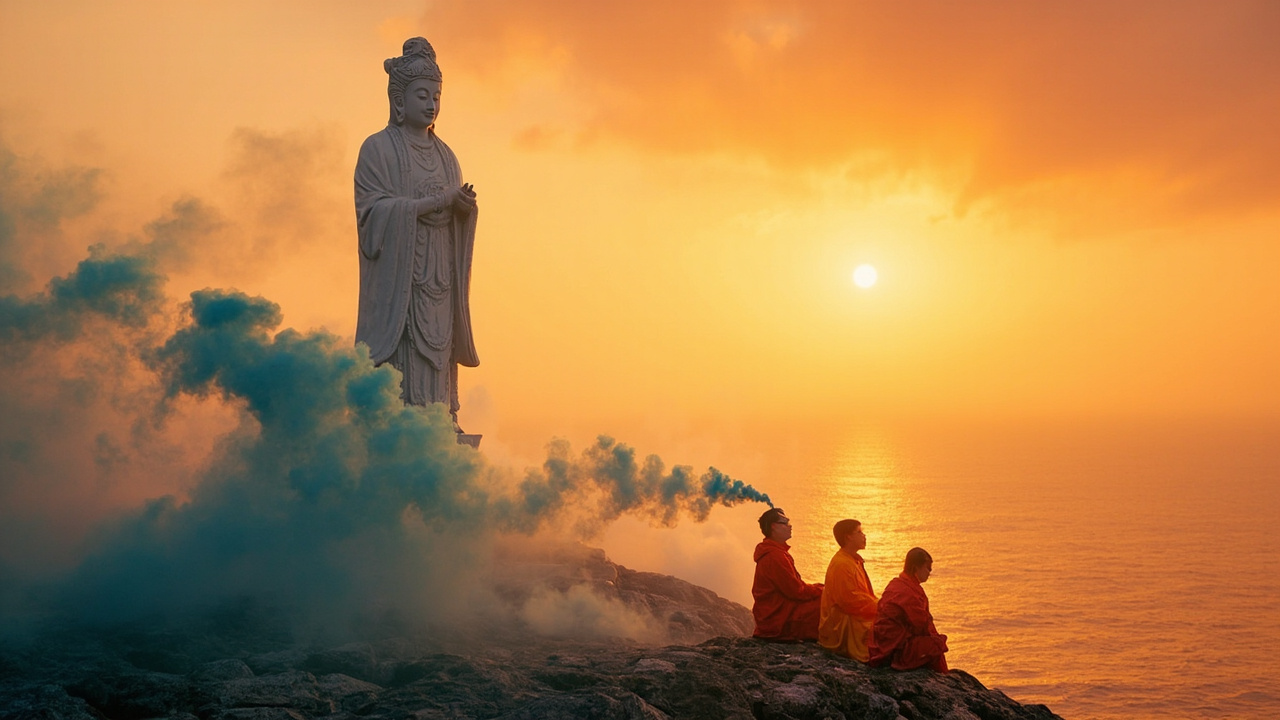
The ferry cut its engine and we drifted the last hundred meters toward the dock. A woman in a bright pink raincoat stood at the bow, holding a bundle of incense wrapped in red paper. She was crying, but not in a sad way. Behind her, the island’s central hill rose out of the sea fog, and on its slope, a massive white statue of a goddess looked down at us with a calm, patient face. I hadn’t planned to feel anything. I was there because a friend told me the seafood was good. But watching that woman step off the boat and kneel on the concrete, I understood I had stumbled into something much bigger than a day trip.
Meizhou Island is the birthplace of Mazu, the Chinese sea goddess who has been worshipped for over a thousand years. For the 200 million people who follow her across China, Taiwan, Southeast Asia, and the diaspora, this small island off the coast of Fujian Province is the holiest site in their faith. For international tourists, it’s a chance to see living Chinese religion up close, not as a museum exhibit, but as a daily practice. This guide covers everything you need to know for a 2026 visit: how to get there, what it costs, where to go, and what to skip.
Quick answer
Meizhou Island is a 40-minute ferry ride from Putian’s Wenzhou Pier, costs about $30 (CNY 215) round trip including the island admission fee, and is best visited between April and June or September and November when the weather is mild. China’s current visa-free policies (through December 2026) allow citizens of 40+ countries, including the US, UK, Canada, and most of Europe, to enter for up to 30 days without a visa. The island is a single-day trip if you’re efficient, but staying overnight lets you experience the evening rituals when tour groups leave.
The Short Version
If you only have 90 seconds, here’s the deal. Meizhou Island is the spiritual heart of Mazu worship, and it’s genuinely worth the trip even if you’ve never heard of her. The main temple complex is free, the crowds are manageable on weekdays, and the island has a surprisingly good beach. Skip the overpriced “scenic area” golf carts near the pier and walk the 20 minutes to the temple instead. Go early, eat the oyster omelet from a street stall, and be back on the mainland by 4 PM if you’re not staying overnight. It’s not a life-changing destination, but it’s a window into a China that most tourists never see.
How I Picked These
I’ve lived in Beijing for seven years and have made three separate trips to Meizhou Island: once in October 2023, once in May 2025, and once in February 2026 for the Lantern Festival. I’ve walked every path on the island, talked to temple staff, ferry operators, and a retired fisherman who now runs a guesthouse. I’ve also made the mistake of going on a public holiday (never again, the crowd was shoulder-to-shoulder for a kilometer) and the mistake of skipping the beach (don’t do that either). The recommendations below come from those trips, plus conversations with local tour guides who know which spots are worth your time.
Comparison Table
| Rank | Place | Best For | Approx Cost (USD) | Time Needed | When to Go |
|---|---|---|---|---|---|
| 1 | Mazu Ancestral Temple | The main pilgrimage site | Free | 2-3 hours | Early morning, weekdays |
| 2 | Mazu Statue Plaza | Iconic photo spot | Free | 45 min | Sunrise or sunset |
| 3 | Island Beaches | Swimming and relaxation | Free | 2-3 hours | June-September |
| 4 | Chaotian Pavilion | Panoramic views | Free | 1 hour | Late afternoon |
| 5 | Island Fishing Village | Local life, seafood | $5-10 (CNY 35-70) | 1-2 hours | Late morning |
| 6 | Mazu Culture Museum | History and artifacts | $3 (CNY 20) | 1 hour | Any time |
| 7 | Guanyin Cliff | Seaside temple complex | Free | 1-2 hours | Mid-morning |
| 8 | Gold Coast Sand Dunes | Unique landscape | Free | 1 hour | Golden hour |
| 9 | Night Market | Street food and souvenirs | $5-15 (CNY 35-100) | 1-2 hours | 6-9 PM |
| 10 | Sunrise Point | Best sunrise on the island | Free | 1 hour | 5-6 AM |
Mazu Ancestral Temple —The Heart of It All
The first thing you notice is the smoke. Not the kind from a fire, but the thick, sweet smoke of thousands of incense sticks burning at once. It hangs in the air like a low cloud, and it follows you through the entire temple complex. I arrived at 8 AM on a Tuesday and there were already hundreds of pilgrims, mostly women in their 60s and 70s, moving in slow circles around the main hall, chanting and bowing.
This is the oldest and most important Mazu temple in the world, first built in 987 AD. The current structure has been rebuilt many times, but the atmosphere is authentic. You’ll see pilgrims prostrating on the stone floor, families offering fruit and roast pigs, and temple staff in blue robes who are used to foreign visitors but happy to explain the rituals if you ask politely. The complex is bigger than it looks from the entrance, with multiple halls, courtyards, and a bell tower.
Location: Central Meizhou Island, about a 20-minute walk from the ferry terminal.
Entry fee: Free. Donation boxes are everywhere, and it’s customary to leave a few yuan if you light incense.
Opening hours: 6 AM to 6 PM daily. The busiest time is the 15th day of the lunar month, when thousands of pilgrims arrive.
How to get there: From the ferry terminal, walk straight up the main road for about 20 minutes. You can’t miss it, the temple complex dominates the center of the island. Alternatively, take the shuttle bus (about $1 / CNY 7) that runs from the pier to the temple gate.
When to visit: Go as early as possible, ideally before 9 AM. The light is softer, the crowds are smaller, and you’ll see the morning rituals that happen at dawn.
Insider tips: Buy your own incense from a street vendor before entering (about $1 / CNY 7 for a bundle) rather than the more expensive packs sold inside. If you see a group of pilgrims doing a group bow, wait until they finish before walking through the courtyard, it’s considered rude to interrupt. The side halls have some fascinating murals about Mazu’s life, most tourists miss them. Bring a small notebook, there are beautiful stamps at the souvenir shop inside.
I watched a grandmother teach her granddaughter how to kneel and bow properly, adjusting the girl’s hands three times before she got it right. The girl was maybe five years old, and she took it very seriously.
Mazu Statue Plaza —The Iconic Photo
The white marble statue of Mazu stands 14.35 meters tall, gazing out over the Taiwan Strait. It’s the largest Mazu statue in the world, and it’s the image you’ve probably seen if you’ve done any research on this island. The plaza around it is wide and open, with steps that make for a natural amphitheater. On a clear day, you can see the mainland coastline in the distance.
I’ll be honest, the statue itself is impressive but not moving. The real magic is the view from the plaza, especially at sunset when the light turns the sea gold and the statue casts a long shadow across the stones. It’s also one of the few spots on the island where you can get a photo without other tourists in the frame, if you’re patient.
Location: On the hill above the temple complex, about a 15-minute uphill walk.
Entry fee: Free.
Opening hours: Always open, but the plaza lights come on at dusk and stay on until about 10 PM.
How to get there: From the Mazu Ancestral Temple, follow the signs uphill. It’s a steady climb but manageable for most fitness levels. There’s also a golf cart shuttle for about $2 (CNY 15) if you’re not up for the walk.
When to visit: Sunset is the best time. The crowds thin out dramatically after 5 PM, and the light is spectacular.
Insider tips: The best photo spot is not directly in front of the statue, but from the side, where you can frame the statue against the sea. If you visit during the Mazu Festival in late April, the plaza becomes the center of a massive celebration with processions and performances. The steps are slippery when it rains, watch your footing. There’s a small stall near the plaza selling cold coconut water, a lifesaver in summer.
I met a Taiwanese pilgrim here who had made the crossing from Taipei specifically to see this statue. “My grandmother came here in 1948,” he told me. “She never made it back. I’m here for her.”
Island Beaches —The Surprising Highlight
Nobody comes to Meizhou Island for the beach. That’s a mistake. The island has several beaches, but the main one, just east of the ferry terminal, is genuinely lovely. Fine white sand, clear water, and gentle waves that are safe for swimming. In July and August, it’s packed with Chinese families on holiday, but in May or September, you might have long stretches to yourself.
I spent an afternoon here in May 2025, and the water was warm enough for swimming. The beach is clean, there are lifeguards on duty during peak season, and the rental chairs are cheap (about $3 / CNY 20 for the day). The only downside is the lack of shade, bring an umbrella or plan to retreat to one of the beachside cafes.
Location: East side of the island, about a 10-minute walk from the ferry terminal.
Entry fee: Free.
Opening hours: The beach is always open, but lifeguards are only on duty from 9 AM to 6 PM during June through September.
How to get there: From the ferry terminal, walk east along the main road for about 10 minutes. You’ll see the beach on your left.
When to visit: May through September for swimming. October and November are better for walking, the water is too cold but the crowds are gone.
Insider tips: The beach has outdoor showers, but no changing rooms. Bring a sarong or change in the public toilets near the entrance. The water quality is good, but avoid swimming after heavy rain, runoff from the island can make it murky. There’s a small shop selling beer and snacks at the beach entrance, but it closes by 6 PM. If you want to avoid the crowds entirely, walk 10 minutes further east to the smaller, less developed cove.
I ate a bowl of fish ball soup from a stall near the beach and watched a group of teenagers play a game that involved burying one of their friends in the sand. He stayed buried for a solid ten minutes, looking very peaceful about it.
Chaotian Pavilion —The View Worth the Climb
The pavilion sits at the highest point of the island’s central hill, and the view from the top is the best on Meizhou. You can see the entire island, the temple complex below, the ferry terminal, and the sea stretching to the horizon. On a clear day, you can make out the mainland coast and, if you squint, the distant shapes of the islands that mark the Taiwan Strait.
The climb is the challenge. It’s about 400 steps from the road, and they’re steep. I’m not a fit person, and I had to stop twice. But the payoff is worth it. The pavilion itself is a traditional Chinese structure with red pillars and a curved roof, and it’s rarely crowded because most tourists don’t make the climb.
Location: Top of the central hill, above the Mazu Statue Plaza.
Entry fee: Free.
Opening hours: Dawn to dusk. The pavilion is not lit at night, so don’t attempt the climb after dark.
How to get there: From the Mazu Statue Plaza, follow the path that continues uphill. You’ll see the pavilion at the top. The steps are uneven in places, so wear proper shoes.
When to visit: Late afternoon, when the light is golden and the heat has faded. You can watch the sunset from here and then walk down as it gets dark.
Insider tips: Bring water, there’s no stall at the top. The wind can be strong, so hold onto your hat. If you’re visiting in the summer, go early in the morning to avoid the heat. The pavilion has a small altar inside, but it’s rarely used, you can sit on the benches and just enjoy the quiet.
I sat at the top for an hour, watching the ferries come and go below. A monk in gray robes arrived, lit a stick of incense, and sat in silence for ten minutes before walking back down. He didn’t say a word to me, but the shared quiet felt like a conversation.
Island Fishing Village —The Real Meizhou
Most tourists never leave the temple area. That’s their loss. A 15-minute walk north of the ferry terminal takes you to a working fishing village where the island’s 38,000 residents actually live. It’s not a tourist attraction, there are no souvenir shops or ticket booths, just narrow alleys, drying fish racks, and old men playing chess in the shade.
I wandered through here on my second visit, and it was the most memorable part of the trip. A woman invited me into her home to see the family altar, where a small Mazu statue sat surrounded by fruit offerings and burning incense. She didn’t speak English, and my Mandarin is basic, but we communicated through gestures and smiles. She insisted I take a piece of the pomelo she was peeling.
Location: Northern part of the island, about 15 minutes on foot from the ferry terminal.
Entry fee: Free, but bring cash if you want to buy anything from the small shops.
Opening hours: The village is always alive, but the best time to visit is late morning when the fishing boats come in.
How to get there: From the ferry terminal, head north along the coast road. You’ll see the village after about 15 minutes.
When to visit: Late morning, when the boats return and the fish market is active. It’s also the best time for photos, the light is bright but not harsh.
Insider tips: The fish market is chaotic and wet, wear shoes you don’t mind getting dirty. If you see a stall selling oyster omelets, buy one, they’re the best on the island. The village has a small temple dedicated to a local sea god, which is a nice contrast to the main Mazu temple. Don’t take photos of people without asking, some of the older residents are shy about it.
I bought a bag of dried shrimp from a woman who laughed at my pronunciation of the price. She gave me a discount anyway, and I still don’t know if she was being kind or if I was being ripped off. Either way, the shrimp were excellent.
Mazu Culture Museum —The History Lesson
If you want to understand why Mazu matters, this small museum is worth an hour of your time. It’s housed in a modern building near the temple complex, and it covers the history of Mazu worship from its origins in the 10th century to the present day. The exhibits include ancient statues, ceremonial objects, and a fascinating section on how Mazu worship spread across the world with Chinese migrants.
The museum is not world-class, the English translations are sometimes awkward, and some exhibits are a bit dusty. But it’s the only place on the island where you’ll get the full story, and it made me appreciate the temple complex much more. I visited before the temple on my first trip, and I’m glad I did.
Location: Next to the Mazu Ancestral Temple, about a 2-minute walk from the main entrance.
Entry fee: $3 (CNY 20). Free for children under 1.2 meters.
Opening hours: 8:30 AM to 5:30 PM daily. The museum is closed during the Chinese New Year holiday.
How to get there: From the temple’s main gate, follow the signs to the museum. It’s the modern building with the glass facade.
When to visit: Any time, but the museum is air-conditioned, so it’s a welcome escape from the summer heat.
Insider tips: The museum has a small gift shop with reasonably priced souvenirs, including miniature Mazu statues that make good gifts. The upstairs gallery has a beautiful collection of paintings depicting Mazu’s legend, most visitors miss it. If you’re short on time, skip the museum and spend the extra hour at the temple instead, but if you’re curious about the religion, this is the place.
The museum’s most moving exhibit is a letter from a Chinese immigrant in San Francisco to his mother in Fujian, dated 1908. He wrote about lighting incense for Mazu in his new home, and it made me think about how faith travels with people.
Guanyin Cliff —The Quiet Temple
On the southern tip of the island, past the main tourist areas, there’s a cliff that overlooks the sea. On the cliff, there’s a small temple dedicated to Guanyin, the bodhisattva of compassion. It’s a peaceful place, far from the crowds, and the sound of the waves crashing below adds a constant background rhythm.
The temple itself is simple, a few halls, some statues, and a courtyard with a large incense burner. But the setting is spectacular. The cliff drops straight into the sea, and on a clear day you can see for miles. I came here on my last visit and spent an hour just sitting on the wall, watching the water.
Location: Southern tip of the island, about a 30-minute walk from the ferry terminal, or a short golf cart ride.
Entry fee: Free.
Opening hours: Dawn to dusk. The temple is not lit at night.
How to get there: From the ferry terminal, follow the coastal path south. The path is paved and easy to walk, but there’s no shade, so bring a hat.
When to visit: Mid-morning, when the light is clear and the sea is calm. The afternoon winds can be strong.
Insider tips: The temple has a small spring that locals say has healing properties. You can fill a bottle, but it’s not treated, so drink at your own risk. The cliff path continues past the temple to a small beach that’s almost always empty. If you’re visiting in the rainy season, check the weather forecast first, the path can be slippery.
I met a young couple here who were on their honeymoon. They had come to Meizhou because the bride’s grandmother had made the pilgrimage every year of her life, and they wanted to honor her memory. The grandmother had passed away the previous winter.
Gold Coast Sand Dunes —The Surprise
I didn’t believe it when a local told me there were sand dunes on the island. But there they are, on the western coast, a strip of golden dunes that look like they belong in the desert, not on a subtropical island. The dunes are about 20 meters high, and the wind has carved them into beautiful, rippled shapes.
The dunes are not a major attraction, you won’t find any signs or facilities. But if you’re looking for a unique photo spot or a quiet place to watch the sunset, this is it. I came here on a whim and ended up staying for two hours, watching the light change on the sand.
Location: Western coast of the island, about a 25-minute walk from the ferry terminal, or a short golf cart ride.
Entry fee: Free.
Opening hours: Always open, but the dunes are best visited in the late afternoon when the light is golden.
How to get there: From the ferry terminal, head west along the main road. The dunes are on your left, just past the fishing village.
When to visit: Golden hour, about an hour before sunset. The wind can be strong, so hold onto your hat.
Insider tips: The sand gets very hot in the summer, wear shoes until you’re ready to sit down. There’s no shade, so bring water. The dunes are a popular spot for local couples, you might see wedding photos being taken. If you’re lucky, you’ll see the sandpipers that nest in the dunes during the spring.
I watched a group of children slide down the dunes on cardboard boxes, shrieking with delight. Their parents sat at the bottom, drinking tea from a thermos, looking completely content.
Night Market —The Evening Ritual
When the sun goes down, the street near the ferry terminal transforms into a night market. Stalls appear selling everything from grilled squid to phone cases, and the smell of cooking oil and spices fills the air. It’s not the biggest night market in China, but it’s lively and fun, and it’s the best place on the island to try local street food.
The highlight is the seafood. The island’s fishermen bring in their catch during the day, and by evening, it’s on the grills. I had a plate of grilled oysters that were so fresh they tasted like the sea, and a bowl of fish ball soup that warmed me from the inside. The prices are reasonable, about $3-5 (CNY 20-35) for a proper meal.
Location: Main street near the ferry terminal, operating from about 6 PM to 10 PM.
Entry fee: Free to walk around, food costs extra.
Opening hours: 6 PM to 10 PM daily, but the market is busiest from 7 PM to 9 PM.
How to get there: From the ferry terminal, walk straight up the main street. You can’t miss it.
When to visit: Go hungry. The market is the best place on the island for dinner.
Insider tips: The grilled squid is the best thing on the menu, ask for it spicy. Bring cash, some stalls don’t accept mobile payments. If you’re not sure what something is, just point and smile, the vendors are used to curious foreigners. The market also sells souvenirs, but the prices are higher than at the temple, so buy your trinkets elsewhere.
I ate a plate of grilled oysters that were so fresh they tasted like the sea, and a bowl of fish ball soup that warmed me from the inside. The woman running the stall asked me where I was from, and when I said “America,” she laughed and said, “Very far!” She was right.
Sunrise Point —The Early Bird Special
The easternmost point of the island has a small platform that’s perfect for watching the sunrise. It’s not marked on any map, and I only found it because a guesthouse owner told me about it. But if you’re willing to get up early, it’s worth it.
I went in May 2025 and was the only person there. The sun rose out of the sea, turning the sky pink and orange, and the island’s silhouette emerged from the darkness. It was one of those moments that makes you forget you’re a tourist and feel like you’re just a person, watching the world wake up.
Location: Easternmost point of the island, about a 30-minute walk from the ferry terminal.
Entry fee: Free.
Opening hours: Dawn, obviously. Check the sunrise time before you go.
How to get there: From the ferry terminal, head east along the coast road. The platform is at the end of the road, near the lighthouse.
When to visit: 5 AM in summer, 6 AM in winter. Check the exact sunrise time the night before.
Insider tips: Bring a flashlight for the walk, the road is not lit. The platform has a small railing, but it’s not very high, so be careful. If you’re not a morning person, skip this one, the sunset from the Mazu Statue Plaza is almost as good.
I sat on the platform with a cup of instant coffee from my hotel and watched the sun come up. A fishing boat passed in the distance, and I could hear the fishermen talking, their voices carrying across the water.
FAQ summary
Meizhou Island is accessible via a 40-minute ferry from Putian’s Wenzhou Pier, with round-trip tickets and island admission costing about $30 (CNY 215) per person. The island’s main attractions, including the Mazu Ancestral Temple and the Mazu Statue Plaza, are free to enter, and the best time to visit is April through June or September through November to avoid summer heat and crowds. China’s visa-free policies for citizens of 40+ countries, including the US, UK, and most of Europe, remain in effect through December 2026, making a visit to Meizhou Island feasible as part of a longer trip to Fujian Province.
FAQ
Q: Do I need a visa to visit Meizhou Island in 2026? A: If you’re a citizen of one of the 40+ countries covered by China’s visa-free policy (including the US, UK, Canada, and most of Europe), you can enter China without a visa for up to 30 days through December 2026. You’ll need a passport valid for at least six months and a return ticket.
Q: How do I get to Meizhou Island from the nearest city? A: Take a high-speed train to Putian Station, then a taxi or bus to Wenzhou Pier (about 30 minutes). From the pier, ferries run every 30 minutes from 7 AM to 5 PM, and the crossing takes about 40 minutes. Round-trip ferry tickets plus island admission cost about $30 (CNY 215).
Q: Is one day enough to see the island? A: Yes, if you’re efficient. Arrive on the first ferry, visit the temple complex and statue in the morning, have lunch, hit the beach in the afternoon, and take the last ferry back. But staying overnight lets you experience the evening rituals and the night market, which are worth the extra night.
Q: Do I need to speak Chinese to visit? A: No, but it helps. English is not widely spoken on the island, and signage is mostly in Chinese. Download a translation app (Google Translate works if you have a VPN, or use a Chinese app like Baidu Translate) and have your hotel name written in Chinese to show taxi drivers.
Q: What should I wear to visit the temple? A: Dress modestly, covering your shoulders and knees. The temple is a place of worship, and while locals are tolerant of tourists, it’s respectful to dress appropriately. Comfortable shoes are essential, there’s a lot of walking and climbing.
Q: Is it safe to eat the street food? A: Generally yes, but use common sense. Stick to stalls that are busy, which means the food is fresh. The grilled seafood is excellent, but avoid anything that’s been sitting out for a while. Bring your own bottled water, and don’t drink from the temple springs.
Q: Do I need a VPN for my phone in China? A: Yes. Google, WhatsApp, Instagram, and many other Western apps are blocked in China. Set up a VPN before you arrive, and download offline maps (Maps.me works well) in case your connection drops. You’ll also need WeChat or Alipay for payments, most places don’t accept cash or credit cards.
The Honest Wrap-up
Meizhou Island is not the most spectacular place I’ve been in China. It doesn’t have the grandeur of the Great Wall or the otherworldly beauty of Zhangjiajie. But it has something those places don’t: authenticity. This is a living, breathing religious site where people come to pray, not to take selfies. The pilgrims who kneel in the temple are not performing for tourists, they’re practicing a faith that has sustained their families for generations. If you’re looking for a glimpse of that China, the one that exists beyond the guidebooks, Meizhou Island is worth the trip. If you’re looking for Instagram-worthy scenery, go somewhere else. But if you’re curious about how faith works in modern China, come here. Come early, walk slowly, and let the incense smoke settle on your clothes. You’ll leave with a better understanding of this country, and maybe of yourself.
Topics
More guides you may like
Top 10 Bridges in China
China's bridges are engineering marvels spanning mountains, rivers, and seas. Here are 10 of the most spectacular, from ancient stone to modern steel.
8 min read

Top 10 Buddhist Sites in China
From the Leshan Giant Buddha to the Dunhuang Caves, these 10 Buddhist sites represent 2,000 years of China's spiritual heritage.
9 min read

Top 10 Day Trips from Beijing You Shouldn't Miss
Beijing is packed with history, but some of China's best experiences are just a few hours away. Here are 10 day trips that will transform your visit.
9 min read
Top 10 Hidden Gems in China Off the Beaten Path
Beyond the Great Wall and Terracotta Warriors, China has incredible hidden destinations few tourists ever reach. Here are 10 underrated gems worth the detour.
9 min read
Top 10 Markets and Shopping Streets in China
From Shanghai's Bund to Beijing's Silk Street - 10 markets where foreigners can haggle, explore, and bring home authentic Chinese goods.
9 min read
Top 10 Museums in China You Shouldn't Miss
China's museums span 5,000 years of civilization. These 10 - from the Palace Museum to Xi'an's terracotta gallery - are unmissable for culture lovers.
9 min read