
China in January Travel: The Complete 2026 Guide
The train pulled out of Beijing West Station at 7:12 AM, and I watched the city dissolve into gray farmland.
The train pulled out of Beijing West Station at 7:12 AM, and I watched the city dissolve into gray farmland. By the time we crossed the Yellow River, the windows had frosted over. A man across the aisle was eating instant noodles with chopsticks, steam fogging his glasses. I remember thinking: January is China’s honest season. No postcard colors, no crowds pretending to have fun. Just cold air, empty temples, and the best food of the year leading up to Spring Festival.
Most first-time visitors come in spring or autumn. They’re wrong. January gives you something better: the country to yourself, prices cut in half, and a front-row seat to the biggest annual migration on Earth. The Great Wall is empty. The Forbidden City is walkable. And if you time it right, you’ll be in a city when the fireworks start and every grandmother in China is cooking the same dumplings.
This guide covers ten places I’ve actually been to in January, with real prices, real transport details, and the mistakes I made so you don’t have to.
Quick answer
Yes, January is a good time to visit China for first-timers, especially if you want fewer crowds and lower prices. Most of the country is cold (0-10C in the south, -10 to 5C in the north), but the trade-off is empty sights and a chance to experience Spring Festival preparations. As of 2026, citizens of 38 countries including the US, UK, Canada, Australia, and most of Europe get 30-day visa-free entry for tourism, so you can skip the visa application entirely. Budget $60-100 per day for a comfortable trip, and pack thermal layers.
The Short Version
If you have 90 seconds: Go north for the Great Wall and Forbidden City (empty, cold, magnificent). Go south for Yunnan or Guangxi (mild, green, relaxed). Skip Shanghai unless you love big cities - it’s damp and gray in January. Book everything before January 20 if you can, because Spring Festival (February 17, 2026) turns the whole country into a human river. Bring cash as backup, set up Alipay before you land, and download a translation app. You’ll be fine.
How I Picked These
I’ve lived in Beijing for seven years and traveled through China more than forty times, including three separate January trips that took me from Harbin in the far northeast to Xishuangbanna on the Laos border. I picked these ten places because they represent the best of what January offers: either winter-specific experiences you can’t get any other month, or southern escapes that dodge the cold entirely. I’ve ridden every train, paid every entrance fee, and gotten lost in every old town on this list. The prices are what I actually paid in 2025-2026, rounded to the nearest dollar.
Comparison Table
| Rank | Place | Best For | Approx Cost (USD) | Time Needed | When to Go |
|---|---|---|---|---|---|
| 1 | Harbin Ice Festival | Winter spectacle | $15-30/day | 2 days | Jan 5-Feb 5 |
| 2 | Beijing | History, empty sights | $50-80/day | 3-4 days | Early Jan |
| 3 | Yunnan (Dali/Lijiang) | Mild weather, scenery | $30-50/day | 4-5 days | All January |
| 4 | Xi’an | History, food | $40-60/day | 2-3 days | Early Jan |
| 5 | Guilin/Yangshuo | Karst scenery | $35-55/day | 3 days | All January |
| 6 | Chengdu | Food, pandas | $35-55/day | 2-3 days | All January |
| 7 | Zhangjiajie | Avatar mountains | $40-60/day | 2-3 days | Jan (snow) |
| 8 | Sanya | Beach escape | $60-100/day | 3-4 days | All January |
| 9 | Huangshan | Snow-covered peaks | $50-70/day | 2 days | Jan (snow) |
| 10 | Suzhou | Gardens, canals | $40-60/day | 2 days | All January |
Harbin - The City That Turns Into Ice
My first sight of the ice festival was from a taxi window at dusk, and I genuinely thought the city had built a second skyline. The ice structures catch the last light and glow blue-white, then the colored LEDs kick in and it looks like a fever dream. The main festival is on the Sun Island side of the river, and the scale is absurd - ice castles the size of apartment buildings, ice slides you can actually ride, and a full ice replica of a Russian church.
January is the only month this makes sense. The average high is -13C (8F), and the festival runs from early January to late February, but the ice is at its clearest in the first three weeks. You need to dress like you’re going to the Arctic: thermal base layer, fleece, down jacket, and the fur-lined boots you can buy cheaply at the Central Street markets.
Location: Sun Island (太阳岛), across the Songhua River from central Harbin.
Entry fee: $45 (CNY 330) for the main Ice and Snow World. The Siberian Tiger Park is separate at $15 (CNY 110).
Opening hours: Ice World opens 11:00 AM to 9:30 PM daily. Go at 4:00 PM so you see it in daylight and then watch the lights come on.
Getting there: Take Metro Line 2 to Sun Island Station, Exit 3, then walk 15 minutes or take the free shuttle. Or take a taxi from central Harbin for about $5 (CNY 35).
Best time: January 10-25, before Spring Festival crowds. Weekdays are quieter than weekends.
Insider tips: Buy hand warmers in bulk before you arrive. The Russian-style Saint Sophia Cathedral is more impressive at night when it’s lit up. Try Harbin’s famous beer even though it’s freezing - it’s a local point of pride. The ice slides are free, so do them multiple times. Don’t bother with the ice lanterns at Zhaolin Park - the main festival is better.
I met a retired teacher from Jilin at the ice slide who told me she comes every year “to remember being a child.” She was 67 and had more energy than I did.
Beijing - The Empty City
I’ve walked through the Forbidden City in July when you couldn’t move without touching someone. In January, I once had the entire central courtyard to myself for ten minutes. The cold keeps people away, and that’s your gift. The air is usually clear - the government’s winter coal restrictions actually work - and the low winter sun makes the red walls and golden roofs glow.
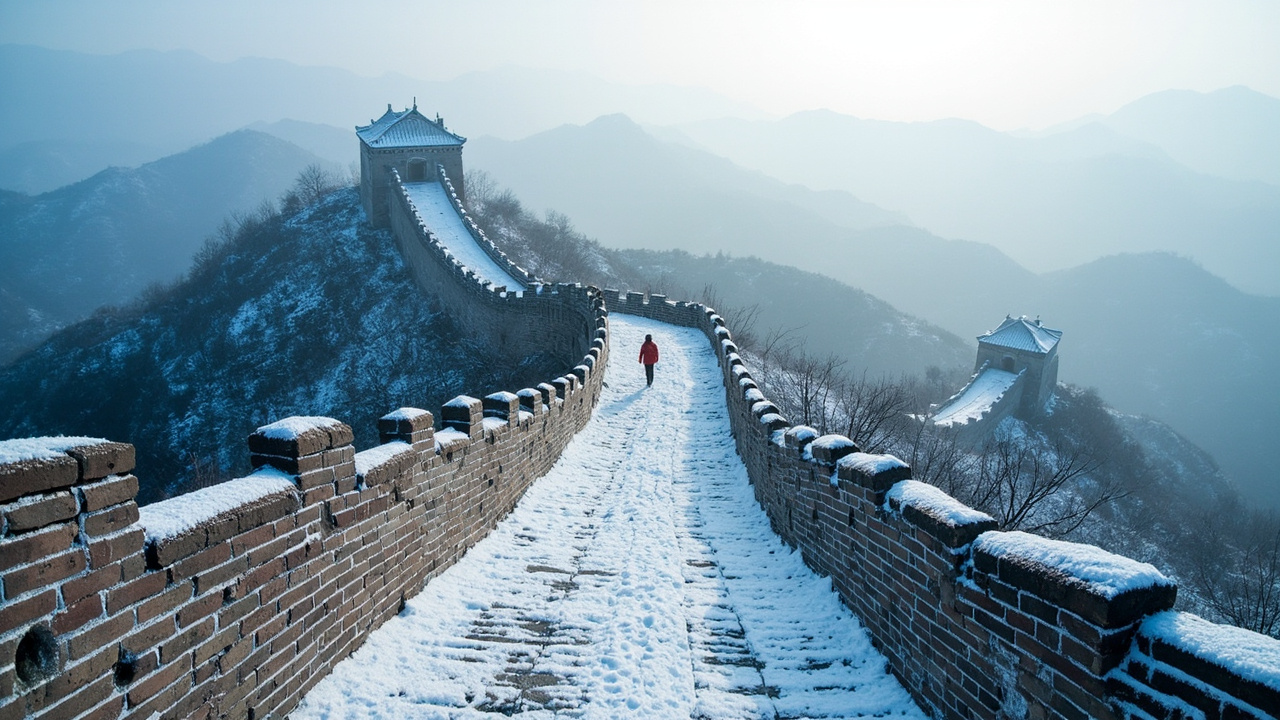
The Great Wall at Mutianyu is the right choice in January. Badaling is a tourist factory; Mutianyu is a real wall with real towers, and the cable car runs year-round. I went on a Tuesday and saw maybe twenty other people across three hours of walking. The wall was dusted with snow, and I could hear my own footsteps on the stone.
Location: Forbidden City is in Dongcheng District, central Beijing. Mutianyu is 70km northeast in Huairou District.
Entry fee: Forbidden City $8 (CNY 60) in winter. Mutianyu $6 (CNY 45) plus $15 (CNY 120) for cable car round trip.
Opening hours: Forbidden City is closed Mondays (except public holidays). Winter hours are 8:30 AM to 4:30 PM, last entry 3:30 PM. Mutianyu is 7:30 AM to 6:00 PM in winter.
Getting there: Forbidden City: Metro Line 1 to Tiananmen East, Exit A, walk through the security check. Mutianyu: Take Metro Line 13 to Dongzhimen, then bus 916快 to Huairou, then a local shuttle. Or book a private car for about $60 (CNY 430) round trip.
Best time: Early January, before the 20th. Go to the Forbidden City right when it opens. Go to Mutianyu on a weekday.
Insider tips: Book Forbidden City tickets on the official WeChat mini-program at least a week ahead - they sell out even in winter. Bring your passport for the Tiananmen security check. The Jingshan Park hill behind the Forbidden City gives you the best panorama and costs $1 (CNY 2). Eat at the Donghuamen night market nearby for street food. The Great Wall at Mutianyu has a toboggan ride down - worth every yuan.
A guard at the Forbidden City’s Gate of Divine Prowess told me January is his favorite month because “I can finally hear the place.”
Yunnan (Dali and Lijiang) - The Warm South
I landed in Kunming after a week in Harbin and felt like I’d arrived in summer. Dali’s average January high is 15C (59F), and the sun is strong enough that you’ll want sunglasses and a light jacket. The old town sits between Cangshan Mountain and Erhai Lake, and the light in January is so clear you can see every ridge on the mountains.
Lijiang is colder but still mild, and the old town’s cobblestone streets and canals are quieter than in peak season. The Jade Dragon Snow Mountain looms over everything, and on clear days it looks close enough to touch. The Naxi people who run the guesthouses are used to foreign visitors and will happily explain their culture over tea.
Location: Dali Old Town is in Dali Bai Autonomous Prefecture, western Yunnan. Lijiang Old Town is 180km north.
Entry fee: Dali Old Town free. Lijiang Old Town now charges $7 (CNY 50) but it’s poorly enforced in winter. Jade Dragon Snow Mountain is $15 (CNY 100) plus cable car $30 (CNY 200).
Opening hours: Old towns are open 24/7. The mountain cable car runs 8:00 AM to 4:00 PM.
Getting there: Fly into Kunming Changshui Airport, then take the high-speed train to Dali (2 hours, $30/CNY 210) or Lijiang (3 hours, $40/CNY 280). From Dali to Lijiang by train is 2 hours, $15 (CNY 105).
Best time: All of January works. The week before Spring Festival is busiest as Chinese tourists arrive.
Insider tips: Rent an electric bike in Dali and ride along Erhai Lake’s eastern shore - it’s the best view in the region. The Three Pagodas are more impressive from a distance than up close, so save the entrance fee. In Lijiang, stay in a guesthouse outside the old town walls to avoid the noise. Try the local goat cheese and rose-flavored pastries. The cable car to Jade Dragon Snow Mountain sells out daily - book online the night before.
A guesthouse owner in Lijiang named A-Mei insisted I try her mother’s yak butter tea. I hated it. She laughed and said that’s how everyone reacts the first time.
Xi’an - The Terracotta Army Without the Crowds
The Terracotta Army is one of those sights that photos don’t prepare you for. The sheer scale - thousands of life-sized soldiers in battle formation - hits you differently when you’re standing at the edge of the pit. In January, you can get close to the barriers and actually study the individual faces. In summer, you’re fighting for a view through a wall of selfie sticks.
Xi’an itself is a walled city with a Muslim Quarter that has some of the best street food in China. The cold is dry and manageable - usually around 2-5C (35-41F) - and the city’s history as the ancient capital means there’s something to see on every corner.
Location: Terracotta Army is in Lintong District, 40km east of Xi’an city center.
Entry fee: $20 (CNY 120) for the Terracotta Army. City wall $7 (CNY 54).
Opening hours: Terracotta Army is 8:30 AM to 5:00 PM daily. City wall is 8:00 AM to 10:00 PM.
Getting there: Take Metro Line 9 to Huaqingchi Station, then transfer to bus 602 which goes directly to the site. Total journey about 1.5 hours. Or take a taxi for $25 (CNY 180) one way.
Best time: Early January, before the 20th. Go to the Terracotta Army right at opening time.
Insider tips: The Terracotta Army has three pits - most people see Pit 1 and leave. Pit 3 is smaller but more intimate. The Muslim Quarter’s food street is best at night. Try the biang biang noodles and the lamb paomo (bread soaked in lamb soup). Rent a bike on the city wall for $5 (CNY 35) and ride the full 14km circuit. The Shaanxi History Museum is free but requires booking days in advance on WeChat.
I spent an hour in Pit 2 watching a single archer’s face. The detail in his expression - the slight frown, the individual hair strands - made me forget the cold entirely.
Guilin and Yangshuo - The Postcard Scenery
The karst peaks around Yangshuo look like a Chinese painting come to life, and in January the mist that hangs between the mountains makes them look even more ethereal. The weather is mild - around 10C (50F) - and the rice paddies are empty, giving the landscape a spare, minimalist quality.
I rented a bicycle in Yangshuo and rode along the Yulong River for three hours without seeing another tourist. The path wound through villages where old women were washing clothes in the river and water buffalo stood in the shallows. This is the China you see in movies, and in January you have it to yourself.
Location: Yangshuo County is in Guilin Prefecture, northeastern Guangxi.
Entry fee: Most of the scenery is free. The Li River cruise from Guilin to Yangshuo is $50 (CNY 350) for a 4-hour trip.
Opening hours: The Li River cruise runs 9:00 AM to 2:00 PM daily.
Getting there: Fly into Guilin Liangjiang Airport, then take a high-speed train to Yangshuo Station (30 minutes, $10/CNY 70). From the station, it’s a 20-minute taxi to the town center.
Best time: All of January. The mist is actually more atmospheric than summer’s clear skies.
Insider tips: Skip the Li River cruise and take the high-speed train instead - you see the same scenery from the train window for a fraction of the cost. The Xianggong Hill viewpoint at sunrise is worth the early wake-up. Rent an ebike for $10 (CNY 70) per day instead of a bicycle - the hills are real. Eat beer fish, a local specialty, at a riverside restaurant. The West Street night market is touristy but fun for people-watching.
A boatman on the Yulong River offered me a cigarette and told me he’d been poling tourists down this river for 22 years. He’d never left Guangxi. He didn’t seem to want to.
Chengdu - Pandas and Hotpot
Chengdu is the city where China relaxes. The pace is slower, the people are friendlier, and the food is designed to warm you from the inside. January temperatures hover around 5-10C (41-50F), and the city’s famous overcast skies give everything a soft, muted light.
The Giant Panda Base is the main draw, and January is actually a great time to see the pandas. They’re more active in cooler weather, and the crowds are thinner than in summer. I watched a panda eat bamboo for forty minutes and it was genuinely one of the best things I’ve done in China.
Location: Chengdu is the capital of Sichuan Province. The Panda Base is in the northern suburbs, Chenghua District.
Entry fee: Panda Base $7 (CNY 55). Hotpot dinner $10-20 per person.
Opening hours: Panda Base is 7:30 AM to 6:00 PM. Go at 7:30 AM when the pandas are most active and the crowds haven’t arrived.
Getting there: Metro Line 3 to Panda Avenue Station, Exit B, then a 10-minute walk or free shuttle bus to the entrance.
Best time: Early January, before Spring Festival. Go on a weekday morning.
Insider tips: The red panda enclosure is often overlooked - they’re smaller and more active than the giant pandas. Try the hotpot at a local chain like Shu Daxia, but order the mild broth if you’re not used to Sichuan spice. The teahouses in People’s Park are a great place to watch locals play mahjong. The Jinli old street is touristy but worth an hour. Book your panda tickets online to skip the line.
A panda keeper told me the pandas get bored in summer because they sleep all day in the heat. In January, they’re “full of energy.” She said this while a panda rolled onto its back and started chewing on its own foot.
Zhangjiajie - The Avatar Mountains in Snow
Zhangjiajie National Forest Park is where the floating mountains from Avatar were inspired, and in January they can be dusted with snow. The sandstone pillars rise hundreds of meters from the valley floor, and when the mist rolls through, they genuinely look like they’re floating.
The catch is the weather. January can bring snow, which is magical, or heavy fog, which means you see nothing. I got lucky with a clear day after a snowfall, and the combination of white snow on orange rock against a blue sky was the single most striking sight of my three January trips.
Location: Zhangjiajie is in northwestern Hunan Province.
Entry fee: $30 (CNY 225) for the park, valid for 4 days. The Bailong Elevator (glass elevator built into a cliff) is an extra $10 (CNY 65).
Opening hours: Park gates open 6:30 AM to 6:00 PM in winter.
Getting there: Fly into Zhangjiajie Hehua Airport, then take a 30-minute taxi to the park entrance. Or take the high-speed train from Changsha (3 hours, $40/CNY 280).
Best time: Mid-January, when snow is most likely but before Spring Festival crowds.
Insider tips: Check the weather forecast before committing - if it’s foggy, wait a day. The Yuanjiajie area has the best pillar views. Take the cable car up and the elevator down to avoid backtracking. The glass bridge at Zhangjiajie Grand Canyon is scary and worth it. Bring crampons or good boots - the paths get icy.
I watched a Chinese tour group take photos on the glass bridge. Half of them were visibly terrified, which was more entertaining than the view.
Sanya - The Tropical Escape
If you want to escape winter entirely, Sanya on Hainan Island is China’s answer to Hawaii. January temperatures hit 25C (77F), and the beaches are warm enough for swimming. It’s where wealthy Chinese go to escape the cold, so the resorts are high-end and the prices reflect it.
The water isn’t as clear as Thailand or the Philippines, but it’s warm and clean, and the scenery - palm trees, green mountains, white sand - is genuinely beautiful. Yalong Bay is the best beach, while Dadonghai is closer to town and more lively.
Location: Sanya is at the southern tip of Hainan Island.
Entry fee: Beaches are free. Yalong Bay Tropical Paradise Forest Park is $20 (CNY 140).
Opening hours: Beaches are open 24/7. The forest park is 7:30 AM to 5:30 PM.
Getting there: Fly into Sanya Phoenix International Airport. From the airport, taxis to Yalong Bay cost about $15 (CNY 105).
Best time: All of January is perfect. Avoid the week of Spring Festival when prices triple.
Insider tips: Book hotels early - Chinese tourists fill Sanya in January. The seafood market at the First Market is where locals eat; pick your seafood and have it cooked at a nearby restaurant. Rent a scooter to explore the coastline. The Wuzhizhou Island day trip is worth it for snorkeling. Skip the touristy “Romantic” show - it’s overpriced.
A taxi driver in Sanya told me he moves there every winter from Harbin. “I drive in the morning, swim in the afternoon. Best job in China.”
Huangshan - The Snowy Peaks
Huangshan, the Yellow Mountain, is China’s most famous mountain, and in January it transforms into a winter wonderland. The granite peaks are topped with snow, the famous pine trees are rimed with frost, and the sea of clouds that rolls through the valleys is more dramatic in winter.
The catch is the cold. The summit is 1,800 meters above sea level, and January temperatures drop to -10C (14F) with wind chill. But the sunrise from the summit - if you get a clear morning - is worth every frozen finger.
Location: Huangshan is in southern Anhui Province, about 5 hours by train from Shanghai.
Entry fee: $25 (CNY 190) for the park, plus $15 (CNY 100) for the cable car each way.
Opening hours: Cable cars run 6:30 AM to 5:00 PM in winter.
Getting there: Take the high-speed train from Shanghai to Huangshan North Station (3 hours, $50/CNY 350), then a 1-hour bus to the park entrance.
Best time: Mid-January for snow. Check the forecast and go on a clear day.
Insider tips: Stay overnight on the mountain - the sunrise is the whole point. Book a bed in the summit hotel months ahead. The West Sea Grand Canyon is the best hiking section. Rent a down coat at the base if you didn’t bring one. The hot springs at the base are the perfect end to a freezing day.
I watched the sunrise with about thirty other people, all of us silent, all of us shivering. When the sun finally cleared the clouds, a Chinese man next to me said “值了” - worth it.
Suzhou - The Classical Gardens
Suzhou is the city of gardens, canals, and silk, and January’s bare trees actually make the classical gardens more legible. Without the summer foliage, you can see the bones of the design - the rock formations, the water features, the borrowed views through windows.
The Humble Administrator’s Garden is the most famous, and in January it’s peaceful enough to actually appreciate the craftsmanship. The nearby Pingjiang Road canal district is a lovely walk, with old houses, small bridges, and tea houses along the water.
Location: Suzhou is in southern Jiangsu Province, 30 minutes from Shanghai by high-speed rail.
Entry fee: Humble Administrator’s Garden $10 (CNY 70). The Master of the Nets Garden $5 (CNY 35).
Opening hours: Gardens are 7:30 AM to 5:00 PM in winter.
Getting there: Take the high-speed train from Shanghai Hongqiao to Suzhou Station (30 minutes, $10/CNY 70). The gardens are in the old city, a 15-minute taxi from the station.
Best time: All of January. Weekdays are quiet.
Insider tips: The Master of the Nets Garden is smaller but more refined than the Humble Administrator’s. The Suzhou Museum, designed by I.M. Pei, is free and worth an hour. Try the local squirrel-shaped mandarin fish - it’s a Suzhou specialty. The silk factories offer free tours. Rent a boat on the canal at night for a different perspective.
A gardener at the Humble Administrator’s Garden was pruning a bonsai with tiny scissors. He told me he’d been caring for that tree for 18 years. “It’s slower than raising a child,” he said, “but it never talks back.”
FAQ summary
January is a viable and often excellent time for a first trip to China: most of the country is cold but manageable, crowds are dramatically thinner, and prices for flights and hotels are 30-50% lower than spring or autumn. The main considerations are packing for cold weather in the north (Harbin, Beijing, Xi’an) and planning around Spring Festival, which falls on February 17, 2026 and causes massive transport congestion and higher prices in the week before and after. As of 2026, citizens of 38 countries including the US, UK, Canada, Australia, and most of Europe can enter China visa-free for 30 days, making last-minute planning much easier. Mobile payment apps WeChat Pay and Alipay are essential for daily transactions, and a VPN is recommended for accessing Google, WhatsApp, and other Western services.
FAQ
Q: Do I need a visa to visit China in January 2026? A: Citizens of 38 countries including the US, UK, Canada, Australia, and most of the EU can enter China visa-free for up to 30 days for tourism. Check the latest policy on the Chinese embassy website before booking, as rules can change.
Q: How cold is China in January? A: It depends on where you go. Beijing and Xi’an average 0-5C (32-41F), Harbin averages -13C (8F), and southern cities like Guilin and Chengdu average 5-10C (41-50F). Sanya in the far south stays around 25C (77F).
Q: Is it safe to travel in China as a solo tourist? A: Yes. China is one of the safest countries I’ve traveled in. Violent crime against tourists is extremely rare, and even petty theft is uncommon. The main risks are language barriers and getting lost, not safety.
Q: Do I need to speak Chinese to travel in China? A: No, but it helps. English is not widely spoken outside major tourist areas. Download a translation app like Google Translate or Pleco before you go, and have your hotel’s name and address written in Chinese to show taxi drivers.
Q: Can I use my credit card in China? A: Sometimes, but not reliably. China is a cashless society that runs on WeChat Pay and Alipay. Set up both apps before you arrive and link your international credit card. Keep some cash as backup for small vendors.
Q: What should I pack for a January trip to China? A: Thermal base layers, a warm mid-layer, a down or puffy jacket, warm socks, waterproof boots, gloves, and a hat. If you’re going to Harbin, add hand warmers and a face mask. If you’re going to Sanya, pack swimwear and light clothing.
Q: Is it worth visiting China during Spring Festival? A: It’s a double-edged sword. You’ll see incredible celebrations and fireworks, but transport is packed, hotels are expensive, and many small restaurants and shops close for the week. If you want a relaxed trip, avoid January 25 to February 20.
The Honest Wrap-up
This list is for travelers who want to see the real China without fighting crowds, who don’t mind cold weather, and who are willing to trade a bit of comfort for authenticity. It’s not for people who want beach weather everywhere, who need English spoken at every corner, or who can’t handle a week of noodles and dumplings.
My final advice: pick two or three places, not ten. China is vast, and January travel is slower than summer travel. I once tried to do Beijing, Xi’an, and Chengdu in six days and spent half my time on trains. It was exhausting. Better to spend four days in one place and actually feel it.
And one more thing: learn to say “bu la” (not spicy) before you go. Your stomach will thank you.
The man eating noodles on that train from Beijing - he offered me a bite. I declined, and he shrugged and went back to his breakfast. That’s China in January: cold outside, warm inside, and always an invitation to share something.
Topics
More guides you may like

Top 10 Bridges in China
China's bridges are engineering marvels spanning mountains, rivers, and seas. Here are 10 of the most spectacular, from ancient stone to modern steel.
8 min read

Top 10 Buddhist Sites in China
From the Leshan Giant Buddha to the Dunhuang Caves, these 10 Buddhist sites represent 2,000 years of China's spiritual heritage.
9 min read

Top 10 Day Trips from Beijing You Shouldn't Miss
Beijing is packed with history, but some of China's best experiences are just a few hours away. Here are 10 day trips that will transform your visit.
9 min read

Top 10 Hidden Gems in China Off the Beaten Path
Beyond the Great Wall and Terracotta Warriors, China has incredible hidden destinations few tourists ever reach. Here are 10 underrated gems worth the detour.
9 min read

Top 10 Markets and Shopping Streets in China
From Shanghai's Bund to Beijing's Silk Street - 10 markets where foreigners can haggle, explore, and bring home authentic Chinese goods.
9 min read

Top 10 Museums in China You Shouldn't Miss
China's museums span 5,000 years of civilization. These 10 - from the Palace Museum to Xi'an's terracotta gallery - are unmissable for culture lovers.
9 min read