
Putuo Mountain Buddhist Island: The Complete 2026 Guide
The ferry horn blared twice, a deep sound that bounced off the hills and startled a group of seagulls into the air.
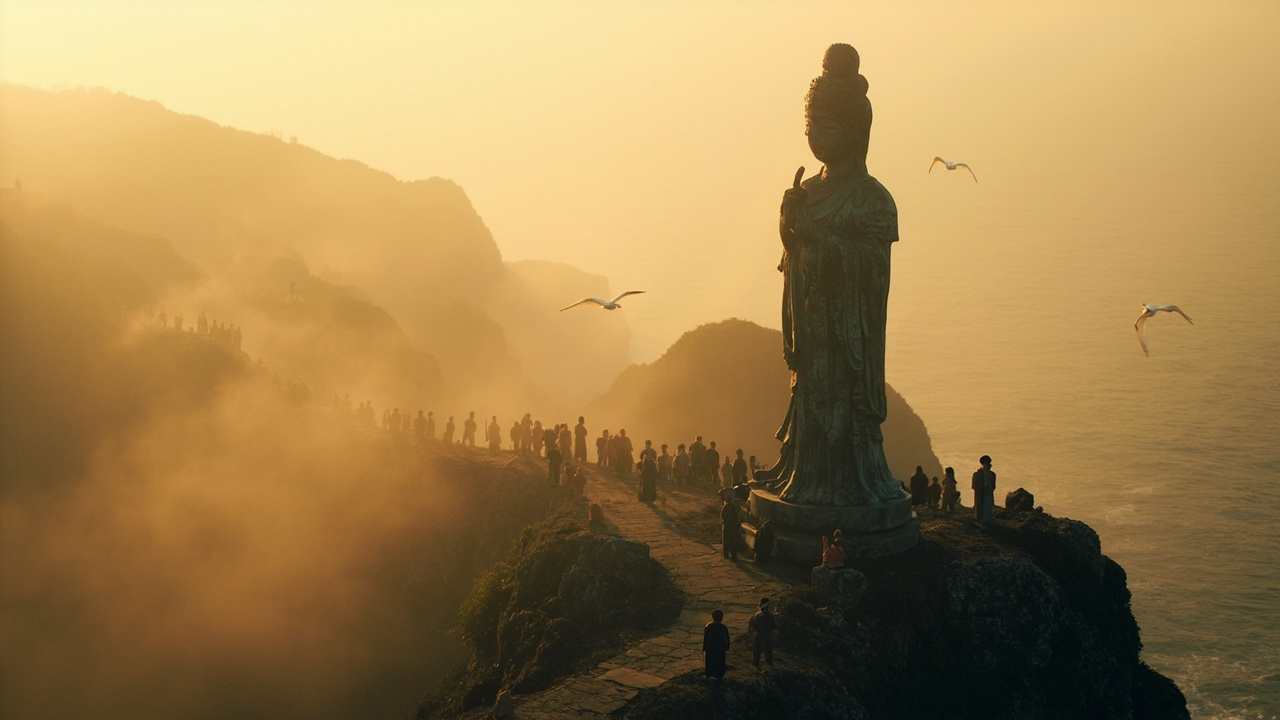
The ferry horn blared twice, a deep sound that bounced off the hills and startled a group of seagulls into the air. I was standing on the deck, gripping the railing, watching the bronze statue of Guanyin grow from a smudge on the horizon into a figure that dominated the skyline. The wind smelled of salt and incense. A woman next to me, a pilgrim from Fujian, was chanting softly under her breath, clutching a bag of fruit she planned to offer at the temple. I had been living in Beijing for years, but this was my first time on Putuo Mountain, and I realized I had been missing something essential about how Chinese people experience faith.
Putuo Mountain is one of the four sacred Buddhist mountains in China, dedicated to Guanyin, the Bodhisattva of Compassion. It is not a mountain you climb; it is an island you circle. For over a thousand years, pilgrims have crossed the East China Sea to walk its paths, light incense, and ask for mercy, luck, or a child. For international visitors, it offers something increasingly rare in China: a place where the spiritual life of the country is not a museum exhibit but a living, breathing practice.
This guide is based on three separate visits I made between 2023 and 2025, including one overnight stay that taught me more than any guidebook. I will tell you exactly how to get there, what it costs, where to stay, and which temples are worth your time. I will also tell you what to skip, because some of it is genuinely skippable.
Quick answer
Putuo Mountain is a 12.5-square-kilometer island off the coast of Zhejiang Province, reachable by ferry from Ningbo or Zhoushan. You need about 2 days to see it properly, and the total cost for a comfortable trip from Shanghai (transport, entry, one night’s lodging, food) runs roughly $150-250 (CNY 1,080-1,800). The best time to visit is April-May or September-October, when the weather is mild and the crowds are thinner than in summer. China’s 240-hour visa-free transit policy (as of 2025) covers this region, so many international travelers can visit without a full tourist visa.
The Short Version
Putuo Mountain is the most accessible of China’s four sacred Buddhist mountains, and it rewards a slow pace. The island is small enough that you can walk across it in a day, but the magic happens when you stay overnight, when the day-trippers leave and the temples empty out. Do not try to see everything. Pick three or four sites, walk the coastal path between them, and leave time to just sit and watch the sea. The ferry schedule is your master; plan around it. And bring cash, because some of the smaller temples and snack stalls do not accept mobile payments.
How I Picked These
I have been to Putuo Mountain three times: once on a rushed day trip from Ningbo, once for a two-day pilgrimage circuit following the traditional route, and once just to wander with no agenda. I talked to the monks at Fayu Temple, the ferry workers at the dock, a shopkeeper who sells prayer beads, and a taxi driver from Zhoushan who ferried me to the wrong pier and refused to take my money. I have also been to the other three sacred mountains (Wutai, Emei, Jiuhua), so I can tell you honestly how Putuo compares. The sites below are the ones I would return to, ranked by how much they stayed with me after I left.
Comparison Table
| Rank | Place | Best For | Approx Cost (USD) | Time Needed | When to Go |
|---|---|---|---|---|---|
| 1 | Fayu Temple | The full sensory experience | $7 (CNY 50) | 1.5-2 hours | Morning, before 10am |
| 2 | Coastal Path (Qianbu Sand to Fayu) | Walking and views | Free | 1-2 hours | Late afternoon |
| 3 | Nanhai Guanyin Statue | The iconic photo | $7 (CNY 50) | 45-60 min | Sunset |
| 4 | Puji Temple | The main temple complex | $6 (CNY 40) | 1-1.5 hours | Early morning |
| 5 | Huiji Temple | The view from the summit | $6 (CNY 40) | 2 hours incl. cable car | Clear days only |
| 6 | Xitian Scenic Area | Rock formations and caves | $6 (CNY 40) | 1-1.5 hours | Mid-morning |
| 7 | Baotu Temple | Quiet contemplation | Free (donation) | 30-45 min | Any time |
| 8 | Yinyu Cave | The sound of the sea | Free | 30 min | Low tide |
| 9 | Zizhulin (Purple Bamboo) Forest | A short, pretty walk | Free | 20 min | Early morning |
| 10 | The Beach at Qianbu Sand | Sunsets and sea air | Free | As long as you want | Golden hour |
Fayu Temple —The One That Made Me Understand
I arrived at Fayu Temple at 8am on a Tuesday, expecting to have the place to myself. Instead, I walked into a courtyard where at least 200 pilgrims were performing a group bowing ritual in perfect unison, their foreheads touching the stone floor in waves that rippled across the square. The sound of their hands hitting the ground was rhythmic, almost musical. I stood at the edge, not sure if I should stay or leave, and an elderly monk gestured for me to sit on a bench. I stayed for an hour.
Fayu Temple is the largest of Putuo’s three main temples, built in 1580 and rebuilt several times since. Its layout follows the classic Chinese temple pattern: a series of courtyards ascending the hillside, each one more ornate than the last. The main hall has a ceiling of golden dragons that I have not seen matched anywhere else in China. But what makes Fayu special is the atmosphere. This is not a tourist site; it is a working monastery where monks and pilgrims coexist in daily rhythm.
The temple sits on the eastern side of the island, about a 20-minute walk from the main dock or a 5-minute shuttle bus ride. The entry fee is $7 (CNY 50), which includes access to the entire complex. Open daily from 6am to 6pm, though the main halls close for lunch between 11:30am and 1:30pm. To get there, take the island shuttle bus from the ferry terminal to the “Fayu Temple” stop, then walk up the stone steps past the lotus pond. The steps are steep and uneven; wear shoes with grip.
Visit in the morning before 10am, when the pilgrim groups are most active and the light comes through the trees at a low angle. Weekdays are dramatically quieter than weekends. If you want to see the monks’ evening chanting, ask at the visitor desk; they sometimes allow foreigners to observe, but you must be silent and stay at the back.
The monk who gestured for me to sit turned out to be from Fujian, and he spoke a little English. He told me he had been at Fayu for 17 years and had never once left the island. When I asked why, he smiled and said, “The sea is enough.”
The Coastal Path —The Walk You Should Not Skip
The path between Qianbu Sand beach and Fayu Temple is the single best walk on the island, and most tourists miss it because they take the shuttle bus. It is a paved trail that hugs the cliffs, passing under stone archways, through pine groves, and past small shrines where pilgrims have left offerings of fruit and cigarettes. Yes, cigarettes. I saw a pack of Double Happiness placed in front of a Guanyin statue, and a local told me that some fishermen offer tobacco to the goddess before heading out to sea.
The walk takes about 45 minutes at a leisurely pace, and it is almost entirely flat. The sea is on your left, crashing against rocks that have been carved by wind and salt into strange shapes. On a clear day, you can see the outline of the mainland and the shipping lanes that carry cargo between Shanghai and the south. The path is well-marked with stone signs in Chinese and English, though the English can be amusingly broken.
There is no entry fee, and the path is open 24 hours, though I would not recommend walking it after dark because the lighting is poor and the steps can be slippery. The best time is late afternoon, when the sun is behind you and the sea turns a deep gold. You will pass a small pavilion about halfway where you can sit and watch fishing boats return to harbor.
Bring water; there are no shops along the path. And wear a hat, because there is no shade for long stretches. If you are lucky, you will see the island’s resident cats, which are fed by the monks and have grown fat and confident.
I made the mistake of walking this path in sandals, and by the end my feet were covered in dust and small blisters. Wear proper shoes. Learn from me.
Nanhai Guanyin Statue —The Icon, and It Earns the Hype
The bronze statue of Guanyin at the southern tip of the island is 33 meters tall, facing the sea with her eyes cast down, one hand raised in a gesture of reassurance. It was completed in 1997 and has become the symbol of Putuo Mountain, appearing on every postcard and travel poster. I am usually skeptical of such landmarks, but standing at its base, looking up at a face that has watched the sea for nearly three decades, I felt something. The scale is humbling.
The statue sits within a larger complex that includes a hall with 10,000 small Guanyin statues and a museum with artifacts from the temple’s history. The entry fee is $7 (CNY 50), and the complex is open from 6am to 6pm. The best time to visit is sunset, when the light hits the bronze and the crowds thin out. On a clear evening, the statue glows against the darkening sky, and the sea behind it turns silver.
To get there, take the shuttle bus to the “Nanhai Guanyin” stop, then walk up a gentle slope for about 10 minutes. The complex is wheelchair accessible, which is rare on this island. If you are visiting on a full moon night, the temple holds a special ceremony at the statue; check with your hotel for the schedule.
I watched a young couple take photos of each other in front of the statue for a full 20 minutes, and I wanted to tell them that the best photo is from the side, where you can see the statue against the sea rather than against the sky. But I did not. Some things you let people discover.
Puji Temple —The Heart of the Island
Puji Temple is the oldest and most historically significant temple on Putuo, dating back to the Song Dynasty. It sits in the center of the island, in a valley that protects it from the wind, and its entrance is marked by a large lotus pond with a stone bridge that pilgrims cross before entering. The morning I visited, a group of elderly women were singing Buddhist chants in a side hall, their voices rising and falling in a melody that I could not place but found deeply soothing.
The temple is smaller than Fayu, but it feels more intimate, more lived-in. The main hall houses a 9-meter-tall Guanyin statue that is said to have been carved from a single piece of camphor wood. The surrounding buildings include a library, a meditation hall, and living quarters for the monks, some of which date back to the Ming Dynasty.
Entry is $6 (CNY 40), open 6am to 6pm. The best time to visit is early morning, around 7am, when the monks are doing their morning prayers and the incense smoke is thick enough to blur the edges of the courtyard. To get there, take the shuttle bus to the “Puji Temple” stop and walk through the small commercial street of shops selling prayer beads and dried seafood. The walk from the bus stop takes about 5 minutes.
There is a vegetarian restaurant inside the temple complex that serves simple meals for about $3 (CNY 20). The food is plain but good, and the dining hall is where you will see monks eating alongside pilgrims. It is acceptable to eat there, but be respectful: no talking loudly, no photos of the monks eating.
The women singing in the side hall were from a village in Anhui. One of them, a woman named Auntie Chen who was 74 years old, told me she had saved for three years to make this pilgrimage. She asked me to take her photo in front of the main hall, and then she asked me to pray for her grandson who was taking his college entrance exam. I did. I am not religious, but I did.
Huiji Temple —The Summit, and the Fog
Huiji Temple sits at the highest point of the island, on the peak of Foding Mountain, and it is the only one of the three main temples that requires a climb. You can take a cable car from the base station for $8 (CNY 55) one way, or you can walk the 1,089 stone steps that wind up through the forest. I took the cable car up and walked down, which I recommend: the descent is easier on the knees, and you can stop at the small shrines along the way.
The temple itself is modest compared to Fayu and Puji, but the setting is extraordinary. On a clear day, you can see the entire island spread out below you, with the sea on all sides and the mainland a faint line on the horizon. On the day I visited, the fog rolled in halfway through my walk, and the temple disappeared into a white void. I sat on the steps and watched the fog swallow the valley, and I understood why this peak was chosen for a temple. The impermanence of the view is the point.
Entry is $6 (CNY 40), open 6am to 5:30pm. The cable car runs from 7am to 5pm and can close in high winds, so check the weather before you commit. The walk down takes about 40 minutes, and the steps are uneven and slippery when wet. Wear hiking shoes if you have them.
The fog cleared as I reached the base, and the island reappeared as if it had been painted back into existence. A young monk was sweeping the steps, and he looked up and smiled. “You came at the right time,” he said in English. “The mountain shows itself only when it wants to.”
Xitian Scenic Area —Rocks, Caves, and a Little Adventure
The Xitian Scenic Area is a collection of rock formations, caves, and small temples on the western side of the island, and it is the least visited of the major sites. This is a shame, because it is also the most fun. The rocks have been weathered into strange shapes over millennia, and the paths between them are narrow and twisting, requiring you to duck under overhangs and squeeze through gaps. There is a cave called “One Thread of Sky” where you can see a thin strip of daylight far above, and another where you can hear the sea crashing beneath your feet.
The area is free to enter, though some of the smaller caves have donation boxes. It is open 24 hours, but I would not recommend going after dark, as the paths are unlit and easy to lose. The best time is mid-morning, when the light filters through the rock gaps and creates interesting shadows. To get there, take the shuttle bus to the “Xitian” stop and follow the signs. The area is compact, and you can see everything in about an hour.
I got lost in the caves for a few minutes, which was genuinely frightening. The passages are narrow and dark, and I had to use my phone flashlight to find my way out. It was not dangerous, but it was disorienting. Bring a flashlight or use your phone, and do not wander off the marked path.
Baotu Temple —The Quiet One
Baotu Temple is a small temple on the northern side of the island, far from the main tourist routes, and it is the place I would go if I wanted to be alone. It is not in any of the guidebooks I have seen, and the only people I encountered there were a few monks and an old woman who was feeding the temple cats. The temple is dedicated to Guanyin in her aspect as the protector of sailors, and the main hall has a small boat suspended from the ceiling as an offering.
The temple is free to enter, though donations are welcome. It is open from 6am to 5pm, and the monks are happy to chat if you speak Chinese or have a translation app. To get there, take the shuttle bus to the “Baotu” stop and walk up the hill for about 10 minutes. The path is steep but short.
I sat in the courtyard for an hour, listening to the wind in the pines and the distant sound of the sea. A monk brought me a cup of tea without asking, and we sat in silence. He did not speak English, and my Chinese was not good enough for a real conversation, so we just sat. It was the most peaceful hour of my trip.
Yinyu Cave —The Sound of the Sea
Yinyu Cave is not really a cave; it is a narrow gorge where the sea rushes in and out, creating a sound that the locals call “the thunder of the dragon.” The entrance is marked by a small pavilion, and you descend a series of stone steps to a platform where you can feel the spray on your face. The sound is loud and primal, and it is easy to understand why the ancient pilgrims believed this was a sacred place.
The cave is free to enter and open 24 hours, though the platform can be slippery when wet. The best time to visit is at low tide, when the water is lower and the sound is more dramatic. To get there, take the shuttle bus to the “Yinyu” stop and follow the signs. You can see it in about 30 minutes.
I stood on the platform for a long time, letting the spray hit my face, and I thought about all the pilgrims who had stood in the same spot over the centuries, asking Guanyin for help. The sea does not answer, but it does not ignore you either. There is something in that.
Zizhulin (Purple Bamboo) Forest —A Short, Pretty Walk
The Purple Bamboo Forest is a small grove near the southern tip of the island, named for the purple-tinted bamboo that grows there. It is not a major site, but it is a pleasant place to walk, and it connects the Nanhai Guanyin statue with the coastal path. The bamboo is dense and tall, and the light filters through it in a way that makes everything look soft and green.
The forest is free to enter and open 24 hours. The best time is early morning, when the bamboo is still wet with dew and the air is cool. To get there, walk south from the Nanhai Guanyin complex for about 10 minutes, or take the shuttle bus to the “Zizhulin” stop.
I walked through the forest on my last morning on the island, and I saw a group of monkeys in the trees, watching me with what I chose to interpret as curiosity rather than aggression. They did not approach, and I did not approach them. We regarded each other for a moment, and then they moved on.
The Beach at Qianbu Sand —Where the Pilgrims Rest
Qianbu Sand is the main beach on Putuo, a wide stretch of golden sand that is unusual for a Buddhist island. It is not a swimming beach; the currents are strong and the water is cold even in summer. But it is a place where pilgrims come to rest after their temple visits, and where families spread out blankets and eat snacks while the children chase the waves.
The beach is free and open 24 hours. The best time is golden hour, when the light turns the sand a deep amber and the island’s hills cast long shadows. To get there, take the shuttle bus to the “Qianbu Sand” stop, or walk from Puji Temple, which takes about 15 minutes.
I sat on the beach and watched a group of monks walk along the waterline, their orange robes bright against the gray sea. They did not seem to be in a hurry. One of them stopped to pick up a piece of driftwood and examine it, then put it back down. I do not know why that moment stayed with me, but it did.
FAQ summary
Putuo Mountain is a Buddhist island in Zhejiang Province, reachable by ferry from Ningbo or Zhoushan, and the total trip cost from Shanghai is approximately $150-250 (CNY 1,080-1,800) for two days. The three main temples are Fayu, Puji, and Huiji, each with an entry fee of $6-7 (CNY 40-50), and the island shuttle bus system connects all major sites for $1-2 (CNY 5-10) per ride. China’s 240-hour visa-free transit policy covers this region, and WeChat Pay and Alipay are accepted at most larger establishments, though cash is needed for small vendors and temple donations.
FAQ
Q: Do I need a visa to visit Putuo Mountain? A: If you are transiting through China to a third country, you may be eligible for the 240-hour visa-free transit policy, which covers Zhejiang Province. Otherwise, you need a standard L tourist visa. Check with your nearest Chinese embassy, as policies change.
Q: How do I get to Putuo Mountain from Shanghai? A: Take a high-speed train from Shanghai Hongqiao to Ningbo (about 2 hours, $30-40 / CNY 220-290), then a taxi or bus to the Zhoushan ferry terminal, then a ferry to Putuo (about 1.5 hours, $15-20 / CNY 110-145). Alternatively, there are direct ferries from Shanghai’s Wusongkou port, but they are slower and less frequent.
Q: How many days do I need on Putuo Mountain? A: Two days is ideal. One day is too rushed to see the main temples and walk the coastal path, and three days is more than most people need unless you want to attend multiple ceremonies or do a full pilgrimage circuit.
Q: Is English spoken on Putuo Mountain? A: Very little. The monks and temple staff speak only Chinese, and the English signage is limited and sometimes inaccurate. Download a translation app before you go, and learn a few basic phrases like “thank you” (xièxiè) and “how much” (duōshǎo qián).
Q: Can I use my credit card or mobile payment on the island? A: WeChat Pay and Alipay are accepted at most hotels, restaurants, and larger shops. Credit cards are rarely accepted outside of major hotels. Bring cash (CNY 500-1,000) for temple entry fees, shuttle buses, and small vendors.
Q: Is there a dress code for the temples? A: There is no strict dress code, but you should dress modestly: cover your shoulders and knees, and remove your hat when entering temple halls. You will also need to remove your shoes before entering some meditation halls.
Q: Do I need a VPN for my phone in China? A: Yes. Google, WhatsApp, Instagram, and many other Western services are blocked in China. Download a reliable VPN before you arrive, and set it up before you land. A local SIM card from China Mobile or China Unicom will give you data, but you still need the VPN.
The Honest Wrap-up
Putuo Mountain is not for everyone. If you want nightlife, luxury resorts, or a beach where you can actually swim, go somewhere else. But if you want to see a side of China that most tourists miss, a place where faith is not a performance but a daily practice, then this small island will stay with you long after you leave. My advice: go for two days, stay at one of the temple guesthouses, walk the coastal path at sunset, and give yourself permission to do nothing but sit and watch. The island rewards patience, and it punishes hurry. Book the ferry, pack light, and let the sea do the rest.
Topics
More guides you may like

Top 10 Bridges in China
China's bridges are engineering marvels spanning mountains, rivers, and seas. Here are 10 of the most spectacular, from ancient stone to modern steel.
8 min read

Top 10 Buddhist Sites in China
From the Leshan Giant Buddha to the Dunhuang Caves, these 10 Buddhist sites represent 2,000 years of China's spiritual heritage.
9 min read

Top 10 Day Trips from Beijing You Shouldn't Miss
Beijing is packed with history, but some of China's best experiences are just a few hours away. Here are 10 day trips that will transform your visit.
9 min read

Top 10 Hidden Gems in China Off the Beaten Path
Beyond the Great Wall and Terracotta Warriors, China has incredible hidden destinations few tourists ever reach. Here are 10 underrated gems worth the detour.
9 min read

Top 10 Markets and Shopping Streets in China
From Shanghai's Bund to Beijing's Silk Street - 10 markets where foreigners can haggle, explore, and bring home authentic Chinese goods.
9 min read

Top 10 Museums in China You Shouldn't Miss
China's museums span 5,000 years of civilization. These 10 - from the Palace Museum to Xi'an's terracotta gallery - are unmissable for culture lovers.
9 min read