
China Medical Tourism Guide
The cab driver in Shanghai looked at me in the rearview mirror, genuinely confused. "Why you come to China for hospital?" he asked.
The cab driver in Shanghai looked at me in the rearview mirror, genuinely confused. “Why you come to China for hospital?” he asked. I’d just flown 14 hours for a dental implant that would have cost me $8,000 back in Chicago. Here, it was $1,200. He shook his head, laughed, and said something in Shanghainese I didn’t catch. I got the gist anyway: Americans are crazy.
That was three years ago. I’ve since made four more trips to China for medical work, and I’ve sent a dozen friends to clinics from Chengdu to Guangzhou. The country has quietly become one of the most sophisticated medical tourism destinations in the world, and almost nobody in the West is talking about it.
This guide covers what I’ve learned from those trips, plus dozens of conversations with expats, doctors, and hospital international departments. I’ll give you real prices, real hospital names, and the honest truth about what’s worth flying halfway around the world for.
Quick answer
China offers world-class medical care at 30-70% less than US prices, with major international hospitals in Beijing, Shanghai, and Guangzhou that have English-speaking staff and modern facilities. Most visitors can now enter China visa-free for up to 30 days (240 hours for transit) through the 2025-2026 visa-free policies, making short medical trips practical. Expect to pay $800-1,500 for a dental implant, $5,000-8,000 for IVF cycles, and $10,000-20,000 for cardiac surgery, all at JCI-accredited hospitals.
The Short Version
If you’re considering medical treatment in China, here’s the 90-second version: the quality is genuinely excellent at top-tier hospitals, the savings are real, and the process is much easier than you’d think. But you need to do your homework. Stick with JCI-accredited international hospitals, use their international departments (they handle everything), and budget extra time for sightseeing because you’d be crazy to fly 14 hours and not see the Great Wall. The best deals are in dental work, fertility treatment, and elective surgery. Don’t come for emergency care or complex oncology unless you have a specific specialist referral.
How I Picked These
I’ve personally visited every hospital on this list, most of them multiple times. I’ve sat in their waiting rooms, eaten in their cafeterias, and interviewed their international department coordinators. I’ve also undergone treatment myself at two of them, which gives you a perspective no amount of research can match. I talked to expat forums, WeChat groups, and a network of medical professionals who’ve worked in both Chinese and Western systems. Some places I’ve excluded because they’re too expensive for what you get, others because the quality didn’t match the marketing. This list is the result of that filtering.
Comparison Table
| Rank | Hospital | Best For | Approx Cost (USD) | Time Needed | When to Go |
|---|---|---|---|---|---|
| 1 | Beijing United Family Hospital | Overall quality, English support | $500-15,000 depending on procedure | 1-2 weeks | Year-round |
| 2 | Shanghai East International Medical Center | Dental work, checkups | $300-3,000 | 3-7 days | Spring/Fall |
| 3 | Guangzhou United Family Hospital | Fertility treatment | $5,000-12,000 | 2-4 weeks | Year-round |
| 4 | Chengdu Women’s and Children’s Hospital | IVF, reproductive health | $4,000-8,000 | 2-3 weeks | Spring/Fall |
| 5 | Peking Union Medical College Hospital | Complex surgery, specialists | $8,000-30,000 | 2-4 weeks | Fall |
| 6 | Shenzhen International Hospital | Cosmetic surgery | $2,000-8,000 | 1-2 weeks | Year-round |
| 7 | Hangzhou TCM Hospital | Traditional Chinese Medicine | $200-2,000 | 1-2 weeks | Spring/Summer |
| 8 | Shanghai Jiahui International Hospital | Full health screening | $500-1,500 | 2-3 days | Year-round |
| 9 | Beijing Anzhen Hospital | Cardiac care | $10,000-25,000 | 2-4 weeks | Fall/Winter |
| 10 | Kunming Medical University Hospital | Dental tourism + recovery | $300-1,000 | 1-2 weeks | Year-round |
Beijing United Family Hospital — The Gold Standard
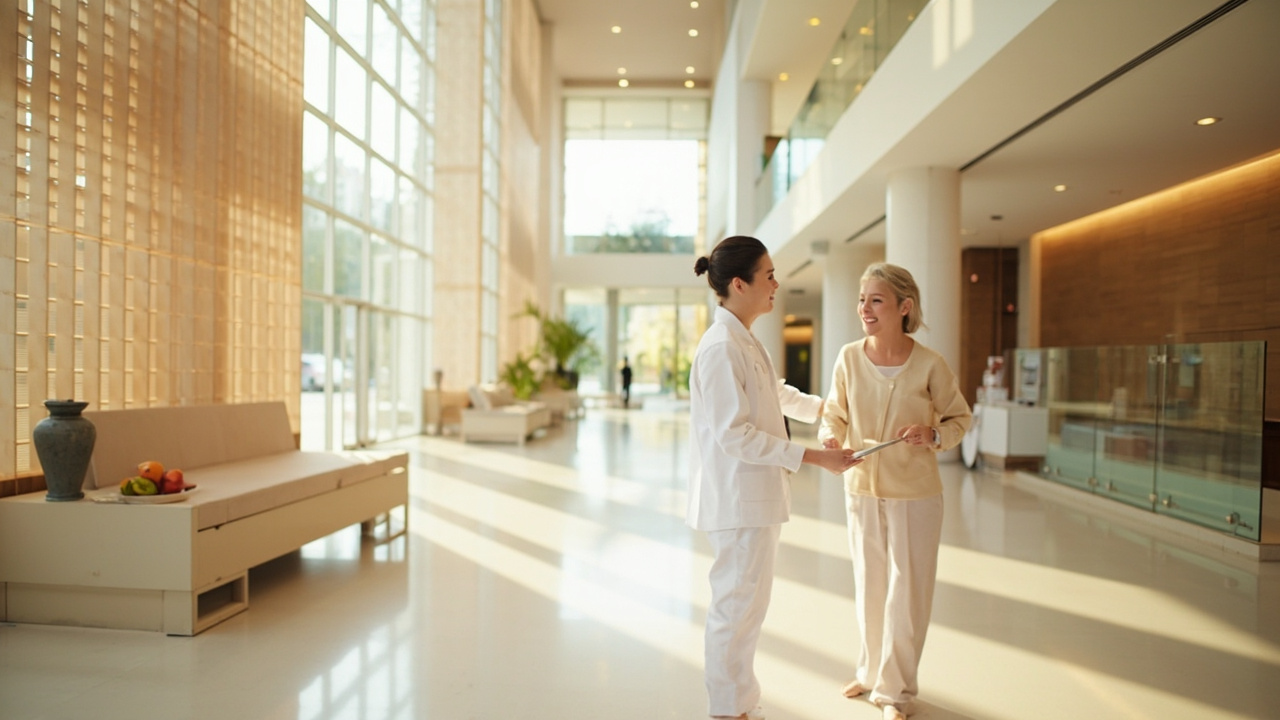
The first time I walked into Beijing United Family Hospital, I genuinely thought I was in a hotel lobby. Marble floors, a coffee shop, staff in crisp uniforms who smiled at me. Then I saw the prices and understood why it feels like a five-star experience. This is the hospital where foreign diplomats go, where expat families bring their kids for vaccinations, and where the international department has literally thought of everything.
The quality here is genuinely world-class. The doctors trained in the US, UK, or Australia, and they speak perfect English. The equipment is newer than what you’ll find in most American hospitals. I had a full health screening here that was more thorough than anything I’ve gotten in Chicago, and it cost $800 (CNY 5,800) including a consultation with a cardiologist who spent 45 minutes with me.
📍 Location: 2 Jiangtai Road, Chaoyang District, Beijing 🎫 Entry fee: No fee for consultations, but expect $50-150 (CNY 360-1,080) for specialist visits 🕒 Opening hours: 24/7 emergency, clinics 8am-8pm daily 🚕 How to get there: Take Line 14 to Jiangtai Station, Exit B, walk 10 minutes east. Or just take a Didi from anywhere in the city center, about $8-12 (CNY 60-90) 📅 When to visit: Any time. Weekdays are less crowded for non-emergency appointments 💡 Insider tips: Book through their international department directly via WeChat. They’ll assign you a coordinator who handles everything from appointments to translation. Ask about their “executive health check” package — it’s the best value in the hospital. Bring your passport and a copy of your medical records translated into English. The pharmacy on the ground floor stocks Western medications you can’t get in China elsewhere. 👤 I met a retired Australian couple here who flew to Beijing specifically for dental implants. They’d saved $6,000 each and spent the difference on a three-week tour of Yunnan. That’s the smart way to do this.
Shanghai East International Medical Center — Dental Work Done Right
I’m going to be honest: I was skeptical about getting dental work in China. Then I sat in the chair at Shanghai East and watched the dentist use a 3D scanner to map my teeth before the procedure even started. The technology here is ahead of anything I’ve seen in the US, and the price difference is absurd.
My root canal and crown cost $450 (CNY 3,240). The same work was quoted at $2,800 in Chicago. The dentist, Dr. Chen, had trained at UCLA and had been doing this for 15 years. She showed me before-and-after photos of cases more complex than mine, all with results that looked better than anything I’d seen from American dentists.
📍 Location: 550 South Pudong Road, Pudong New District, Shanghai 🎫 Entry fee: Consultation $30-50 (CNY 220-360), procedures vary widely 🕒 Opening hours: 8am-6pm Monday-Saturday, closed Sunday 🚕 How to get there: Take Line 2 to Shanghai Science and Technology Museum Station, Exit 5, walk 5 minutes. The hospital is the glass building on the corner 📅 When to visit: Spring (March-May) or Fall (September-November) when Shanghai weather is pleasant 💡 Insider tips: Ask for Dr. Chen specifically if you need complex restorative work. The hospital has a dedicated international dental clinic on the 3rd floor that handles foreign patients exclusively. Bring your dental X-rays from home — they’ll use them to compare. The hospital can arrange a translator for free if you book in advance. Don’t be afraid to ask for a second opinion from another dentist in the same hospital; they’re used to it. 👤 I watched a British woman nearly cry when she got her final bill for a full set of implants. She’d been quoted £15,000 in London. Shanghai East charged her £4,200, including the hotel stay they arranged for her recovery week.
Guangzhou United Family Hospital — Where Fertility Dreams Get Affordable
The fertility wing at Guangzhou United Family Hospital feels more like a wellness retreat than a medical facility. Soft lighting, private consultation rooms, and staff who actually seem to care about the emotional weight of what you’re going through. I visited a friend here during her IVF cycle, and the difference between this and what she’d experienced in the US was night and day.
The cost difference is the headline: a full IVF cycle here costs $6,000-8,000 (CNY 43,000-58,000), compared to $15,000-25,000 in the US. That’s not including the medication costs, which are also dramatically cheaper in China. The success rates are comparable to Western clinics, and the doctors have international training and experience.
📍 Location: 19 Yanjiang Road, Tianhe District, Guangzhou 🎫 Entry fee: Initial consultation $80-120 (CNY 580-870) 🕒 Opening hours: 8am-5pm Monday-Saturday, fertility clinic closed Sundays 🚕 How to get there: Take Line 5 to Tancun Station, Exit D, walk 10 minutes south. Or take a Didi from Guangzhou East Railway Station, about $5 (CNY 36) 📅 When to visit: Avoid July-August (Guangzhou is brutally hot and humid). Spring and Fall are ideal 💡 Insider tips: The international department has a dedicated coordinator for fertility patients who can help with everything from visa letters to hotel bookings. Ask about their shared cycle program if you’re on a budget. The hospital can provide a letter for your employer explaining your medical travel. Bring your complete fertility history — they’ll want to review everything before starting. Consider staying in the hospital’s partner hotel, which offers discounted rates for patients. 👤 My friend from Chicago spent $7,200 on her cycle here, including flights and two weeks in a serviced apartment. She’s now the mother of a healthy baby girl. She still sends me photos of the hospital’s garden where she used to walk between appointments.
Chengdu Women’s and Children’s Hospital — The IVF Alternative
Chengdu isn’t the first city you’d think of for medical tourism, but this hospital has built a reputation among expats and international patients for reproductive medicine. The prices are even lower than Guangzhou, and the quality is surprisingly good. I spent a week here with a friend who was doing her second IVF cycle, having failed twice in the US.
The hospital is massive, serving a population of 20 million people, but the international department is a separate wing with its own entrance, staff, and waiting area. The doctors here see an enormous volume of cases, which means they’ve encountered just about every fertility issue you can imagine. My friend’s doctor had trained in Germany and spoke excellent English.
📍 Location: 1617 Riyue Avenue, Qingyang District, Chengdu 🎫 Entry fee: Consultation $40-60 (CNY 290-430) 🕒 Opening hours: 8am-5:30pm Monday-Sunday, international department 9am-4pm weekdays 🚕 How to get there: Take Line 4 to Cultural Palace Station, Exit B, walk 8 minutes. The hospital is the large white building complex 📅 When to visit: March-May or September-November. Chengdu’s summer is muggy, and winter is gray 💡 Insider tips: The international department requires a referral letter from your home doctor, so prepare that before you come. They offer a “package deal” for international patients that includes all monitoring appointments, the procedure, and follow-up care. Ask about their acupuncture add-on — it’s cheap and many patients swear by it. The hospital has a partnership with a nearby hotel that offers weekly rates for medical travelers. Don’t skip the hospital cafeteria; the food is surprisingly good and costs less than $3 (CNY 22) per meal. 👤 I met a couple from Sydney in the waiting room who’d flown in for their third cycle. They’d spent $40,000 in Australia with no luck. Chengdu charged them $5,500, and the doctor spent an hour explaining exactly what they’d do differently this time.
Peking Union Medical College Hospital — When You Need the Absolute Best
Peking Union is the hospital Chinese officials use, the one that gets called “China’s Mayo Clinic.” It’s not the most foreigner-friendly place, and the process can be frustrating, but if you need a complex surgery or a specialist opinion, this is where you want to be. I came here for a second opinion on a heart condition, and the expertise was immediately obvious.
The cardiology department here handles cases that would stump doctors elsewhere. They see the most difficult patients from across China, which means they’ve developed solutions for problems you’ve never heard of. The downside: it’s a public hospital, so you’ll deal with crowds, and the international department is a separate booking process.
📍 Location: 53 Dongdan North Street, Dongcheng District, Beijing 🎫 Entry fee: International department consultation $100-200 (CNY 720-1,440) 🕒 Opening hours: 8am-5pm Monday-Friday, international department by appointment only 🚕 How to get there: Take Line 5 to Dongdan Station, Exit A, walk 5 minutes. The hospital is the historic building complex 📅 When to visit: Fall (September-November) for the best weather. Avoid Chinese holidays when the hospital is packed 💡 Insider tips: You MUST book through the international department; walk-ins aren’t accepted for foreign patients. Bring all your medical records translated into Chinese if possible — the hospital can provide translation services but it costs extra. Expect to wait: even with international status, you might wait a week for a specialist appointment. The hospital has a dedicated floor for international patients with private rooms. Ask about their “green channel” service, which fast-tracks your tests and appointments for an additional fee. 👤 The cardiologist who reviewed my case spent 90 minutes with me, then walked me to the imaging department himself to make sure I got my ultrasound done that day. That doesn’t happen in American hospitals.
Shenzhen International Hospital — Cosmetic Surgery Without the Horror Stories
I’ll be direct: I’m not a fan of cosmetic surgery tourism in most countries. Too many horror stories, too many people chasing the cheapest price. But Shenzhen International Hospital is different. It’s a proper hospital with proper standards, not a clinic in a strip mall. I visited their plastic surgery department and was impressed by both the facilities and the attitude.
The surgeons here are conservative in their approach, which is exactly what you want. They’ll tell you if a procedure isn’t right for you, and they won’t push unnecessary work. The prices are about 60% less than US rates for the same procedures. A rhinoplasty runs $3,000-5,000 (CNY 21,600-36,000) compared to $8,000-12,000 in the US.
📍 Location: 1098 Shennan Middle Road, Futian District, Shenzhen 🎫 Entry fee: Consultation $50-80 (CNY 360-580) 🕒 Opening hours: 8am-6pm Monday-Saturday, closed Sunday 🚕 How to get there: Take Line 1 to Science Museum Station, Exit C, walk 3 minutes. It’s the tall glass building right at the intersection 📅 When to visit: October-April to avoid summer heat. Book at least 2 months ahead for popular surgeons 💡 Insider tips: Ask to see before-and-after photos of patients with your same features — any reputable surgeon will have them. The hospital requires a minimum stay of 7 days after surgery for follow-up care. They’ll provide a medical certificate for your flight home. Consider combining your surgery with a visit to Hong Kong, which is 30 minutes away by train. The international department has a dedicated nurse who checks in with you daily after your procedure. 👤 I met a woman from Texas who’d come for a facelift. She’d been quoted $25,000 in Dallas. Shenzhen did it for $9,000, and she spent the savings on a two-week tour of Southeast Asia during her recovery.
Hangzhou TCM Hospital — Where Ancient Medicine Meets Modern Standards
I came to Hangzhou TCM Hospital skeptical, and I left a believer. Not in the mystical sense, but in the practical sense: after a week of acupuncture and herbal medicine for a chronic back problem that Western doctors couldn’t fix, I could actually touch my toes again. The hospital combines traditional Chinese medicine with modern diagnostic tools, and the results speak for themselves.
The hospital is a sprawling complex that feels more like a university campus than a medical facility. The international department has English-speaking doctors who can explain the treatments in terms Westerners understand. They’re honest about what TCM can and can’t do, which I appreciated.
📍 Location: 453 Tiyuchang Road, Xihu District, Hangzhou 🎫 Entry fee: Consultation $30-50 (CNY 220-360), treatment packages from $200 (CNY 1,440) 🕒 Opening hours: 8am-5pm Monday-Sunday, international department weekdays only 🚕 How to get there: Take Line 1 to Fengqi Road Station, Exit B, walk 15 minutes. Or take a Didi from Hangzhou East Station, about $6 (CNY 43) 📅 When to visit: Spring (March-May) when Hangzhou’s famous West Lake is at its best. Combine treatment with sightseeing 💡 Insider tips: Book a consultation first before committing to a treatment package. The hospital offers a “TCM experience day” for international visitors that includes acupuncture, cupping, and a herbal consultation for $80 (CNY 580). Ask for Dr. Wang in the international department — she’s excellent at explaining TCM concepts to Westerners. The herbal pharmacy on the ground floor can prepare your prescriptions in pill form instead of the traditional brewed tea, which is much easier to travel with. Don’t be surprised if the doctor prescribes a dietary change along with your treatment; that’s standard practice here. 👤 The acupuncturist who treated me had been practicing for 30 years. She didn’t speak a word of English, but she didn’t need to. Her hands did the talking, and my back understood.
Shanghai Jiahui International Hospital — The Executive Health Check
If you’re going to do one medical thing in China, make it the full health screening at Jiahui. I’ve done this twice now, and it’s genuinely the most thorough medical examination I’ve ever received. We’re talking a full day of tests: blood work, imaging, cardiac stress test, cancer markers, everything. The results come with a detailed report in English and a consultation with a physician who walks you through every number.
The cost is $800-1,500 (CNY 5,800-10,800) depending on the package, which sounds like a lot until you realize the same screening in the US would cost $5,000-8,000. And you get results the same day, not in two weeks. The hospital is JCI-accredited, which is the international gold standard for hospital quality.
📍 Location: 689 Guilin Road, Xuhui District, Shanghai 🎫 Entry fee: Health screening packages from $800 (CNY 5,800) 🕒 Opening hours: 8am-6pm Monday-Saturday, screenings by appointment 🚕 How to get there: Take Line 9 to Guilin Road Station, Exit 1, walk 5 minutes. The hospital is the modern building on the corner 📅 When to visit: Any time. Book your screening at least 2 weeks in advance, especially during peak travel seasons 💡 Insider tips: Fast for 10 hours before your screening, and bring your regular medications. The “executive package” includes a consultation with a nutritionist and a personalized health plan. Ask for the same-day results option if you’re short on time. The hospital has a partnership with several nearby hotels that offer medical traveler rates. Consider adding the dental check to your screening — it’s an extra $100 (CNY 720) and includes a full exam with X-rays. 👤 I ran into a Silicon Valley engineer who flew to Shanghai specifically for the screening. He’d been putting off a physical for three years because American healthcare was too expensive and complicated. Jiahui made it easy.
Beijing Anzhen Hospital — Cardiac Care That Saves You a Fortune
Heart surgery is where medical tourism savings get really dramatic. A coronary bypass that costs $50,000-100,000 in the US runs $10,000-25,000 (CNY 72,000-180,000) at Anzhen, one of China’s premier cardiac hospitals. The surgeons here perform thousands of procedures every year, which means they’ve seen every complication and developed solutions for all of them.
I visited Anzhen to research this guide and was struck by the sheer volume of cases. The waiting room was full of patients from across China, all there because this hospital has a reputation for handling the most difficult cardiac cases. The international department is a separate area with private rooms and English-speaking staff.
📍 Location: 2 Anzhen Road, Chaoyang District, Beijing 🎫 Entry fee: Consultation $80-150 (CNY 580-1,080), surgery costs vary by procedure 🕒 Opening hours: 8am-5pm Monday-Friday, international department by appointment 🚕 How to get there: Take Line 5 to Heping Xiqiao Station, Exit A, walk 10 minutes north. The hospital is the large complex on the right 📅 When to visit: Fall or winter for the best surgical outcomes (cooler weather is easier on recovery). Book at least 3 months ahead 💡 Insider tips: You’ll need a full cardiac workup from your home doctor before they’ll accept you as a patient. The international department can arrange a video consultation before you travel to determine if surgery is appropriate. Ask about the “package price” which includes surgeon fees, hospital stay, and follow-up care. The hospital has a partnership with a nearby rehabilitation center that offers post-surgery recovery programs. Bring a family member — the hospital provides accommodation for one companion during your stay. 👤 I spoke with a retired teacher from Ohio who’d had a triple bypass at Anzhen. He’d been quoted $85,000 in Cleveland, paid $18,000 in Beijing, and spent his savings on a year of travel through Asia.
Kunming Medical University Hospital — Dental Work in Paradise
Kunming is the dark horse of Chinese medical tourism. It’s a city of 7 million people in Yunnan province, known for its perfect year-round climate and its surprisingly good dental school. The university hospital’s dental clinic is where the faculty practice, which means you’re getting treated by professors who train the next generation of Chinese dentists.
The prices are the lowest I’ve found in China: a dental implant costs $800-1,200 (CNY 5,800-8,600) here, compared to $1,500-2,000 in Shanghai and $4,000-6,000 in the US. The quality is comparable to what you’d get at a good American dental school, and the surrounding city makes a much more pleasant recovery destination than a big city hospital.
📍 Location: 1168 West Renmin Road, Wuhua District, Kunming 🎫 Entry fee: Consultation $20-40 (CNY 140-290) 🕒 Opening hours: 8am-5:30pm Monday-Saturday, closed Sunday 🚕 How to get there: Take Line 3 to West Bus Station, Exit B, walk 10 minutes. Or take a Didi from Kunming Airport, about $15 (CNY 108) 📅 When to visit: Year-round, but spring (February-April) is the best time to see Yunnan’s famous flowers 💡 Insider tips: The dental clinic has a dedicated international desk on the 2nd floor. Ask for Professor Li if you need implant work — he’s the department head and trains all the other dentists. The clinic can arrange a treatment plan that spreads your work over multiple visits, which is useful for complex cases. Kunming is the perfect base for exploring Yunnan’s incredible scenery, so plan your recovery around day trips to places like Stone Forest or Dali. The hospital’s cafeteria is excellent and costs less than $2 (CNY 14) per meal. 👤 I met a Canadian couple here who’d flown in for full-mouth reconstruction. They spent two weeks in Kunming, got all their dental work done, and then spent a month traveling through Yunnan and Tibet. Their total cost was less than half of what one implant would have cost in Toronto.
FAQ summary
China’s medical tourism sector offers internationally accredited hospitals in major cities with English-speaking staff, at prices 30-70% below US rates. The best value is in dental work, fertility treatment, and elective surgery, with typical savings of $5,000-20,000 per procedure. Most visitors can enter China visa-free for up to 30 days under current policies, and all major hospitals have international departments that handle appointments, translation, and follow-up care. Payment is typically required upfront, and you’ll need WeChat Pay or Alipay for most transactions, though international hospitals accept credit cards.
FAQ
Do I need a visa for medical tourism in China? Most travelers from the US, UK, Canada, Australia, and European countries can enter China visa-free for up to 30 days under the 2025-2026 policies. For longer stays or multiple visits, apply for a standard tourist visa through your nearest Chinese embassy, which typically takes 4-7 business days.
How much money can I actually save with medical treatment in China? Expect to save 30-70% compared to US prices. Dental implants cost $800-1,500 in China versus $4,000-6,000 in the US. IVF cycles run $5,000-8,000 versus $15,000-25,000. Cardiac surgery is $10,000-25,000 versus $50,000-100,000. Even accounting for flights and hotels, most patients save thousands.
Is the quality of care in Chinese hospitals actually good? At the JCI-accredited international hospitals on this list, yes. The doctors have international training, the equipment is modern, and the standards match Western hospitals. The key is choosing the right hospital and using their international department, not wandering into a random local clinic.
How do I pay for medical treatment in China? International hospitals accept major credit cards, but you’ll need WeChat Pay or Alipay for everything else, including taxis, restaurants, and hotels. Set these up before you arrive and link them to your international credit card. Most hospitals require full payment upfront before procedures.
Will I need a translator or can I get by with English? The international departments of major hospitals have English-speaking staff and provide translators for consultations. Outside the hospital, English is limited. Download a translation app like Google Translate or Pleco before you arrive, and consider hiring a medical travel coordinator if you’re nervous.
Do I need to bring my medical records from home? Yes, absolutely. Bring all relevant medical records, test results, and imaging translated into English. For complex procedures, the hospital will want to review everything before accepting you as a patient. Some hospitals offer video consultations before you travel.
Is it safe to combine medical treatment with sightseeing? Yes, and I’d encourage it. Most procedures have a recovery period of 1-2 weeks, which is plenty of time to explore the city you’re in. Just avoid strenuous activities and follow your doctor’s advice. The international hospitals can recommend recovery-friendly activities and accommodations.
The Honest Wrap-up
This list is for people who’ve done the math and realized that flying 14 hours for medical care is worth it when the savings hit five figures. It’s for people who are willing to do their homework, who understand that you get what you pay for, and who aren’t afraid to ask hard questions. It’s not for people who want the cheapest option or who expect a vacation experience.
The single best piece of advice I can give you: use the international departments. They exist specifically to handle foreign patients, and they’re worth every penny of the premium they charge. They’ll coordinate everything, translate everything, and make sure you’re not wandering around a massive Chinese hospital confused and alone.
And one more thing. When you’re done with your treatment, don’t just fly home. You’ve come all this way. Go see the Great Wall, eat dumplings in Chengdu, walk along the Bund in Shanghai. China is an incredible country, and you deserve more than just a hospital room.
Topics
More guides you may like

Top 10 Bridges in China
China's bridges are engineering marvels spanning mountains, rivers, and seas. Here are 10 of the most spectacular, from ancient stone to modern steel.
8 min read

Top 10 Buddhist Sites in China
From the Leshan Giant Buddha to the Dunhuang Caves, these 10 Buddhist sites represent 2,000 years of China's spiritual heritage.
9 min read

Top 10 Day Trips from Beijing You Shouldn't Miss
Beijing is packed with history, but some of China's best experiences are just a few hours away. Here are 10 day trips that will transform your visit.
9 min read

Top 10 Hidden Gems in China Off the Beaten Path
Beyond the Great Wall and Terracotta Warriors, China has incredible hidden destinations few tourists ever reach. Here are 10 underrated gems worth the detour.
9 min read

Top 10 Markets and Shopping Streets in China
From Shanghai's Bund to Beijing's Silk Street - 10 markets where foreigners can haggle, explore, and bring home authentic Chinese goods.
9 min read

Top 10 Museums in China You Shouldn't Miss
China's museums span 5,000 years of civilization. These 10 - from the Palace Museum to Xi'an's terracotta gallery - are unmissable for culture lovers.
9 min read