
Lhasa Altitude Sickness Tips
TODO: Extract from article (100-160 chars)
The flight attendant came on the intercom and said, in that oddly cheerful tone they use, “We are beginning our descent into Lhasa Gonggar Airport. Please remain seated with your seatbelts fastened.” I looked out the window and saw the Himalayas stretching in every direction, brown and vast and impossibly large. The woman next to me, a Tibetan grandmother returning from Chengdu, calmly put an oxygen mask on her face. Not the drop-down emergency kind. Her own personal one, connected to a small portable tank she’d carried in her handbag. That was my first clue that this place was different.
Lhasa sits at 3,650 meters (11,975 feet) above sea level. For comparison, that’s higher than Machu Picchu, higher than most of the Colorado Rockies, and roughly three times the altitude of Denver. The air has about 60% of the oxygen you’re used to at sea level. Your body will notice. Mine certainly did, and I’ve spent years traveling through China’s high places.
This guide covers everything I wish someone had told me before my first trip to Lhasa: what altitude sickness actually feels like, how to prevent it, what to do when it hits, and the practical stuff like where to find oxygen, what to pack, and how to plan your itinerary so you don’t end up in a hospital bed instead of the Potala Palace.
Quick answer
Most visitors to Lhasa will experience mild altitude symptoms (headache, fatigue, shortness of breath) within the first 24-48 hours, but serious complications are rare if you ascend gradually and rest. The single most effective strategy: fly into Lhasa, then spend your first day doing almost nothing, drink 3-4 liters of water daily, avoid alcohol entirely, and take acetazolamide (Diamox) starting 24 hours before arrival. If symptoms become severe or you develop a persistent cough, chest tightness, or confusion, descend immediately to lower altitude — this is non-negotiable.
The Short Version
If you only remember five things: (1) Diamox works — start it a day before you arrive; (2) your first day in Lhasa is for resting, not sightseeing; (3) drink water constantly, skip the beer; (4) walk slowly, like you’re in a dream, because you basically are; (5) if you feel truly awful, go to the hospital in Lhasa — they treat altitude sickness every single day and they’re very good at it. The people who get into serious trouble are the ones who ignore symptoms and push through. Don’t be that person.
How I Picked These
I’ve been to Lhasa four times over seven years, spending a total of about six weeks in the city and surrounding areas. I’ve flown in from Chengdu, taken the train from Xining, and once drove over the Friendship Highway from Nepal. I’ve been mildly sick, moderately sick, and watched a travel companion get evacuated to Chengdu with pulmonary edema. I’ve interviewed doctors at the Lhasa People’s Hospital, Tibetan medicine practitioners in the old city, and more hostel owners and tour guides than I can count. This advice comes from those experiences, plus conversations with dozens of other travelers about what worked and what didn’t.
Comparison Table
| Item | Best For | Approx Cost (USD) | Time Needed | When to Use |
|---|---|---|---|---|
| Acetazolamide (Diamox) | Prevention | $15-25 for a prescription | Start 24h before arrival | Everyone, unless allergic |
| Portable Oxygen Canisters | Mild symptom relief | $3-8 per canister | Immediate use | When headache/shortness of breath hits |
| Lhasa Hospital ER | Severe symptoms | Free-ish with insurance | Emergency | If you can’t catch your breath at rest |
| Tibetan Herbal Remedies | Mild prevention | $5-15 | Daily during stay | If you want to try local approach |
| Rest Day in Hotel | Prevention | Free | Full first day | Every first-time visitor |
| Private Car with Driver | Reducing exertion | $50-80/day | Full days | If you’re struggling with walking |
| Pulse Oximeter | Monitoring | $15-30 | Continuous use | Anyone over 50 or with health concerns |
| Bottled Water | Hydration | $1-2 per liter | Constant | Everyone, every day |
Diamox: The Drug That Actually Works
Let me be direct about this. Acetazolamide, sold as Diamox, is the only medication with solid scientific evidence for preventing altitude sickness. It works by making your blood slightly more acidic, which tricks your body into breathing faster and deeper, which helps you acclimatize faster.
You need a prescription, which means a doctor’s visit before your trip. I know, it’s annoying. Do it anyway. The standard dose is 125mg twice daily, starting 24 hours before you arrive in Lhasa and continuing for the first 2-3 days. Side effects include tingling in your fingers and toes, and carbonated drinks will taste flat and metallic. That’s normal. It means it’s working.
I’ve taken Diamox on every trip to Lhasa and I’ve watched friends skip it and suffer. The difference is dramatic. One friend, a healthy 32-year-old who runs marathons, refused to take it because he thought it was “cheating.” He spent his first two days in Lhasa vomiting and unable to leave his hotel room. I spent those same two days walking slowly around the Barkhor and eating thukpa noodles. Take the drug.
If you can’t get a prescription before you leave home, you can sometimes buy acetazolamide at pharmacies in Chengdu or Kathmandu without one. Ask for “乙酰唑胺” (yǐ xiān zuò àn) in Chengdu. But don’t count on this — bring your own supply.
Portable Oxygen: The Local Solution
Walk down Beijing Road in Lhasa and you’ll see shops selling small oxygen canisters, about the size of a can of hairspray. Locals buy them constantly. Tibetan colleagues of mine in Lhasa keep them in their offices and cars, even though they’ve lived at altitude their whole lives.
These canisters cost about 20-50 RMB ($3-8 USD) each and provide maybe 10-15 minutes of oxygen. They’re not a treatment for altitude sickness. They’re a temporary patch for a headache or a moment of breathlessness while climbing stairs. Think of them like aspirin for a hangover — they make you feel better for a bit, but they don’t solve the underlying problem.
Still, I always carry one in my daypack in Lhasa. There’s something reassuring about knowing it’s there. And when I woke up at 3am on my first night with a pounding headache and couldn’t sleep, a few puffs of oxygen helped me get back to sleep. The canisters are sold at most pharmacies and convenience stores in the city center.
The First 48 Hours: How to Not Ruin Your Trip
Here’s the thing nobody tells you about arriving in Lhasa: the first 24 hours are the most dangerous, and also the most boring. You’ll land, feel fine, maybe even a little excited. The altitude sickness won’t hit you on the plane or at the airport. It hits you four to eight hours later, usually in the middle of the night, when your body realizes it’s not getting enough oxygen and starts panicking.
My rule for first-timers: arrive in Lhasa, check into your hotel, eat a light lunch, and then do nothing for the rest of the day. Walk slowly to the Jokhang Temple area if you must, but don’t climb stairs, don’t carry heavy bags, and absolutely don’t try to visit the Potala Palace on day one. The Potala has over 300 steps to climb. You will regret attempting it on your first day.
Day two is for gentle exploration. The Barkhor Kora, the old city streets, maybe the Sera Monastery if you’re feeling strong. Day three is when most people can handle the Potala Palace and the bigger excursions. By day four or five, you’ll have a sense of how your body is handling the altitude, and you can decide whether to push further into Tibet.
I learned this the hard way. On my first trip, I arrived in Lhasa at noon, dropped my bags, and immediately walked to the Potala Palace. I made it about halfway up the steps before I had to sit down, gasping, while elderly Tibetan pilgrims walked past me carrying prayer wheels and looking completely unbothered. A monk came over and handed me a cup of sweet tea. “Slow,” he said in English. “Slow is fast here.” He was right.
What Actually Helps: The Practical List
Beyond Diamox and rest, here’s what makes a real difference:
Water. Drink at least 3-4 liters a day in Lhasa. The air is incredibly dry and you lose more fluid through breathing at altitude than you realize. Dehydration makes altitude sickness worse. I set an alarm on my phone to drink water every hour.
Food. Eat light meals. Heavy, greasy food makes you feel worse. Tibetan restaurants serve thukpa (noodle soup), momos (dumplings), and butter tea. The butter tea is an acquired taste — it’s salty, not sweet — but it’s calorie-dense and locals swear by it for altitude. I’ve come to like it.
Alcohol. Don’t drink any alcohol for the first 48 hours. None. Not even one beer. Alcohol dehydrates you and depresses your respiratory system, both of which are terrible ideas at altitude. I know you’re on vacation. I know you want to try Tibetan barley beer. Wait until day three at least.
Sleep. Sleep with your head elevated on extra pillows. This helps with the nighttime headaches that many people experience. If you wake up gasping in the night, that’s sleep apnea triggered by altitude — roll onto your side and try to breathe slowly.
Walking. Walk like you’re in a slow-motion movie. Short steps, even breathing, frequent pauses. Locals walk at a pace that looks leisurely but is actually carefully calibrated to their oxygen levels. Copy them.
The Hospital Question: When to Get Help
Lhasa has several hospitals that treat altitude sickness constantly. The main one is the Lhasa People’s Hospital (拉萨市人民医院), located on Beijing Middle Road. The emergency room staff speak some English and they see dozens of altitude sickness cases every day during tourist season. They know exactly what they’re doing.
You should go to the hospital if you experience any of these symptoms: shortness of breath that doesn’t improve with rest, a persistent cough (especially if you’re coughing up anything pink or frothy), confusion, difficulty walking in a straight line, or a headache that doesn’t respond to ibuprofen or acetazolamide. These could be signs of high altitude pulmonary edema (HAPE) or high altitude cerebral edema (HACE), both of which are serious medical emergencies.
The treatment is straightforward: oxygen, medication, and in serious cases, descent. The hospital has oxygen beds where you can lie down and breathe supplemental oxygen for a few hours. This sounds dramatic but it’s remarkably effective. I’ve known travelers who spent an afternoon on oxygen at the hospital and were fine the next day.
If the hospital recommends you descend, do it. Immediately. Fly back to Chengdu or take the train down. Your vacation is not worth your life. The mountains will still be there when you come back.
The Train Option: Slower But Gentler
If you’re really worried about altitude sickness, consider taking the train from Xining or Chengdu to Lhasa instead of flying. The train takes 20-30 hours and climbs gradually, which gives your body more time to acclimatize. The Qinghai-Tibet Railway is also one of the most spectacular train journeys on Earth, crossing the Tanggula Pass at over 5,000 meters.
The train has oxygen enrichment systems built into the carriages, which kick in automatically when the altitude gets extreme. You’ll also pass through several stations where you can get off and stretch your legs, though the air is thin and cold at most of them.
The downside is time. If you only have a week for Tibet, spending two days on a train eats into your itinerary. But if you have flexibility, the train is genuinely easier on your body. I’ve done both, and while the flight is faster, the train arrival feels less like being hit by a truck.
For train bookings, use the official China Railway website or the Trip.com app. You’ll need your passport details. China’s high-speed rail network makes getting to Xining or Chengdu easy from most major cities.
What to Pack for Lhasa
Beyond your normal China packing list, bring these specifically for the altitude:
Medication. Diamox, ibuprofen for headaches, and any personal medications you take. Pharmacies in Lhasa exist but you don’t want to be hunting for your specific blood pressure medication at 3,650 meters.
A pulse oximeter. These small devices clip on your finger and measure blood oxygen saturation. They cost $15-30 on Amazon. Normal oxygen saturation at sea level is 95-100%. In Lhasa, expect 85-90%. If you drop below 80%, that’s concerning. If you drop below 75%, go to the hospital immediately.
Lip balm and moisturizer. The air in Lhasa is incredibly dry. Your lips will crack, your skin will feel like sandpaper, and you might get nosebleeds. I learned this the hard way on my first trip.
Sunscreen. The UV index in Lhasa is extreme. You’re closer to the sun and there’s less atmosphere to filter the rays. SPF 50 minimum, and reapply constantly.
Layers. Lhasa’s weather swings wildly. It can be freezing in the morning, warm at noon, and freezing again by evening. I’ve seen snow in July and 25°C (77°F) in January. Pack a warm jacket, a fleece, and a light shirt, and plan to peel layers on and off throughout the day.
Cash. While Alipay and WeChat Pay work in most of Lhasa, some smaller shops and market stalls only take cash. Bring enough RMB to cover a few days of expenses.
The Potala Palace: Worth the Climb, If You’re Ready
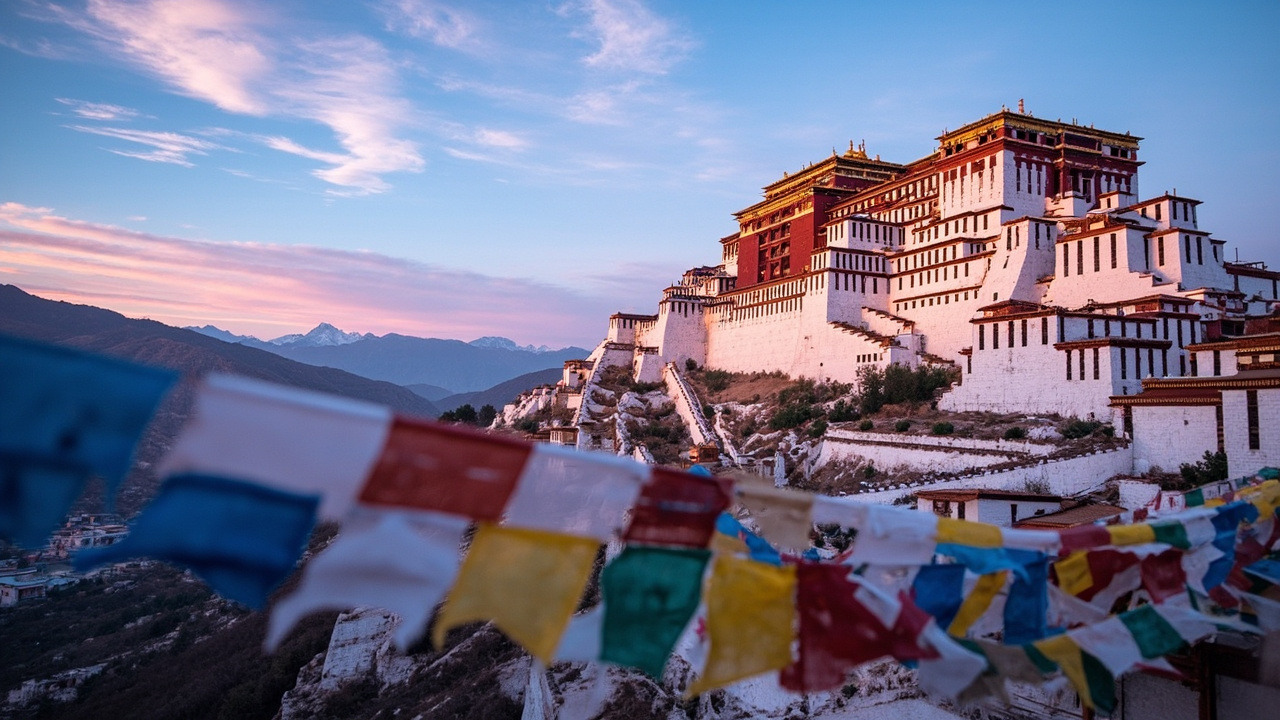
The Potala Palace is the reason most people come to Lhasa, and it genuinely deserves the hype. The former winter residence of the Dalai Lamas, it’s a massive white and red fortress that towers over the city from Marpo Ri hill. It’s also, for altitude-sensitive visitors, a serious physical challenge.
The entrance is at the base of the hill, and you climb a series of switchback ramps and stairs to reach the main building. The climb takes 30-60 minutes depending on your pace, and the altitude makes every step feel like you’re wearing lead boots. I watched a fit-looking German tourist nearly pass out halfway up. He’d arrived in Lhasa the day before and decided to tackle the Potala immediately. Bad call.
My advice: schedule the Potala for day three or later, take it slowly, and carry a portable oxygen canister. The views from the top are worth the effort. Looking down over Lhasa’s white buildings and red-roofed temples, with the mountains rising in every direction, is one of the great travel moments of my life.
Entry costs 200 RMB ($28 USD) during peak season (May-October) and 100 RMB ($14 USD) in winter. You need to book in advance through the official WeChat account or a tour agency. The palace is closed on Mondays and has limited daily visitor numbers, so plan ahead.
The Jokhang Temple: The Spiritual Heart
If the Potala is Lhasa’s crown, the Jokhang Temple is its soul. This is the holiest temple in Tibetan Buddhism, housing a statue of the young Buddha that’s said to be over 1,300 years old. Pilgrims travel from across Tibet to prostrate themselves before it, their hands and foreheads worn smooth from years of prayer.
The temple is in the middle of the old city, surrounded by the Barkhor Kora, the circular pilgrimage route that’s always packed with worshippers spinning prayer wheels and murmuring mantras. The atmosphere is intense, smoky with butter lamps and incense, and deeply moving even if you’re not Buddhist.
Entry costs 85 RMB ($12 USD). The temple opens at 8am and gets busiest in the late morning. Go early, around 8:30, when the light is golden and the pilgrims are at their most fervent. The rooftop offers excellent views over the old city and the Potala in the distance.
One thing I’ll never forget: watching a young monk, maybe 12 years old, carefully pouring yak butter into the lamps while chanting. He caught me watching and smiled, then gestured for me to come closer. He pointed at the butter lamps and said something in Tibetan that I didn’t understand, but the meaning was clear. This was his life, his devotion, his home. I felt like an intruder, but a welcome one.
Sera Monastery: The Debating Monks
About 5 kilometers north of the old city, Sera Monastery is one of Tibet’s three great Gelug monasteries. It’s most famous for its debating courtyard, where monks engage in animated philosophical arguments every afternoon, punctuating their points with loud hand claps and dramatic gestures.
The debates start around 3pm and run until about 5pm. It’s mesmerizing to watch, even if you don’t understand a word of Tibetan. The monks pace, gesture, and shout, their red and yellow robes swirling as they make their points. It’s part theater, part scholarship, and completely unlike anything you’ll see elsewhere.
Entry costs 50 RMB ($7 USD). Take a taxi from central Lhasa (about 20-30 RMB, $3-4 USD) or walk if you’re feeling energetic. The monastery sits at the base of a hill, and the walk up from the main road is gentle but noticeable at altitude. Take your time.
The debates are held outdoors in a gravel courtyard shaded by trees. There are benches where visitors can sit and watch. The monks are used to tourists and generally don’t mind an audience, but keep your distance and don’t interrupt. I once saw a tourist try to take a selfie with a debating monk and get firmly shooed away. The monks are serious about their practice.
Drepung Monastery: The Grand Old Man
Drepung Monastery, about 8 kilometers west of central Lhasa, was once the largest monastery in the world, housing over 10,000 monks at its peak. It’s less visited than Sera, which makes it feel more authentic and peaceful.
The monastery is built into the side of a hill, a maze of whitewashed buildings connected by narrow lanes and steep staircases. Getting lost here is part of the experience. I wandered for two hours and kept discovering new courtyards, prayer halls, and viewpoints over the Lhasa valley.
Entry costs 60 RMB ($8.50 USD). Take a taxi from central Lhasa (about 40-50 RMB, $6-7 USD) or catch bus 24 or 25 from the city center. The monastery is spread out, so you’ll do a lot of walking. Allow at least three hours.
The highlight for me was the main assembly hall, where hundreds of monks would gather for prayers. The hall is dark, lit only by butter lamps and shafts of sunlight through high windows. The air is thick with incense and the sound of chanting. It felt like stepping back 500 years.
The Barkhor Kora: Shopping and Pilgrimage
The Barkhor is the old city’s main street, encircling the Jokhang Temple. It’s part pilgrimage route, part market, and part open-air museum. For most of the day, it’s packed with pilgrims walking clockwise, spinning prayer wheels, and tourists browsing the stalls selling prayer flags, thangka paintings, and Tibetan jewelry.
This is the best place in Lhasa to buy souvenirs, but be prepared to bargain. The stallholders start with prices that assume you’re wealthy and naive. Offer about half, then negotiate from there. I once bought a beautiful hand-painted thangka for 200 RMB ($28 USD) after the initial asking price was 800 RMB ($110 USD). The seller seemed happy, and so was I.
The Barkhor is also where you’ll see the most intense displays of religious devotion. Pilgrims perform full-body prostrations along the route, their hands protected by wooden blocks that slide across the stones. It’s a humbling sight, and it reminds you that this place is not a theme park. It’s a living, breathing center of faith.
Go in the late afternoon, when the light is soft and the crowds thin out slightly. The shops start closing around 7pm, but the pilgrims keep circling well into the evening.
Namtso Lake: The High, Cold Beauty
If you have time and your body is handling the altitude well, consider a day trip to Namtso Lake, one of the highest saltwater lakes in the world at 4,718 meters (15,479 feet). It’s about 200 kilometers north of Lhasa, a 4-5 hour drive each way.
The lake is stunningly beautiful, a vast expanse of turquoise water ringed by snow-capped peaks. The drive crosses the Laken La Pass at 5,190 meters, the highest point you’ll reach on this route. You’ll feel that altitude. I did, and I was well-acclimatized by that point in my trip.
Day trips from Lhasa cost about 500-800 RMB ($70-110 USD) per person with a private driver and guide. You can also take a public bus, but it’s complicated and the schedule is unreliable. I recommend the private option — it’s worth the money to have someone who knows the route and can adjust the plan if you’re feeling unwell.
Bring warm clothes even in summer. The wind at Namtso is brutal, and the temperature can drop below freezing even in July. I made this mistake on my first visit and spent an hour shivering on the lakeshore while my guide laughed and handed me a spare down jacket.
FAQ summary
Most visitors to Lhasa will experience mild altitude sickness symptoms within the first 48 hours, but serious complications are rare with proper precautions. The most effective prevention combines acetazolamide (Diamox) starting 24 hours before arrival, complete rest on day one, aggressive hydration (3-4 liters daily), and avoiding alcohol. Severe symptoms like persistent cough, confusion, or shortness of breath at rest require immediate medical attention at Lhasa People’s Hospital or descent to lower altitude. The train from Xining or Chengdu offers a gentler acclimatization curve than flying, but either arrival method is manageable with the right preparation.
FAQ
Q: How long does altitude sickness last in Lhasa? A: Mild symptoms typically last 24-72 hours as your body acclimatizes. Most people feel significantly better by day three. If symptoms persist beyond day four or worsen, seek medical attention.
Q: Can I visit Lhasa if I have asthma or heart problems? A: You should consult your doctor before traveling to high altitude. Many people with well-controlled conditions visit Lhasa successfully, but altitude puts extra strain on your heart and lungs. Your doctor can advise based on your specific situation.
Q: Is it better to fly or take the train to Lhasa? A: The train from Xining or Chengdu takes 20-30 hours but allows gradual acclimatization. Flying takes 2-3 hours but drops you into high altitude quickly. If you’re worried about altitude sickness, the train is gentler. If you’re short on time, fly and rest on day one.
Q: What is the best time of year to visit Lhasa? A: May through October is the main tourist season, with July and August being warmest but also wettest. Winter (November through March) is cold but clear and less crowded, with cheaper flights and fewer tourists. The Potala Palace is easier to visit in winter due to fewer visitors.
Q: Do I need a special permit to visit Lhasa? A: Yes. Foreign visitors need a Tibet Travel Permit, which must be arranged through a licensed tour operator. You’ll need to provide your passport details and Chinese visa information. The permit is required for all foreigners, regardless of visa-free transit eligibility.
Q: How much does a trip to Lhasa cost? A: Budget at least $100-150 USD per day for a basic trip including accommodation, food, transport, and permits. Flights from Chengdu cost $150-300 USD round trip. A full week in Lhasa with a guide and driver will run $1,000-2,000 USD total.
Q: What happens if I get really sick in Lhasa? A: Go to Lhasa People’s Hospital on Beijing Middle Road. They treat altitude sickness daily and have oxygen beds and experienced staff. If they recommend descending, fly to Chengdu immediately. Don’t wait to see if you feel better.
The Honest Wrap-up
Lhasa is one of the most extraordinary places I’ve ever been, and I’ve been to a lot of places. The combination of profound religious devotion, stunning mountain scenery, and a culture that feels completely different from anywhere else in China makes it unforgettable. But it demands respect. The altitude is not a joke, and the people who struggle are the ones who think they can power through it.
This guide is for the first-time visitor who wants to see Lhasa without ending up in a hospital. It’s not for extreme adventurers planning to trek to Everest Base Camp on day two. If you follow the advice here, rest on day one, take your Diamox, drink your water, and listen to your body, you’ll have an incredible time.
One last thing: when you’re standing in front of the Potala Palace, gasping for breath and wondering why you didn’t just go to Shanghai instead, remember what that monk told me. Slow is fast here. Take your time. The mountains aren’t going anywhere.
More guides you may like

Top 10 Bridges in China
China's bridges are engineering marvels spanning mountains, rivers, and seas. Here are 10 of the most spectacular, from ancient stone to modern steel.
8 min read

Top 10 Buddhist Sites in China
From the Leshan Giant Buddha to the Dunhuang Caves, these 10 Buddhist sites represent 2,000 years of China's spiritual heritage.
9 min read

Top 10 Day Trips from Beijing You Shouldn't Miss
Beijing is packed with history, but some of China's best experiences are just a few hours away. Here are 10 day trips that will transform your visit.
9 min read

Top 10 Hidden Gems in China Off the Beaten Path
Beyond the Great Wall and Terracotta Warriors, China has incredible hidden destinations few tourists ever reach. Here are 10 underrated gems worth the detour.
9 min read

Top 10 Markets and Shopping Streets in China
From Shanghai's Bund to Beijing's Silk Street - 10 markets where foreigners can haggle, explore, and bring home authentic Chinese goods.
9 min read

Top 10 Museums in China You Shouldn't Miss
China's museums span 5,000 years of civilization. These 10 - from the Palace Museum to Xi'an's terracotta gallery - are unmissable for culture lovers.
9 min read