
Street Food Safety in China
TODO: Extract from article (100-160 chars)
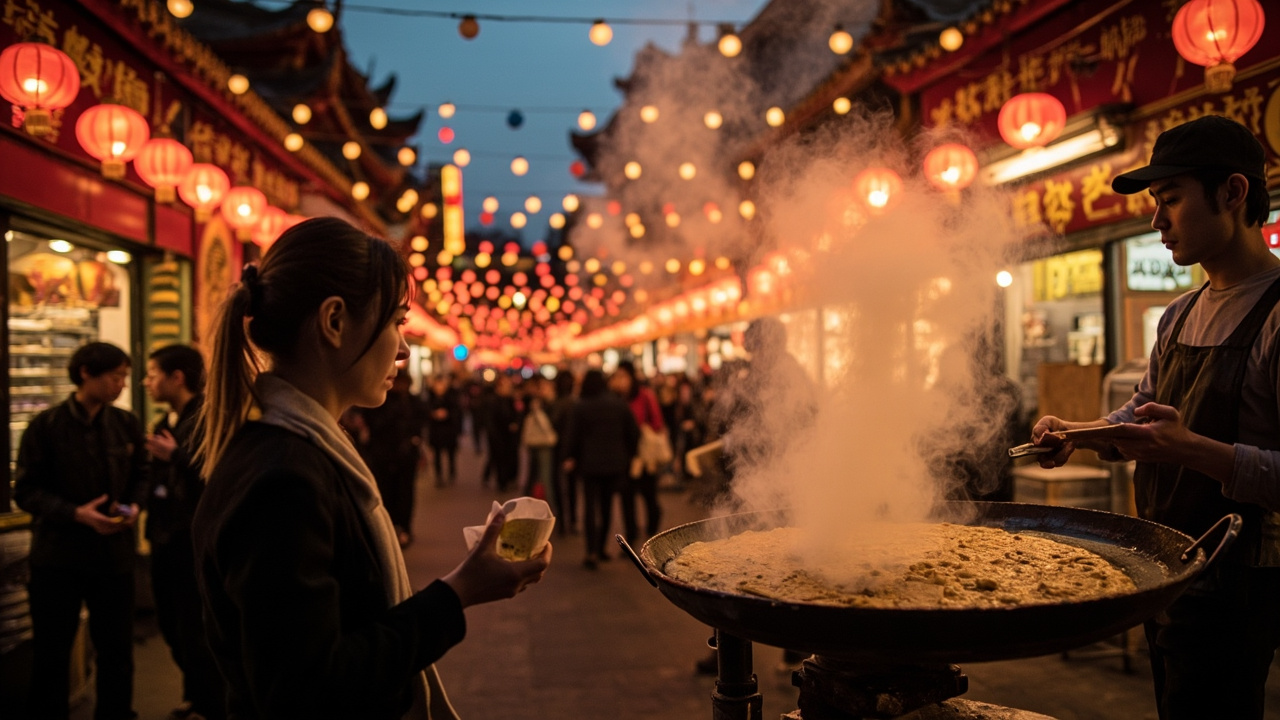
The first time I really understood Chinese street food was in Xi’an, at 11 p.m., standing in a haze of cumin smoke outside a stall in the Muslim Quarter. A man in a stained apron was flipping flatbread in a wok the size of a car tire, and he handed me a paper bowl of something I couldn’t name but that cost about a dollar. I ate it standing up, burned my tongue, and watched a family of four negotiate for three skewers of lamb with a vendor who clearly knew them by name. That was seven years and dozens of cities ago.
Street food is the beating heart of eating in China. It’s not a novelty or a budget hack. It’s how most people actually eat most of the time, from the breakfast jianbing grabbed on the way to the subway to the late-night chuan’r that ends a night out. For a first-time visitor, it’s also the most intimidating part of the trip. You’ve heard the horror stories about hygiene, or you’ve read the forums where someone claims they spent three days in a hotel bathroom after eating a dumpling.
Here’s the truth: street food in China is generally safe if you follow a few simple rules, and it’s one of the most rewarding things you’ll do here. This guide covers what to eat, what to avoid, how to spot a clean stall, what to do if your stomach rebels anyway, and how to pay for it all without fumbling. I’ve eaten at hundreds of stalls across the country, and I’ve gotten sick exactly twice. Both times were my own fault.
Quick answer
Street food in China is safe for most travelers if you eat at busy stalls where food is cooked fresh to order and avoid anything raw or sitting out for hours. Expect to pay $1–4 (¥7–30) per item, and bring your phone with Alipay or WeChat Pay set up, since most vendors don’t take cash or cards. The most important rule is simple: if the stall is crowded with locals, eat there. If it’s empty, walk on.
The Short Version
If you only remember a few things: eat where the line is long, watch your food being cooked, and skip anything that’s been sitting under a heat lamp. Carry your own tissues and hand sanitizer. Drink bottled water, never tap. Don’t eat raw vegetables or unpeeled fruit from stalls. And don’t let fear ruin this for you. The best meal of your trip will probably cost less than $3 and come from a cart with a propane tank strapped to the side.
How I Picked These
I’ve lived in Beijing since 2019 and have traveled to every province except Tibet and Taiwan. For this guide, I spent two months re-visiting street food scenes in ten cities, eating at over 60 stalls, and talking to vendors, food bloggers, and a few gastroenterologists who treat tourists. I also polled my WeChat groups of expat friends and Chinese colleagues about their own rules for eating on the street. The places below aren’t a ranking of the “best” food in China. They’re a practical guide to the street food experiences that are most worth your time, with honest notes on what could go wrong and how to avoid it.
Comparison Table
| Rank | City | Best For | Approx Cost (USD) | Time Needed | When to Go |
|---|---|---|---|---|---|
| 1 | Xi’an | Muslim Quarter lamb skewers | $1–3 per item | 2–3 hours | Evening, spring/autumn |
| 2 | Chengdu | Spicy skewers and noodles | $1–4 per item | 2 hours | Anytime, but evenings are liveliest |
| 3 | Beijing | Breakfast jianbing and donkey burgers | $1–2 per item | 1–2 hours | Morning, before 10 a.m. |
| 4 | Guangzhou | Morning dim sum and rice rolls | $2–5 per item | 2 hours | Early morning |
| 5 | Shanghai | Xiaolongbao and shengjianbao | $2–4 per item | 1–2 hours | Late morning or afternoon |
| 6 | Wuhan | Hot dry noodles (re gan mian) | $1–2 per bowl | 30–60 minutes | Breakfast, before 9 a.m. |
| 7 | Changsha | Stinky tofu and chougan | $1–2 per item | 1–2 hours | Evening |
| 8 | Kunming | Mushroom noodles and grilled cheese | $1–3 per item | 1–2 hours | Spring/autumn, daytime |
| 9 | Qingdao | Grilled seafood and beer | $2–5 per item | 2 hours | Summer evenings |
| 10 | Harbin | Russian-influenced breads and sausages | $1–3 per item | 1–2 hours | Winter, for the cold street scene |
Xi’an — The Muslim Quarter Is a Masterclass in Street Eating
I remember standing in the Muslim Quarter with lamb juice running down my chin, thinking: this is what I came to China for. The narrow alleys are packed with stalls selling roujiamo (the “Chinese hamburger,” though the locals will correct you), biangbiang noodles being slapped against counters, and skewers of lamb that arrive at your table still sizzling.
The reason this place matters isn’t just the food. It’s the density. You can walk 200 meters and eat ten different things, each cooked by someone who’s been doing it for decades. The stall owners here are professionals, not amateurs. The turnover is so high that food doesn’t sit around.
📍 Location: Muslim Quarter (Huimin Jie), central Xi’an, near the Drum Tower.
🎫 Entry fee: Free. Food costs $1–3 (¥7–20) per item.
🕒 Opening hours: Most stalls open 10 a.m. to midnight. The real action starts after 5 p.m.
🚕 How to get there: Take Metro Line 2 to Zhonglou Station (钟楼站), Exit C. Walk west toward the Drum Tower, then follow the crowds into the pedestrian street.
📅 When to visit: Go on a weekday evening if you can. Weekends are shoulder-to-shoulder with domestic tourists.
💡 Insider tips:
- The roujiamo at the stall called “Lao Sun Jia” is famous, but the one two doors down is just as good and has a shorter line.
- Don’t eat the fruit that’s been cut and sitting out. It’s been sitting out.
- Bring your own napkins. Most stalls have a communal roll that’s been touched by everyone.
- The lamb skewers are best when they’re slightly charred. Ask for “la yi dian” (a bit more spicy) if you want the full experience.
- If you see a stall with a line of locals, join it. Don’t read reviews. The line is the review.
I once watched a tourist try to haggle with a skewer vendor over 2 yuan. The vendor just smiled and handed her the skewer for free. She was so embarrassed she bought three more.
Chengdu — Where the Spice Is a Feature, Not a Bug
Chengdu taught me that “spicy” in China is a different word entirely. The first time I tried a properly numbing mapo tofu from a street stall, my face went numb for twenty minutes. I loved it. The city runs on chili oil and Sichuan peppercorn, and the street food reflects that: cold noodles tossed in chili oil, skewers of vegetables and meat dragged through a bubbling pot of broth, and the legendary chuanchuanxiang, where you pay by the stick.
The street food scene here is less organized than Xi’an’s. It’s scattered across the city in night markets and residential neighborhoods. That’s part of the charm. You’ll stumble onto something incredible that has no name and no reviews, and you’ll never find it again.
📍 Location: Kuanzhai Alley and the surrounding neighborhoods, plus the night market at Yulin.
🎫 Entry fee: Free. Most items $1–3 (¥7–20).
🕒 Opening hours: Kuanzhai Alley stalls open around 10 a.m. Night markets start at 6 p.m. and run until midnight.
🚕 How to get there: Take Metro Line 4 to Kuanzhai Alley Station (宽窄巷子站), Exit B. Walk 200 meters to the entrance.
📅 When to visit: Spring and autumn are ideal. Summer is brutally hot and humid, which makes eating spicy food less appealing.
💡 Insider tips:
- The chuanchuanxiang places charge by the stick. A meal for two usually costs $10–15 (¥70–100).
- If you can’t handle spice, say “bu la” (not spicy). But know that even “not spicy” Chengdu food has a kick.
- Drink soy milk with spicy food. It cools the mouth better than water.
- The best dan dan noodles are often at tiny hole-in-the-wall shops, not the famous tourist spots.
- Watch the vendor cook your food. If they’re using fresh oil, you’re fine. If the oil looks dark and old, skip it.
I asked a vendor once if his food was spicy. He laughed and said, “For you? Yes.” He was right. I drank three bottles of water and still couldn’t feel my lips.
Beijing — Breakfast Is the Best Meal of the Day
Most tourists skip breakfast in Beijing, which is a mistake. The city’s street food shines in the morning, when vendors set up carts on street corners and office workers grab jianbing (a savory crepe filled with egg, cilantro, and crispy cracker) and youtiao (fried dough sticks) on their way to work.
The jianbing is the star. It’s made fresh in front of you on a round griddle, and the whole process takes about two minutes. The vendor spreads batter, cracks an egg, sprinkles scallions and cilantro, adds a crispy wafer, brushes on sauce, and folds it into a neat rectangle. It costs about $1.50 (¥10), and it’s the best breakfast deal in the world.
📍 Location: Any residential neighborhood, but the hutongs around Gulou and Nanluoguxiang have good morning stalls.
🎫 Entry fee: Free. Jianbing is $1–2 (¥7–15).
🕒 Opening hours: Breakfast stalls operate roughly 6 a.m. to 10 a.m. Some jianbing carts appear again in the late afternoon.
🚕 How to get there: Take Metro Line 8 to Gulou Dajie Station (鼓楼大街站), Exit G. Walk south into the hutong area and follow your nose.
📅 When to visit: Weekday mornings are best, when the stalls are busiest with locals. Weekends are quieter.
💡 Insider tips:
- Ask for “jia guozi” (add a crispy cracker) on your jianbing. It’s the proper way.
- If you see a stall selling “lurou huoshao” (braised pork burgers), try one. They’re a Hebei specialty that’s become a Beijing staple.
- Don’t drink the soy milk from the big metal vats if it’s been sitting out. Get it fresh from the cart.
- The best youtiao are the ones that are still sizzling when they come out of the oil.
- Bring your own cup if you want coffee. Street stalls don’t do coffee.
I once watched a Beijing grandmother order a jianbing with such precision that the vendor nodded respectfully. She’d clearly been doing this for decades. I tried to copy her order and got it wrong. The vendor fixed it for me without comment.
Guangzhou — Dim Sum’s Humble Street Cousin
Guangzhou doesn’t get enough attention from tourists, which is a shame. The city is the birthplace of dim sum, and while the fancy restaurants get the glory, the street version is where the real action is. In the mornings, old men gather at tea houses and street stalls, drinking pu’er tea and eating har gow (shrimp dumplings) and cheung fun (rice noodle rolls) that cost a fraction of what you’d pay in a restaurant.
The street food here is more Cantonese than the rest of China. It’s lighter, less oily, and more focused on fresh ingredients. You’ll find congee (rice porridge) with century egg, rice rolls with shrimp, and the famous wonton noodles that Guangzhou does better than anywhere else.
📍 Location: The old city around Shangxiajiu Pedestrian Street and the neighborhoods near Chen Clan Ancestral Hall.
🎫 Entry fee: Free. Items range from $2–5 (¥15–35).
🕒 Opening hours: Morning stalls operate 6 a.m. to 11 a.m. Some return in the evening.
🚕 How to get there: Take Metro Line 1 to Changshou Lu Station (长寿路站), Exit D. Walk east toward Shangxiajiu.
📅 When to visit: Go early. The best congee is usually gone by 9 a.m.
💡 Insider tips:
- The wonton noodles at Baozhi Noodle Shop are famous, but the street stalls nearby are just as good.
- If you see a stall selling “zha liang” (fried dough wrapped in rice noodle roll), get it. It’s a Guangzhou specialty.
- Don’t be afraid of the congee with “thousand-year egg.” It tastes better than it sounds.
- Cantonese food is less spicy than Sichuan or Hunan food. If you want heat, you’ll need to ask for chili oil separately.
- The old men at the tea houses will happily recommend their favorite stalls. Ask them.
I sat next to an elderly man at a congee stall who insisted I try his order. He pointed at my bowl and shook his head, then ordered me a different one. He was right. His was better.
Shanghai — The Delicate Art of the Soup Dumpling
Shanghai’s street food is more refined than the rest of China’s. The city’s signature dish, xiaolongbao (soup dumplings), requires a level of precision that borders on obsessive. The skin must be thin enough to see through, the soup inside must be hot but not scalding, and the whole thing must be eaten in one bite without spilling a drop.
The best street versions are found in the old neighborhoods, where tiny shops have been making the same dumplings for generations. The most famous is Jia Jia Tang Bao, but the line is always long. The lesser-known shops are just as good and don’t require a 40-minute wait.
📍 Location: The old city around Yuyuan Garden and the neighborhoods near People’s Square.
🎫 Entry fee: Free. Xiaolongbao is $2–4 (¥15–30) for a basket of six.
🕒 Opening hours: Most shops open 7 a.m. to 8 p.m. The best time is late morning, after the breakfast rush but before lunch.
🚕 How to get there: Take Metro Line 10 to Yuyuan Garden Station (豫园站), Exit 1. Walk east toward the old city.
📅 When to visit: Avoid weekends, when the old city is packed with tourists.
💡 Insider tips:
- Eat the xiaolongbao in one bite. Bite a small hole, sip the soup, then eat the rest.
- The vinegar and ginger dipping sauce is essential. Don’t skip it.
- Shengjianbao (pan-fried pork buns) are the street version of xiaolongbao. They’re greasier but arguably better.
- If a shop has a line, it’s probably worth the wait. If it doesn’t, it’s probably not.
- The best shops are often the ones with no English signage. Look for the ones with the oldest equipment.
I burned my tongue on my first xiaolongbao because I didn’t wait for it to cool. The shop owner laughed and handed me a cup of cold tea. I’ve been more careful ever since.
Wuhan — Breakfast of Champions
Wuhan is a city that takes breakfast seriously. The locals claim they have the best breakfast in China, and they might be right. The signature dish is re gan mian (hot dry noodles), a bowl of sesame-paste-coated noodles topped with scallions and pickled vegetables. It costs about $1.50 (¥10), and it’s the fuel that powers the city.
The breakfast scene is chaotic and wonderful. Streets are lined with stalls selling noodles, dumplings, and fried dough. The locals eat standing up, hunched over their bowls, sometimes while walking. It’s a beautiful sight.
📍 Location: The neighborhoods around Hubu Alley (户部巷) and the older residential areas near the Yangtze River.
🎫 Entry fee: Free. Re gan mian is $1–2 (¥7–15).
🕒 Opening hours: Breakfast stalls operate 6 a.m. to 10 a.m. Hubu Alley has some stalls open all day.
🚕 How to get there: Take Metro Line 2 to Jiyu Qiao Station (积玉桥站), Exit C. Walk south toward Hubu Alley.
📅 When to visit: Go before 9 a.m. The best noodles sell out early.
💡 Insider tips:
- The sesame paste on re gan mian is the key. If the stall uses fresh paste, the noodles will be creamy and rich. If not, they’ll be watery.
- Add a fried dough stick to your noodles. It’s the traditional way to eat them.
- Don’t drink the tap water. Wuhan’s water is notoriously hard.
- The best stalls are the ones with the shortest menus. If they only sell one thing, they’re probably good at it.
- If you see a stall selling “doupi” (a savory rice cake with sticky rice and pork), try it. It’s a Wuhan specialty that’s hard to find elsewhere.
I once asked a Wuhan local what the best breakfast was. He looked at me like I was insane and said, “Re gan mian. Obviously.” He wasn’t wrong.
Changsha — The City That Eats Fire
Changsha is the capital of Hunan province, and Hunan food is the spiciest in China. Not Sichuan spicy, which numbs your mouth. Hunan spicy is pure heat, the kind that makes you sweat and question your life choices. The street food reflects this.
The signature dish is chou doufu (stinky tofu), which sounds terrible and smells worse but tastes incredible. The tofu is fermented for days, then deep-fried until crispy on the outside and soft on the inside. It’s served with chili oil and pickled vegetables. The smell is off-putting, but the taste is addictive.
📍 Location: The night market on Pozi Street (坡子街) and the surrounding neighborhoods.
🎫 Entry fee: Free. Stinky tofu is $1–2 (¥7–15).
🕒 Opening hours: Night market stalls open around 5 p.m. and run until midnight.
🚕 How to get there: Take Metro Line 1 to Huangxing Square Station (黄兴广场站), Exit 2. Walk east to Pozi Street.
📅 When to visit: Evenings are best. The market is liveliest between 7 p.m. and 10 p.m.
💡 Insider tips:
- The stinky tofu at the stall called “Wen Heping” is the most famous. The line is long, but it’s worth it.
- If you can’t handle the smell, hold your nose for the first bite. After that, you won’t notice it.
- The “chougan” (stinky dried tofu) is a different dish from stinky tofu. It’s less smelly and more chewy.
- Drink cold beer with Hunan food. It helps with the heat.
- Don’t touch your eyes after eating Hunan food. You’ll regret it.
I watched a European tourist try stinky tofu for the first time. He took one bite, paused, then ordered three more portions. The vendor was delighted.
Kunming — The Mushroom Capital
Kunming is the capital of Yunnan province, and it’s a food city that most tourists skip. The street food here is different from the rest of China. It’s influenced by the province’s ethnic minorities and its proximity to Southeast Asia. You’ll find things you won’t see anywhere else in China.
The signature dish is mushroom noodles, made with the wild mushrooms that grow in Yunnan’s mountains. The mushrooms are expensive and sometimes toxic if not cooked properly, so the good stalls take them seriously. The result is a bowl of noodles that tastes like the forest floor, in the best possible way.
📍 Location: The night market on Nanping Street and the neighborhoods around Green Lake Park.
🎫 Entry fee: Free. Mushroom noodles are $2–4 (¥15–30).
🕒 Opening hours: Night market stalls open around 6 p.m. and run until midnight.
🚕 How to get there: Take Metro Line 3 to Wuyi Road Station (五一路站), Exit B. Walk east toward Nanping Street.
📅 When to visit: Spring and autumn are best. The mushroom season is June to October.
💡 Insider tips:
- The grilled cheese (rubing) is a Yunnan specialty. It’s made from goat’s milk and tastes like a cross between mozzarella and halloumi.
- The “guoqiao mixian” (crossing-the-bridge noodles) is a Yunnan classic. It comes with a bowl of boiling broth and a plate of raw ingredients that you cook yourself.
- Don’t eat wild mushrooms unless you’re sure they’ve been cooked properly. The good stalls know what they’re doing. The bad ones don’t.
- The rose-flavored pastries are a Kunming specialty. They’re sweet and floral and unlike anything else in China.
- If you see a stall selling “erkuai” (a type of rice cake), try it grilled with chili powder.
I once asked a Kunming vendor if his mushrooms were safe. He looked offended and said, “I’ve been eating these for 40 years.” Then he handed me a bowl. I’m still alive.
Qingdao — Seafood and Beer on the Coast
Qingdao is famous for two things: beer and seafood. The city was a German concession in the early 20th century, and the German influence is still visible in the architecture and the beer. The street food scene revolves around grilled seafood and cold beer, best enjoyed on a summer evening.
The seafood is fresh from the Yellow Sea, and the stalls grill it over charcoal. You’ll find oysters, clams, shrimp, and squid, all seasoned with garlic and chili. The beer is the local Tsingtao, which is somehow better in Qingdao than anywhere else.
📍 Location: The night market on Taidong Pedestrian Street and the beach areas near Zhanqiao Pier.
🎫 Entry fee: Free. Grilled seafood is $2–5 (¥15–35).
🕒 Opening hours: Night market stalls open around 5 p.m. and run until midnight.
🚕 How to get there: Take Metro Line 2 to Taidong Station (台东站), Exit E. Walk west to the pedestrian street.
📅 When to visit: Summer evenings are ideal. The weather is warm and the beer is cold.
💡 Insider tips:
- The grilled oysters with garlic are the best thing on the menu. Order at least two.
- Don’t eat the raw seafood unless you’re sure of the stall’s reputation. The grilled stuff is safer.
- The beer is served in plastic bags with a straw. It’s a Qingdao tradition.
- If you see a stall selling “liangpi” (cold noodles), try it. It’s a refreshing break from the seafood.
- The locals eat seafood with their hands. Don’t be shy.
I once shared a table with a group of Qingdao locals who insisted I try their beer. They were drinking it from plastic bags and toasting everyone who walked by. It was one of the best nights of my trip.
Harbin — Where the Cold Makes the Food Better
Harbin is the coldest major city in China, and the street food reflects that. In winter, when temperatures drop to -30°C (-22°F), the vendors set up stalls on the frozen streets and sell food that’s designed to keep you warm.
The signature dish is the Harbin sausage, a smoked pork sausage with a German influence. It’s served hot, straight off the grill, and it’s the perfect food for a freezing day. The city also has a tradition of Russian-influenced breads and pastries, a legacy of the Russian community that once lived here.
📍 Location: The streets around Central Street (中央大街) and the Ice and Snow World.
🎫 Entry fee: Free. Sausages are $1–3 (¥7–20).
🕒 Opening hours: Winter stalls operate from late November to late February. Hours vary.
🚕 How to get there: Take Metro Line 2 to Central Street Station (中央大街站), Exit C. Walk east to the pedestrian street.
📅 When to visit: January is the best time, when the Ice and Snow World is open and the streets are at their most festive.
💡 Insider tips:
- The Harbin sausage is best eaten hot, straight off the grill. Don’t let it cool.
- The “guobaorou” (锅包肉, sweet and sour pork) is a Harbin specialty. It’s different from the Cantonese version.
- The Russian breads are dense and hearty. They’re best with butter and jam.
- If you’re visiting in winter, dress in layers. The cold is no joke.
- The locals drink hot soy milk to warm up. It’s a better choice than coffee.
I once stood in -25°C weather eating a Harbin sausage and watching the snow fall on Central Street. The sausage was hot, the beer was cold, and I’ve never been happier.
FAQ summary
Street food in China is safe if you eat at busy stalls where food is cooked fresh to order, and you should expect to pay $1–4 (¥7–30) per item. The most important rules are to eat where locals eat, avoid anything raw or sitting out, carry your own tissues and hand sanitizer, and drink only bottled water. Payment is almost always by Alipay or WeChat Pay, so set up your account before you arrive, and bring a SIM card or eSIM so you can translate menus and navigate.
FAQ
Q: Is it safe to eat street food in China? A: Yes, for most travelers, if you follow basic precautions. Eat at busy stalls with high turnover, watch your food being cooked, and avoid anything raw or that’s been sitting out. The risk of food poisoning is real but manageable.
Q: What should I do if I get sick from street food? A: Stay hydrated with bottled water and oral rehydration salts, which you can buy at any pharmacy. Most cases resolve within 24–48 hours. If you have a fever or blood in your stool, see a doctor. Major hospitals in big cities have international departments.
Q: How do I pay for street food in China? A: Almost all vendors accept Alipay or WeChat Pay. Cash is rarely accepted, and credit cards are almost never accepted. Set up your payment apps before you arrive and link them to your international card.
Q: Do I need to worry about the water? A: Yes. Never drink tap water in China. Drink bottled water, which is cheap and widely available. Also avoid ice in drinks unless you’re sure it’s made from purified water. Brush your teeth with bottled water too, just to be safe.
Q: What foods should I avoid at street stalls? A: Avoid anything raw, including salads, unpeeled fruit, and raw shellfish. Also avoid food that’s been sitting under heat lamps for hours. Stick to food that’s cooked fresh to order, and you’ll be fine.
Q: Is it okay to eat at stalls that don’t look clean? A: Use your judgment. A stall that looks rough but has a long line of locals is probably fine. A stall that looks rough and is empty is probably not. Trust the crowd, not the appearance.
Q: What if I have dietary restrictions or allergies? A: This is challenging in China, where cross-contamination is common and English is rarely spoken. Learn the Chinese words for your allergens and show them to the vendor. For severe allergies, consider skipping street food entirely and eating at restaurants that can accommodate you.
The Honest Wrap-up
This guide is for travelers who want to eat like the locals do, not for people who need hand-holding. If you’re the kind of person who reads every review before trying a new restaurant, you might struggle with the chaos of Chinese street food. But if you’re willing to trust your instincts and follow the crowds, you’ll be rewarded with some of the best meals of your life.
The one piece of advice I’d give a friend who’s about to book the flight: don’t let fear dictate your choices. Yes, you might get sick. It happens. But the alternative is eating only at tourist restaurants and missing out on the real China. The best food in this country is served on plastic stools under fluorescent lights, and it costs less than your coffee back home.
Bring your appetite, your hand sanitizer, and your sense of adventure. You’ll need all three.
More guides you may like

Top 10 Bridges in China
China's bridges are engineering marvels spanning mountains, rivers, and seas. Here are 10 of the most spectacular, from ancient stone to modern steel.
8 min read

Top 10 Buddhist Sites in China
From the Leshan Giant Buddha to the Dunhuang Caves, these 10 Buddhist sites represent 2,000 years of China's spiritual heritage.
9 min read

Top 10 Day Trips from Beijing You Shouldn't Miss
Beijing is packed with history, but some of China's best experiences are just a few hours away. Here are 10 day trips that will transform your visit.
9 min read

Top 10 Hidden Gems in China Off the Beaten Path
Beyond the Great Wall and Terracotta Warriors, China has incredible hidden destinations few tourists ever reach. Here are 10 underrated gems worth the detour.
9 min read

Top 10 Markets and Shopping Streets in China
From Shanghai's Bund to Beijing's Silk Street - 10 markets where foreigners can haggle, explore, and bring home authentic Chinese goods.
9 min read

Top 10 Museums in China You Shouldn't Miss
China's museums span 5,000 years of civilization. These 10 - from the Palace Museum to Xi'an's terracotta gallery - are unmissable for culture lovers.
9 min read