
Guangxi Detian Waterfall
TODO: Extract from article (100-160 chars)
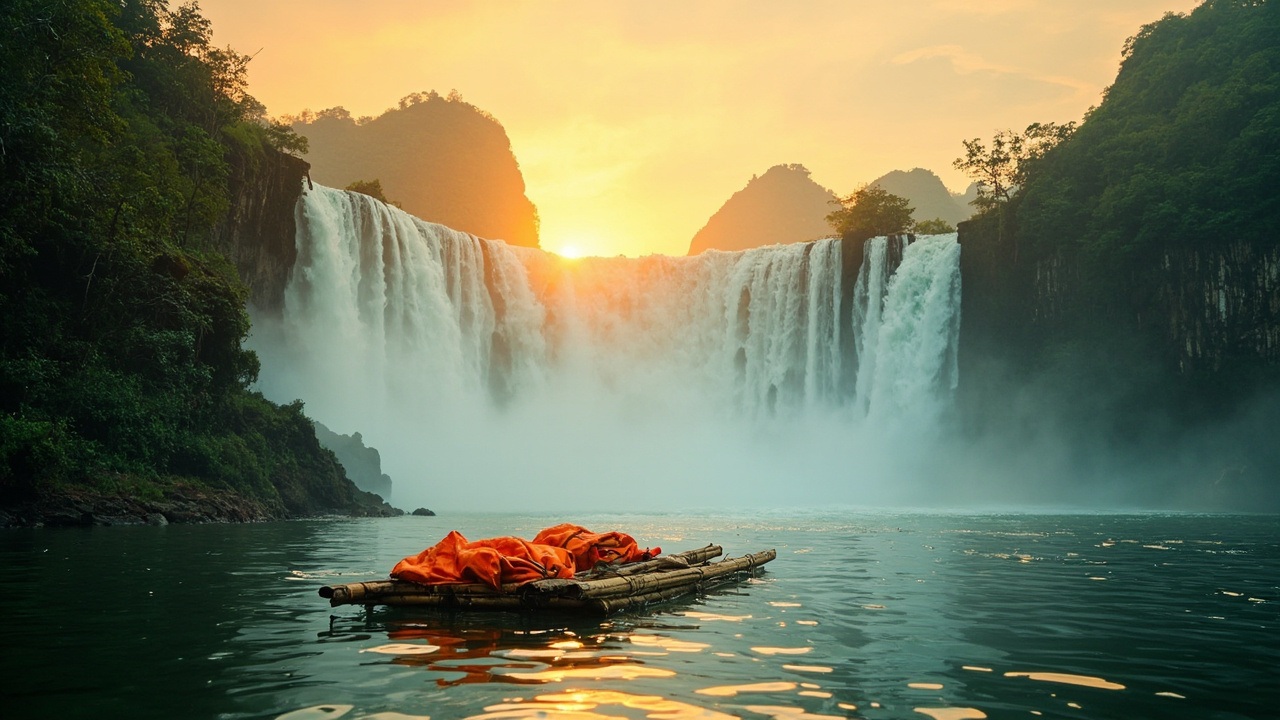
The bus groaned around another switchback, and then I saw it. A wall of white water, maybe three hundred feet across, hammering down a cliff face that marked the border between China and Vietnam. I pressed my face to the cold window. The guy next to me, a farmer hauling a sack of rice, nodded and said something I didn’t catch, but I knew what he meant. Worth the ride.
Detian Waterfall is not the tallest waterfall in the world, and it’s not the widest. But it’s the only one I know where you can stand on Chinese soil, watch Vietnamese tourists on the other side of the river doing the exact same thing, and feel the spray on your face while a bamboo raft driver yells at you in two languages to get on board. It’s a border, a natural wonder, and a tourist complex all at once, and it’s genuinely spectacular when the water is running.
This guide covers everything you need to know before you go: how to get to Detian from Nanning or Chongzuo, what it costs in 2026, whether the cross-border gimmicks are worth your money, and how to see the waterfall without feeling like you’re in a shopping mall. I’ve been three times, in different seasons, and I’ve made the mistakes so you don’t have to.
Quick answer
Detian Waterfall is a 200-foot-high, 650-foot-wide transnational waterfall on the China-Vietnam border in Guangxi, reachable from Nanning by a 4-hour bus or private car. The entry fee is about $16 (¥115) plus a mandatory $5 (¥35) sightseeing bus, and the best time to visit is September to October when rainfall keeps the water heavy. US, UK, Canadian, and most European passport holders can visit China visa-free for up to 30 days through 2026, so you don’t need a visa for a standalone trip.
The Short Version
Go in autumn, not summer. Summer water is impressive but the river turns brown with mud and the humidity is brutal. Arrive when the gates open at 8:30 AM to beat the tour groups. Skip the overpriced Vietnamese market stalls on the border bridge. Take the bamboo raft, it’s the only way to feel the full power of the falls. And don’t skip the walk up to the viewing platform at the top, even though the stairs will punish you. It’s a long way from anywhere, so plan a full day and treat it as a journey, not a quick stop.
How I Picked These
I’ve lived in China for seven years and traveled through Guangxi more times than I can count. For Detian specifically, I’ve visited three times: once in August during peak flood season, once in November when the water was disappointingly thin, and once in late September, which I now consider the sweet spot. I’ve taken the public bus from Nanning, hired a private driver, and stayed overnight in the nearby town of Shuolong so I could be first in line at the ticket gate. I’ve also talked to enough local drivers, hostel owners, and fellow travelers to separate what’s genuinely useful from what’s just repeated in blog posts.
Comparison Table
| Rank | Place | Best For | Approx Cost (USD) | Time Needed | When to Go |
|---|---|---|---|---|---|
| 1 | Detian Waterfall Main Viewing Area | First-timers, the classic view | $21 (¥150) total | 3-4 hours | Sep-Oct |
| 2 | Bamboo Raft Ride | Getting close to the falls | $7 (¥50) extra | 30 minutes | Sep-Oct |
| 3 | Viewing Platform at the Top | Seeing the source of the falls | Included | 40 min hike | Sep-Oct |
| 4 | Vietnam Border Market | Souvenir shopping, border novelty | Free | 30 minutes | Any time |
| 5 | Shuolong Village | Budget stays, local food | $15-30/night | Overnight | Year-round |
| 6 | Ming River Scenic Area | Combining with Detian | $13 (¥90) | 2-3 hours | Sep-Nov |
| 7 | Tongling Gorge | A quieter alternative nearby | $15 (¥105) | 3 hours | Any time |
| 8 | Friendship Pass | Border history, less touristy | $10 (¥70) | 2 hours | Year-round |
| 9 | Daxin County Town | Local life, cheap eats | Free | 1-2 hours | Year-round |
| 10 | Longhu Mountain | Monkeys and karst scenery | $13 (¥90) | 3 hours | Year-round |
1. Detian Waterfall Main Viewing Area 鈥?The View That Made the Trip Worth It
The first time I saw Detian, I actually laughed out loud. Not because it was funny, but because it was so much bigger than the photos suggested. The photos make it look like a nice waterfall. In person, it’s a roaring, mist-shrouded monster that makes conversation difficult and photographs pointless. You’ll take photos anyway. Everyone does.
The main viewing area is a series of tiered platforms that follow the river downstream from the falls. The lowest platform is where the tour groups cluster, taking selfies with the spray. The higher platforms are quieter and give you a different angle, looking down at the water as it crashes into the pool below. My advice: start at the bottom, work your way up, and save the highest platform for last. The view from the top, looking across the river into Vietnam, is the one you’ll remember.
What makes Detian special isn’t just the waterfall itself, it’s the setting. The karst peaks that define Guangxi’s landscape rise up on both sides of the border, and the river that feeds the falls splits around a small island that’s technically Vietnamese territory. You can see Vietnamese tourists on their side of the river, and they can see you. There’s something genuinely moving about standing at a border that’s marked by nothing more than a river and a waterfall.
📍 Location: Daxin County, Chongzuo City, Guangxi. The falls are on the border with Vietnam’s Cao Bang Province.
🎟 Entry fee: $16 (¥115) for the park, plus a mandatory $5 (¥35) for the internal sightseeing bus. You can’t walk from the gate to the falls, it’s about 4 miles.
🕒 Opening hours: 8:00 AM to 5:30 PM daily, year-round. The last entry is around 4:30 PM.
🚌 How to get there: From Nanning Langdong Bus Station, take the direct bus to Detian (about 4 hours, $13/¥90). The bus drops you at the tourist center, from where you take the internal bus. Alternatively, take a train to Chongzuo (1.5 hours from Nanning, $12/¥85) and then a local bus or taxi for the remaining 2 hours.
☀ When to visit: September to October for the best water flow without the summer crowds. Arrive at 8:30 AM, before the tour buses from Nanning start arriving around 10 AM.
💡 Insider tips:
- The sightseeing bus stops at three points. Get off at the last stop and walk back toward the falls, it’s less crowded.
- Bring a rain jacket or poncho. The spray at the lower platforms will soak you.
- The “cross-border” walkway that lets you step into Vietnam requires a day pass and a passport. It’s a novelty, but you’ll spend more time in line than in Vietnam.
- Don’t buy the “Vietnamese” goods at the market stalls. Most are made in Yiwu, China.
I met a retired couple from Chengdu at the top platform who told me they’d been coming to Detian every autumn for a decade. “The water is different every year,” the husband said. “But the sound never changes.”
2. The Bamboo Raft Ride 鈥?Worth Every Yuan
I almost skipped the raft. I’d seen the photos of tourists in orange life jackets packed onto bamboo rafts, and it looked like a theme park ride. But a local driver told me, “You haven’t seen the waterfall until you’ve felt it,” and he was right.
The rafts are actually plastic tubes disguised as bamboo, and they’re operated by local families who’ve been running the river for generations. The ride takes you from the dock below the falls to within about 50 feet of the main cascade. The spray hits you like rain, the noise is deafening, and you get a perspective that’s completely different from the viewing platforms. You’re looking up at the water as it falls, and you realize just how much force is involved.
The rafts also cross the border line briefly, and you can wave at the Vietnamese raft operators on their side. It’s a strange feeling, being on a river that’s an international boundary, with no passport control in sight.
📍 Location: The raft dock is at the lowest viewing platform, about a 10-minute walk from the internal bus stop.
🎟 Cost: $7 (¥50) per person, paid separately from the park entry. Cash or WeChat Pay accepted.
🕒 Operating hours: 8:30 AM to 5:00 PM, weather permitting. The rafts stop running if the river is too high or too low.
🚶 How to access: From the main viewing area, follow the path downstream to the lowest platform. The dock is clearly marked.
☀ When to go: Morning, before the wind picks up. The spray is more manageable when the air is still.
💡 Insider tips:
- The rafts hold about 10 people. If you want a less crowded ride, go early or late in the day.
- Wear sandals or shoes you don’t mind getting wet. Your feet will be in water.
- The Vietnamese raft operators will try to sell you goods from their boats. It’s technically illegal but happens anyway.
- If you’re prone to motion sickness, sit in the middle of the raft, not the front.
The raft operator, a man named Wei who’d been running the river for 22 years, pointed at the Vietnamese side and said, “My grandmother was born over there. Before the border was closed, families crossed freely. Now we wave.”
3. Viewing Platform at the Top 鈥?The Hike That Punishes and Rewards
The stairs are brutal. I’ll say that upfront. From the middle viewing platform, a stone staircase climbs about 300 feet to the top of the falls, where the river splits and plunges over the edge. It’s not a long hike, maybe 20 minutes if you’re fit, but it’s steep, and the humidity in Guangxi makes it feel twice as hard.
But the view from the top is worth every step. You’re standing at the source of the waterfall, watching the river gather itself before it drops. The water is clear and green here, before it churns into white foam below. On the Vietnamese side, you can see their viewing platforms and the small village that sits just across the border.
The top platform is also where you’ll find the actual border marker, a stone pillar that’s been there since the border was demarcated in the 19th century. Tourists line up to take photos with it, but if you wait until the tour groups leave, you’ll have it to yourself.
📍 Location: The staircase starts at the middle viewing platform and climbs to the top of the falls.
🎟 Cost: Included in the park entry fee.
🕒 Access: The staircase is open during park hours. It’s well-maintained but slippery when wet.
🚶 How to access: From the main viewing area, follow the signs for “Top Viewing Platform” (观景台). The path is clearly marked.
☀ When to go: Late morning, after the mist has burned off. The views are clearer.
💡 Insider tips:
- Take your time on the stairs. There are rest platforms every 50 steps or so.
- The top platform has a small shop selling water and snacks, but prices are double what you’d pay elsewhere.
- If you have mobility issues, skip this. The view from the middle platform is still excellent.
- The path continues past the top platform to a bridge that crosses the river. On the other side, you can walk along the Vietnamese border fence.
I made the mistake of doing this hike at noon in August. By the time I reached the top, my shirt was soaked through and I’d drunk all my water. Learn from me: bring water, go in the morning.
4. Vietnam Border Market 鈥?A Novelty, Not a Necessity
The border market at Detian is exactly what you’d expect from a tourist attraction that straddles an international boundary: a collection of stalls selling the same souvenirs you’ll find at every tourist site in China, plus a few things that are actually from Vietnam. Coffee, dried fruit, and the ubiquitous “Vietnamese” sandals that are actually made in China.
The market is located on the bridge that crosses the river to Vietnam, and you can walk to the middle of the bridge before being stopped by a gate. On the Vietnamese side, you can see their market stalls and the Vietnamese border guards, who look bored and are happy to pose for photos if you ask nicely.
Is it worth the walk? If you’re already at Detian, sure. It takes 20 minutes to browse, and the coffee is genuinely decent. But don’t plan your trip around it. The real border crossing is at Friendship Pass, about 2 hours away, and that’s a different experience entirely.
📍 Location: The bridge is at the eastern edge of the park, about a 15-minute walk from the main viewing area.
🎟 Cost: Free to walk to the middle of the bridge. You need a passport and a day pass to cross into Vietnam.
🕒 Hours: The market is open during park hours.
🚶 How to access: Follow the path from the main viewing area toward the river. The bridge is clearly visible.
☀ When to go: Any time. The market is busiest in the late morning.
💡 Insider tips:
- The “Vietnamese coffee” is worth buying, but check the price. Some stalls charge double for the same brand.
- Don’t buy the “genuine” Vietnamese goods without checking the labels. Most are made in China.
- The border guards on both sides are used to tourists taking photos. Just don’t point your camera at the guard posts.
- If you want to actually cross into Vietnam, you need to do it at a formal border crossing, not here.
I bought a bag of Vietnamese coffee from a woman who spoke no Chinese and I spoke no Vietnamese. We communicated through a translation app and she threw in a free packet of dried jackfruit. The coffee was excellent.
5. Shuolong Village 鈥?Where to Sleep When You Don’t Want to Rush
Most tourists visit Detian as a day trip from Nanning, which means they spend 8 hours on a bus for 3 hours at the waterfall. That’s a mistake. Stay overnight in Shuolong, the small town at the entrance to the park, and you’ll have the falls almost to yourself in the morning.
Shuolong is not a pretty town. It’s a collection of guesthouses, restaurants, and souvenir shops that exist entirely to serve Detian tourists. But it’s got a certain charm, especially in the evening when the tour buses have left and the streets quiet down. The food is local Guangxi fare, heavy on rice noodles and river fish, and the guesthouses are basic but clean.
The real advantage of staying in Shuolong is timing. The park gates open at 8:00 AM, and if you’re staying in town, you can be first in line. By 9:00 AM, you’ll have the main viewing platforms to yourself. By 10:00 AM, the tour groups arrive and it’s a different experience entirely.
📍 Location: Shuolong is about 1 mile from the Detian tourist center, at the entrance to the scenic area.
🏨 Cost: Guesthouse rooms range from $15-30 (¥100-200) per night. The better places are closer to the park entrance.
🕒 Best time to arrive: Late afternoon, so you can explore the town and have dinner before an early night.
🚌 How to get there: The direct bus from Nanning stops in Shuolong before continuing to the tourist center. If you’re taking a private car, tell the driver you’re staying overnight.
☀ When to visit: Year-round, but the town is quieter in the off-season (November to March).
💡 Insider tips:
- Book your guesthouse in advance during peak season (September to October and Chinese holidays).
- The restaurants in Shuolong are hit-or-miss. Look for the ones with locals eating inside.
- Your guesthouse can arrange a private driver for the next day’s sightseeing, usually cheaper than hiring one from Nanning.
- The town has a small supermarket if you need supplies, but don’t expect Western brands.
My guesthouse owner, a woman in her 50s named Auntie Chen, insisted I try her homemade rice wine. It was strong, sweet, and I woke up the next morning with a headache and a newfound respect for Guangxi hospitality.
6. Ming River Scenic Area 鈥?The Boat Ride That Shows You Guangxi’s Other Side
If you’re already making the journey to Detian, it’s worth adding the Ming River scenic area to your itinerary. It’s on the way, about 30 minutes from Detian, and it offers a completely different perspective on the same karst landscape that makes the region famous.
The Ming River is a tributary of the Black River, and the scenic area is a 2-hour boat ride through a valley of limestone peaks, rice paddies, and small villages. The boats are flat-bottomed and quiet, and the scenery is the kind that makes you want to put your camera down and just look.
The highlight is the “landscape of the immortals,” a stretch of river where the karst peaks are reflected perfectly in the still water. It’s the kind of view that’s been painted by Chinese artists for centuries, and seeing it in person makes you understand why.
📍 Location: The Ming River scenic area is between Daxin County and Detian, about 30 minutes from the waterfall.
🎟 Entry fee: $13 (¥90) for the boat ride, which lasts about 2 hours.
🕒 Hours: Boats run from 8:00 AM to 5:00 PM daily.
🚌 How to get there: If you’re driving from Nanning to Detian, the Ming River scenic area is on the way. Look for the turnoff after Daxin County. If you’re taking public transport, you’ll need to hire a taxi or join a tour.
☀ When to visit: Morning, when the water is calmest and the reflections are clearest.
💡 Insider tips:
- Sit on the left side of the boat for the best views.
- The boat ride is peaceful, but it’s not a wildlife safari. Don’t expect to see monkeys or exotic birds.
- Bring snacks and water. There are no food stalls on the river.
- The boat drops you off at a small village where you can catch a bus back to the main road.
The boat driver pointed out a cave in one of the karst peaks and told me it was used as a hideout during the war with Vietnam in 1979. “My father hid there,” he said. “Now we take tourists past it.”
7. Tongling Gorge 鈥?The Quiet Alternative Most Tourists Miss
If Detian is the famous waterfall that everyone visits, Tongling Gorge is the lesser-known sibling that locals prefer. It’s about an hour from Detian, deeper into the karst mountains, and it offers a completely different kind of waterfall experience.
Tongling is a narrow gorge, maybe 100 feet wide at its narrowest, with a waterfall at the end that drops into a pool of impossibly clear water. Unlike Detian, which is a wide curtain of water, Tongling is a single column that falls from a height of about 500 feet. The sound echoes off the gorge walls, and the mist creates rainbows on sunny days.
The hike through the gorge takes about 2 hours, following a path that winds through dense forest, past small pools and cascades, until you reach the main falls. It’s not a difficult hike, but it’s uneven in places, and the humidity can be intense.
📍 Location: Tongling Gorge is about 30 miles from Detian, in the direction of Jingxi City.
🎟 Entry fee: $15 (¥105) for the gorge and the hike.
🕒 Hours: 8:00 AM to 5:00 PM daily.
🚌 How to get there: You’ll need a private car or taxi. There’s no public transport to Tongling.
☀ When to visit: Afternoon, when the sun hits the gorge and creates rainbows in the mist.
💡 Insider tips:
- The path can be slippery after rain. Wear shoes with good grip.
- The pool at the base of the falls is technically swimmable, but the water is freezing.
- There’s a small restaurant at the entrance serving local dishes. The river fish is excellent.
- If you’re short on time, skip Tongling. But if you want to escape the crowds at Detian, it’s worth the detour.
I had the gorge almost to myself on a weekday in September. I sat on a rock near the base of the falls for 30 minutes, just watching the water and listening to the sound. It was the most peaceful hour of my entire trip through Guangxi.
8. Friendship Pass 鈥?History at the Border
Friendship Pass, or Youyi Guan, is the main border crossing between China and Vietnam in Guangxi. It’s about 2 hours from Detian, near the city of Pingxiang, and it’s a place where history feels very close to the surface.
The pass has been a border crossing for centuries, and it’s been the site of wars, invasions, and diplomatic negotiations. The current gate was built in the 1950s, after China and Vietnam established diplomatic relations, and it’s a strange mix of Chinese and Vietnamese architectural styles.
You can walk up to the gate, but you can’t cross without a valid visa for Vietnam. The border guards are used to tourists taking photos, and there’s a small museum nearby that explains the history of the pass. It’s not a must-see, but if you’re interested in the region’s history, it’s worth the detour.
📍 Location: Pingxiang City, about 2 hours from Detian by car.
🎟 Entry fee: $10 (¥70) for the museum and the area around the gate.
🕒 Hours: 8:00 AM to 6:00 PM daily.
🚌 How to get there: From Detian, you’ll need a private car or taxi. Alternatively, take a bus from Nanning to Pingxiang (3 hours) and then a taxi to the pass.
☀ When to visit: Any time. The pass is less crowded in the afternoon.
💡 Insider tips:
- Don’t try to cross the border without a visa. The Chinese guards will turn you back, and it’s not worth the hassle.
- The museum has English translations for the main exhibits.
- The town of Pingxiang has some excellent Vietnamese restaurants, a legacy of the border trade.
- If you’re planning to continue to Vietnam, this is the crossing to use. The visa process takes about 30 minutes on a good day.
I stood at the gate and watched a group of Vietnamese workers crossing into China for their shift at a nearby factory. They walked past the ornate gate without a glance, chatting and laughing. The border is just a line on a map, but it’s also a daily reality for thousands of people.
9. Daxin County Town 鈥?Real Life in the Karst Mountains
Daxin County is the administrative center of the region, and it’s where you’ll change buses if you’re taking public transport to Detian. It’s not a tourist destination, but it’s a place where you can see how people actually live in this part of Guangxi.
The town is built along the banks of the Black River, and it’s a typical small Chinese county town: wide streets, concrete buildings, and a central square where old men play chess and young people scroll on their phones. There’s a morning market where farmers sell vegetables, live chickens, and mysterious herbs, and there are noodle shops on every corner.
If you have an hour to kill between buses, walk across the river to the old town, where some of the original buildings from the Qing Dynasty are still standing. They’re not restored or touristified, just old and lived-in, with laundry hanging from balconies and old women sitting in doorways.
📍 Location: Daxin County is about 1 hour from Detian by car, on the road to Nanning.
🎟 Cost: Free to explore.
🕒 Best time to visit: Morning, when the market is in full swing.
🚌 How to get there: Buses from Nanning to Detian stop in Daxin. If you’re driving, it’s on the main road.
☀ When to visit: Year-round.
💡 Insider tips:
- The morning market is the best place to try local fruits and snacks. Look for the yellow-skinned passion fruit, which is sweeter than the purple variety.
- The noodle shops near the bus station are cheap and good. A bowl of beef noodles costs about $2 (¥15).
- If you need to use an ATM, Daxin has several. Detian does not.
- The town has a few small hotels if you get stuck, but Shuolong is a better base for visiting Detian.
I stopped in Daxin for lunch on my way back to Nanning and ended up staying for two hours. The owner of the noodle shop, a woman named Li, told me about her son who was studying in Guangzhou. “He says he’ll never come back to Daxin,” she said. “But this is his home.”
10. Longhu Mountain 鈥?Monkeys and Karst Peaks
Longhu Mountain, or Dragon Tiger Mountain, is a scenic area about 30 minutes from Daxin County. It’s known for two things: dramatic karst peaks and a population of wild monkeys that have become accustomed to tourists.
The monkeys are the main attraction. They’re Tibetan macaques, and they’ve learned that tourists carry food. They’ll approach you, sit on your shoulder, and try to grab your bag. It’s cute for the first five minutes, then it becomes a bit much. The park staff sell peanuts and fruit for you to feed them, but I’d advise against it unless you’re prepared for the chaos.
The scenery, though, is worth the visit. The karst peaks here are taller and more dramatic than at Detian, and there’s a walking path that winds through the valley, past rice paddies and small villages. The path is flat and easy, suitable for all fitness levels.
📍 Location: Longhu Mountain is about 30 minutes from Daxin County, in the direction of Long’an.
🎟 Entry fee: $13 (¥90) for the park.
🕒 Hours: 8:00 AM to 5:30 PM daily.
🚌 How to get there: From Daxin, take a local bus or taxi. There’s no direct public transport from Detian.
☀ When to visit: Morning, when the monkeys are most active.
💡 Insider tips:
- Hold your bag tightly. The monkeys are expert thieves.
- Don’t bring food into the park unless you’re prepared to share it.
- The best views are from the top of the main peak, which requires a steep climb of about 30 minutes.
- The park is popular with domestic tourists on weekends. Go on a weekday if you can.
A monkey stole my water bottle and drank from it before dropping it on the ground. The park ranger laughed. “He does that to everyone,” he said. “He’s the boss of this mountain.”
FAQ summary
Detian Waterfall is a transnational waterfall on the China-Vietnam border in Guangxi, reachable from Nanning by a 4-hour bus ride or private car. The total cost is approximately $21 (¥150) including the mandatory internal bus, and the best time to visit is September to October when water flow is heavy but the weather is manageable. Most Western passport holders can enter China visa-free for up to 30 days through 2026, making a standalone trip to Detian feasible without advance visa paperwork. For the best experience, stay overnight in Shuolong Village and arrive at the park gates when they open at 8:00 AM.
FAQ
Q: How do I get to Detian Waterfall from Nanning? A: Take the direct bus from Nanning Langdong Bus Station to Detian, which takes about 4 hours and costs $13 (¥90). The bus drops you at the tourist center, where you transfer to the mandatory internal sightseeing bus for the final 4 miles to the falls.
Q: Do I need a visa to visit Detian Waterfall in 2026? A: Most US, UK, Canadian, Australian, and European passport holders can enter China visa-free for up to 30 days through 2026. This covers tourism, so you don’t need a separate visa for a trip to Detian. Check the latest visa-free transit policies before you go.
Q: What is the best time of year to visit Detian Waterfall? A: September to October is the sweet spot. The water is still heavy from the summer rains, but the weather is cooler and the crowds are thinner than in July and August. November through March has much less water, and the falls can be disappointing.
Q: Is Detian Waterfall worth the long trip from Nanning? A: Yes, if you have at least two days to spare. The journey takes 4 hours each way, so a day trip means 8 hours on a bus for 3 hours at the falls. Stay overnight in Shuolong Village and you’ll have the falls to yourself in the early morning.
Q: Can I cross into Vietnam at Detian Waterfall? A: There’s a pedestrian bridge that crosses the border, but you can only walk to the middle without a valid Vietnam visa. If you want to actually enter Vietnam, use the Friendship Pass near Pingxiang, about 2 hours away.
Q: What should I bring to Detian Waterfall? A: A rain jacket or poncho for the spray, comfortable walking shoes for the stairs, and cash or a phone with Alipay or WeChat Pay set up. The park has few ATMs and many vendors don’t accept foreign credit cards.
Q: Is English spoken at Detian Waterfall? A: Very little. The staff at the ticket office and the internal bus understand basic phrases, but you’ll need a translation app for most interactions. Download a VPN and translation app before you arrive, as Google services are blocked in China.
The Honest Wrap-up
Detian Waterfall is not the most convenient destination in China. It’s a long way from anywhere, the infrastructure is basic, and you’ll spend more time in transit than you will at the falls themselves. But that’s also its charm. It’s a place that rewards the traveler who’s willing to put in the effort, who’s not just checking boxes on a tour itinerary.
This guide is for the traveler who wants to see a genuinely spectacular natural wonder without the crowds of Guilin or the commercialization of Huangshan. It’s not for the traveler who wants luxury accommodations or fine dining, because you won’t find either in Shuolong. It’s for the traveler who’s willing to eat noodles for breakfast, sleep in a basic guesthouse, and wake up early to see a waterfall before the tour buses arrive.
If you’re planning a trip to China and you have the time, make the journey to Detian. But if you’re on a tight schedule, skip it and spend your days in Guilin or Chengdu. Detian is a detour, not a destination. But for me, it’s the kind of detour that makes travel worth it.
More guides you may like

Top 10 Bridges in China
China's bridges are engineering marvels spanning mountains, rivers, and seas. Here are 10 of the most spectacular, from ancient stone to modern steel.
8 min read

Top 10 Buddhist Sites in China
From the Leshan Giant Buddha to the Dunhuang Caves, these 10 Buddhist sites represent 2,000 years of China's spiritual heritage.
9 min read

Top 10 Day Trips from Beijing You Shouldn't Miss
Beijing is packed with history, but some of China's best experiences are just a few hours away. Here are 10 day trips that will transform your visit.
9 min read

Top 10 Hidden Gems in China Off the Beaten Path
Beyond the Great Wall and Terracotta Warriors, China has incredible hidden destinations few tourists ever reach. Here are 10 underrated gems worth the detour.
9 min read

Top 10 Markets and Shopping Streets in China
From Shanghai's Bund to Beijing's Silk Street - 10 markets where foreigners can haggle, explore, and bring home authentic Chinese goods.
9 min read

Top 10 Museums in China You Shouldn't Miss
China's museums span 5,000 years of civilization. These 10 - from the Palace Museum to Xi'an's terracotta gallery - are unmissable for culture lovers.
9 min read