
Chongqing Hotpot City Guide
TODO: Extract from article (100-160 chars)
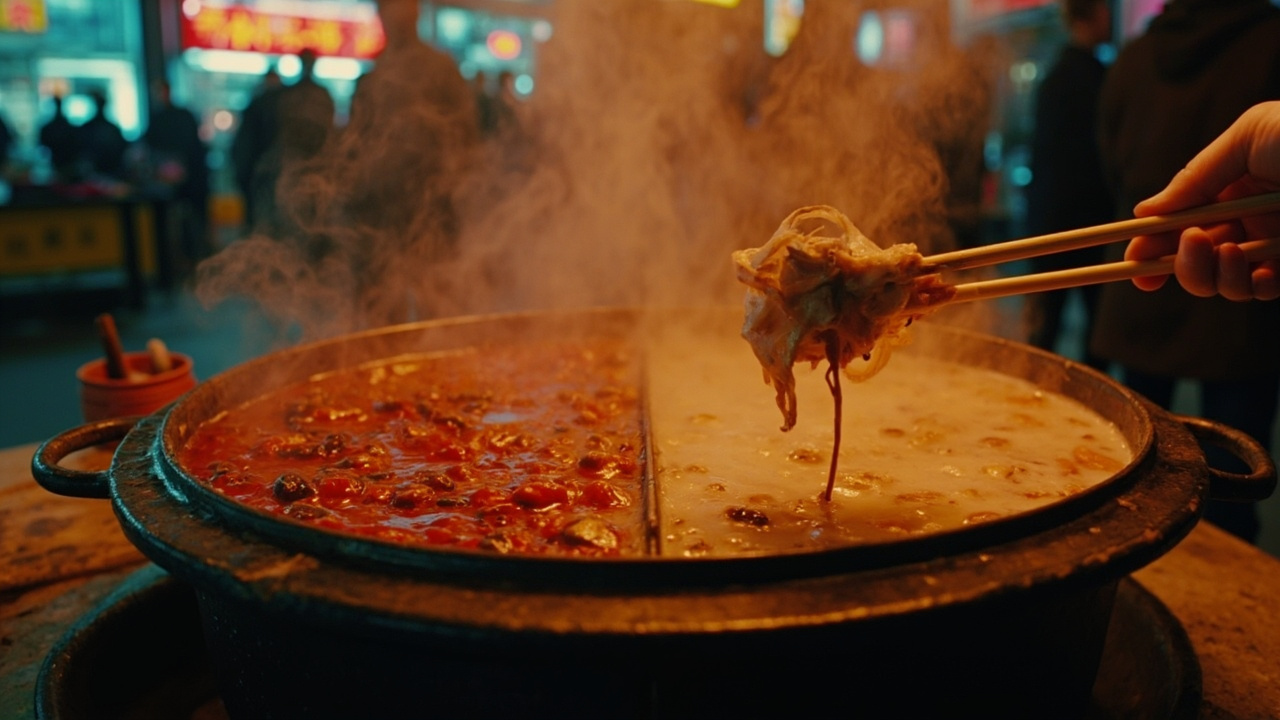
Chongqing Hotpot City Guide
The first thing I noticed wasn’t the smell. It was the sound — a low, constant rumble of thousands of people talking over bubbling broth, punctuated by the clink of beer bottles and the occasional shriek of someone who’d just bitten into a Sichuan peppercorn. I was sitting on a plastic stool at a table barely wide enough for two plates, on a side street off Jiefangbei, and my host — a Chongqing local named Wei who I’d met two hours earlier at my hostel — was grinning at me. “You eat the tripe first,” he said. “It cooks in eight seconds. If you leave it thirty, it’s rubber.”
I’d come to Chongqing specifically for this. Not for the Instagram-famous monorail through the apartment building, not for the cyberpunk skyline, though both are genuinely worth your time. I came because I’d been told, repeatedly, by Chinese friends in Beijing, that Chongqing is the hotpot capital of China, and that everything I thought I knew about hotpot was wrong. They were right. What I found over ten days was a city where hotpot isn’t a meal — it’s a civic ritual, a social contract, a reason to stay out until 3 a.m. arguing about whether beef tallow or vegetable oil makes a better base.
This guide covers where to actually eat, how much it costs, how to order when you don’t speak Mandarin, and the specific mistakes I made so you don’t have to. If you’re planning your first trip to China and Chongqing is on your list, read this before you book anything.
Quick answer
Chongqing is the hotpot capital of China, and a full hotpot meal for two people typically costs $15–30 (100–200 CNY) including beer. Most foreign visitors can enter China visa-free for up to 30 days under the current policy (check your nationality), and you’ll need Alipay or WeChat Pay set up before you arrive because almost no hotpot restaurant takes foreign credit cards. The best time to visit is October–November or March–April, when the humidity drops and you can eat outdoors without sweating through your shirt.
The Short Version
If you only have one night in Chongqing, go to a mid-range local spot in Yuzhong or Jiulongpo, order the 鸳鸯锅 (half spicy, half mild) even if you think you’re tough, get beef tripe, beef tallow base, and a cold bottle of local beer. Budget $20 (135 CNY) per person. Don’t go to the famous chains — they’re fine, but they’re not the point. The point is the neighborhood place with plastic stools and a menu you can’t read. Use your translation app, point at what the next table has, and let it happen.
How I Picked These
I spent ten days in Chongqing across two trips, ate hotpot eleven times, and got sick exactly once (my fault — I ate at a tourist-trap place near Hongya Cave at 1 a.m.). I picked these spots based on three things: whether locals I met actually ate there, whether the broth tasted like it had been built over years rather than mixed from a powder, and whether a foreigner with no Mandarin could realistically order and pay without a meltdown. I also cross-checked with a Chongqing food writer I met through a mutual friend, and with the receptionist at my hostel who grew up in Shapingba and had strong opinions about everything. A few famous places didn’t make the cut. A few obscure ones did.
Comparison Table
| Rank | Place | Best For | Approx Cost (USD) | Time Needed | When to Go |
|---|---|---|---|---|---|
| 1 | Zhao Er Hotpot (赵二火锅) | First-timers, classic beef tallow base | $18–25 (120–170 CNY) | 1.5–2 hrs | Weeknight, 7–9 p.m. |
| 2 | Yu Wei Xiao Mian Hotpot (余味小面火锅) | Late-night, locals-only vibe | $12–18 (80–120 CNY) | 1–1.5 hrs | After 10 p.m. |
| 3 | Nan Shan Hotpot (南山火锅一条街) | Groups, mountain views | $20–30 (135–200 CNY) | 2–3 hrs | Weekend evening |
| 4 | Xiao Tian’e (小天鹅) | Clean, English menu, safe bet | $25–35 (170–235 CNY) | 1.5 hrs | Any time |
| 5 | Liu Yishou (刘一手) | Chain consistency, air-con | $20–28 (135–190 CNY) | 1.5 hrs | Lunch, avoids crowds |
| 6 | Haidilao (海底捞) | Service, solo travelers | $30–40 (200–270 CNY) | 1.5–2 hrs | Off-peak hours |
| 7 | Jiefangbei Alley Stalls | Street-style, quick | $8–15 (55–100 CNY) | 45 min | 6–8 p.m. |
| 8 | Ciqikou Old Town Hotpot | Tourist-friendly, historic setting | $15–22 (100–150 CNY) | 1.5 hrs | Weekday afternoon |
| 9 | Guanyinqiao Night Market | Variety, non-hotpot options too | $10–20 (70–135 CNY) | 1–2 hrs | 8 p.m.–midnight |
| 10 | Hotpot Museum (火锅博物馆) | Understanding the culture | Free–$5 (0–35 CNY) | 1 hr | Any weekday |
1. Zhao Er Hotpot — The One I’d Send a Friend To First
I found this place because Wei, the guy from my hostel, refused to tell me about it until I’d eaten somewhere worse first. “You need to know the difference,” he said. He was right. Zhao Er is a small, unremarkable-looking restaurant on a side street in Yuzhong, with fluorescent lights, tiled floors, and a menu that’s entirely in Chinese. The broth is beef tallow — the real stuff, not the vegetable oil shortcut — and it arrives at your table as a solid white block that melts into a deep red pool as it heats.
Why it’s special: this is the benchmark. If you eat here first, every other hotpot in the city gets measured against it, and most will fall short. The base is built on dried chilies from Guizhou, Sichuan peppercorns from Hanyuan, and a fermented bean paste that the owner makes in-house. The result is spicy but not punishing, numbing but not anesthetic. It’s the kind of broth you keep drinking even after you’ve stopped eating, which is a mistake, but a good one.
📍 Location: Yuzhong District, off Zhongshan Yi Road, about 10 minutes’ walk from Jiaochangkou Station 🎫 Entry fee: Free (meal cost only) 🕒 Opening hours: 11 a.m.–2 p.m., 5 p.m.–midnight, daily 🚕 How to actually get there: Take Metro Line 1 or 2 to Jiaochangkou Station, Exit 5, walk east on Zhongshan Yi Road for about 8 minutes. Look for the red lanterns and the plastic stools on the sidewalk. There’s no English sign. ⏰ When to visit: Weeknight, 7–9 p.m. Weekends after 8 p.m. are chaos. 💡 Insider tips: Order the 鸳鸯锅 (yuanyang guo, half-spicy half-mild) even if you think you can handle full spice — you’ll want the mild side to reset your palate. Tripe (毛肚) cooks in 8 seconds, not 30. Ask for 油碟 (yóudié, a bowl of sesame oil and garlic) to dip your food in; it cools the spice and adds flavor. Bring cash as backup — their card reader is unreliable. Set up Alipay or WeChat Pay before you come. The mistake I made: I ordered the “extra spicy” option on my first visit. Don’t.
2. Yu Wei Xiao Mian Hotpot — The 2 a.m. Spot
There’s a specific kind of hunger that only shows up after midnight in a city that never fully sleeps. I stumbled into Yu Wei at 1:40 a.m. after a failed attempt to find a taxi back to my hostel, and it was packed — every table full, a line of people waiting with beer bottles in hand. Nobody spoke English. Nobody cared that I didn’t speak Mandarin. A woman at the next table pointed at her bowl, then at me, then gave a thumbs up.
Why it’s special: this is hotpot as pure function — cheap, fast, open until 4 a.m., and unapologetically local. The broth is lighter than Zhao Er’s, more chili-forward and less tallow-heavy, which makes it easier to eat when you’re tired. The menu is small: tripe, beef, potato slices, tofu skin, and a few vegetables. That’s it. That’s the whole thing. And it works.
📍 Location: Jiulongpo District, near Yangjiaping Station 🎫 Entry fee: Free 🕒 Opening hours: 6 p.m.–4 a.m., daily (closed Mondays) 🚕 How to actually get there: Metro Line 2 to Yangjiaping Station, Exit B, walk 5 minutes north. It’s on the second floor of a building with a faded yellow sign. ⏰ When to visit: After 10 p.m. on any night. This is not a lunch place. 💡 Insider tips: Bring your own tissues — they charge for napkins. The beer is cheaper than the water. If you’re solo, sit at the counter and the staff will help you order. Don’t wear anything you care about; you’ll smell like chili for two days. The food I tried: a bowl of 冰粉 (bīngfěn, ice jelly with brown sugar) at the end, which is the local way to cool your mouth down. Life-changing at 2 a.m.
3. Nan Shan Hotpot Street — The Group Dinner
Nan Shan is a mountain ridge south of the Yangtze, and the entire road up is lined with hotpot restaurants — maybe forty of them — all with outdoor seating and views back over the city. I went with a group of six people I’d met at a Chengdu hostel who’d taken the train over with me. We picked a place at random, sat outside, and ate for three hours while the city lights came on below us.
Why it’s special: it’s not about any single restaurant — it’s about the experience of eating hotpot outdoors, on a mountain, with the whole city spread out beneath you. The broth quality varies wildly from place to place, so pick one with a full parking lot. The vibe is unbeatable. This is where Chongqing locals go for birthdays, reunions, and any excuse to stay out late.
📍 Location: Nanshan District, along Chongwen Road 🎫 Entry fee: Free (meal cost only) 🕒 Opening hours: Most restaurants 11 a.m.–midnight 🚕 How to actually get there: Take a taxi or Didi — it’s about 30 minutes from Jiefangbei and costs $8–12 (55–80 CNY). Public transport is possible but slow; take Bus 384 from Nanping. ⏰ When to visit: Weekend evening, arriving by 6 p.m. to get a table with a view. 💡 Insider tips: Bring a jacket — it’s cooler up the mountain. Order the 毛血旺 (máoxuěwàng, duck blood curd in chili oil) as a side; it’s a Chongqing specialty. Split the bill with your group — most places don’t do separate checks. Book a Didi back in advance; taxis are scarce after 10 p.m. The person I met: our waiter, a college student named Li, who practiced his English with us all night and refused to let us tip.
4. Xiao Tian’e — The Safe Bet
I’ll be honest: I didn’t want to like Xiao Tian’e. It’s a chain, it’s clean, it has an English menu, and it felt like the opposite of what I’d come to Chongqing for. But after a disastrous attempt at a hole-in-the-wall place where I accidentally ordered pig brain (delicious, but not what I wanted at 9 p.m. on a Tuesday), I ended up here, and it was exactly what I needed.
Why it’s special: it’s reliable. The broth is good — not transcendent, but good. The service is friendly, the menu has pictures, and the staff will help you order without making you feel stupid. If you’re traveling with someone who’s nervous about the whole “can’t read the menu” thing, this is where you go. It’s also a good place to learn the mechanics of hotpot before you graduate to the real spots.
📍 Location: Multiple locations; the Jiefangbei branch is at 8 Minquan Road 🎫 Entry fee: Free 🕒 Opening hours: 10 a.m.–10 p.m., daily 🚕 How to actually get there: Metro Line 2 to Linjiangmen Station, Exit A, walk 3 minutes. The sign is in English and Chinese. ⏰ When to visit: Lunch, when it’s quiet. Dinner is packed with tour groups. 💡 Insider tips: The 番茄锅 (tomato broth) is a good non-spicy option if you’re with kids or spice-averse friends. Ask for the English menu — they have one, but you have to ask. The bathroom is clean, which matters more than you’d think after three hours of hotpot. The mistake I made: I assumed “medium spicy” would be mild. It was not. Order “mild” if you’re unsure.
5. Liu Yishou — The Air-Conditioned Option
Chongqing in July is brutal — 95°F (35°C) with 80% humidity, and eating hotpot outdoors in that is a form of self-punishment. Liu Yishou is a chain with strong air conditioning, which sounds like a small thing until you’re sweating into your broth. I ate here twice, both times because I couldn’t face the heat.
Why it’s special: it’s a chain done well. The broth is consistent, the ingredients are fresh, and the air conditioning is aggressive. It’s not the most authentic experience in the city, but it’s a solid one, and sometimes that’s what you need. The 麻辣 (málà, numbing-spicy) base here is genuinely good — better than most chains.
📍 Location: Multiple; the Guanyinqiao branch is at 9 Beicheng Tian Jie 🎫 Entry fee: Free 🕒 Opening hours: 11 a.m.–10 p.m., daily 🚕 How to actually get there: Metro Line 3 to Guanyinqiao Station, Exit 2, walk 5 minutes. It’s on the third floor of a mall. ⏰ When to visit: Lunch on a hot day. Avoid weekend dinners. 💡 Insider tips: The 自助调料台 (self-serve sauce station) is where you build your dipping sauce — mix sesame oil, garlic, cilantro, and a little vinegar. Don’t skip it. The 冰镇酸梅汤 (iced plum drink) is the best non-alcoholic pairing. Ask for a table away from the door to stay cool. The food I tried: 酥肉 (sūròu, crispy fried pork) as an appetizer — order it before the hotpot arrives, it’s the local way to start.
6. Haidilao — The Solo Traveler’s Friend
I ate at Haidilao alone on my last night in Chongqing, mostly because I was tired and didn’t want to deal with a language barrier. It’s the most famous hotpot chain in China, known for its almost absurd level of service — they’ll give you a stuffed animal to sit with if you’re alone, which I found both charming and slightly humiliating.
Why it’s special: the service is the point. They’ll bring you a phone charger, a hair tie, a plastic bag for your phone, and free snacks while you wait. The food is good, not great. But if you’re a solo traveler who’s tired of pointing at menus, this is a soft landing. It’s also the most foreigner-friendly hotpot experience in the city — English menus, English-speaking staff at most locations, and a payment system that accepts international cards.
📍 Location: Multiple; the Jiefangbei branch is at 10 Bayi Road 🎫 Entry fee: Free 🕒 Opening hours: 10 a.m.–6 a.m. (yes, really) 🚕 How to actually get there: Metro Line 2 to Linjiangmen Station, Exit B, walk 2 minutes. ⏰ When to visit: Off-peak — 3–5 p.m. or after 10 p.m. — to avoid the wait. 💡 Insider tips: You can order half-portions of most items, which is great for solo diners. The 捞面 (noodle) performance is worth watching once. Download the Haidilao app for a discount, but you’ll need a Chinese phone number. The person I met: my server, a young woman named Chen, who brought me a stuffed panda and then apologized for it three times.
7. Jiefangbei Alley Stalls — The Quick Fix
Not every hotpot meal needs to be a two-hour event. The alley stalls around Jiefangbei serve a stripped-down version — a small pot, a few skewers, and a stool on the sidewalk. I ate here three times, usually between other meals, and it’s the closest thing to “fast food hotpot” you’ll find.
Why it’s special: it’s cheap, it’s fast, and it’s genuinely good. The broth is simpler — usually just chili, oil, and a few aromatics — but the ingredients are fresh and the whole thing takes 20 minutes. This is where you go when you want hotpot but don’t want the ceremony.
📍 Location: Jiefangbei pedestrian area, side alleys off Minquan Road 🎫 Entry fee: Free 🕒 Opening hours: 5 p.m.–midnight, most stalls 🚕 How to actually get there: Metro Line 2 to Linjiangmen Station, Exit A, walk into the pedestrian area and follow the smell. ⏰ When to visit: 6–8 p.m., before the dinner rush. 💡 Insider tips: Pay per skewer, not per plate — most stalls charge $0.30–0.70 (2–5 CNY) per stick. Bring small bills. Don’t sit at a table without confirming it’s the right vendor’s — the alleys are shared. The mistake I made: I sat at the wrong table and got yelled at in rapid Chongqing dialect. I still don’t know what was said.
8. Ciqikou Old Town Hotpot — The Tourist Version (In a Good Way)
Ciqikou is Chongqing’s preserved old town — stone streets, tea houses, souvenir shops — and yes, it’s touristy. But the hotpot here is genuinely decent, and the setting is worth the trip. I ate at a place overlooking the Jialing River, and while it wasn’t the best hotpot I had in the city, it was the most atmospheric.
Why it’s special: it’s hotpot with a view and a story. The old town dates back to the Ming Dynasty, and eating hotpot on a balcony overlooking the river is a genuinely lovely experience. The food is fine — not the best, but not bad — and the whole thing feels like a postcard.
📍 Location: Ciqikou Old Town, Shapingba District 🎫 Entry fee: Free to enter the old town; meal costs vary 🕒 Opening hours: 10 a.m.–10 p.m., daily 🚕 How to actually get there: Metro Line 1 to Ciqikou Station, Exit 1, walk 5 minutes. ⏰ When to visit: Weekday afternoon, when the crowds are thinner. 💡 Insider tips: The old town gets packed on weekends — go on a Tuesday. Try the 陈麻花 (Chén máhuā, fried dough twists) from the famous shop on the main street. The river view tables are worth the extra $5 (35 CNY). The food I tried: 毛血旺 again, this time with a view. Still great.
9. Guanyinqiao Night Market — The Non-Hotpot Option
Sometimes you want variety. Guanyinqiao is Chongqing’s biggest night market, and while hotpot is available, it’s not the main event. I came here on a night when I couldn’t face another bowl of broth and ate my way through skewers, dumplings, and grilled corn instead.
Why it’s special: it’s the best place in the city to eat many small things rather than one big thing. The hotpot stalls here are fine, but the real draw is everything else — 串串 (chuànchuàn, skewers), 烤鱼 (kǎoyú, grilled fish), 酸辣粉 (suānlàfěn, sour and spicy noodles). Come hungry and graze.
📍 Location: Jiangbei District, Guanyinqiao pedestrian street 🎫 Entry fee: Free 🕒 Opening hours: 6 p.m.–midnight, daily 🚕 How to actually get there: Metro Line 3 to Guanyinqiao Station, Exit 2, follow the crowds. ⏰ When to visit: 8 p.m.–midnight, any night. 💡 Insider tips: Bring cash for the smaller stalls. The 酸辣粉 here is some of the best in the city — get it from the stall with the longest line. Don’t eat at the first stall you see; walk the whole street first. The person I met: a vendor named Zhang who sold me grilled corn and then insisted I try his wife’s dumplings for free.
10. Hotpot Museum — The Context
I almost skipped this. A museum about hotpot sounded like a gimmick. But I went on my last day, mostly because it was raining and I had three hours to kill, and it turned out to be the thing that made everything else make sense.
Why it’s special: it explains the history. Hotpot in Chongqing goes back to the Qing Dynasty, when boatmen on the Yangtze cooked cheap offcuts in spiced broth to make them edible. The museum traces that history — the tools, the migration, the regional variations — and by the end, you understand why this city takes it so seriously. It’s not just food. It’s identity.
📍 Location: Jiangbei District, near the Grand Theatre 🎫 Entry fee: Free for the main exhibit; special exhibits $3–5 (20–35 CNY) 🕒 Opening hours: 9 a.m.–5 p.m., closed Mondays 🚕 How to actually get there: Metro Line 6 to Grand Theatre Station, Exit 3, walk 5 minutes. ⏰ When to visit: Weekday morning, when it’s quiet. 💡 Insider tips: The English signage is limited — bring a translation app. The gift shop sells hotpot base packets you can take home. Combine this with a walk along the river afterward. The food I tried: nothing — but I left wanting hotpot again, which is the point.
FAQ summary
Chongqing is the hotpot capital of China, and a typical meal for two costs $15–30 (100–200 CNY) including beer. Most foreign visitors can enter China visa-free for up to 30 days (verify your nationality), but you must set up Alipay or WeChat Pay before arrival because foreign cards are rarely accepted. The best time to visit is October–November or March–April. For first-timers, order the half-spicy/half-mild 鸳鸯锅, get beef tripe and beef tallow base, and use a translation app — English menus are rare outside chains. Most hotpot restaurants are open from late morning until midnight or later, and the best ones are in Yuzhong, Jiulongpo, and Nanshan.
FAQ
Q: Do I need a visa to visit Chongqing? A: Most foreign visitors — including Americans, most Europeans, and many Southeast Asians — can enter China visa-free for up to 30 days under the current policy as of 2026. Check your specific nationality, as the list changes. If you’re not eligible, apply for a tourist visa in advance; see our China visa guide for details.
Q: How much does a hotpot meal cost in Chongqing? A: A full meal for two people, including beer and sides, typically costs $15–30 (100–200 CNY). Budget chains like Haidilao run $30–40 (200–270 CNY) per person. Street stalls are cheaper — around $8–15 (55–100 CNY) per person.
Q: Can I pay with a foreign credit card at hotpot restaurants? A: Almost never. You’ll need Alipay or WeChat Pay set up and linked to a foreign card before you arrive. See our payment guide for step-by-step setup. Bring some cash as backup, especially for street stalls.
Q: Is the hotpot too spicy for foreigners? A: It can be, but you have options. Order the 鸳鸯锅 (yuanyang guo) — a divided pot with half spicy, half mild broth. Dip your food in sesame oil (油碟) to cool it down. Start with “mild” and work up.
Q: Do I need a VPN or SIM card in Chongqing? A: Yes, if you want to use Google, Instagram, or WhatsApp. You’ll need a VPN installed before you arrive, and a local SIM or eSIM for data. See our SIM and internet guide for specifics.
Q: Is English spoken at hotpot restaurants? A: Rarely outside of chains like Haidilao or Xiao Tian’e. Download a translation app (Pleco or Google Translate with offline Chinese) before you go. Pointing at what the next table has works surprisingly well.
Q: What’s the best time of year to visit Chongqing for hotpot? A: October–November and March–April. Summer is brutally hot and humid (95°F/35°C), and winter is cold and damp. Spring and fall let you eat outdoors comfortably.
The Honest Wrap-up
This guide is for people who want to eat hotpot the way locals do — not the sanitized version, but the real thing, with plastic stools and a menu you can’t read and a broth that’s been simmering for years. If you want a comfortable, English-menu, air-conditioned experience, that’s fine too — Haidilao and Xiao Tian’e are genuinely good, and there’s no shame in starting there. But if you’re the kind of traveler who wants to earn the meal, start with Zhao Er, make a mistake or two, and let the city teach you. One last thing: don’t book your flight for July. I did that my first time. I regret it.
More guides you may like

Top 10 Bridges in China
China's bridges are engineering marvels spanning mountains, rivers, and seas. Here are 10 of the most spectacular, from ancient stone to modern steel.
8 min read

Top 10 Buddhist Sites in China
From the Leshan Giant Buddha to the Dunhuang Caves, these 10 Buddhist sites represent 2,000 years of China's spiritual heritage.
9 min read

Top 10 Day Trips from Beijing You Shouldn't Miss
Beijing is packed with history, but some of China's best experiences are just a few hours away. Here are 10 day trips that will transform your visit.
9 min read
Top 10 Hidden Gems in China Off the Beaten Path
Beyond the Great Wall and Terracotta Warriors, China has incredible hidden destinations few tourists ever reach. Here are 10 underrated gems worth the detour.
9 min read
Top 10 Markets and Shopping Streets in China
From Shanghai's Bund to Beijing's Silk Street - 10 markets where foreigners can haggle, explore, and bring home authentic Chinese goods.
9 min read
Top 10 Museums in China You Shouldn't Miss
China's museums span 5,000 years of civilization. These 10 - from the Palace Museum to Xi'an's terracotta gallery - are unmissable for culture lovers.
9 min read