
Hunan Travel Guide
TODO: Extract from article (100-160 chars)
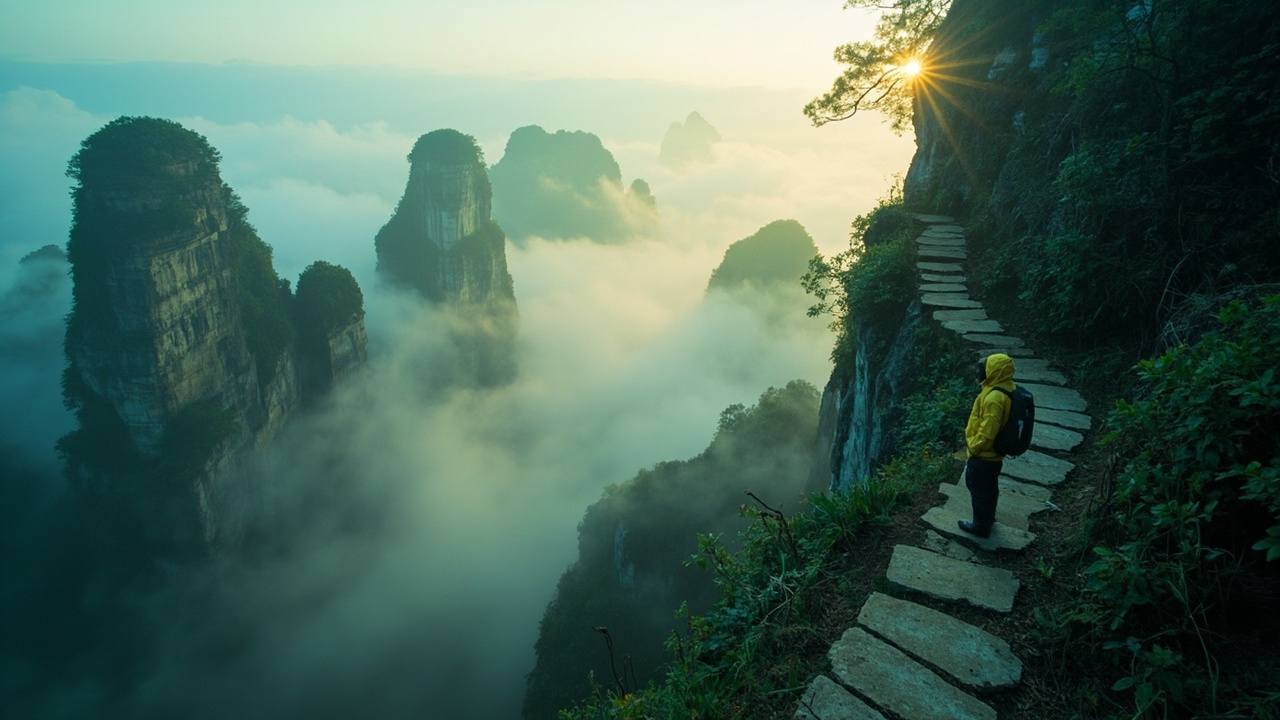
Hunan Travel Guide
I was standing on a wooden platform at the foot of Tianmen Mountain, watching a man in a blue uniform motion me toward a glass box hanging from a cable. The box was going to haul me up 1,200 meters of vertical cliff, and I’d paid about $40 for the privilege. An older woman next to me, maybe 70, was calmly eating a boiled egg. I asked her (through my phone, badly) if she was scared. She laughed, handed me half the egg, and said something I didn’t understand. Then the cable car lurched forward and the whole valley dropped away beneath us.
That’s Hunan. It doesn’t ease you in. The province hits you with mountains that look computer-generated, food that will make your lips numb for an hour, and a history so dense that a random village schoolhouse turns out to be where Mao Zedong once taught. Most first-timers to China go to Beijing and Shanghai and skip right over it, which is a mistake. Hunan sits in the middle of the country, roughly 350 km south of the Yangtze, and it packs in some of the most dramatic scenery and best eating in China for a fraction of what you’d spend in the big cities.
This guide covers the ten places in Hunan actually worth your time, with real prices, real transport details, and the stuff I wish someone had told me before my first trip here in 2019. I’ve been back four times since.
Quick answer
Hunan is best visited between April and June or September and November, when temperatures sit around 15–25°C (59–77°F) and the mountain fog is manageable. Most Western tourists can now enter China visa-free for up to 30 days (check your nationality — the policy expanded in 2025 and covers most EU countries, the US, UK, Australia, and Japan), so you don’t need a visa for a Hunan trip under a month. Budget roughly $60–100 per day including hotels, food, and intercity trains, and plan at least 7 days if you want to see Zhangjiajie, Fenghuang, and Changsha without sprinting.
The Short Version
If you only have time for three things: Zhangjiajie’s Avatar mountains, the old riverside town of Fenghuang at night, and a bowl of Changsha stinky tofu at 11pm on Pozi Street. Skip the big group tours — Hunan is easy to do independently with a translation app and Alipay. Bring good shoes, a stomach for chili, and patience for cable car queues in October.
How I Picked These
I’ve been to Hunan four times between 2019 and 2025, mostly solo, once with my partner who doesn’t speak Mandarin. I’ve taken the high-speed rail from Changsha to Zhangjiajie three times, gotten lost in Fenghuang’s alley maze twice, and once spent a very cold night in a Wulingyuan guesthouse with no heating because I booked in February like an idiot. The places below are the ones I keep telling friends about — not the ones with the biggest TripAdvisor counts. I’ve cross-checked prices with local friends in Changsha and with hostel staff in Zhangjiajie as recently as late 2025.
Comparison Table
| Rank | Place | Best For | Approx Cost (USD) | Time Needed | When to Go |
|---|---|---|---|---|---|
| 1 | Zhangjiajie National Forest Park | Mountain scenery, hiking | $35–60/day | 3–4 days | Apr–Jun, Sep–Nov |
| 2 | Fenghuang Ancient Town | Riverside atmosphere, photos | $40–70/day | 2 days | Mar–May, Sep–Oct |
| 3 | Changsha | Food, nightlife, museums | $50–90/day | 2–3 days | Year-round |
| 4 | Tianmen Mountain | Cable cars, glass walkways | $45–70/day | 1–2 days | Apr–Oct |
| 5 | Wulingyuan Scenic Area | Karst pillars, quieter hikes | $30–50/day | 1–2 days | Apr–Jun, Sep–Nov |
| 6 | Furong Ancient Town | Waterfall town, fewer crowds | $30–50/day | 1 day | Apr–Oct |
| 7 | Hengshan (South Sacred Mountain) | Pilgrimage, temples | $40–60/day | 1–2 days | Apr–Oct |
| 8 | Dehang Miao Village | Miao culture, hiking | $25–45/day | 1 day | Apr–Oct |
| 9 | Yueyang Tower | History, Yangtze views | $20–40/day | Half day | Mar–Nov |
| 10 | Shaoshan | Mao’s birthplace, Communist history | $25–45/day | 1 day | Year-round |
Zhangjiajie National Forest Park – The Mountains That Made James Cameron Lie About Inspiration
The first time I saw the quartz sandstone pillars rise out of the mist, I actually said “oh” out loud. Not a word, just a sound. I was on the Yuanjiajie viewing platform at 7:15am, having taken the Bailong Elevator up (a glass lift bolted to a cliff face, 326 meters, ¥72 / $10), and the fog was doing that thing where it slides between the pillars like it’s alive.
Zhangjiajie is the reason most people come to Hunan. The 3,000-odd sandstone columns here inspired the floating mountains in Avatar, though the park’s official stance is that they didn’t — a small fiction everyone politely maintains. What matters is that the scenery genuinely looks fake. It doesn’t photograph as well as it looks in person, which is rare.
📍 Location: Wulingyuan District, about 40 km north of Zhangjiajie city. The park has five entrances; Wulingyuan Gate is the main one. 🎫 Entry fee: ¥228 ($32) for a 4-day pass. Bailong Elevator ¥72 ($10) one-way, Tianzi Mountain cable car ¥72 ($10), and the Ten-Mile Gallery mini-train ¥38 ($5) are all extra. 🕐 Opening hours: 7:00am–6:00pm (last entry 5:00pm). Winter hours shorten to 8:00am–5:00pm. 🚕 How to get there: High-speed rail from Changsha South Station to Zhangjiajie West takes about 2.5 hours (¥150–180 / $21–25). From Zhangjiajie West, take bus 6 or a taxi (¥30 / $4) to the Wulingyuan gate area. If you’re coming from Beijing, fly instead — 2.5 hours vs. 6+ by train. ⏰ When to visit: Late April to early June, or mid-September to early November. Avoid Chinese national holidays (Oct 1–7, May 1–5) unless you enjoy being shuffled through caves like cattle. 💡 Insider tips: Buy your park ticket on the official WeChat mini-program the night before — the queue at the gate is 40 minutes shorter. Stay in Wulingyuan town, not Zhangjiajie city; you’ll save 90 minutes of commuting each day. The lesser-known Yangjiajie section has the same scenery and a tenth of the people. Bring cash for the small noodle stalls inside the park — some don’t take Alipay or WeChat Pay.
I met a park ranger named Old Zhou on the Golden Whip Stream trail who told me, in slow Mandarin, that he’d walked the same 5 km path every workday for 22 years and still noticed something new each week. I believed him.
Fenghuang Ancient Town – The Riverside Town That’s Better After Dark
Everyone told me Fenghuang was too touristy. They were half right. During the day it’s a scrum of selfie sticks and souvenir stalls selling the same embroidered bags. But at 9pm, when the red lanterns come on and reflect off the Tuo River, and the tour groups have retreated to their hotels, it becomes something else entirely.
Fenghuang is a Ming and Qing dynasty town built along a river, home to the Miao and Tujia ethnic minorities. The stilt houses on the water are the postcard image, but the real charm is in the side alleys — narrow stone lanes where grandmothers sell hand-woven cloth and the smell of cured pork hangs in the air.
📍 Location: Fenghuang County, western Hunan, about 430 km from Changsha. 🎫 Entry fee: The town itself is free to enter. Individual attractions (Former Residence of Shen Congwen, East Gate Tower, etc.) cost ¥40–60 ($6–8) each, or ¥148 ($21) for a combo ticket. Honestly, skip the combo — the town is the attraction. 🕐 Opening hours: 24 hours, but shops open around 8:00am and close around 11:00pm. 🚕 How to get there: High-speed rail from Changsha South to Fenghuang Ancient Town Station (opened 2021) takes about 3 hours (¥180–220 / $25–31). From the station, take the shuttle bus (¥7 / $1) or a taxi (¥50 / $7) into the old town. ⏰ When to visit: Weekday evenings in April, May, September, or October. Avoid weekends if you can — the town doubles in population Friday through Sunday. 💡 Insider tips: Stay inside the old town, not in the new town across the river — you’ll pay $15 more per night but save hours of walking. The best photo spot is the Hong Bridge at 7:30am, before the crowds. Boat rides on the Tuo River cost ¥80 ($11) for 20 minutes and are worth it once. Don’t eat at the riverside restaurants — walk two streets inland and pay half.
I made the mistake of ordering “medium spicy” at a riverside restaurant my first night. The waitress looked at me, looked at my face, and brought me a bowl of plain rice without being asked. She was right.
Changsha – The City That Eats at Midnight
Changsha surprised me more than any other city in China. I expected a provincial capital with a Mao statue and not much else. Instead I found a city of 8 million people with a food scene that rivals Chengdu, a nightlife strip that runs until 4am, and a general attitude that life is for enjoying.
The city is famous for two things: Chairman Mao (he studied here, and there’s a giant statue of him on Orange Isle) and food. The food is the real draw. Hunan cuisine is hotter and more sour than Sichuan — less numbing, more direct. A bowl of Changsha rice noodles (米粉) with pickled beans and chili oil costs ¥8 ($1.10) and is one of the best breakfasts in China.
📍 Location: Changsha is the capital of Hunan, central-eastern part of the province. The main tourist areas are Pozi Street (food), Orange Isle (Mao statue, river views), and the Yuelu Academy area. 🎫 Entry fee: Most attractions are free. Yuelu Academy is ¥50 ($7). Hunan Provincial Museum is free but requires advance booking via WeChat. 🕐 Opening hours: Hunan Provincial Museum 9:00am–5:00pm, closed Mondays. Pozi Street food stalls run from 10am to 3am. 🚕 How to get there: Changsha Huanghua International Airport has direct flights from most major Asian hubs. High-speed rail from Shanghai takes 4.5 hours (¥450 / $63), from Guangzhou 2.5 hours (¥314 / $44). Metro Line 2 connects the airport to the city center. ⏰ When to visit: October and November are ideal. Summer (July–August) is brutally hot and humid — 38°C (100°F) with 80% humidity is normal. 💡 Insider tips: Get a Chinese SIM card at the airport — you’ll need a local number for restaurant reservations and museum bookings. Download a VPN before you arrive if you want Google, Instagram, or WhatsApp. The Hunan Provincial Museum’s Mawangdui exhibition (a 2,100-year-old preserved corpse) is genuinely worth the booking hassle. Try stinky tofu (臭豆腐) from a street cart, not a restaurant — the cart version is better and costs ¥10 ($1.40).
A taxi driver named Liu drove me from the train station to my hotel and refused to take a tip. He just pointed at the Mao statue in the distance and said “Hao.” Good. That was the whole conversation.
Tianmen Mountain – The One With the Glass Walkway
Tianmen is the mountain with the hole in it. That’s the simplest way to describe it. A natural arch, 131 meters high, punched through the top of a mountain like someone took a hole punch to the sky. The cable car up is 7.5 km long — one of the longest in the world — and takes 30 minutes.
I’m not usually a cable car person. I’d rather hike. But Tianmen’s cable car is the attraction. You rise from the city of Zhangjiajie, cross over farmland, then over a highway, then straight up a cliff face, and the whole time the city shrinks below you until it’s just a smudge. The glass walkway at the top (¥5 / $0.70 extra for shoe covers) is 60 meters of transparent floor bolted to the cliff. I watched a grown man crawl across it on his hands and knees while his wife filmed him.
📍 Location: Zhangjiajie city, about 8 km south of the downtown area. The cable car base station is on Guanli Road. 🎫 Entry fee: ¥278 ($39) for the full ticket including cable car, bus, and escalators. Glass walkway shoe covers ¥5 ($0.70). 🕐 Opening hours: 8:00am–4:00pm (last cable car down 6:00pm). Closed for maintenance occasionally — check the day before. 🚕 How to get there: From Zhangjiajie city center, take bus 5 or a taxi (¥15 / $2) to the cable car station. If you’re coming from Wulingyuan, it’s a 40-minute taxi (¥100 / $14). ⏰ When to visit: Weekday mornings in May, June, September, or October. The mountain closes in heavy fog or high wind, so build in a buffer day. 💡 Insider tips: Take the cable car up and the bus down (or vice versa) — you get two different views. The 999 steps to Heaven’s Gate are brutal; take the escalators inside the mountain instead (included in your ticket). Bring a light jacket even in summer — the top is 10°C cooler than the base. The “Ghost Valley” walkway is less crowded than the glass one and scarier.
I ate a bowl of instant noodles at the summit restaurant for ¥25 ($3.50) and it was one of the best meals of the trip, mostly because I was cold and hungry and the view through the window was a sea of clouds.
Wulingyuan Scenic Area – The Quieter Side of Zhangjiajie
Most people treat Wulingyuan as just another part of Zhangjiajie National Forest Park. It’s technically a separate scenic area, though the tickets overlap, and it’s where you go when you want the same sandstone pillars without the crowds.
The highlight is the Ten-Mile Gallery (十里画廊), a 5.8 km valley walk with pillar formations that have been given names like “Old Man Gathering Herbs” and “Three Sisters Peak.” The names are silly but the scenery isn’t. I walked it in the rain and had the whole valley to myself for an hour.
📍 Location: Wulingyuan District, adjacent to Zhangjiajie National Forest Park. The main gate is on the east side. 🎫 Entry fee: Included in the Zhangjiajie National Forest Park ticket (¥228 / $32 for 4 days). The mini-train through the gallery is ¥38 ($5). 🕐 Opening hours: 7:00am–6:00pm. 🚕 How to get there: From Wulingyuan town, take bus 1 or a taxi (¥10 / $1.40) to the Wulingyuan gate. ⏰ When to visit: Any weekday morning. Rain actually improves the experience — the mist between the pillars is the whole point. 💡 Insider tips: The Suoxi Valley section is the least visited and has the best hiking. Bring rain gear — this area gets 1,400 mm of rain a year. The mini-train is worth it one-way only; walk back. Guesthouses in Wulingyuan town are cheaper and friendlier than the hotels inside the park.
Furong Ancient Town – The One With the Waterfall
Furong is what Fenghuang was 20 years ago. A small Tujia town built on a cliff, with a 60-meter waterfall crashing through the middle of it. It’s genuinely spectacular and genuinely uncrowded, mostly because it’s harder to reach than Fenghuang.
I spent one night here and wished I’d spent two. The waterfall is lit at night, the old streets are quiet, and the locals actually seem happy to see foreigners — a rarity in Chinese tourist towns these days.
📍 Location: Yongshun County, western Hunan, about 60 km from Zhangjiajie. 🎫 Entry fee: ¥100 ($14) for the scenic area. 🕐 Opening hours: 8:00am–6:00pm. 🚕 How to get there: High-speed rail from Zhangjiajie West to Furong Town Station takes 25 minutes (¥30 / $4). From the station, it’s a 10-minute walk downhill to the old town. ⏰ When to visit: April–October, weekday afternoons. The waterfall is strongest after rain. 💡 Insider tips: The best view of the waterfall is from the Tujia stilt houses on the far bank — most tourists miss it. Stay overnight; the day-trippers leave by 5pm. Bring cash — ATMs are scarce.
Hengshan – The South Sacred Mountain
Hengshan is one of China’s five sacred Taoist and Buddhist mountains, and it’s a pilgrimage site, not a tourist attraction. That distinction matters. People come here to climb, pray, and burn incense, not to take selfies.
The hike to the summit (Zhurong Peak, 1,300 m) takes 4–6 hours. There’s also a cable car and a bus if you’re not up for the full climb. I did the hike in October and passed maybe 200 pilgrims, most of them elderly, most of them faster than me.
📍 Location: Hengyang city, southern Hunan, about 2 hours from Changsha by high-speed rail. 🎫 Entry fee: ¥120 ($17) for the scenic area, ¥80 ($11) for the cable car one-way. 🕐 Opening hours: 7:00am–6:00pm. 🚕 How to get there: High-speed rail from Changsha South to Hengshan West (40 minutes, ¥80 / $11), then bus 3 to the mountain gate. ⏰ When to visit: April–October. Avoid the Lunar New Year period, when the mountain is packed with pilgrims. 💡 Insider tips: Wear real hiking shoes — the stone steps are worn smooth. Temples on the mountain serve vegetarian meals for ¥20 ($2.80). The sunrise from the summit is famous but requires an overnight stay at a monastery guesthouse.
Dehang Miao Village – The One Most Tourists Skip
Dehang is a Miao village about 20 km from Jishou, and it’s the most authentic ethnic minority village I’ve visited in Hunan. The Miao people here still wear traditional dress daily, still speak Miao at home, and still make their own silver jewelry by hand.
I went on a Tuesday in October and was the only foreigner there. A woman named Auntie Long invited me into her home for tea, showed me her silverwork, and refused to let me pay for anything. I bought a bracelet from her for ¥200 ($28) and it’s the best souvenir I’ve ever brought home from China.
📍 Location: Jishou city, western Hunan, about 30 km from Fenghuang. 🎫 Entry fee: ¥80 ($11). 🕐 Opening hours: 8:00am–5:30pm. 🚕 How to get there: From Jishou, take bus 11 or a taxi (¥50 / $7). From Fenghuang, it’s a 1-hour drive. ⏰ When to visit: Weekdays, April–October. 💡 Insider tips: Learn a few Miao greetings — locals appreciate the effort. The Miao drum dances happen at 11am and 3pm. Don’t photograph people without asking; a smile and a gesture works fine.
Yueyang Tower – The One for History Nerds
Yueyang Tower is one of China’s four great ancient towers, built in 220 AD and rebuilt many times since. It’s not the most spectacular sight in Hunan, but it’s the most historically significant — it’s been written about by poets for 1,800 years and sits right on the edge of Dongting Lake, one of China’s largest freshwater lakes.
I went on a rainy Tuesday and had the tower mostly to myself. The view over the lake was gray and moody and perfect.
📍 Location: Yueyang city, northern Hunan, on the shore of Dongting Lake. 🎫 Entry fee: ¥80 ($11). 🕐 Opening hours: 7:30am–6:00pm. 🚕 How to get there: High-speed rail from Changsha South to Yueyang East (30 minutes, ¥70 / $10), then bus 15 or a taxi (¥20 / $3). ⏰ When to visit: March–November. Sunset over the lake is the best time. 💡 Insider tips: Combine with a boat trip on Dongting Lake (¥100 / $14). The nearby Junshan Island is worth a half-day. The tower’s poem inscriptions are in classical Chinese — a translation app helps.
Shaoshan – The One That’s Complicated
Shaoshan is Mao Zedong’s birthplace, and visiting it is a strange experience for a Westerner. It’s a pilgrimage site for Chinese communists, with a museum, a bronze statue, and Mao’s childhood home preserved as a shrine. There are tour groups in red scarves singing revolutionary songs.
I went out of historical curiosity and left with mixed feelings. It’s a fascinating window into how modern China remembers its founding figure, but it’s also deeply political. Go with an open mind and a willingness to observe rather than judge.
📍 Location: Shaoshan city, about 100 km southwest of Changsha. 🎫 Entry fee: Free for most sites, including Mao’s former residence. The Mao Zedong Memorial Hall is free but requires booking. 🕐 Opening hours: 8:00am–5:00pm, closed Mondays. 🚕 How to get there: High-speed rail from Changsha South to Shaoshan South (30 minutes, ¥40 / $6), then bus 1. ⏰ When to visit: Weekdays, any season. Avoid Mao’s birthday (December 26) and the October holiday. 💡 Insider tips: The museum has English signage. Photography is restricted in some buildings. The local food is excellent and cheap — try the braised pork (红烧肉), Mao’s favorite dish.
FAQ summary
The most important takeaways for planning a Hunan trip: most Western tourists can enter China visa-free for 30 days as of 2025–2026, so no visa is needed for a typical 1–2 week Hunan itinerary. Zhangjiajie is the top draw and needs 3–4 days minimum, while Changsha works as your arrival hub with the best food and transport connections. Budget $60–100 per day for hotels, food, and trains, and set up Alipay or WeChat Pay before you arrive — cash is increasingly awkward in China, even in smaller Hunan towns.
FAQ
Q: Do I need a visa to visit Hunan in 2026? A: Most Western passport holders (US, UK, EU, Australia, Japan, and others) can enter China visa-free for up to 30 days under the expanded policy that took effect in 2025. Check your specific nationality before booking, and confirm the policy hasn’t changed. If you’re staying longer or your country isn’t covered, apply for a standard tourist visa at least 4 weeks in advance.
Q: What’s the best time of year to visit Hunan? A: April to June and September to November. Spring brings mild temperatures and occasional rain, autumn is dry and clear. Avoid July–August (38°C / 100°F with high humidity) and the October 1–7 National Day holiday, when every scenic spot is packed.
Q: How do I get around Hunan without speaking Chinese? A: High-speed rail connects all the major cities, and station signage is bilingual. Download a translation app (Google Translate works offline if you pre-download Chinese, or use Baidu Translate), and screenshot your hotel address in Chinese. Taxi drivers rarely speak English, so use Didi (China’s Uber) through Alipay instead.
Q: Is Hunan food too spicy for foreigners? A: It’s genuinely spicy — hotter than most Sichuan food. But restaurants will adjust if you ask (“bú yào là” means “no chili”). Ask for “wēi là” (mild) and you’ll get something manageable. Changsha rice noodles and most breakfast foods are mild by default.
Q: How much should I budget per day in Hunan? A: $60–100 per day covers a mid-range hotel ($30–50), three meals ($15–25), and local transport ($5–10). Add $20–40 per intercity train. Zhangjiajie and Fenghuang are slightly more expensive than Changsha.
Q: Do I need a VPN in Hunan? A: Yes, if you want to use Google, Gmail, Instagram, WhatsApp, or Facebook. Download and install a reputable VPN before you arrive — they’re hard to install once you’re inside China. WeChat, Alipay, Didi, and most Chinese apps work fine without one.
Q: Is Hunan safe for solo travelers? A: Very safe. Violent crime against tourists is rare, and women traveling alone generally report feeling comfortable. The main risks are pickpocketing in crowded tourist areas and getting scammed on taxi fares — use Didi to avoid the latter.
The Honest Wrap-up
This guide is for travelers who want mountains, food, and a bit of history without the crowds of Beijing or Shanghai. It’s not for people who want five-star resorts and English-speaking tour guides at every turn — Hunan is rougher around the edges than China’s first-tier cities, and that’s exactly why I keep going back.
If you’re booking a flight right now, my one piece of advice: give yourself more days than you think you need. Hunan rewards slow travel. The best moments I’ve had here weren’t at the famous viewpoints — they were on a rainy trail with no one around, or at a noodle stall at midnight in Changsha, or sharing a boiled egg with a stranger on a cable car. Build in the slack. Let the province surprise you.
More guides you may like
Top 10 Bridges in China
China's bridges are engineering marvels spanning mountains, rivers, and seas. Here are 10 of the most spectacular, from ancient stone to modern steel.
8 min read

Top 10 Buddhist Sites in China
From the Leshan Giant Buddha to the Dunhuang Caves, these 10 Buddhist sites represent 2,000 years of China's spiritual heritage.
9 min read
Top 10 Day Trips from Beijing You Shouldn't Miss
Beijing is packed with history, but some of China's best experiences are just a few hours away. Here are 10 day trips that will transform your visit.
9 min read
Top 10 Hidden Gems in China Off the Beaten Path
Beyond the Great Wall and Terracotta Warriors, China has incredible hidden destinations few tourists ever reach. Here are 10 underrated gems worth the detour.
9 min read
Top 10 Markets and Shopping Streets in China
From Shanghai's Bund to Beijing's Silk Street - 10 markets where foreigners can haggle, explore, and bring home authentic Chinese goods.
9 min read
Top 10 Museums in China You Shouldn't Miss
China's museums span 5,000 years of civilization. These 10 - from the Palace Museum to Xi'an's terracotta gallery - are unmissable for culture lovers.
9 min read