
Mount Emei Travel Guide
TODO: Extract from article (100-160 chars)
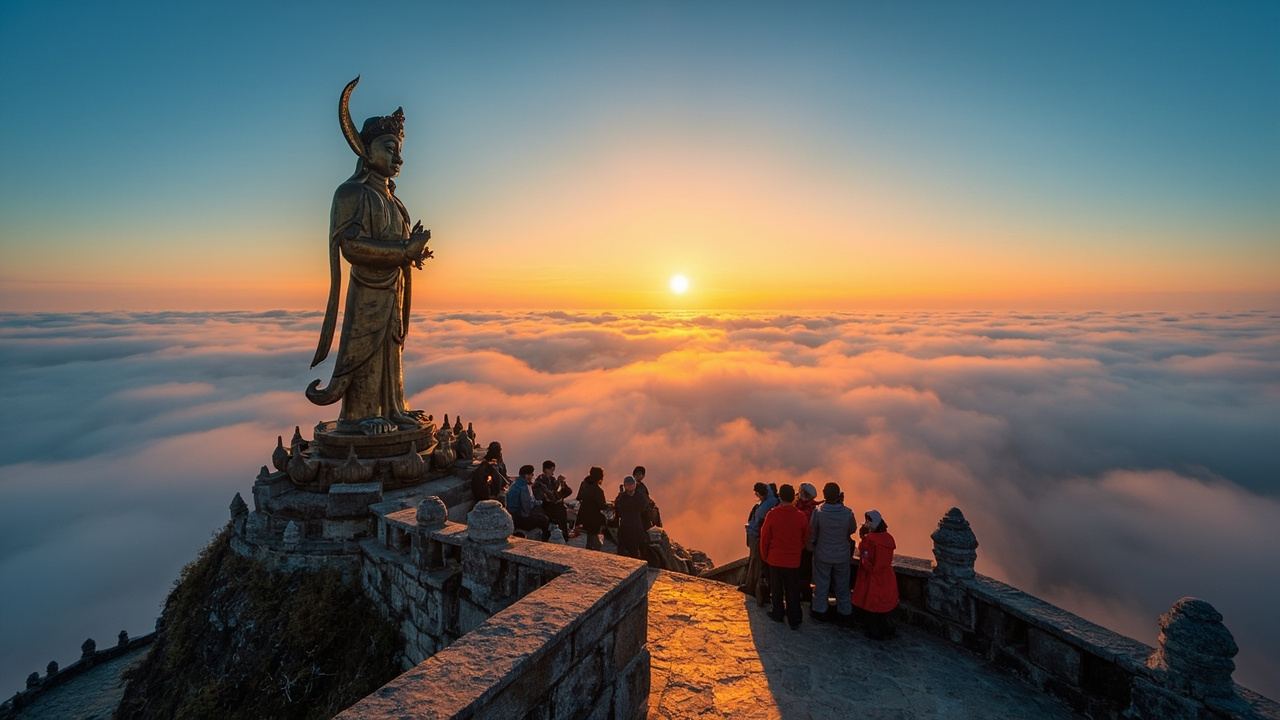
Mount Emei Travel Guide
The monkey came out of nowhere. I was maybe twenty minutes up the trail from Qingyin Pavilion, still smug about how easy the climb felt, when a macaque the size of a small dog dropped onto the railing beside me and stared directly at the plastic bag in my hand. A woman behind me yelled “别打开!” — don’t open it — and I froze. The monkey grabbed the bag, found nothing but a half-empty water bottle, and looked at me with what I can only describe as contempt before sauntering back into the bamboo. That was my introduction to Mount Emei, and honestly, it set the tone for the whole trip: beautiful, a little chaotic, and full of things that will absolutely take your snacks.
Mount Emei (峨眉山, Éméi Shān) is one of China’s four sacred Buddhist mountains, rising 3,099 meters out of the Sichuan basin about 150 km southwest of Chengdu. It’s been a pilgrimage site for over 1,800 years, and the summit — Golden Summit, or Jinding — is one of the few places in China where you can stand above a sea of clouds at sunrise while a 48-meter bronze bodhisattva watches over you. It’s also genuinely demanding if you try to walk it, genuinely easy if you don’t, and full of enough monkeys, temples, and questionable noodle stalls to fill two or three days.
This guide is for first-timers who’ve never been to China, don’t speak Mandarin, and want to know exactly how to get there, what it costs, and whether they should take the cable car or be a hero about it. I’ve been up three times — once in summer rain, once in winter ice, once in golden October — and I’ve made most of the mistakes so you don’t have to.
Quick answer
Mount Emei is a 2–3 day trip from Chengdu, reachable by high-speed train to Emeishan Station in about 1 hour 20 minutes (¥65–¥75, roughly $9–$11). The full entrance ticket is ¥160 ($22) and stays valid for two days; the return cable car to Golden Summit is ¥120 ($17). Most foreign visitors can now enter China visa-free for up to 30 days under the 2025–2026 expanded policy, so if you’re American, British, Australian, or from most EU countries, you don’t need a visa for this trip — just your passport and a working payment app.
The Short Version
Go in October or April. Take the train from Chengdu, sleep one night in Baoguo Village at the base, take the bus-and-cable-car combo to Golden Summit the next morning for sunrise, then walk down through the middle section (Qingyin Pavilion to Wannian Temple) on day two to actually see the mountain. Skip the full 60-km foot pilgrimage unless you’ve trained for it. Bring cash for small stalls, a VPN if you need Google, and do not — I mean it — carry visible food near the monkeys.
How I Picked These
I’ve climbed Emei three times between 2019 and 2025, twice with Chinese friends from Chengdu and once solo with terrible Mandarin and a translation app. I’ve stayed in a monastery guesthouse, a ¥180 village hotel, and a ¥900 summit hotel, and I’ve eaten at both the tourist-trap restaurants near the gate and the hole-in-the-wall places locals pointed me toward. The ten spots below are the ones I’d send a friend to — ranked by how much they’d actually add to a first trip, not by how Instagrammable they are. Where I’m unsure about a 2026 price, I’ve given a range and said so.
Comparison Table
| Rank | Place | Best For | Approx Cost (USD) | Time Needed | When to Go |
|---|---|---|---|---|---|
| 1 | Golden Summit (Jinding) | Sunrise, sea of clouds, the big Buddha | $22 ticket + $17 cable car | Half day | Oct–Nov, Apr–May |
| 2 | Baoguo Temple & Village | Base camp, food, first night | Free–$22 | 2–3 hrs | Any |
| 3 | Qingyin Pavilion | Riverside walking, monkey zone | Included in ticket | 2 hrs | Spring–autumn |
| 4 | Wannian Temple | The 62-ton bronze statue | Included in ticket | 2 hrs | Any |
| 5 | Leidong坪 / Elephant Bathing Pool | Mid-mountain rest stop | Included | 1 hr | Any |
| 6 | Ecological Monkey Zone | Monkeys (obviously) | Included | 1 hr | Daytime only |
| 7 | Fuhu Temple | Quiet forest temple | Free | 1 hr | Any |
| 8 | Baoguo Hot Springs | Sore legs | $15–$30 | 2 hrs | Evening |
| 9 | Emei Shan Museum | Context before you climb | Free | 1 hr | Any |
| 10 | Leshan Giant Buddha (day trip) | A bonus UNESCO site | $11 | Half day | Any |
Golden Summit 鈥?the reason you came, and yes it’s worth the cable car
I got to Jinding at 6:40 a.m. in October, shivering in a rented coat that smelled like everyone who’d worn it before me, and watched the sun come up through a layer of cloud so thick the peaks below looked like islands. A monk in gray robes stood next to me and said nothing for twenty minutes. Then he said, in English, “Good luck today,” and walked off. I still think about that.
This is the top of the mountain, 3,099 meters, and the whole point of the trip. The 48-meter Samantabhadra statue is genuinely enormous — you feel it in your chest when you round the corner — and on a clear morning you’re standing above the clouds while the sun rises behind the statue’s head. On a bad day you see fog and nothing else. It’s a gamble.
馃搷 Location: Summit of Mount Emei, reachable by shuttle bus from Leidong坪 then cable car or 20-minute walk.
馃帿 Entry fee: Included in the ¥160 ($22) mountain ticket. Cable car up is ¥65 ($9), down ¥55 ($8), or ¥120 ($17) round trip.
馃晲 Opening hours: Cable car runs roughly 7:00 a.m.–6:00 p.m. in summer, 8:00 a.m.–5:00 p.m. in winter. Summit itself is open 24 hours.
馃殕 How to actually get there: From Baoguo Village, take the green shuttle bus (¥90 round trip, $12.50) to Leidong坪, about 2 hours. Then either walk 20 minutes to the cable car station or take the small monorail. Cable car takes 3 minutes.
鈴?When to visit: Sunrise in October or April is the sweet spot. Avoid Chinese public holidays — Golden Week (Oct 1–7) is a crush.
馃挕 Insider tips: Rent a coat at the summit for ¥30 ($4) instead of hauling your own. Bring gloves even in summer — it’s 10°C colder up top. The “sunrise” viewing platform fills up by 5:30 a.m., so sleep at the summit hotel if you can afford it (¥600–¥1,200, ~$85–$170). And set up Alipay or WeChat Pay before you come — the summit shops don’t take foreign cards.
I paid ¥45 for a bowl of instant noodles at the summit and would do it again.
Baoguo Temple and Village 鈥?where you actually sleep and eat
Baoguo Village is the unglamorous base of the mountain: a strip of hotels, noodle shops, and souvenir stalls where every trip starts. I stayed at a ¥180 (~$25) room with a hard bed and a view of a parking lot, and it was perfect.
The village exists because of the temple — Baoguo Temple is the oldest and largest on the mountain, founded in the 16th century, and it’s free to enter the outer courtyards. It’s worth an hour before dinner. The real draw of the village, though, is the food. Sichuan here means mapo tofu that will numb your mouth, cold noodles with chili oil, and a local specialty called 叶儿粑 — sticky rice dumplings wrapped in bamboo leaves, ¥5 (~$0.70) each.
馃搷 Location: Foot of Mount Emei, 6 km from Emeishan city center.
馃帿 Entry fee: Temple outer courtyard free; main hall ¥8 (~$1).
馃晲 Opening hours: Temple 8:00 a.m.–6:00 p.m. daily.
馃殕 How to actually get there: From Emeishan Station (high-speed rail from Chengdu), take bus 5 or a taxi (¥20–¥30, $3–$4) — 15 minutes.
鈴?When to visit: Arrive the evening before your climb, eat, sleep, start early.
馃挕 Insider tips: Buy your mountain ticket at the village visitor center the night before to skip the morning queue. Hotels here will store luggage for ¥10/day while you climb. Most receptionists speak zero English — have your hotel name written in Chinese. And the hot springs at the nicer hotels are open to non-guests for ¥100–¥200 ($15–$30).
A woman at a noodle stall near my hotel refused to let me pay for a second bowl of tea. She just waved her hand and said “喝, 喝” — drink, drink.
Qingyin Pavilion 鈥?the prettiest two hours on the mountain
This is the part of Emei that shows up in every Chinese painting: a river rushing between two cliffs, a red pavilion straddling the water, stone steps cut into moss. I walked it in the rain and it was better than in the sun.
Qingyin Pavilion (清音阁) sits at about 710 meters, and the walk from Wuxiangang (五显岗) bus stop to the pavilion and on to the Ecological Monkey Zone is the single best short hike on the mountain. It’s mostly flat, follows the river, and takes about 90 minutes each way. The pavilion itself is small but perfectly placed — you stand on a stone bridge and watch two streams merge below you.
馃搷 Location: Mid-lower mountain, between Wuxiangang and the monkey zone.
馃帿 Entry fee: Included in the ¥160 mountain ticket.
馃晲 Opening hours: Trail open daylight hours; pavilion area roughly 7:00 a.m.–6:00 p.m.
馃殕 How to actually get there: From Baoguo, take the shuttle bus to Wuxiangang (¥20, $3, 30 min), then walk 20 minutes uphill to the pavilion.
鈴?When to visit: Morning, before the tour groups. Weekdays are dramatically quieter.
馃挕 Insider tips: This is where the monkeys start. Do not carry plastic bags. Do not feed them. Do not make eye contact with a big one. Keep your phone in a zipped pocket — they steal those too. There’s a small tea house near the pavilion where you can sit for ¥20 ($3) and let your legs recover.
I watched a French tourist lose an entire bag of oranges to a monkey here. He was not happy. The monkey was.
Wannian Temple 鈥?the bronze elephant you didn’t know you needed to see
Wannian Temple (万年寺) is the one I almost skipped, and I’m glad I didn’t. It houses a 62-ton bronze statue of Samantabhadra riding a white elephant, cast in 980 AD, and it’s genuinely one of the strangest, most beautiful things I’ve seen in China.
The temple sits at 1,020 meters, surrounded by old trees, and the main hall is a domed brick structure that looks more like a Mughal tomb than a Chinese temple. Inside, the elephant and rider are lit by a single shaft of light from above. It’s quiet. It’s cool. It’s the opposite of the summit.
馃搷 Location: Mid-mountain, above Qingyin Pavilion.
馃帿 Entry fee: Included in the mountain ticket.
馃晲 Opening hours: 7:00 a.m.–6:00 p.m. daily.
馃殕 How to actually get there: From Qingyin Pavilion, walk up about 90 minutes (steep), or take the cable car from Wannian parking lot (¥65, $9, 5 min).
鈴?When to visit: Late morning, after the Qingyin walk, before lunch.
馃挕 Insider tips: The vegetarian lunch at the temple refectory is ¥30 ($4) and worth it — rice, tofu, greens, no menu, just sit down. Photography inside the main hall is banned; a monk will tap your shoulder if you try. And the walk down from Wannian to Qingyin is much easier than the walk up.
A monk here corrected my terrible attempt at “谢谢” and then gave me a small paper charm. I still have it.
Leidong坪 鈥?the mid-mountain rest stop that’s better than it sounds
Leidong坪 (雷洞坪) is where the shuttle bus from Baoguo ends and the summit section begins. It’s cold, it’s crowded, and it smells like fried food and diesel. But it’s also where the mountain changes character — you’re at 2,430 meters, the trees are stunted, and the air is thin enough that you notice it on stairs.
Most people blow through here in 20 minutes en route to the cable car. I’d suggest an hour. There’s a small temple, a few food stalls selling yak jerky and instant noodles, and a genuinely good view back down the valley on a clear day. It’s also where you’ll see the famous “sedan chair” porters — men who will carry you up the last stretch in a bamboo chair for ¥300–¥600 (~$42–$85). I didn’t take one. I thought about it.
馃搷 Location: 2,430 m, end of the shuttle bus line. 馃帿 Entry fee: Included in mountain ticket. 馃晲 Opening hours: Bus runs roughly 6:00 a.m.–5:00 p.m.; stalls open daylight hours. 馃殕 How to actually get there: Shuttle bus from Baoguo (¥90 round trip, ~$12.50, 2 hrs). 鈴?When to visit: On your way up, or on your way down if you’re staying at the summit. 馃挕 Insider tips: This is the last place to buy reasonably priced water (¥10, ~$1.40). Above here it doubles. The bathrooms are grim — use them anyway. If you’re prone to altitude sickness, this is where you’ll first feel it; drink water and slow down.
I bought a bag of yak jerky from a woman who insisted I try three kinds before choosing. I bought the wrong one. She laughed at me.
Ecological Monkey Zone 鈥?yes, they really are that aggressive
I have complicated feelings about the monkeys. On one hand, Tibetan macaques in the wild are genuinely cool to see up close. On the other, they have learned that tourists carry food, and they have zero fear. I watched one unzip a man’s backpack while he was wearing it.
The zone is a designated stretch of trail between Qingyin Pavilion and Wannian Temple, roughly 1 km long, where the macaques hang out. There are staff with slingshots (they don’t hit the monkeys, just scare them), but they can’t be everywhere. The monkeys are wild, not tame, and they bite.
馃搷 Location: Between Qingyin Pavilion and Wannian Temple, mid-lower mountain. 馃帿 Entry fee: Included in mountain ticket. 馃晲 Opening hours: Daylight hours only; monkeys are most active 9:00 a.m.–3:00 p.m. 馃殕 How to actually get there: Walk from Qingyin Pavilion (20 min) or down from Wannian Temple (40 min). 鈴?When to visit: Mid-morning, weekday if possible. 馃挕 Insider tips: No plastic bags, no visible food, no dangling water bottles. If a monkey grabs you, let go and don’t fight. Keep your phone in a zipped pocket, not a loose one. Don’t smile at them — bared teeth is a threat in monkey language. And don’t bring a child holding food; I saw that go badly.
A staff member told me, in surprisingly good English, “They know the difference between tourists and locals. Tourists have food.”
Fuhu Temple 鈥?the quiet one nobody talks about
Fuhu Temple (伏虎寺) is a 20-minute walk from Baoguo Village, tucked into a forest, and almost empty. I went on a Tuesday morning and had the whole place to myself except for two monks sweeping.
It’s a working monastery, founded in the Tang dynasty, rebuilt several times, and it has the kind of stillness that the big temples on the mountain have lost. The main hall has a beautiful wooden ceiling, and the courtyards are full of old pines. There’s a small tea room where you can sit for free if you buy tea (¥30, ~$4).
馃搷 Location: 1 km uphill from Baoguo Village, in the forest. 馃帿 Entry fee: Free. 馃晲 Opening hours: 8:00 a.m.–5:30 p.m. daily. 馃殕 How to actually get there: Walk from Baoguo Village — from the main gate, head uphill on the paved road for 15 minutes, follow signs. 鈴?When to visit: Morning or late afternoon. It’s a good pre-climb warm-up walk. 馃挕 Insider tips: This is where you go if you want to escape the crowds without leaving the base area. The nuns here run a small vegetarian kitchen; ask politely and they’ll feed you for a donation. Bring small bills — no card readers.
The monk who swept the courtyard nodded at me and kept sweeping. That was the whole interaction, and it was perfect.
Baoguo Hot Springs 鈥?the reward for your legs
After two days of stairs, the hot springs at the base are not optional. They’re the difference between “I’ll never walk again” and “that was amazing.”
Several hotels in Baoguo Village have hot spring pools fed by natural mineral water, and most sell day passes to non-guests. The water is genuinely hot (around 40°C), sulfur-smelling, and exactly what your calves need. I went at 8 p.m. after my second day and stayed for two hours.
馃搷 Location: Various hotels in Baoguo Village, base of the mountain.
馃帿 Entry fee: ¥100–¥200 ($15–$30) for a day pass.
馃晲 Opening hours: Usually 2:00 p.m.–11:00 p.m. daily.
馃殕 How to actually get there: Walk from your hotel — most are within 10 minutes of each other.
鈴?When to visit: Evening, after your climb. Avoid after 9 p.m. when it gets crowded.
馃挕 Insider tips: Bring your own towel if you can — rentals are ¥20 ($3) and thin. Most pools are segregated or require swimwear; check before you go. The nicest one I found was at the Emeishan Hot Spring Hotel, ¥168 (~$24) for a day pass.
I fell asleep in the outdoor pool and a staff member had to wake me up. Worth it.
Emei Shan Museum 鈥?one hour that makes the whole mountain make sense
I’ll be honest: I skipped this on my first two trips and regretted it. The museum sits just outside Baoguo Temple and does a genuinely good job explaining what you’re looking at — the geology of the mountain, the history of Buddhism in Sichuan, the pilgrimage routes, and the plants and animals (including the monkeys).
It’s small, takes about an hour, and has English signage on most exhibits. If you’re going to spend two days on a sacred Buddhist mountain, an hour of context is worth it.
馃搷 Location: Next to Baoguo Temple, Baoguo Village. 馃帿 Entry fee: Free with mountain ticket, otherwise ¥20 (~$3). 馃晲 Opening hours: 9:00 a.m.–5:00 p.m., closed Mondays. 馃殕 How to actually get there: Walk from Baoguo Village center, 5 minutes. 鈴?When to visit: The afternoon you arrive, before dinner. 馃挕 Insider tips: The section on the mountain’s four seasons is genuinely useful for packing. The gift shop has decent English-language books on Buddhism. And the bathrooms here are the cleanest in the village.
I spent 20 minutes reading about the mountain’s cloud formations and then saw exactly the cloud formation described the next morning. Small win.
Leshan Giant Buddha 鈥?the day trip that’s worth the detour
Most people do Leshan as a separate trip from Chengdu, but if you’re already at Emei, it’s 40 minutes away by train and absolutely worth a half day. The Giant Buddha is 71 meters tall, carved into a cliff in the 8th century, and it’s one of the most impressive things in China.
The catch: the line to walk down the staircase beside the Buddha can be 2–3 hours on weekends. The alternative is a boat ride that takes you past the Buddha from the river for ¥70 (~$10) and takes 30 minutes. I did the boat. I’d do it again.
馃搷 Location: Leshan city, 40 km north of Emei.
馃帿 Entry fee: ¥80 ($11) for the walking route; ¥70 ($10) for the boat.
馃晲 Opening hours: 7:30 a.m.–6:30 p.m. (summer), 8:00 a.m.–5:30 p.m. (winter).
馃殕 How to actually get there: High-speed train from Emeishan Station to Leshan Station (20 min, ¥11, ~$1.50), then bus 13 or a taxi to the Buddha (¥30, ~$4).
鈴?When to visit: Weekday morning. Avoid weekends and holidays entirely.
馃挕 Insider tips: The boat is the smarter move if you’re short on time. Buy tickets online via WeChat mini-program the day before. And if you do walk, go early — the line forms by 8 a.m.
I met a Canadian couple on the boat who’d skipped Emei entirely and done only Leshan. They were happy. I think they missed the better mountain.
FAQ summary
Mount Emei is best done as a 2–3 day trip from Chengdu, with one night in Baoguo Village at the base and one night at the summit if you want sunrise. The full mountain ticket is ¥160 ($22) and covers two days; the round-trip cable car to Golden Summit is ¥120 ($17). Most foreign visitors can enter China visa-free for up to 30 days in 2026, but you’ll need Alipay or WeChat Pay set up before you arrive, since foreign cards are rarely accepted on the mountain. October and April are the best months; avoid Chinese public holidays.
FAQ
Q: Do I need a visa to visit Mount Emei as a foreign tourist? A: Most likely no. As of 2026, citizens of the US, UK, Australia, Canada, and most EU countries can enter China visa-free for up to 30 days under the expanded policy. Check the current visa-free rules before booking, since the list changes.
Q: How do I get from Chengdu to Mount Emei? A: Take a high-speed train from Chengdu East or Chengdu South Station to Emeishan Station — about 1 hour 20 minutes, ¥65–¥75 (~$9–$11). From the station, bus 5 or a taxi (¥20–¥30) gets you to Baoguo Village in 15 minutes.
Q: How much does Mount Emei cost in total?
A: Budget roughly $80–$150 per person for two days, including the ¥160 ($22) mountain ticket, ¥120 ($17) round-trip cable car, ¥90 (~$12.50) shuttle bus, one or two nights of lodging ($25–$170/night), and meals. Summit hotels are the expensive part.
Q: Can I climb Mount Emei without taking the cable car? A: Yes, but it’s a serious hike — the full walking route from Baoguo to Golden Summit is about 60 km and takes 2–3 days with overnight temple stays. Most visitors take the shuttle bus to Leidong坪 and then either walk 20 minutes or take the cable car to the summit.
Q: Are the monkeys dangerous? A: They can be. Tibetan macaques on Emei are habituated to tourists and will grab food, bags, and phones. Don’t carry visible food, keep your phone zipped, and don’t fight them if they grab something. Bites are rare but happen; if bitten, wash the wound and see a doctor.
Q: Do I need a VPN or a local SIM card on Mount Emei? A: Yes to both, ideally. Google, WhatsApp, and Instagram are blocked in China, so install a VPN before you arrive. A local SIM or eSIM is useful for maps and translation — see our China SIM and internet guide for setup. Wi-Fi at hotels is common but unreliable on the mountain.
Q: What should I pack for Mount Emei? A: Layers, rain jacket, sturdy shoes, gloves (even in summer for the summit), cash in small bills, a power bank, and a translation app. The summit is 10–15°C colder than the base, and weather changes fast.
The Honest Wrap-up
Mount Emei is not for everyone. If you want a relaxing vacation with good food and no stairs, this isn’t it — go to Chengdu and eat hotpot for a week instead. But if you want one mountain that gives you a sunrise above the clouds, a 1,000-year-old bronze elephant, aggressive monkeys, and a bowl of noodles that costs more than it should because you’re 3,000 meters up, this is the one. Book two nights, take the cable car, and don’t try to be a hero on the stairs. And if a monkey looks at you, walk away. Seriously.
More guides you may like

Top 10 Bridges in China
China's bridges are engineering marvels spanning mountains, rivers, and seas. Here are 10 of the most spectacular, from ancient stone to modern steel.
8 min read

Top 10 Buddhist Sites in China
From the Leshan Giant Buddha to the Dunhuang Caves, these 10 Buddhist sites represent 2,000 years of China's spiritual heritage.
9 min read

Top 10 Day Trips from Beijing You Shouldn't Miss
Beijing is packed with history, but some of China's best experiences are just a few hours away. Here are 10 day trips that will transform your visit.
9 min read

Top 10 Hidden Gems in China Off the Beaten Path
Beyond the Great Wall and Terracotta Warriors, China has incredible hidden destinations few tourists ever reach. Here are 10 underrated gems worth the detour.
9 min read

Top 10 Markets and Shopping Streets in China
From Shanghai's Bund to Beijing's Silk Street - 10 markets where foreigners can haggle, explore, and bring home authentic Chinese goods.
9 min read

Top 10 Museums in China You Shouldn't Miss
China's museums span 5,000 years of civilization. These 10 - from the Palace Museum to Xi'an's terracotta gallery - are unmissable for culture lovers.
9 min read