
China Altitude Sickness Tibet
TODO: Extract from article (100-160 chars)
China Altitude Sickness Tibet
I threw up in a hotel bathroom in Lhasa at 2 a.m., and I want to tell you about it because nobody told me it would happen.
The day before, I’d flown from Chengdu to Lhasa Gonggar Airport in about two and a half hours. I walked off the plane feeling fine, posed for the obligatory photo under the “Welcome to Tibet” sign, and rode the airport bus into the city. By dinner I had a headache that felt like a rubber band tightening around my skull. I blamed the yak butter tea. It was not the yak butter tea.
Tibet sits on the Qinghai-Tibet Plateau at an average elevation above 4,000 meters (13,100 feet), and Lhasa itself is at 3,650 meters (11,975 feet). That’s roughly the altitude of a small plane’s cruising cabin, except you’re walking around in it, eating in it, and trying to sleep in it. Your body needs a few days to make more red blood cells and adjust its breathing. If you rush it, altitude sickness — called AMS, acute mountain sickness — will find you.
This guide is for first-time visitors who are nervous about the altitude and want real answers: what actually happens to your body, how to get to Tibet as a foreigner in 2026, which routes are gentler, what to pack, and what to do when the headache hits at 2 a.m. I’ve been through it three times now, including one trip where I did everything wrong so you don’t have to.
Quick answer
Foreign tourists need a Tibet Travel Permit arranged through a licensed Tibetan travel agency, plus a Chinese visa (or visa-free entry if eligible), and you cannot book flights or trains into Tibet independently. The single most effective way to avoid severe altitude sickness is to arrive by train from Xining or Chengdu rather than flying, spend your first 48 hours in Lhasa doing almost nothing, and start preventive medication (acetazolamide/Diamox) the day before you ascend. Mild AMS affects roughly 50-60% of visitors flying directly to Lhasa, but severe cases are rare if you ascend slowly and don’t ignore warning signs.
The Short Version
Fly straight to Lhasa from sea level and you have maybe a 50/50 chance of a rough first night. Take the train, or spend two nights in Xining (2,275 m) first, and your odds improve a lot. Diamox works but makes beer taste weird and makes you pee constantly. Don’t drink alcohol for the first 48 hours, don’t take a hot shower on night one, and if you can’t walk in a straight line, that’s not jet lag — that’s your cue to descend or see a doctor.
How I Picked These
I’ve done the Lhasa flight twice and the Xining-to-Lhasa train once, and I’ve talked to enough travelers in Tibetan guesthouses to know that everyone’s experience is different. I also spent an afternoon with a doctor at a Lhasa clinic who treats AMS cases weekly — she was blunt about what tourists get wrong. The routes and altitude figures below come from my own trips plus verified elevation data. Prices are 2026 estimates and shift with the season, so treat them as ranges, not gospel. Where I’m unsure, I say so.
Comparison Table
| Rank | Route / Place | Best For | Approx Cost (USD) | Time Needed | When to Go |
|---|---|---|---|---|---|
| 1 | Xining → Lhasa train | Gradual acclimatization | $60–120 ($430–860 CNY) | 21–22 hrs | May–Oct |
| 2 | Chengdu → Lhasa flight | Saving time | $180–320 ($1,300–2,300 CNY) | 2.5 hrs | Apr–Oct |
| 3 | Lhasa (3,650 m) | First base | Varies by tour | 3–4 days | Apr–Oct |
| 4 | Shigatse (3,840 m) | Culture + lower stress | Tour-included | 1–2 days | May–Sep |
| 5 | Everest Base Camp (5,200 m) | The big one | $400+ add-on | 3–4 days | Apr–May, Sep–Oct |
| 6 | Namtso Lake (4,718 m) | Day-trip scenery | $80–150 | 1–2 days | Jun–Sep |
| 7 | Nyingchi (3,000 m) | Lower-altitude warm-up | Tour-included | 2 days | Mar–Oct |
1. Lhasa — Where Everyone Starts, Whether They’re Ready or Not
The first thing I noticed in Lhasa wasn’t the Potala Palace. It was how slowly everyone walked. Old Tibetan pilgrims shuffled clockwise around the Barkhor circuit with prayer wheels, and even the teenagers moved like they had all the time in the world. After two days, I understood: they’re not being leisurely. They’re being smart.
Lhasa is the unavoidable first stop for almost every foreign visitor because the permit system routes you here. At 3,650 meters, it’s high enough to trigger AMS in most people who fly in from sea level, but low enough that your body can adjust within 48–72 hours if you behave.
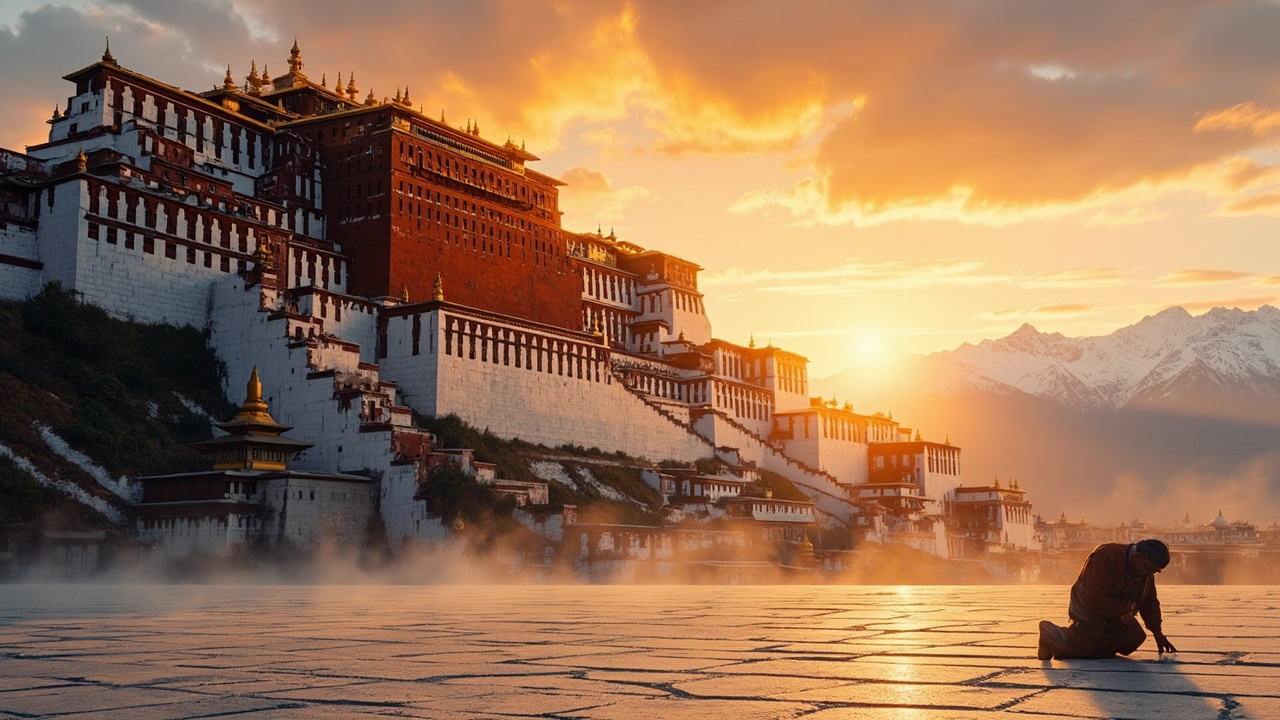
Why it’s special: The Potala Palace at dawn, when the light hits the white and red walls and the whole thing looks like it’s floating, is worth the trip alone. But the real Lhasa is the Barkhor, the circular pilgrim route around the Jokhang Temple, where you’ll smell juniper incense and butter lamps and hear the constant click-whirr of prayer wheels.
📍 Location: Chengguan District, central Lhasa.
🎫 Entry fee: Potala Palace $28 ($200 CNY) in high season; Jokhang Temple $4–6).
⏰ When to visit: April–October. Go to the Barkhor early morning (7–9 a.m.) for the pilgrim atmosphere.
💡 Insider tips: Book Potala tickets through your tour agency — you can’t buy them at the gate as a foreigner. Drink 3–4 liters of water daily. Skip the hotel gym and the rooftop bar on night one. If your hotel has oxygen canisters, use them sparingly — they can delay acclimatization.
I met a Belgian guy at my guesthouse who ignored all of this, went straight to a rooftop bar, and spent the next day in bed. Don’t be the Belgian guy.$12 ($85 CNY); Barkhor circuit is free.
🕒 Opening hours: Potala 9:00–16:00, timed-entry tickets, closed some Mondays; Jokhang 7:00–18:00.
🚕 How to get there: Fly into Lhasa Gonggar (LXA), then take the airport shuttle bus ($4 / 30 CNY, 1 hour) to the city center. Or arrive by train at Lhasa Station and take a taxi (
2. The Xining-to-Lhasa Train — The Smart Way Up
I took the Z21 train from Xining and it changed how I think about altitude. Instead of a 2.5-hour flight that dumps you at 3,650 meters, you spend 21 hours climbing gradually through the Qinghai-Tibet Plateau. The train is pressurized and oxygen-enriched, but more importantly, your body gets a slow ramp instead of a cliff.
The scenery is genuinely wild — frozen lakes, herds of yaks, and a stretch where you cross the Tanggula Pass at 5,072 meters, the highest point on any railway in the world.
Why it’s special: You wake up to sunrise over the plateau, and by the time you reach Lhasa you’re already partway acclimatized. Most people on my train had mild headaches at worst.
📍 Location: Departs Xining Station; also available from Chengdu, Chongqing, and Lanzhou. 🎫 Entry fee: Soft sleeper ~$60–120 ($430–860 CNY) depending on origin and class. 🕒 Opening hours: Daily departures; the Xining–Lhasa run takes 21–22 hours. 🚆 How to get there: Your agency books the ticket as part of the permit package. Xining Station is on Metro Line 1. ⏰ When to visit: May–October. Book soft sleeper if you can — hard sleeper is fine but noisier. 💡 Insider tips: The train has oxygen outlets at every berth; use them if you feel breathless. Bring your own snacks — dining car food is mediocre. Keep your passport handy; officials check it at Golmud. The high-speed rail network connects Xining to most major cities. A Tibetan woman in my compartment shared her momos with me and laughed at my attempts to say thuk-je-che (thank you). I still can’t pronounce it right.
3. Shigatse — Tashilhunpo Monastery and a Gentler Pace
Shigatse (Xigazê) sits at 3,840 meters, only slightly higher than Lhasa, and it’s the traditional seat of the Panchen Lama. I went there mostly to break up the drive toward Everest, and I ended up liking it more than Lhasa — fewer tourists, more actual life.
Tashilhunpo Monastery is the main draw, a sprawling complex where monks debate in courtyards and the giant bronze statue of the future Buddha fills an entire hall.
Why it’s special: The monastery’s kora (pilgrim path) circles the whole hillside and takes about an hour. Do it at sunset and you’ll have the place mostly to yourself.
📍 Location: Shigatse city center, ~270 km west of Lhasa. 🎫 Entry fee: ~$11 ($80 CNY) for the monastery. 🕒 Opening hours: 9:00–17:00 daily. 🚗 How to get there: Usually by private vehicle as part of a tour; 4–5 hours from Lhasa on the Friendship Highway. ⏰ When to visit: May–September. Weekdays are quieter. 💡 Insider tips: The altitude here is manageable if you’ve already spent 2–3 days in Lhasa. Don’t skip the monk debate courtyard at 3 p.m. Bring small bills for monastery donations. ATMs are limited — carry cash. I bought a hand-woven yak wool scarf from a woman near the entrance who refused to let me pay full price. I still have it.
4. Everest Base Camp (Tibet Side) — The Real Test
This is where altitude stops being a mild inconvenience and becomes the main event. The Tibetan EBC sits at around 5,200 meters (17,060 feet), and the drive there crosses passes above 5,000 meters multiple times.
I’ll be honest: I got lucky. I’d spent a week acclimatizing in Lhasa and Shigatse first, so by the time I reached EBC I had a headache and shortness of breath but nothing worse. A guy in my group who’d flown into Lhasa three days earlier spent the night vomiting in the tent.
Why it’s special: Standing at the north base camp, looking at the north face of Everest across the Rongbuk Glacier, is one of those moments that resets your sense of scale.
📍 Location: Tingri County, ~600 km from Lhasa via Shigatse. 🎫 Entry fee: Included in tour packages; EBC itself ~$25 ($180 CNY) plus vehicle fees. 🕒 Opening hours: Access is tour-only; overnight stays are in tent camps or the Rongbuk Monastery guesthouse. 🚗 How to get there: Private 4WD with your tour operator; 2 days from Shigatse. ⏰ When to visit: April–May and September–October for clearest skies. Avoid the monsoon (June–August). 💡 Insider tips: Bring a proper down jacket even in summer — nights drop below freezing. Diamox is almost mandatory here. Don’t sleep at EBC if you have any AMS symptoms; sleep lower at Tingri (4,300 m). The Rongbuk Monastery is the highest monastery in the world and worth the extra hour. I watched the sunrise hit the summit from inside a tent, drinking instant coffee that tasted like victory.
5. Namtso Lake — Beautiful, But Sneaky High
Namtso is one of the most photographed lakes in Tibet, a vast turquoise expanse at 4,718 meters. Tourists love it. Here’s what they don’t tell you: many people feel worse at Namtso than at EBC because they do it as a rushed overnight trip from Lhasa without proper acclimatization.
Why it’s special: The lake’s color is unreal — a deep blue-green that shifts with the clouds. The Tashi Dor peninsula has small hermit caves and prayer flags everywhere.
📍 Location: ~240 km north of Lhasa, Damxung County. 🎫 Entry fee: ~$17 ($120 CNY) plus vehicle fee. 🕒 Opening hours: 24 hours; overnight stays in basic guesthouses. 🚗 How to get there: 4–5 hours by private vehicle from Lhasa. ⏰ When to visit: June–September only; the pass is often snowed in otherwise. 💡 Insider tips: Only go if you’ve already spent 3+ nights in Lhasa. Bring your own oxygen if you’re prone to AMS. The guesthouses are cold and basic — expect a sleeping bag situation. Sunset and sunrise are the payoff. I met a Korean photographer there who’d been waiting three days for clear skies. He got them on the morning I left.
6. Nyingchi — Tibet’s Low-Altitude Warm-Up
Nyingchi (Linzhi) sits at around 3,000 meters and feels like a different country — pine forests, peach blossoms in spring, and a much gentler climate. Some travelers use it as an acclimatization stop before heading to Lhasa.
Why it’s special: It’s the greenest part of Tibet, with the Yarlung Tsangpo Grand Canyon nearby, one of the deepest canyons on Earth.
📍 Location: Southeastern Tibet, ~400 km east of Lhasa. 🎫 Entry fee: Varies by site; Basum Lake ~$17 ($120 CNY). 🕒 Opening hours: Daylight hours for most attractions. 🚗 How to get there: Flights from Lhasa or Chengdu to Nyingchi Mainling Airport, or a long drive. ⏰ When to visit: March–April for peach blossoms; September–October for clear weather. 💡 Insider tips: This is a good first stop if you’re nervous about altitude. The food here is more varied than in central Tibet. Bring rain gear. The guesthouse owner in Bayi made me a bowl of noodle soup that I still think about.
7. Tingri — The Acclimatization Stop Nobody Talks About
Tingri sits at 4,300 meters and is where smart EBC travelers spend a night to adjust before the final push. It’s a dusty, windblown town with one main street and incredible views of the Himalayas on clear days.
Why it’s special: You can see four 8,000-meter peaks from the roadside on a good day, including Everest and Cho Oyu.
📍 Location: Tingri County, on the Friendship Highway. 🎫 Entry fee: None for the town. 🕒 Opening hours: N/A. 🚗 How to get there: 5–6 hours by vehicle from Shigatse. ⏰ When to visit: April–May, September–October. 💡 Insider tips: Sleep here instead of EBC if you’re feeling rough. The guesthouses are basic but warm enough. Bring cash — no ATMs. The altitude here is no joke; treat it like a real stop, not a pit stop. I ate yak stew here that was so good I asked for the recipe. The cook just laughed.
8. Gyantse — The Forgotten Middle Stop
Gyantse (Gyantse) at 3,977 meters is often skipped in favor of Shigatse, which is a shame. The Kumbum Stupa here has 108 chapels and is one of the most photogenic structures in Tibet.
Why it’s special: Fewer crowds, a walkable old town, and the Pelkor Chode Monastery complex.
📍 Location: ~250 km southwest of Lhasa. 🎫 Entry fee: ~$8 ($60 CNY) for the Kumbum. 🕒 Opening hours: 9:00–17:00. 🚗 How to get there: 4 hours by vehicle from Lhasa. ⏰ When to visit: May–September. 💡 Insider tips: Climb the Kumbum’s spiral staircase for views over the valley. The old town has good local restaurants. It’s a good overnight stop between Lhasa and Shigatse. A monk here showed me how to spin a prayer wheel properly. I’d been doing it wrong for a week.
9. Yamdrok Lake — The Turquoise Detour
Yamdrok Tso sits at 4,441 meters and is a standard stop on the Lhasa–Shigatse route. The color is almost fluorescent on a sunny day.
Why it’s special: The drive over the Gampa La pass (4,794 m) gives you a panoramic view of the lake that’s genuinely jaw-dropping.
📍 Location: ~110 km southwest of Lhasa. 🎫 Entry fee: ~$8 ($60 CNY). 🕒 Opening hours: Daylight hours. 🚗 How to get there: 2 hours by vehicle from Lhasa. ⏰ When to visit: May–October. 💡 Insider tips: The pass is cold and windy — bring layers. The lakeside viewpoint has souvenir stalls and yak photo ops (they’ll ask for money). Don’t rush the altitude here; the pass is higher than Lhasa. I paid $3 to take a photo with a yak. Worth it.
10. The Potala Palace — The One You Came For
I saved the Potala for last because it’s the emotional center of the whole trip. Seeing it lit up at night from the Barkhor, with the whole city below, is the image that stays with you.
Why it’s special: It’s a genuine architectural wonder, 13 stories of white and red walls built into the hillside, with over 1,000 rooms and centuries of history.
📍 Location: Central Lhasa, Chengguan District. 🎫 Entry fee: ~$28 ($200 CNY) high season; ~$14 ($100 CNY) low season. 🕒 Opening hours: 9:00–16:00, timed entry, closed some Mondays. 🚶 How to get there: Walk from the Barkhor (15 min) or take a taxi. ⏰ When to visit: Early morning for fewer crowds; book tickets through your agency well in advance. 💡 Insider tips: You get a strict time slot and about an hour inside. No photos in the main halls. The climb up is steep — take it slow, especially if you’re still adjusting. Bring your passport. I watched an elderly Tibetan woman do a full prostration circuit around the palace at dawn. I sat and watched for twenty minutes. It was better than any photo.
FAQ summary
For most foreign visitors, the biggest altitude risk is flying directly to Lhasa from sea level and jumping straight into sightseeing. Taking the train from Xining or Chengdu, or spending two nights at an intermediate altitude like Xining (2,275 m) or Nyingchi (3,000 m), dramatically reduces your chances of severe AMS. Diamox (acetazolamide) is the standard preventive medication and should be started the day before you ascend, but it’s not a substitute for slow ascent. Severe altitude sickness is rare among tourists who follow basic rules — hydrate, avoid alcohol, don’t overexert, and descend if symptoms worsen.
FAQ
Q: Do I need a permit to visit Tibet as a foreigner? A: Yes. You need a Tibet Travel Permit arranged through a licensed Tibetan travel agency, plus your Chinese visa (or visa-free entry if eligible). You cannot book flights or trains into Tibet independently — the agency handles the paperwork and often the tickets too.
Q: Can I take Diamox for altitude sickness? A: Yes, acetazolamide (Diamox) is the most common preventive medication. Start it the day before you ascend and continue for 2–3 days at altitude. It causes tingling in fingers and increased urination. Ask your doctor first, especially if you have sulfa allergies.
Q: What are the symptoms of altitude sickness I should watch for? A: Headache, nausea, dizziness, fatigue, and trouble sleeping are common mild AMS symptoms. Warning signs of severe AMS include vomiting that won’t stop, confusion, difficulty walking in a straight line, and breathlessness at rest. If you get those, descend immediately and seek medical help.
Q: Is it safe to fly directly to Lhasa? A: It’s allowed, but it’s the fastest way to trigger AMS. If you fly, plan to do almost nothing for the first 48 hours. Many travelers do better taking the train from Xining or Chengdu, which lets your body adjust gradually.
Q: How much does a Tibet trip cost for a foreigner? A: Budget $1,500–3,000 ($10,800–21,600 CNY) for a 7–10 day tour including permits, transport, guide, and accommodation. EBC add-ons run $400+ extra. Independent travel isn’t possible — you must go through an agency.
Q: Do I need a VPN or special SIM card in Tibet? A: Yes. Standard China SIM cards and internet setup apply, and a VPN is essential if you want to use Google, WhatsApp, or Instagram. Signal is spotty outside Lhasa. Download offline maps before you go.
Q: What should I pack for altitude? A: Layers, a down jacket, sunscreen (the UV is brutal), lip balm, a refillable water bottle, Diamox if prescribed, and any prescription meds. Oxygen canisters are available locally but shouldn’t be your main strategy.
The Honest Wrap-up
This guide is for travelers who want to see Tibet but are worried about the altitude — and honestly, you should be a little worried. It’s not a place to wing it. If you have serious heart or lung conditions, or you’re pregnant, talk to a doctor before booking. If you’re generally healthy and willing to slow down, you’ll almost certainly be fine.
My one piece of advice: build in a buffer day in Lhasa before your tour officially starts. Sleep, hydrate, walk slowly, and let your body catch up. The mountains aren’t going anywhere.
More guides you may like

Top 10 Bridges in China
China's bridges are engineering marvels spanning mountains, rivers, and seas. Here are 10 of the most spectacular, from ancient stone to modern steel.
8 min read

Top 10 Buddhist Sites in China
From the Leshan Giant Buddha to the Dunhuang Caves, these 10 Buddhist sites represent 2,000 years of China's spiritual heritage.
9 min read

Top 10 Day Trips from Beijing You Shouldn't Miss
Beijing is packed with history, but some of China's best experiences are just a few hours away. Here are 10 day trips that will transform your visit.
9 min read

Top 10 Hidden Gems in China Off the Beaten Path
Beyond the Great Wall and Terracotta Warriors, China has incredible hidden destinations few tourists ever reach. Here are 10 underrated gems worth the detour.
9 min read

Top 10 Markets and Shopping Streets in China
From Shanghai's Bund to Beijing's Silk Street - 10 markets where foreigners can haggle, explore, and bring home authentic Chinese goods.
9 min read

Top 10 Museums in China You Shouldn't Miss
China's museums span 5,000 years of civilization. These 10 - from the Palace Museum to Xi'an's terracotta gallery - are unmissable for culture lovers.
9 min read