
China Power Adapter Type
The first thing I do in any Chinese hotel room, before I even put my bag down, is check the wall by the desk. Not for the view. For the outlet. I've been…
Destination at a glance
- Best time to visit
- April-May and September-October for mild weather across most of China; avoid the July-August heat and the Lunar New Year travel crush.
- Daily budget
- $45-90/day for a mid-range foreign tourist, covering a business hotel, meals, metro, and one paid attraction.
- Visa
- Most European and Southeast Asian passport holders qualify for the 240-hour visa-free transit; US and UK citizens generally need a tourist visa unless transiting.
- Safety
- Very safe for tourists, with low street crime; the main risks are traffic, scams at tourist traps, and altitude in western regions.
- Getting around
- Metro plus Didi (ride-hail) covers most cities; English signage is limited outside major hubs, so a translation app is essential.
- Connectivity
- Buy an eSIM or local SIM on arrival; a VPN installed before you fly is required to access Google, WhatsApp, and Instagram.
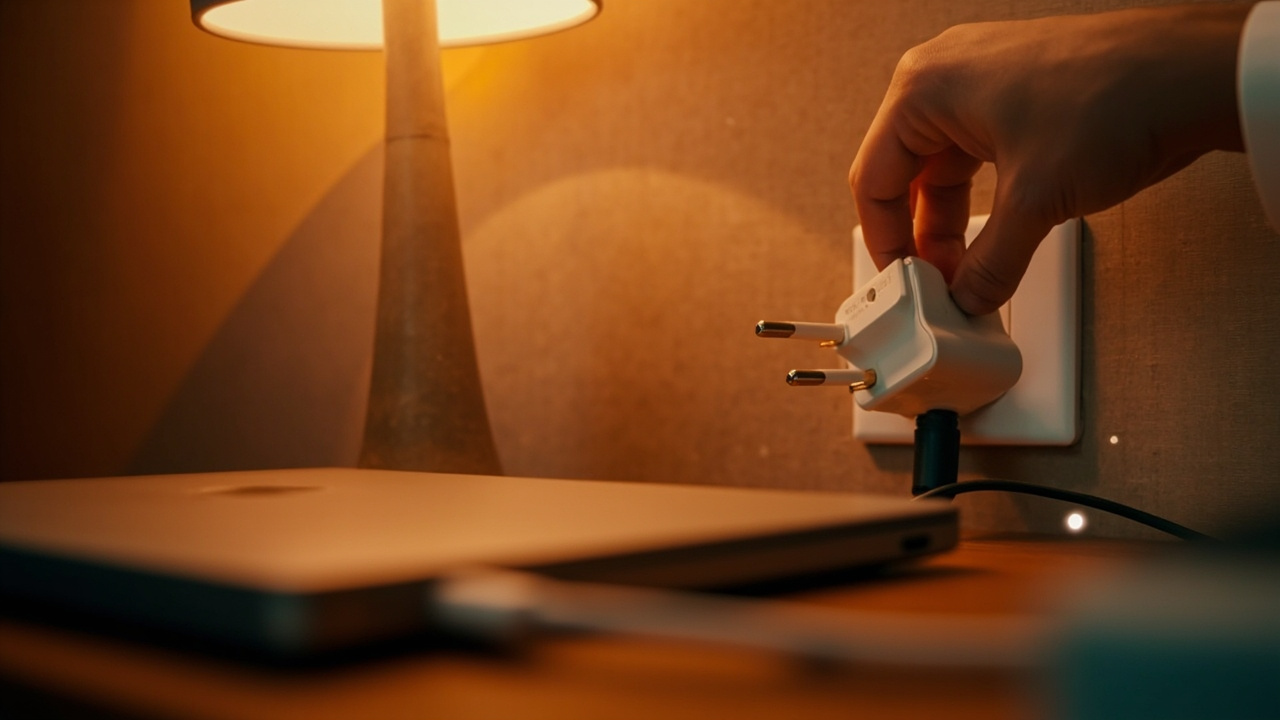
The first thing I do in any Chinese hotel room, before I even put my bag down, is check the wall by the desk. Not for the view. For the outlet. I’ve been doing this for seven years now, ever since a trip to Chengdu where I stood in a very nice hotel room holding a dead laptop charger and a plug that simply would not fit, and had to mime “adapter” to a front desk clerk who eventually produced a universal brick the size of a paperback book.
Here’s the thing nobody tells you before your first China trip: the outlets are not the problem. The outlets are actually fine. The problem is the shape of your plug, the voltage your devices expect, and the fact that the hotel’s “universal” socket might be a lie.
This guide is what I wish someone had handed me in that Chengdu lobby. It covers the actual plug types you’ll meet, what voltage China runs, which of your devices will survive without a converter, where to buy an adapter once you land, and the one setting on your phone that matters more than any plug.
Quick answer
China uses 220V at 50Hz, with Type A (two flat pins), Type C (two round pins), and Type I (three slanted flat pins) outlets — often combined into one universal-looking socket on the wall. Travelers from the US, UK, Australia, and most of Europe will need a plug adapter, but only US/Canada and a few other 110-120V countries need a voltage converter, and only for high-draw appliances like hair dryers. Phones, laptops, and camera chargers are almost all dual-voltage (100-240V) and just need the physical adapter.
The Short Version
Buy a universal travel adapter before you fly (about $10-15 / ¥70-110 on Amazon). It handles Type A, C, and I in one brick. Skip the voltage converter unless you’re bringing a hair dryer or curling iron — those will fry on 220V. Your phone and laptop are fine. And download a VPN before you land, because you’ll want it for everything else.
How I picked this
This isn’t a list of destinations — it’s a single practical question I’ve answered the hard way across maybe 40 trips through China, from Harbin in January to Shenzhen in August. I’ve stayed in ¥120 hostel dorms and ¥1,400 business hotels, and the outlet situation varies wildly between them. I’ve bought adapters from convenience stores, electronics markets, and one memorable afternoon at a Huawei service center in Kunming. I’ve also fried a cheap travel hair dryer on a 220V socket in Xi’an, which is how I learned the voltage lesson permanently. Everything below comes from that accumulated mess, cross-checked against current 2026 standards.
Comparison table
| Rank | What you need | Best For | Approx Cost (USD) | Time Needed | When to Get It |
|---|---|---|---|---|---|
| 1 | Universal travel adapter (A/C/I/G) | Everyone | $10-15 (¥70-110) | 5 min to pack | Before you fly |
| 2 | Type A/C/I single adapter | Minimalists, one-device travelers | $3-6 (¥20-45) | 2 min | Before or on arrival |
| 3 | Voltage converter (step-down) | Hair dryers, curling irons, some shavers | $25-45 (¥180-320) | 10 min | Before you fly |
| 4 | Multi-port USB charger (dual-voltage) | Families, photographers, gadget people | $15-25 (¥110-180) | 5 min | Before you fly |
| 5 | Local adapter from convenience store | Emergencies, forgot yours | $2-5 (¥15-35) | 10 min walk | On arrival |
The plugs, explained without the chart headache
China’s official standard is Type I — the three slanted flat pins you’ll recognize from Australia, New Zealand, and Argentina. That’s the “official” one. In practice, most modern Chinese sockets and power strips are hybrid: they’ll accept Type A (two flat pins, like the US), Type C (two round pins, like most of Europe), and Type I all in the same face. You’ll see this everywhere, from airport lounges to hotel desks to the outlet behind the kettle.
What that means for you: if you’re coming from the US, your two-flat-pin plug will often just… work. No adapter needed. I’ve plugged a US laptop charger directly into a Beijing hotel wall more times than I can count. But don’t count on it. Older buildings, budget guesthouses, and rural homestays may only have the Type I socket, and then you’re stuck.
UK travelers, you’re the unlucky ones. Type G (three fat rectangular pins) fits nothing in China. You will need an adapter, no exceptions. Same for India (Type D), South Africa (Type M), and Israel (Type H). Bring the adapter.
The safest move for everyone is a universal adapter that covers A, C, I, and G. It costs about the same as a mediocre airport sandwich and eliminates the entire question.
Voltage: the part that actually matters
This is where people get hurt, and I mean that literally — I once watched a woman in a Lijiang guesthouse plug a US hair dryer into the wall and hear it make a sound I can only describe as “expensive.”
China runs 220-240V at 50Hz. The US and Canada run 110-120V at 60Hz. If you plug a 110V-only device into a Chinese socket, you’re feeding it roughly double the voltage it was designed for. Small electronics with switching power supplies — phones, laptops, tablets, camera chargers, most electric shavers — are dual-voltage and will say “100-240V” on the brick. Those are fine. Check the label. It’s printed there in tiny letters.
The devices that are NOT fine: hair dryers, curling irons, straighteners, some electric kettles, and older or cheaper appliances. These are usually single-voltage and will either die instantly or run dangerously hot. If you must bring a hair dryer, buy a travel one rated for 220V, or just use the hotel’s. Every hotel I’ve stayed at in China above the hostel tier has a hair dryer bolted to the bathroom wall.
One more thing: the 50Hz vs 60Hz difference can make motorized devices (like some fans or older shavers) run slightly slower, but for almost everything a tourist carries, it’s irrelevant. Voltage is the killer, not frequency.
Where to buy an adapter once you’re in China
Forgot yours? You have options, and they’re cheap.
Convenience stores — 7-Eleven, FamilyMart, Lawson — in bigger cities often stock a basic adapter near the checkout for ¥15-35 ($2-5). Quality is hit or miss, but it’ll get you through the trip.
Electronics markets are the real answer. In Shenzhen, the famous Huaqiangbei market has entire floors of adapters. In Beijing, try the Zhongguancun area. In Shanghai, the Xujiahui electronics cluster. Bring your plug and test it before you pay. Prices are negotiable and a universal adapter runs ¥30-60 ($4-8).
Hotel front desks will often lend you one for free, especially at international chains. Ask politely. I’ve had front desk staff dig through a drawer of orphaned adapters and hand me one with a shrug and a smile — no charge, just “return it when you leave.”
The one place I’d avoid: airport electronics shops, where the same adapter costs three times as much. Buy before security, not after.
The universal adapter I actually recommend
I’ve been through maybe six of these over the years. The ones that survive are the ones with a sliding or rotating pin mechanism and at least two USB ports. The cheap ones with separate snap-on plug heads always lose a head somewhere in a suitcase.
Look for: a universal input (accepts your home plug), swappable or retractable pins for A/C/I/G, at least one USB-A and one USB-C port, and a rating of 6A or higher. That last spec matters — cheap adapters rated at 2.5A will get warm and occasionally fail when you run a laptop charger through them.
A good one costs $12-18 (¥85-130). Brands like EPICKA, Ceptics, and OREI are reliable and widely available on Amazon. Don’t overthink it. Buy one, throw it in your bag, and forget about it until you need it.
If you’re traveling with a partner or family and everyone has multiple devices, bring a multi-port USB charger too — one that’s dual-voltage (100-240V) so it works everywhere. A single 65W GaN charger with three ports can replace three separate bricks and saves real weight.
The outlet situation in hotels vs. hostels vs. homestays
Hotel rooms at international chains (Marriott, Hilton, Hyatt) almost always have universal sockets at the desk and bedside, plus USB ports built into the lamps. You may not need your adapter at all. This is the easy tier.
Chinese domestic business hotels (like the Hanting, Home Inn, or Atour chains) usually have hybrid A/C/I sockets but fewer USB ports. Bring your adapter and a multi-port charger and you’re set. These are great value — often $40-70 (¥280-500) a night in major cities.
Hostels and guesthouses are the wild card. Some have modern wiring and universal sockets. Others have one Type I outlet per dorm room and a power strip that looks like it predates the internet. Bring a small power strip with a universal face and you’ll be everyone’s hero. I once made three friends in a Chengdu hostel dorm purely by owning a six-outlet strip.
Homestays in rural areas (like the ones around Huangshan or in Yunnan) may have limited outlets and occasional power fluctuations. A small surge protector is cheap insurance for your electronics.
The VPN thing (yes, it belongs in this article)
This isn’t strictly about adapters, but it’s the other thing that will strand you on arrival if you don’t prepare. Google, Gmail, Instagram, WhatsApp, and most Western apps are blocked in China. You need a VPN installed and tested before you land — you cannot download one from inside the country.
Set it up at home, run it once to confirm it works, and keep it updated. The China SIM card and internet guide covers the specifics of eSIMs vs. local SIMs and which VPNs actually hold up in 2026. Your phone’s charging situation and your internet situation are the same category of “handle it before you fly” prep.
Also worth doing before you land: set up Alipay and WeChat Pay. China is close to cashless, and linking a foreign card to Alipay takes ten minutes at home and saves you an hour of confusion at a noodle shop counter.
Power banks, drones, and other edge cases
Power banks are fine to bring but must go in carry-on, not checked luggage. Chinese airports enforce this strictly — I’ve watched a man argue with security about a power bank in his checked bag and lose. Capacity limits are typically 100Wh (about 27,000mAh) without airline approval, 160Wh with approval. Check your airline.
Drones are a separate headache. China has strict no-fly zones over most cities and all airports, and registration requirements for drones over a certain weight. If you’re bringing one, research the specific city’s rules before you pack it. Most casual tourists leave the drone at home, and honestly, that’s the right call.
Laptop chargers, camera batteries, e-readers, and CPAP machines are all dual-voltage and adapter-only. No converter needed.
FAQ summary
China’s electrical system is 220V/50Hz with Type A, C, and I outlets, usually combined into hybrid sockets that accept US and European plugs directly. Most travelers only need a cheap universal plug adapter (about $10-15), not a voltage converter — converters are only necessary for single-voltage high-draw appliances like hair dryers and curling irons. Buy your adapter before you fly, install a VPN before you land, and set up Alipay or WeChat Pay at home to avoid the three most common arrival-day problems.
FAQ
Q: Do I need a voltage converter for my phone and laptop in China? A: No. Almost all phones, laptops, tablets, and camera chargers are dual-voltage (100-240V) and will work fine on China’s 220V supply with just a plug adapter. Check the small print on your charger brick — if it says “100-240V” you’re set.
Q: Will my US plug work in a Chinese outlet without an adapter? A: Often yes, because many Chinese sockets are hybrid and accept Type A (two flat pins). But not always — older buildings and budget guesthouses may only have Type I sockets. Bring a universal adapter anyway; it costs $10 and removes the gamble.
Q: Can I use my hair dryer in China? A: Only if it’s rated for 220V. Most US hair dryers are 110V-only and will overheat or die instantly on Chinese power. Either buy a 220V travel hair dryer or use the one provided by your hotel, which nearly all mid-range and up hotels supply.
Q: Where can I buy an adapter if I forget mine? A: Convenience stores (7-Eleven, FamilyMart, Lawson) sell basic adapters for ¥15-35 ($2-5), electronics markets like Shenzhen’s Huaqiangbei have huge selections for ¥30-60 ($4-8), and hotel front desks will often lend you one for free. Avoid airport shops, which charge triple.
Q: Is the electricity in China stable enough for my electronics? A: Yes, in cities and most tourist areas the grid is reliable. Rural homestays occasionally have brief outages or fluctuations, so a small surge protector is cheap insurance if you’re carrying expensive camera gear or a laptop.
Q: Do Chinese hotels have USB ports in the room? A: International chains almost always do, often built into lamps and bedside panels. Domestic business hotels and hostels are hit or miss. Bring a multi-port USB charger and a small power strip to cover all your bases.
Q: What’s the one thing I should do before my flight regarding power? A: Buy a universal adapter and install a VPN. Both cost under $20 combined and both are nearly impossible to sort out smoothly once you’re inside China. Do them at home, test them once, and pack them.
The honest wrap-up
This guide is for the traveler who’s never been to China and doesn’t want their first hour in the country to be spent miming “adapter” at a hotel clerk. It’s not for seasoned Asia hands who already own three universal adapters and a GaN charger — you know who you are.
If I could give one piece of advice to a friend about to book the flight: spend the $15 on a decent universal adapter and the ten minutes installing a VPN before you leave. Everything else about China — the food, the trains, the visa-free transit rules, the sheer scale of the place — you can figure out as you go. But power and internet are the two things that will genuinely strand you if you don’t prep. Handle them at home. Then go enjoy the noodles.
Destination at a Glance
- Best time to visit: April-May and September-October for mild weather across most of China; avoid the July-August heat and the Lunar New Year travel crush.
- Daily budget: $45-90/day for a mid-range foreign tourist, covering a business hotel, meals, metro, and one paid attraction.
- Visa: Most European and Southeast Asian passport holders qualify for the 240-hour visa-free transit; US and UK citizens generally need a tourist visa unless transiting.
- Safety: Very safe for tourists, with low street crime; the main risks are traffic, scams at tourist traps, and altitude in western regions.
- Getting around: Metro plus Didi (ride-hail) covers most cities; English signage is limited outside major hubs, so a translation app is essential.
- Connectivity: Buy an eSIM or local SIM on arrival; a VPN installed before you fly is required to access Google, WhatsApp, and Instagram.
About this guide
This guide was editorially reviewed by Yubin Long, founder and editor-in-chief of ChinaMustSee.com, a Beijing-based travel editor who has lived in China for over a decade. The voltage and plug-type facts were checked against current 2026 IEC standards and China’s GB 2099 socket specifications, and the VPN and payment-app guidance was verified against 2026 app availability as of this writing. (Yubin Long)
More guides you may like

Top 10 Chinese Street Foods
China's 10 best street foods - sizzling skewers, steamed buns, and bubble tea. Where to find them and what to ask for.
18 min read

Hangzhou West Lake Complete Guide
Hangzhou West Lake Complete Guide: 2026 guide covers current prices, transport, payment apps, and what foreign visitors need to know.
18 min read

Yangtze River Cruise Three Gorges Guide
Yangtze River Cruise Three Gorges Guide: 2026 guide covers current prices, transport, payment apps, and what foreign visitors need to know.
19 min read

Guilin Li River Cruise Complete Guide
Guilin Li River Cruise Complete Guide: 2026 guide covers current prices, transport, payment apps, and what foreign visitors need to know.
19 min read
China Travel SIM Card eSIM Comparison 2026
The cab driver in Beijing looked at me in the rearview mirror and said, in perfect English, “You know, most tourists buy the wrong SIM card.” I’d been in China
10 min read

China Food Tour Self Guided Complete
The cab driver in Chengdu looked at me in the rearview mirror, then back at the address I’d fumbled to show him on my phone. He laughed. Not a mean laugh—the ki
16 min read