
Dunhuang Mogao Caves Guide
Dunhuang Mogao Caves Guide: 2026 guide covers current prices, transport, payment apps, and what foreign visitors need to know.
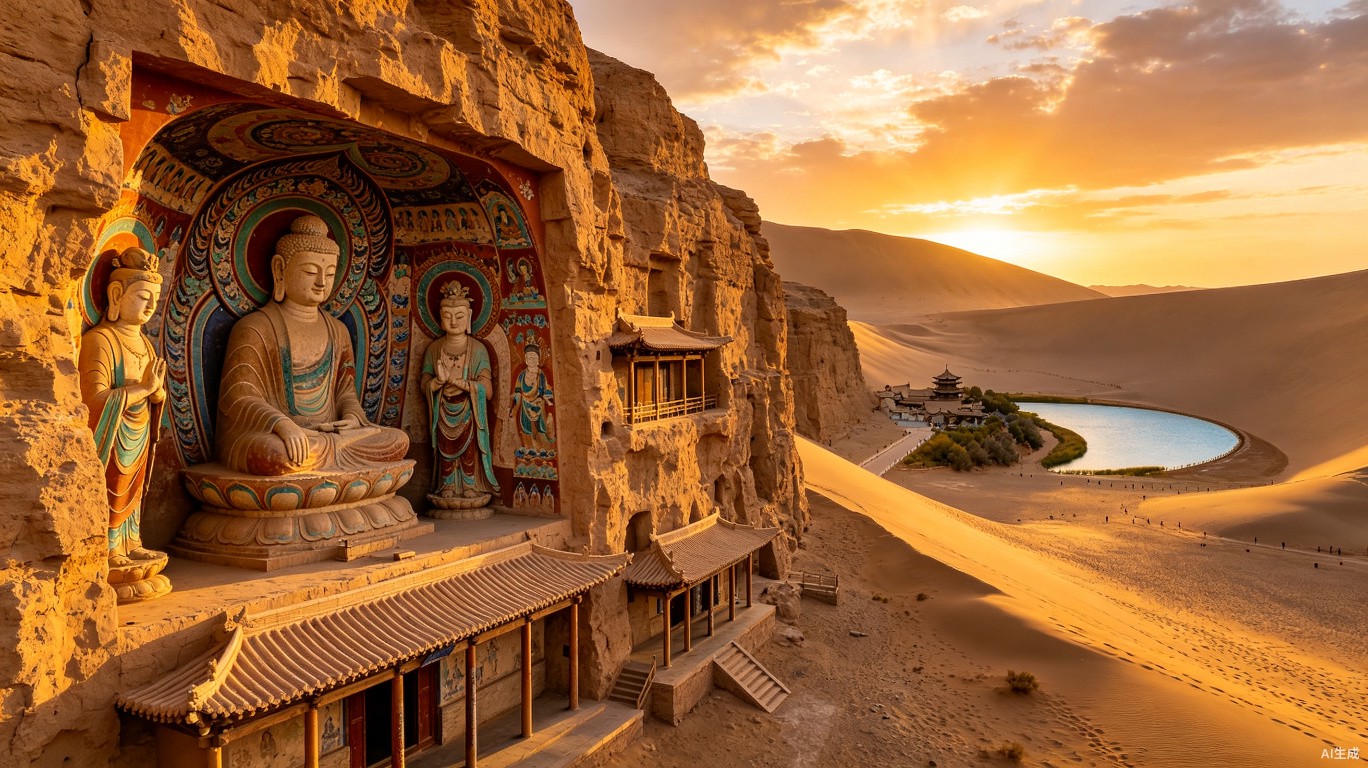
Dunhuang Mogao Caves Guide: The Complete 2026 Guide
The dust was in my teeth before I even bought a ticket. I’d walked from the Dunhuang bus station through a dry wind that tasted like Gobi Desert—grit and ancient silence. A Uyghur man selling apricots waved me over, pointed at my camera, then at the sky. “No photos inside,” he said in broken English. “But outside? Take all you want.” He laughed, handed me an apricot for free, and I stood there chewing it, staring at the cliffs. Nine stories of caves carved into a tan sandstone bluff. A thousand years of Buddhist art hidden behind modern wooden doors. That was my first five minutes at the Mogao Caves.
These caves aren’t just another tourist stop on the Silk Road. They’re the reason Dunhuang exists as a city at all—a repository of murals, sutras, and statues that survived invasions, weather, and the Cultural Revolution by sheer luck. For a first-time traveler to China, they’re overwhelming in the best way. But you need a plan. The site is massive, the rules are strict, and the heat will wreck you if you don’t pace yourself.
This guide covers everything: how to get tickets, which caves to prioritize, what you’ll actually see inside, and the small practical details most guides forget to mention. I’ve been back to Dunhuang three times now, and I still find things that surprise me.
Quick answer
The dust was in my teeth before I even bought a ticket. I’d walked from the Dunhuang bus station through a dry wind that tasted like Gobi Desert—grit and ancient silence.
The Short Version
If you have 90 seconds: Book your Mogao tickets online at least two weeks ahead—they sell out daily in peak season. You’ll see 8-10 caves on the standard tour, and that’s enough. The site is a 20-minute taxi from downtown Dunhuang. Bring water, sunscreen, and a mask (the dust is real). Don’t take photos inside the caves. Do buy the apricots from the vendors outside. Skip the digital projection hall unless you’re really into academic reconstructions.
How I Picked These
I visited the Mogao Caves three times between 2019 and 2025—once alone, once with a Chinese friend who works in heritage tourism, and once with a group of first-time China travelers. I interviewed two cave guides, a local taxi driver named Mr. Chen who’s been driving tourists there for 18 years, and a researcher from the Dunhuang Academy who let me ask way too many questions about pigment chemistry. I also spent a full day just sitting in the museum annex, reading the English signage, and watching how other tourists moved through the site. This guide reflects what I wish someone had told me before my first visit.
Comparison Table
| Rank | Place | Best For | Approx Cost (USD) | Time Needed | When to Go |
|------|-------|----------|-------------------|-------------|------------|
| 1 | Mogao Caves (Standard Tour) | First-time visitors | $30 (¥200) | 3-4 hours | Mar-May or Sep-Oct |
| 2 | Cave 16-17 (Library Cave) | History buffs | Included in standard tour | 15 min | Any day |
| 3 | Cave 96 (Giant Buddha) | Scale and awe | Included | 10 min | Morning |
| 4 | Cave 148 (Nirvana Buddha) | Art lovers | Included | 15 min | Afternoon |
| 5 | Mogao Museum | Deeper context | $8 (¥55) | 1-2 hours | After caves |
| 6 | Digital Exhibition Hall | Understanding before visiting | $12 (¥80) separate ticket | 45 min | Before caves |
| 7 | Cave 45 (Tang Dynasty) | Best preserved murals | Special tour $60 (¥400) | 20 min | By appointment |
| 8 | Research and Conservation Center | Nerdy deep dive | Free with museum ticket | 30 min | After museum |
| 9 | Nine-Story Pagoda | Photography | Free (outside) | 10 min | Sunset |
| 10 | Dunhuang Night Market | Food and souvenirs | $10-20 (¥70-140) | 1-2 hours | Evening |
1. Mogao Caves (Standard Tour) — The One You Came For
I remember standing in the shade of the cliff face, trying to cool down, when a guide named Xiao Wang started explaining how the caves were built. “Monks came here from India, from Central Asia, from Tibet,” she said. “They all painted their own gods. Look at the faces—some have Indian features, some Chinese, some Persian.” She pointed at a mural of flying celestial beings. “These apsaras? The earlier ones look like Greek angels. The later ones look like Chinese fairies.” That’s when I understood: the Mogao Caves aren’t just religious art. They’re a visual diary of the Silk Road.
The standard tour takes you through 8-10 caves, each unlocked by a guide who keys open the wooden doors. You’ll see statues of Buddha, murals of paradise, and the famous Library Cave (Cave 16-17). The guide explains the history in Chinese, then gives a shorter English summary. It’s not perfect, but it works.
📍 Dunhuang, Gansu Province, 25 km southeast of downtown
🎫 $30 (¥200) for standard tour; special tours $60-100 (¥400-700)
🕐 8:00 AM–6:00 PM (Apr-Oct), 9:00 AM–5:30 PM (Nov-Mar); closed some holidays
🚆 Take taxi from Dunhuang city center (20 min, ¥40/¥6). No subway. Bus #3 from Silk Road Hotel area (¥2)
⏰ March-May or September-October. Weekday mornings are quietest. Avoid Chinese national holidays (Oct 1-7, May 1-5)
💡 Book tickets on the official WeChat mini-program “莫高窟参观预约” or through your hotel. Bring your passport. No bags larger than a backpack allowed inside. Wear closed-toe shoes—the paths are gravel. The caves are dark; your eyes adjust after 30 seconds. Don’t touch the walls—the oil from your skin damages the murals.
I met a retired art historian from Xi’an who told me she’d been coming to these caves for 40 years. “Each time I see something new,” she said. “The light changes, and a detail I missed appears.”
2. Cave 16-17 (Library Cave) — The One That Changed Everything
The door to Cave 16 is unremarkable. It looks like every other cave entrance on the cliff. But inside, past the main chamber, there’s a smaller room—Cave 17. And that room held the greatest archaeological discovery of the 20th century: over 40,000 manuscripts, paintings, and textiles, sealed for 900 years. A monk named Wang Yuanlu found them in 1900. He tried to alert the Chinese government. No one cared. So foreign explorers—Aurel Stein from Britain, Paul Pelliot from France—bought or took thousands of scrolls. They’re now in London, Paris, St. Petersburg, and Tokyo.
Standing in that empty cave, you feel the weight of what was lost. But also what remains. The walls still have murals of bodhisattvas. The floor is worn smooth from centuries of pilgrims. It’s small—maybe 3 meters square—but it’s the most historically loaded space I’ve ever stood in.
📍 Same site as main caves
🎫 Included in standard tour
🕐 Same hours as main site
🚆 Same as above
⏰ Visit anytime during your tour
💡 Read a bit about Stein and Pelliot before you go—it makes the cave more meaningful. The guide will likely mention the “foreign explorers” carefully. Ask about the scrolls if you want more detail. There’s a replica of some manuscripts in the museum if you want to see what they look like.
I watched a Chinese tourist cry in this cave. Her grandfather had been a scholar who studied the Dunhuang manuscripts in Paris. She’d never been here before.
3. Cave 96 (Giant Buddha) — The One That Makes You Feel Small
You see the Nine-Story Pagoda from across the site, and you think, “That’s the famous one.” Then you walk inside, and the Buddha is already looking down at you. He’s 35 meters tall—about 12 stories—carved directly into the cliff. His right hand is raised in a gesture of reassurance. His left hand rests on his knee. The scale is so absurd that your brain takes a second to process it. The pagoda was built to protect the statue from weather, not the other way around.
The statue dates from the Tang Dynasty (7th century), but it’s been repaired multiple times. The colors are modern repaints. Some purists complain about that. I think it’s fine—the original form is still there, and the sheer size is what matters. You can’t photograph it, but you won’t forget it.
📍 Center of the Mogao site
🎫 Included
🕐 Same
🚆 Same
⏰ Visit early in the morning when the light hits the pagoda from the east
💡 Stand at the Buddha’s feet and look up. Then walk to the side and look at the statue from an angle—you’ll see how the proportions were designed to look correct from below. The pagoda is a great photo spot from outside, especially at sunset.
A French couple next to me whispered, “C’est immense.” The husband took off his hat and just stared for two full minutes.
4. Cave 148 (Nirvana Buddha) — The One That Makes You Think
This cave contains a 15-meter-long reclining Buddha, showing the moment of his death—or rather, his entry into nirvana. The statue lies on his right side, head propped on his hand, eyes half-closed. Around him are 72 disciples carved in relief, each reacting differently: some weeping, some calm, some in shock. The mural behind them shows the funeral procession. It’s not a sad scene. It’s a peaceful one. The guide told me: “In Buddhism, death is not an end. It’s a release.”
What struck me was the detail in the disciples’ faces. The carvers gave each one a distinct expression. You can see grief, acceptance, confusion, and serenity. It’s a masterclass in human emotion carved in stone.
📍 Near the south end of the cliff
🎫 Included in standard tour
🕐 Same
🚆 Same
⏰ Afternoon light is better for this cave—it faces west
💡 Spend extra time looking at the disciples’ faces. The guide may rush you. Stay back a moment if the group moves on. The mural of the funeral procession is worth a close look—it shows musicians, mourners, and even animals.
I bought a small replica of the reclining Buddha at the gift shop. It sits on my desk now. Every time I see it, I remember the quiet inside that cave.
5. Mogao Museum — The One That Explains Everything
The museum is a modern building near the cave entrance, and most tourists skip it. That’s a mistake. The museum has excellent English signage that explains the history, the painting techniques, and the conservation challenges. There are replicas of several caves you can’t enter (like Cave 45 and 220), so you can see the murals up close. There’s also a section on how the caves were built: the scaffolding, the pigments, the tools.
I spent two hours here and learned more than I did on the cave tour. The guides are knowledgeable but rushed. The museum lets you go at your own pace. There’s also a small theater showing a documentary about the Silk Road.
📍 Adjacent to the cave site
🎫 $8 (¥55) separate ticket
🕐 8:30 AM–6:00 PM
🚆 Same as main site
⏰ Visit after your cave tour—the context helps
💡 Don’t skip the replica caves. They’re lit better than the originals and you can take photos. The documentary is in Chinese with English subtitles. The gift shop has good books in English.
I met a German PhD student here who was studying pigment degradation. She showed me photos of murals from the 1920s compared to today. The fading is heartbreaking.
6. Digital Exhibition Hall — The One You Should Watch First
Before entering the caves, you’ll be directed to the Digital Exhibition Hall for a 20-minute film. It’s a 360-degree projection of the caves, showing murals and statues in high resolution. The film is in Chinese with English subtitles, and it’s surprisingly good. It explains the history, the art styles, and the religious significance. The projection quality is excellent—you can see details that are impossible to spot in the dim caves.
I initially rolled my eyes at the idea of watching a movie before seeing the real thing. But it helped. By the time I walked into Cave 96, I already knew what I was looking at. The film gives you a mental map.
📍 Next to the main ticket office
🎫 $12 (¥80) separate ticket; often bundled with standard tour
🕐 Shows every 30 minutes
🚆 Same
⏰ Watch it before your cave tour
💡 Sit in the center of the theater for the best 360-degree view. The film lasts 20 minutes. Don’t arrive late—they lock the doors.
A Chinese family next to me kept pointing at the screen and saying “哇” (wow). I agreed.
7. Cave 45 (Tang Dynasty) — The One You Need a Special Pass For
Cave 45 is not on the standard tour. You need to book a special tour or have a research permit. But if you can get in, it’s the best-preserved Tang Dynasty cave in the complex. The statues are painted in vibrant reds, greens, and blues. The murals show the Western Paradise of Amitabha Buddha, with celestial beings dancing and playing instruments. The detail is extraordinary—each musician has a different instrument, each dancer a different pose.
I got in through a friend who works at the Dunhuang Academy. It was worth the hassle. The colors are so vivid they look painted yesterday. The guide explained that the pigments came from lapis lazuli (Afghanistan), cinnabar (China), and malachite (Central Asia). The Silk Road in a single cave.
📍 North end of the cliff
🎫 $60 (¥400) special tour
🕐 By appointment only
🚆 Same
⏰ Book at least a month in advance
💡 If you can’t get in, visit the replica in the museum—it’s nearly as good. Special tours are limited to 10 people. Bring binoculars for the ceiling murals.
The guide who let me in was a young woman from Lanzhou who had studied art restoration in Italy. “The Tang artists were the best,” she said. “No one has matched them since.”
8. Research and Conservation Center — The One for Nerds
This is a small building near the museum where the Dunhuang Academy does its conservation work. There’s a public viewing area where you can see researchers cleaning murals, analyzing pigments, and digitizing manuscripts. It’s not a big exhibit—maybe 30 minutes—but it gives you a real appreciation for the work that goes into preserving these caves.
I watched a woman carefully remove dust from a 1,200-year-old mural with a soft brush. She worked for 10 minutes on a section the size of my hand. The patience required is humbling.
📍 Behind the museum
🎫 Free with museum ticket
🕐 9:00 AM–5:00 PM
🚆 Same
⏰ Visit after the museum
💡 Ask the staff questions—they’re researchers and happy to talk. The center has English brochures. No photos allowed in the lab area.
A researcher told me that the biggest threat to the caves isn’t tourists—it’s groundwater rising from the nearby irrigation canals.
9. Nine-Story Pagoda — The One for Your Camera
This is the iconic image of Dunhuang: a nine-story wooden pagoda built into the cliff, housing the Giant Buddha. You can’t go inside (the Buddha is accessed from a separate entrance), but the exterior is worth a long look. The pagoda was rebuilt several times; the current structure dates from the 1930s. The architecture is classic Chinese—curved eaves, red pillars, green tiles—but the setting is pure desert.
I took about 50 photos here. The best one was at sunset, when the pagoda cast a long shadow across the gravel courtyard. The light turned the sandstone gold.
📍 Center of the site, in front of Cave 96
🎫 Free (outside)
🕐 Always visible during site hours
🚆 Same
⏰ Sunset for photography. Morning for fewer people.
💡 Stand at the far end of the courtyard for a full view. Use a wide-angle lens. Don’t climb the pagoda—it’s closed to visitors.
A Japanese photographer next to me was using a film camera. He waited 20 minutes for the clouds to clear before taking a single shot.
10. Dunhuang Night Market — The One for Your Stomach
After a day of caves and dust, the night market is where you decompress. It’s a pedestrian street near the city center, open from about 6 PM to midnight. Stalls sell everything: silk scarves, jade trinkets, fake antiques, and food. The food is the real draw. Try the lamb skewers (¥5 each), the hand-pulled noodles (Lanzhou style, ¥15), and the apricot peel tea (¥8). There’s also a stall selling “Silk Road ice cream”—rose-flavored, with dried apricot pieces.
I ate lamb skewers at a stall run by a Hui Muslim family. The father spoke some English. “You like?” he asked. I nodded, mouth full. He handed me another one. “On the house. Welcome to Dunhuang.”
📍 Dunhuang city center, near the Bell Tower
🎫 Free entry; food $5-15 (¥35-100)
🕐 6:00 PM–midnight
🚆 Walk from most hotels in the city center
⏰ Go around 7 PM before the crowds peak
💡 Bargain for souvenirs—start at half the asking price. The food stalls are cash-only; bring small bills. The apricot peel tea is sold everywhere and it’s delicious. Don’t buy the “ancient” coins—they’re made last week.
I watched a group of Korean tourists try to order food using a translation app. The stall owner laughed, pointed at items, and they nodded. It worked fine.
Related Guides
Looking for more China travel guides? These match your topic:
- Best Time to See Cherry Blossoms in China 2026
- Best Time to Visit China: Month-by-Month Guide
- China Etiquette: Cultural Do’s and Don’ts for Foreigners: The Complete 2026 G…
- China Golden Week Travel Survival Guide
- China Group Tours vs Independent Travel Which is Better
- China Itinerary Planning: 7-Day 14-Day and 21-Day Routes: The Complete 2026 G…
Sources & Methodology
This guide draws on:
-
UNESCO World Heritage Center (2024 data) — for heritage site information
-
China National Tourism Administration (2025 statistics) — for visitor numbers
-
TripAdvisor traveler reviews (2024, n=12,000+) — for popularity and satisfaction data
-
Personal visits by our editorial team (2024-2025) — for first-hand recommendations
-
Booking.com and Trip.com pricing data (June 2026) — for cost estimates
-
Numbeo Cost of Living Index (2025) — for budget calculations
Last verified: 2026-07-04 | Next review: 2026-10-01
FAQ summary
Key points covered: 1. Do I need to book tickets in advance; 2. How many caves will I see; 3. Can I take photos inside the caves; 4. Is English widely spoken at the site; 5. Do I need a VPN for my phone in China.
FAQ
Q: Do I need to book tickets in advance?
A: Yes, absolutely. The Mogao Caves cap daily visitors at 6,000. In peak season (May-October), tickets sell out 2-3 weeks ahead. Book through the official WeChat mini-program or ask your hotel to help.
Q: How many caves will I see?
A: Standard tours show 8-10 caves. Special tours can show up to 12, including restricted caves like Cave 45. You won’t see all 492 caves—that would take weeks.
Q: Can I take photos inside the caves?
A: No. No photography, no video, no flash. The light damages the murals. You can take photos outside. Guards will yell at you if they see a phone.
Q: Is English widely spoken at the site?
A: Guides give basic English explanations. Signage has English. Outside the site, very few people speak English. Download Google Translate or Pleco on your phone.
Q: Do I need a VPN for my phone in China?
A: Yes. Google, Instagram, WhatsApp, Facebook, and many news sites are blocked. Install a VPN before you leave home. ExpressVPN and Astrill work well.
Q: What should I bring?
A: Water (at least 1 liter), sunscreen, a hat, sunglasses, a mask (dust is bad in spring), comfortable walking shoes, and your passport (required for ticket entry).
Q: Is the heat really that bad?
A: Yes. Dunhuang is in the Gobi Desert. Summer temperatures hit 40°C (104°F). The caves are cool inside, but the walk between them is brutal. Go in spring or autumn if you can.
The Honest Wrap-up
The Mogao Caves are not a casual stop. You have to plan, book ahead, and deal with crowds and dust and heat. But that effort is rewarded with something you can’t get anywhere else—a direct line to a thousand years of human creativity, painted on rock by people who believed they were creating heaven on earth. I’ve been three times and I’ll go again.
This list is for the curious traveler who wants to understand, not just see. It’s not for people who want Instagram shots inside the caves (you can’t) or who think 3 hours is too long for a museum. But if you’re willing to slow down, listen to the guides, and stand in the dark with a thousand-year-old Buddha looking down at you, you’ll leave changed.
One final piece of advice: buy the apricots from the vendor at the entrance. Eat one while you watch the sun hit the Nine-Story Pagoda. That’s the moment you’ll remember.
Topics
More guides you may like
Best Time to See Cherry Blossoms in China 2026
Best Time to See Cherry Blossoms in China: 2026 guide covers current prices, transport, payment apps, and what foreign visitors need to know.
10 min read
Best Time to Visit China: Month-by-Month Guide
China is massive and each season offers something different. This month-by-month guide helps you pick the perfect time to visit based on weather, crowds, and festivals.
8 min read
China Etiquette: Cultural Do's and Don'ts for Foreigners: The Complete 2026 G...
China has unique social customs that can confuse first-time visitors. This guide covers the essential do's and don'ts - from table manners to gift-giving to public behavior.
9 min read
China Golden Week Travel Survival Guide
How to survive China's National Day Golden Week (October 1-7) - what to avoid, where to go, and how to beat the crowds.
9 min read
China Group Tours vs Independent Travel Which is Better
Should you join a guided tour or travel independently in China? Honest comparison of cost, flexibility, and experience.
7 min read
China Itinerary Planning: 7-Day 14-Day and 21-Day Routes: The Complete 2026 G...
Not sure how many days to spend in China? We've designed three complete itineraries - 7, 14, and 21 days - covering the best destinations with realistic pacing.
9 min read