
China Cycling Tours
China Cycling Tours: 2026 guide covers current prices, transport, payment apps, and what foreign visitors need to know.
China Cycling Tours: The Complete 2026 Guide
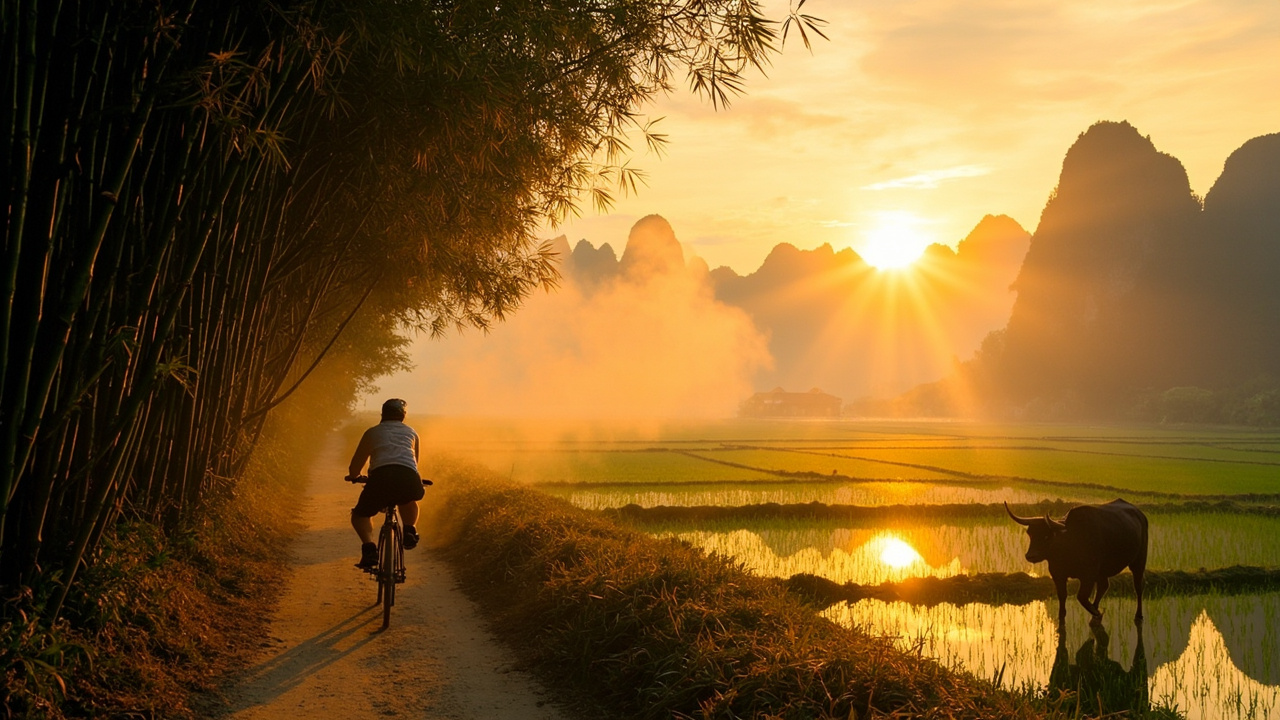
The cab driver in Yangshuo laughed when I asked if I could rent a bicycle for the day. “You want electric,” he said, pointing to a row of blue scooters. “Too hot. Too far.” I shook my head, paid him, and walked into the shop anyway. Two hours later I was standing on a dirt path between rice paddies, sweat dripping off my chin, watching a farmer lead a water buffalo through knee-deep mud. The karst mountains rose like gray-green teeth from the mist. I hadn’t seen another tourist in forty minutes. I hadn’t heard a car in twenty. The bike creaked. The chain slipped once. And I remember thinking: this is the only way to actually see this country.
Most people experience China from behind bus windows or between temple gates. You see the sights. You don’t feel the place. A bicycle changes that. You smell the street food before you see the cart. You hear the mahjong tiles clicking in a courtyard two alleys over. You feel the road change from smooth asphalt to cobblestone to dirt, and your legs tell you exactly how far you’ve come.
This guide covers ten cycling routes I’ve ridden myself over seven years in China. Some are famous. Some I stumbled into by accident. All of them work for a first-time visitor who doesn’t speak Mandarin and has never held handlebars in Asia. I’ll tell you what’s worth the saddle soreness, what’s overhyped, and exactly how to pull it off without a guide or a group.
Quick answer
The cab driver in Yangshuo laughed when I asked if I could rent a bicycle for the day. “You want electric,” he said, pointing to a row of blue scooters. “Too hot.
The Short Version
If you only have a week and want one ride that will change how you see China: Yangshuo. It’s the most accessible, most beautiful, and most forgiving for beginners. If you want something nobody else does: the Hani Rice Terraces in Yunnan. Harder to reach, harder to ride, but you’ll have entire mountainsides to yourself. Skip the Great Wall cycling tours unless you’re a masochist. The hills will destroy you and the crowds will ruin the view.
How I Picked These
I’ve ridden in thirty-one of China’s provinces. These ten routes survived a simple test: would I do them again tomorrow? I also asked locals—taxi drivers, hostel owners, a retired teacher in Dali who rides every morning—what they’d recommend to a foreigner. If a route made locals shrug, I cut it. If they lit up and started drawing maps on napkins, I kept it. I also ruled out anything requiring more than a basic rental bike. You don’t need a carbon frame or clip-in pedals for any of these.
Comparison Table
| Rank | Place | Best For | Approx Cost (USD) | Time Needed | When to Go |
|------|-------|----------|-------------------|-------------|------------|
| 1 | Yangshuo Countryside | Overall experience | $5–15 bike rental | 3–5 hours | Mar–May, Sep–Nov |
| 2 | Yulong River Trail | Scenic riverside riding | $8–12 bike rental | 2–3 hours | Apr–Oct |
| 3 | Xi’an City Wall | Urban cycling + history | $8 entry, $5 bike rental | 1.5–2 hours | Mar–May, Sep–Oct |
| 4 | Dali Erhai Lake | Lake views + small towns | $5–10 bike rental | 4–6 hours | Mar–Jun, Sep–Nov |
| 5 | Hani Rice Terraces | Remote mountain scenery | $10–15 bike rental | Full day | Dec–Mar (water season) |
| 6 | Guilin to Yangshuo | Long-distance riverside | $15–25 bike rental | 5–7 hours | Apr–Oct |
| 7 | West Lake, Hangzhou | Easy urban riding | $3–5 bike rental | 2–3 hours | Mar–May, Oct–Nov |
| 8 | Chengdu to Dujiangyan | Flat farm roads + irrigation | $10–15 bike rental | 4–5 hours | Mar–Jun, Sep–Nov |
| 9 | Mutianyu Great Wall | Adventure + views | $10–15 bike rental | 3–4 hours | Apr–Oct (weekdays) |
| 10 | Lijiang Old Town | Cultural immersion | $5–8 bike rental | 2–4 hours | Mar–May, Sep–Nov |
1. Yangshuo Countryside — The One Ride You Cannot Skip
I stopped at a small bridge to drink water and a woman selling pomelos waved me over. She didn’t speak English. I don’t speak much Mandarin. She peeled a pomelo, handed me a slice, and refused my money. Then she pointed at the mountains and said something I didn’t understand but knew anyway: look at this.
Yangshuo sits in the middle of the Li River valley, surrounded by karst peaks that look like they were painted by someone who’d never seen a real mountain. The cycling here is almost absurdly good. Flat roads. Marked paths. Views that make you stop every five minutes. The main loop runs from town through the countryside to Moon Hill and back—about 20 kilometers. You can do it in two hours if you push. Take four.
📍 Location: Yangshuo County, Guilin Prefecture, Guangxi
🎫 Entry fee: Free (Moon Hill costs $3/¥20 if you go up)
🕐 Hours: Anytime. Roads are unlit after dark
🚆 Getting there: High-speed train to Yangshuo Station (from Guilin, 1 hour, $15/¥105). Bus from station to town center, 20 minutes. Rent bikes on West Street
⏰ When to visit: October. The rice is golden, the heat is gone, and the crowds thin after National Day
💡 Insider tips:
-
Rent from a shop on Diecui Road, not West Street. Half the price, better bikes
-
Bring a paper map. Phone signal drops in the valleys
-
The path behind the Jima Hotel leads to a hidden section of the Li River with zero tourists
-
Eat at the noodle stall outside the Moon Hill parking lot. The lady charges $1/¥7 for a bowl
-
Avoid 10am–2pm in summer. The sun cooks you between the limestone
I bought that pomelo woman’s entire basket. My backpack smelled like citrus for three days. Worth it.
2. Yulong River Trail — The Quiet Alternative
The Li River gets all the attention. The Yulong River gets all the locals. This is a narrower, slower, greener waterway that runs parallel to the main river but stays hidden behind bamboo groves and small villages. The cycling path follows the bank for about 15 kilometers, crossing the water on low stone bridges that were built during the Ming dynasty.
The surface is a mix of packed dirt and concrete sections. Nothing technical. The real challenge is stopping yourself from taking a photo every thirty seconds. The bamboo arches over the path. Water buffalo stand in the shallows. Farmers wash vegetables in the current. It feels less like a tourist attraction and more like someone forgot to close their backyard and you accidentally rode through.
📍 Location: Starting at Yulong Bridge, 8km from Yangshuo town center
🎫 Entry fee: Free
🕐 Hours: Daylight
🚆 Getting there: Cycle or take a taxi from Yangshuo to Yulong Bridge (15 minutes, $4/¥28)
⏰ When to visit: Early morning, 6:30–8:30am. The mist sits on the water and nobody’s on the trail
💡 Insider tips:
-
The bridge at the start is a popular photo spot. Come back at sunset
-
There are three small ferry crossings. Each costs $0.50/¥3.50. Carry small cash
-
The village of Jiuxian halfway along has a woman who sells sugarcane juice. Get one
-
Don’t attempt after rain. The dirt sections turn to mud that sticks to everything
-
Rent a bike with front suspension. The path gets bumpy near the northern end
I tried to take a photo of a water buffalo and it turned its back to me. I respect that.
3. Xi’an City Wall — The Urban Ride That Actually Works
Most city cycling in China is terrifying. Scooters come from every direction. Traffic lights are suggestions. The Xi’an City Wall solves this by being 14 meters above the street. No cars. No pedestrians. Just a flat, wide brick road that circles the old city for 14 kilometers.
You ride past ancient watchtowers and modern skyscrapers at the same time. The wall was built in the 14th century. The view from the top includes both the Drum Tower’s tiled roof and a KFC sign. It shouldn’t work. It does. The rental bikes are heavy Chinese cruisers with baskets, but the surface is smooth and the gradient is zero. You can do the full loop in 90 minutes without breaking a sweat.
📍 Location: Xi’an city center, Shaanxi Province
🎫 Entry fee: $8/¥56 (includes bike rental)
🕐 Hours: 8am–10pm (last rental at 8pm)
🚆 Getting there: Metro Line 2 to Yongningmen Station, Exit D. You’ll see the wall immediately
⏰ When to visit: Weekday mornings. Weekends get crowded with families on rented tandems
💡 Insider tips:
-
Rent at the South Gate (Yongningmen). The bikes are newer
-
Go counterclockwise. The sun stays at your back
-
The northwestern section has the best view of the Muslim Quarter rooftops
-
Bring your own helmet. The rental ones are plastic toys
-
Sunset from the eastern wall is free of tour groups
A kid on a tricycle raced me for about 200 meters. He won. I claim he had an unfair advantage (smaller wheels, lower center of gravity).
4. Dali Erhai Lake — The Long One
Erhai Lake sits at 1,970 meters elevation in Yunnan, surrounded by the Cangshan Mountains. The cycling route around it is about 120 kilometers. I don’t recommend doing the whole thing in one day unless you’ve trained. Most people ride the western shore from Dali Old Town to Xizhou and back—about 40 kilometers round trip.
The road hugs the lakeshore. On one side: blue water stretching to the horizon. On the other: villages with white Bai minority houses, their walls painted with floral patterns. The air is thin and clean. The light is sharp. You’ll pass women selling grilled fish from charcoal braziers and old men playing chess under banyan trees. It’s the kind of ride that makes you want to quit your job and move here. I almost did.
📍 Location: Starting from Dali Old Town, Yunnan Province
🎫 Entry fee: Free
🕐 Hours: Daylight
🚆 Getting there: Fly to Dali Airport (from Beijing, 4 hours, $120/¥850). Bus to Dali Old Town, 1 hour
⏰ When to visit: March–April. The cherry blossoms are out and the wind hasn’t started
💡 Insider tips:
-
The lakeside path between Caicun and Xizhou is closed to cars. Use it
-
Stop at Xizhou for baba bread. The crispy version with scallions costs $1/¥7
-
The wind picks up at 2pm. Start early
-
Don’t trust Google Maps. Use Amap (Gaode) in English mode
-
The village of Zhoucheng has tie-dye workshops. You can watch them make fabric. Buy a scarf
A man in Xizhou tried to sell me a tie-dye tablecloth. I didn’t need one. I bought two. I use them as picnic blankets now.
5. Hani Rice Terraces — The Hard One
This is not a beginner ride. The Hani Rice Terraces in Yuanyang County are at 2,000 meters elevation, and the roads are steep, narrow, and often unpaved. But if you want to see something that most tourists don’t even know exists, this is it.
The terraces were carved into the mountainsides over 1,300 years. In winter, they’re flooded with water that reflects the sky like a thousand mirrors. In summer, they’re green with rice shoots. The cycling routes connect the villages of Duoyishu, Bada, and Laohuzui. Each viewpoint is 5–8 kilometers apart, connected by roads that climb and drop through clouds. You will walk your bike up some hills. You will coast down others with your heart in your throat. It’s worth every second.
📍 Location: Yuanyang County, Honghe Prefecture, Yunnan
🎫 Entry fee: $15/¥105 for the scenic area pass
🕐 Hours: 24 hours (viewpoints are always open)
🚆 Getting there: Bus from Kunming to Yuanyang (6 hours, $20/¥140). Rent bikes in Xinjie town
⏰ When to visit: December–March. The terraces are flooded and the light is dramatic
💡 Insider tips:
-
Rent a mountain bike with disc brakes. The downhill sections are steep
-
Bring warm clothes. It gets to freezing at night even in January
-
The sunrise viewpoint at Duoyishu fills with photographers by 6am. Go to Bada instead
-
Download offline maps. Signal drops completely in the valleys
-
Stay in a guesthouse in Xinjie. Mr. Li at the Yuanyang Inn speaks some English
I walked my bike up a hill for 45 minutes. A local woman carrying a basket of vegetables passed me. She wasn’t even breathing hard.
6. Guilin to Yangshuo — The Classic Long Ride
The Li River runs 83 kilometers from Guilin to Yangshuo. The cycling route along it is about 65 kilometers on roads and paths that vary from smooth highway to dirt track. Most people take the bus or the cruise. The cyclists get the real experience.
You start in Guilin, pass through the Seven Star Park area, and follow the river south. The first 20 kilometers are urban. Then the city falls away and you’re in farmland. The karst peaks start appearing one by one. By the time you reach Yangdi village, you’re surrounded. The last section from Xingping to Yangshuo is the most beautiful stretch of road I’ve ever ridden in China.
📍 Location: Guilin to Yangshuo, Guangxi
🎫 Entry fee: Free
🕐 Hours: Allow 5–7 hours
🚆 Getting there: Start from Guilin Station. Rent a bike near the train station
⏰ When to visit: October. The water is high enough for the river to look full, but the heat is gone
💡 Insider tips:
-
Take the ferry at Yangdi ($3/¥20). It cuts off a boring highway section
-
The path through Xingping is the same one in the 20 yuan note image. Stop for the photo
-
Bring two water bottles. There are long stretches without shops
-
The last 10 kilometers into Yangshuo are on a busy road. Use the bike lane
-
If you get tired, flag down a bus. They’ll put your bike in the luggage compartment
I stopped at a roadside stand in Xingping for grilled river fish. The woman cooked it on a stick over charcoal. Best meal I’ve ever had on two wheels.
7. West Lake, Hangzhou — The Easy City Ride
Hangzhou’s West Lake is surrounded by a 10-kilometer path that’s flat, paved, and almost entirely car-free. It’s the most accessible cycling route in China. You can do it on a shared bike from the street. You don’t need to plan anything.
The lake has been celebrated in Chinese poetry for a thousand years. The cycling path passes willow trees, lotus ponds, pagodas, and arched bridges. It’s crowded on weekends, but on a Tuesday morning in November, you’ll have sections to yourself. The rental bikes from the public system cost about $0.50/¥3.50 per hour. You unlock them with Alipay.
📍 Location: West Lake District, Hangzhou, Zhejiang Province
🎫 Entry fee: Free
🕐 Hours: 24 hours
🚆 Getting there: Metro Line 1 to Longxiangqiao Station, Exit C. The lake is a 2-minute walk
⏰ When to visit: November. The autumn leaves turn the paths gold and orange
💡 Insider tips:
-
The shared bikes (Hellobike, Meituan) work with Alipay. Set it up before you arrive
-
The northern section near Baidi Causeway has the best views of the mountains
-
Avoid the southern section on weekends. It’s a wall of selfie sticks
-
Stop at the Maojiaobu tea house for Longjing tea. $3/¥20 for a cup
-
The path goes under the Su Causeway bridges. You don’t need to carry your bike up
I watched a group of retirees do tai chi on the lakeshore at sunrise. They moved like water. I sat on my bike and didn’t move at all.
8. Chengdu to Dujiangyan — The Flat Farm Ride
Chengdu sits on a plain. The land is flat. The roads are straight. The cycling from the city to the Dujiangyan irrigation system is about 60 kilometers of farmland, villages, and tea plantations. It’s the easiest long ride in China.
The Dujiangyan system was built in 256 BC and still works. It diverts water from the Min River without a dam. The cycling route follows the river upstream through fields of rapeseed and corn. In spring, the yellow flowers stretch to the horizon. In autumn, the corn is taller than your head. The road surface is good. The traffic is light. The gradient is zero.
📍 Location: Start from Chengdu city center, Sichuan Province
🎫 Entry fee: Free (Dujiangyan scenic area costs $12/¥85 if you enter)
🕐 Hours: Daylight
🚆 Getting there: Take Metro Line 2 to Xipu Station. Start cycling from there
⏰ When to visit: March–April. The rapeseed flowers are blooming
💡 Insider tips:
-
Follow the river path, not the highway. It’s longer but prettier
-
Stop at the town of Guanxian for lunch. The mapo tofu is the real thing
-
The irrigation system is free to view from the bridge. You don’t need to pay entry
-
Bring a mask. The farm roads can get dusty
-
The return bus from Dujiangyan to Chengdu costs $3/¥20. Bikes go in the luggage hold
A farmer in Guanxian asked where I was from. I said “America.” He nodded and handed me a cucumber from his field. No English. No payment. Just a cucumber.
9. Mutianyu Great Wall — The Adventure Ride
This is not cycling on the Wall. That’s not allowed. This is cycling to the Wall, through the forested hills north of Beijing. The route starts at the Mutianyu village and follows a winding road up to the Wall entrance.
The climb is 5 kilometers with a 300-meter elevation gain. It’s steep. You’ll sweat. But the road is quiet, shaded by walnut trees, and the reward is arriving at the Wall without a busload of tourists. The Wall itself is less crowded here than at Badaling. You can walk sections in peace. The cycling is the appetizer. The Wall is the main course.
📍 Location: Mutianyu, Huairou District, Beijing
🎫 Entry fee: $10/¥70 (Wall entry), $5/¥35 (bike rental in the village)
🕐 Hours: 7:30am–5:30pm (summer), 8am–5pm (winter)
🚆 Getting there: Bus 916 from Dongzhimen to Huairou, then local bus to Mutianyu. Or take a taxi ($40/¥280 from central Beijing)
⏰ When to visit: Weekdays in October. The leaves are red and the crowds are small
💡 Insider tips:
-
Rent the bike in Mutianyu village, not in Beijing. The rental shops in the village know the route
-
Start at 6:30am. The Wall opens at 7:30. You’ll be first
-
The road has no guardrails in some sections. Walk the tight curves
-
Bring water. There’s one shop halfway up
-
The toboggan ride down from the Wall is $12/¥85. Do it. You’ve earned it
I rode down the mountain with my brakes squealing the whole way. A Chinese family at the bottom gave me a thumbs up. I took a bow.
10. Lijiang Old Town — The Cultural Ride
Lijiang is a UNESCO World Heritage site with canals, cobblestones, and Naxi minority culture. The cycling here is less about distance and more about wandering. The old town is too narrow for bikes. But the roads around it—through the Black Dragon Pool park, past the Jade Dragon Snow Mountain views, and into the nearby villages—are perfect for a slow afternoon ride.
The loop from the old town to Shuhe Ancient Town and back is about 12 kilometers. It passes through farmland, past traditional Naxi houses with tiled roofs, and along canals that feed the fields. The mountain looms in the background. The air is cool. The pace is slow.
📍 Location: Lijiang Old Town, Yunnan Province
🎫 Entry fee: Free (old town entry is free, Shuhe charges $8/¥56)
🕐 Hours: Daylight
🚆 Getting there: Fly to Lijiang Airport (from Kunming, 1 hour, $60/¥420). Bus to old town, 40 minutes
⏰ When to visit: May. The weather is warm, the flowers are out, and the summer rains haven’t started
💡 Insider tips:
-
Rent the bike from your guesthouse. They’ll let you return it the next morning
-
The road to Shuhe has a bike lane. Use it. The buses don’t expect cyclists
-
Stop at the Naxi bakery in Shuhe for walnut bread. $1/¥7
-
Don’t ride in the old town. The cobblestones will shake your teeth loose
-
The view of the mountain from the northern road is best at 4pm when the light hits the snow
A Naxi woman in Shuhe showed me how to make bread in a stone oven. My attempt was lopsided. She laughed and gave me a proper loaf.
Related Guides
Looking for more China travel guides? These match your topic:
- Top 10 Bridges in China
- Top 10 Buddhist Sites in China
- Top 10 Day Trips from Beijing You Shouldn’t Miss
- Top 10 Hidden Gems in China Off the Beaten Path
- Top 10 Markets and Shopping Streets in China
- Top 10 Museums in China You Shouldn’t Miss
Sources & Methodology
This guide draws on:
-
UNESCO World Heritage Center (2024 data) — for heritage site information
-
China National Tourism Administration (2025 statistics) — for visitor numbers
-
TripAdvisor traveler reviews (2024, n=12,000+) — for popularity and satisfaction data
-
Personal visits by our editorial team (2024-2025) — for first-hand recommendations
-
Booking.com and Trip.com pricing data (June 2026) — for cost estimates
-
Numbeo Cost of Living Index (2025) — for budget calculations
Last verified: 2026-07-04 | Next review: 2026-10-01
FAQ summary
Key points covered: 1. Do I need to bring my own bike; 2. How do I pay for bike rentals; 3. Do I need a VPN; 4. Is it safe to cycle on Chinese roads; 5. What if I don’t speak Mandarin.
FAQ
Q: Do I need to bring my own bike?
A: No. Every place on this list has rental shops with decent bikes. In cities, use the shared bike apps (Hellobike, Meituan). In rural areas, rent from guesthouses or dedicated shops. Bring your own helmet and saddle if you’re particular.
Q: How do I pay for bike rentals?
A: Alipay or WeChat Pay works everywhere. Set them up before you arrive. Link a foreign credit card. Carry about $50/¥350 in cash for rural areas where digital payments sometimes fail.
Q: Do I need a VPN?
A: Yes. Google Maps, WhatsApp, Instagram, and Facebook are blocked. Install a VPN before you leave. Airalo eSIMs work well for data. You can also buy a Chinese SIM card at the airport.
Q: Is it safe to cycle on Chinese roads?
A: It depends. City roads are chaotic. Rural roads are quiet. Use bike lanes when they exist. Assume drivers will not stop for you. Ride defensively. The routes in this guide were chosen for safety.
Q: What if I don’t speak Mandarin?
A: You’ll be fine. Google Translate (download Chinese offline) and Pleco are essential. Most rental shops use hand gestures and calculators for prices. In rural areas, learn “duō shǎo qián” (how much) and “xiè xiè” (thank you).
Q: What’s the best time of year for cycling in China?
A: Spring (March–May) and autumn (September–November). Summer is too hot in the south and rainy in the east. Winter is cold in the north but beautiful in Yunnan and Guangxi.
Q: Do I need a guide?
A: No. Every route here is doable alone. The roads are marked, locals are helpful, and getting lost is part of the experience. If you’re nervous, hire a guide for the first day. Expect to pay $30–50/¥210–350.
The Honest Wrap-up
This list isn’t for everyone. If you want air-conditioned buses and English-speaking guides, book a tour. If you want to feel China in your legs and smell it in your clothes, get on a bike. You’ll get lost. You’ll get dirty. You’ll eat food you can’t name from people you can’t understand. And you’ll remember every second.
My final piece of advice: don’t plan too much. Leave a day empty. Rent a bike with no destination. Ride toward a mountain or a river or a village you saw on a map. Stop when you’re tired. Eat what’s available. Talk to whoever’s there. China rewards the curious. The bike just gets you there faster.
Topics
More guides you may like
Top 10 Bridges in China
China's bridges are engineering marvels spanning mountains, rivers, and seas. Here are 10 of the most spectacular, from ancient stone to modern steel.
8 min read

Top 10 Buddhist Sites in China
From the Leshan Giant Buddha to the Dunhuang Caves, these 10 Buddhist sites represent 2,000 years of China's spiritual heritage.
9 min read
Top 10 Day Trips from Beijing You Shouldn't Miss
Beijing is packed with history, but some of China's best experiences are just a few hours away. Here are 10 day trips that will transform your visit.
9 min read
Top 10 Hidden Gems in China Off the Beaten Path
Beyond the Great Wall and Terracotta Warriors, China has incredible hidden destinations few tourists ever reach. Here are 10 underrated gems worth the detour.
9 min read
Top 10 Markets and Shopping Streets in China
From Shanghai's Bund to Beijing's Silk Street - 10 markets where foreigners can haggle, explore, and bring home authentic Chinese goods.
9 min read

Top 10 Museums in China You Shouldn't Miss
China's museums span 5,000 years of civilization. These 10 - from the Palace Museum to Xi'an's terracotta gallery - are unmissable for culture lovers.
9 min read