
Khunjerab Pass Pakistan Border
The taxi driver on the Pakistani side, a man named Rashid who'd been running the Karakoram Highway route for twenty years.
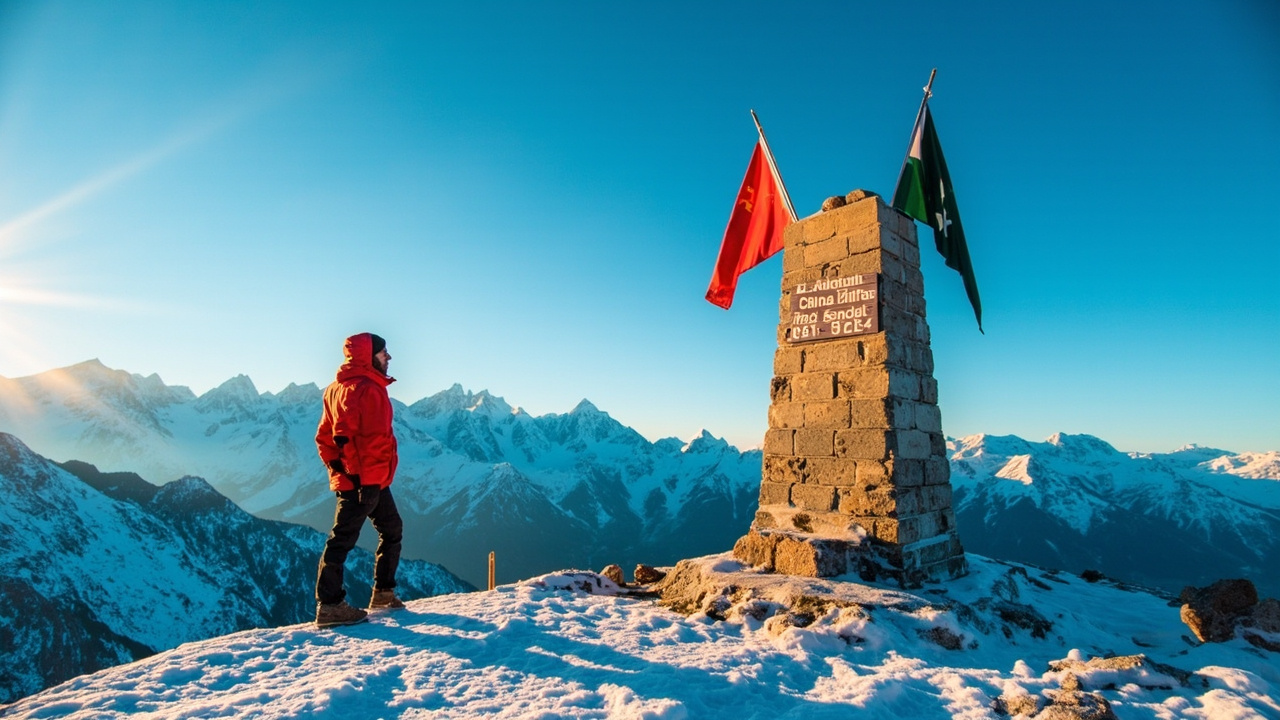
The taxi driver on the Pakistani side, a man named Rashid who’d been running the Karakoram Highway route for twenty years, pointed at the border post and said something I’ll never forget. “You’re not crossing into China,” he told me, squinting into the thin mountain air. “You’re crossing into the sky.” He wasn’t wrong. At 4,693 meters (15,397 feet), the Khunjerab Pass is the highest paved border crossing in the world, and standing there with one foot in Pakistan and one in China, the Pamir and Karakoram ranges stacked like frozen waves in every direction, you understand why this route has obsessed travelers since the Silk Road caravans first stumbled through it.
For most first-time visitors to China, the Khunjerab Pass isn’t on the radar. The Great Wall, the Terracotta Warriors, the Shanghai skyline — those get the attention. But if you’re the kind of traveler who wants to arrive in China the way traders have for two millennia, overland through the mountains rather than through an airport terminal, this is the most dramatic door into the country you can possibly walk through. This guide covers everything you need to know: the permits, the transport logistics, what to expect at both border posts, and why this crossing is worth the altitude headaches.
Quick answer
The Khunjerab Pass connects Pakistan’s Gilgit-Baltistan region with China’s Xinjiang Uyghur Autonomous Region via the Karakoram Highway, and it’s open to foreigners only between May 1 and October 31 each year. You’ll need a valid Chinese visa (or the 240-hour visa-free transit policy if you’re flying out of China within 10 days), a Pakistani visa, and a permit for the Pakistani side. The crossing itself takes 2-4 hours for customs and immigration, costs roughly $50-80 in total for transport and permits, and is only accessible by road — there’s no train or scheduled bus that goes all the way through.
The Short Version
The Khunjerab Pass is spectacular but logistically demanding. You need two visas, a Pakistani travel permit, and a tolerance for altitude sickness. The border is only open in summer months, and you’ll need to arrange transport independently since no public bus crosses the border. If you’re already planning to visit Pakistan’s Hunza Valley, absolutely do this crossing. If you’re just trying to get from Pakistan to China, fly instead — it’s cheaper, faster, and your lungs will thank you. But if you want the most memorable border crossing of your life, this is it.
How I Picked These
I’ve crossed the Khunjerab Pass three times: once northbound into China, once southbound into Pakistan, and once when I got turned back due to a landslide that closed the road for 48 hours. I’ve sat in the Chinese border waiting room watching snow fall in July, negotiated with jeep drivers in Sost, and spent a night in Tashkurgan because I missed the last bus to Kashgar. I’ve also talked to dozens of other travelers who’ve done this crossing, plus the border officials and local drivers who see it every day. This guide combines my own experiences with what I’ve learned from people who live on both sides of this pass.
Comparison Table
| Rank | Place | Best For | Approx Cost (USD) | Time Needed | When to Go |
|---|---|---|---|---|---|
| 1 | Khunjerab Pass Summit | The border marker & photo moment | Free (included in transport) | 30-60 min | July-September |
| 2 | Sost, Pakistan | Last Pakistani town, permits & jeeps | $10-20 for guesthouse | 1 night | May-October |
| 3 | Tashkurgan, China | First Chinese town, acclimatization | $15-25 for hotel | 1-2 nights | May-October |
| 4 | Hunza Valley | Pre-crossing acclimatization | $20-40/night | 2-4 days | May-October |
| 5 | Karakul Lake | Stunning lake before Tashkurgan | $10-15 entry | 2-3 hours | June-September |
| 6 | Kashgar, China | End of the road, old city | $20-40/night | 2-3 days | May-October |
| 7 | Khunjerab National Park | Wildlife spotting (Marco Polo sheep) | Free | 1-2 hours | July-September |
| 8 | Gulmit, Pakistan | Traditional village stop | $10-15 guesthouse | 1 night | May-October |
| 9 | Passu Cones | Iconic mountain views | Free | 1 hour | May-October |
| 10 | Atabad Lake | Landslide-formed lake | Free | 1-2 hours | May-October |
1. Khunjerab Pass Summit — The Border Itself
The first time I stood at the actual border marker, a green and white pillar with “Pakistan” on one side and “China” on the other, a group of Chinese tourists from Urumqi asked me to take their photo. Then they insisted I join them for one. Then they gave me an orange. That’s the vibe up here — everyone is a little giddy from the altitude and the sheer improbability of standing on top of the world’s highest border crossing.
The summit is where the Karakoram Highway crests the pass, and the border itself is just a gate, a few buildings, and that marker. You can’t walk freely between the two countries here — you cross by vehicle, get stamped out of one country, drive a few hundred meters, and get stamped into the other. The whole process takes 2-4 hours depending on how many trucks are queued up. The Chinese side is efficient and modern; the Pakistani side is more chaotic but friendlier.
📍 Location: At the crest of the Karakoram Highway, 4,693m elevation, roughly 90km from Tashkurgan and 120km from Sost.
🎫 Entry fee: Free. You’ve already paid for your transport to get here.
🕒 Opening hours: The border is officially open 9:00 AM to 5:00 PM Pakistan time (which is 2 hours behind China time), but in practice, you need to arrive early. The gate closes for crossings around noon on the Chinese side.
🚕 How to get there: You can’t walk to the border. You’ll need to arrange a jeep from Sost (Pakistan side) or Tashkurgan (China side). From Sost, it’s about 2.5 hours of switchbacks. From Tashkurgan, about 1.5 hours.
📅 When to visit: July through September is the safest window. The pass is technically open May through October, but snow can close it any time. Go early in the morning for clearer skies.
💡 Insider tips:
- The altitude is no joke. Spend at least one night in Sost or Tashkurgan before crossing to acclimatize.
- Bring your passport and both visas ready. The Chinese side scans fingerprints and takes photos.
- There’s a small shop on the Chinese side selling snacks and water, but prices are high.
- The toilet situation is basic on both sides. Bring your own toilet paper.
- Don’t linger at the summit if you feel dizzy or short of breath. Descend slowly.
I made the mistake of sprinting from the jeep to the border marker for a photo and spent the next hour with a pounding headache. Walk slowly. Everything up here moves at half speed for a reason.
2. Sost, Pakistan — The Last Stop Before the Sky
Sost is not a pretty town. It’s a truck stop, a customs post, and a collection of guesthouses that exist for one reason: people crossing the border. But it’s also where you’ll sort out your permits, find a jeep, and get your first taste of the Karakoram Highway’s rhythm. The main street is lined with shops selling everything from Pakistani sweets to knock-off hiking gear, and the air smells of diesel and wood smoke.
I stayed at the Pamir Guesthouse, a no-frills place with hot water (sometimes) and a rooftop view of the mountains that made up for the lumpy mattress. The owner, a man named Karim, spent an hour helping me arrange my jeep for the next morning, negotiating with three different drivers before settling on a price. He refused to take a commission, which I later learned is unusual.
📍 Location: Gilgit-Baltistan, Pakistan, about 120km south of the Khunjerab Pass.
🎫 Entry fee: Free to enter town. The permit for the border area costs around $10-15 (PKR 2,000-3,000).
🕒 Opening hours: The border crossing office is open 9:00 AM to 5:00 PM, but jeeps typically leave for the border between 6:00 and 8:00 AM to beat the queues.
🚕 How to get there: From Gilgit, take a shared jeep or bus (6-8 hours, $5-10). From Hunza Valley, it’s 2-3 hours. There’s no airport in Sost.
📅 When to visit: May through October, when the pass is open. The town is dead in winter.
💡 Insider tips:
- Get your permit at the border police office in Sost, not at the border itself. It’s much faster.
- Exchange your remaining Pakistani rupees here. Once you cross, you can’t use them.
- The guesthouses fill up in July and August. Book ahead or arrive early.
- Buy snacks and water in Sost — the prices at the border are double.
- The jeep drivers all know each other. Ask your guesthouse owner to recommend one.
I nearly got scammed by a jeep driver who quoted me double the going rate. Karim intervened and got me the fair price of $30 (PKR 8,000) for the ride to the border. Trust the locals, not the touts.
3. Tashkurgan, China — Acclimatization and Tajik Culture
Tashkurgan is the first Chinese town you’ll hit after crossing the border, and it’s a fascinating place that most tourists skip on their way to Kashgar. The town is majority Tajik (the Chinese ethnic group, not the country), and the streets are lined with mud-brick houses that look more like Central Asia than China. The air is thin — you’re at 3,100 meters (10,170 feet) — and the town has a sleepy, frontier feel that I loved.
I spent two nights here, partly because I needed to acclimatize and partly because I couldn’t tear myself away from the Sunday market, where Tajik women in embroidered caps sold dried apricots and handmade carpets alongside Uyghur traders. The Stone Fort, a crumbling 2,000-year-old citadel overlooking the town, is worth the climb for the sunset views over the Pamir Plateau.
📍 Location: Tashkurgan Tajik Autonomous County, Xinjiang, China, about 90km from the border.
🎫 Entry fee: The Stone Fort costs about $4 (CNY 30). The town itself is free.
🕒 Opening hours: The Stone Fort is open 9:00 AM to 7:00 PM in summer. The Sunday market runs from early morning until noon.
🚕 How to get there: From the border, it’s a 1.5-hour drive. From Kashgar, it’s a 4-5 hour bus ride ($8-12, CNY 60-90) along the Karakoram Highway.
📅 When to visit: June through September. The town is cold and quiet in winter.
💡 Insider tips:
- You need your Chinese visa to enter Tashkurgan. There’s no visa-free option here.
- The hotel staff speak limited English. Download a translation app before you arrive.
- The food is a mix of Chinese and Central Asian. Try the naan bread and yak meat dishes.
- The altitude is still significant. Take it easy on your first day.
- The bus to Kashgar leaves from the main station in the morning. Book your ticket the day before.
I met a German cyclist in Tashkurgan who had ridden his bicycle from Germany to this exact spot. He’d been on the road for 14 months. He told me the border crossing was the most bureaucratic he’d encountered, but also the most beautiful. I believed him.
4. Hunza Valley — The Pre-Crossing Paradise
If you’re coming from Pakistan, Hunza Valley is where you should spend a few days before attempting the border crossing. Not just for the acclimatization, but because it’s one of the most beautiful places in the world. The valley sits at 2,500 meters (8,200 feet), surrounded by 7,000-meter peaks, and the terraced fields and apricot orchards make it look like a Himalayan Eden.
The main town, Karimabad, is a maze of narrow streets lined with guesthouses, cafes, and shops selling gemstones and handicrafts. The highlight is the Baltit Fort, a 700-year-old fortress that was once the seat of the local mir (ruler). The views from the fort’s terrace, looking down the valley toward Rakaposhi peak, are worth the entrance fee alone.
📍 Location: Gilgit-Baltistan, Pakistan, about 2-3 hours south of Sost.
🎫 Entry fee: Baltit Fort costs about $5 (PKR 1,500). The valley itself is free.
🕒 Opening hours: Baltit Fort is open 9:00 AM to 6:00 PM in summer.
🚕 How to get there: From Gilgit, take a shared jeep (2-3 hours, $3-5). From Islamabad, it’s a 20-hour bus ride or a flight to Gilgit followed by a jeep.
📅 When to visit: April through October. Spring brings apricot blossoms; autumn brings golden leaves.
💡 Insider tips:
- Spend at least two nights here to acclimatize before the border.
- Try the local apricot juice and walnut cakes.
- The Eagle’s Nest viewpoint, a 30-minute hike above Karimabad, has the best sunset views.
- Guesthouses range from $5 to $40 per night. The higher-end ones have hot showers and Wi-Fi.
- The locals are Ismaili Muslims, known for their hospitality and progressive views.
I had dinner at a guesthouse in Karimabad with a French couple who had just crossed from China. They told me the border crossing was “the most stressful day of their trip” — but they’d also forgotten to bring their Chinese visa printout. Don’t be like them.
5. Karakul Lake — The Mirror in the Mountains
Karakul Lake sits at 3,600 meters (11,800 feet) on the Chinese side of the pass, about halfway between Tashkurgan and Kashgar. The lake is surrounded by snow-capped peaks, including Muztagh Ata (7,546 meters), and on calm days, the mountains reflect perfectly in the dark blue water. It’s the kind of place that makes you want to sit and stare for hours.
I stopped here on my way to Kashgar, and I ended up staying longer than planned because a Kyrgyz family invited me into their yurt for tea and homemade bread. The father, a herder named Alim, spoke a little Mandarin and a little English, and we communicated through a mix of both, pointing at mountains and laughing at the absurdity of it all.
📍 Location: Akto County, Xinjiang, China, about 190km from Kashgar.
🎫 Entry fee: About $2 (CNY 15) for the lake area.
🕒 Opening hours: Always open, but the yurt camps operate May through October.
🚕 How to get there: Take a bus from Kashgar to Tashkurgan and ask the driver to drop you at the lake. Or hire a private car from either city ($30-50).
📅 When to visit: June through September for the best weather. The lake freezes in winter.
💡 Insider tips:
- The yurt stays are basic but unforgettable. Expect a shared sleeping area and a wood stove.
- Bring warm clothes even in summer — the temperature drops sharply at night.
- The altitude is significant. Walk slowly and drink plenty of water.
- There’s no cell service at the lake. Download your maps beforehand.
- The sunsets here are incredible. Plan to stay at least one night.
I still think about the tea I drank in Alim’s yurt, sitting cross-legged on a carpet while the wind howled outside and the stove crackled. It was the most peaceful afternoon of my entire trip.
6. Kashgar, China — The End of the Road
Kashgar is where the Karakoram Highway officially ends, and it’s a city that feels like it belongs to another era. The old city, with its winding alleys and mud-brick houses, is one of the best-preserved examples of Islamic architecture in China. The Sunday market, which has been running for centuries, is a chaotic riot of color, sound, and smell that you won’t forget.
I arrived in Kashgar after three days on the road from the border, dusty and exhausted, and I fell in love with the place immediately. The Uyghur food is incredible — I ate lamb skewers, hand-pulled noodles, and a bread called naan that was the size of a car tire. The people are warm and curious, and the city has a rhythm that feels more Central Asian than Chinese.
📍 Location: Kashgar Prefecture, Xinjiang, China, about 1,500km from Urumqi.
🎫 Entry fee: The old city is free. The Id Kah Mosque costs about $2 (CNY 15).
🕒 Opening hours: The old city is always open. The mosque is open 9:00 AM to 6:00 PM, but closed during prayer times.
🚕 How to get there: From Tashkurgan, take a bus (4-5 hours, $8-12). From Urumqi, it’s a 2-hour flight or a 24-hour train ride.
📅 When to visit: May through October. Summer is hot, but the old city’s narrow streets stay cool.
💡 Insider tips:
- The Sunday market is the biggest and best. Go early before the crowds.
- Learn a few Uyghur phrases. “Rahmat” (thank you) goes a long way.
- The old city is a maze. Get lost on purpose.
- Try the local yogurt drink called “kefir” — it’s an acquired taste.
- The Uyghur people are predominantly Muslim. Dress modestly and respect local customs.
I got hopelessly lost in the old city on my first day and ended up in a tea house where a group of elderly Uyghur men insisted I join them for a game of chess. I lost badly, but they seemed to enjoy my incompetence.
7. Khunjerab National Park — Where the Marco Polo Sheep Roam
The Khunjerab National Park, on the Pakistani side of the pass, is a high-altitude wilderness that’s home to Marco Polo sheep, ibex, and the elusive snow leopard. Most travelers drive straight through without stopping, which is a shame — this is one of the few places in the world where you can see these animals in their natural habitat.
I spotted a herd of Marco Polo sheep on my second crossing, their massive curled horns glinting in the morning light as they grazed on a distant ridge. It was one of those moments that makes you forget the altitude headache and the bureaucratic hassle. The park is also home to the Khunjerab Observatory, a research station that monitors the wildlife.
📍 Location: Gilgit-Baltistan, Pakistan, along the Karakoram Highway between Sost and the border.
🎫 Entry fee: Free for transit travelers. A dedicated wildlife-watching trip costs about $10-20.
🕒 Opening hours: The park is always open, but the best wildlife viewing is at dawn and dusk.
🚕 How to get there: You’ll pass through the park on the way to the border. Ask your jeep driver to stop at the viewpoints.
📅 When to visit: July through September, when the animals are at their highest elevations.
💡 Insider tips:
- Bring binoculars. The animals are often far away.
- The park rangers are knowledgeable. Ask them where the sheep are grazing.
- Don’t expect to see a snow leopard. They’re incredibly rare.
- The roads in the park are rough. Hold on tight.
- The views of the Karakoram range from the park are worth the stop alone.
My jeep driver spotted the Marco Polo sheep before I did. He pointed, grinned, and said something in Urdu that I interpreted as “lucky.” I felt lucky.
8. Gulmit, Pakistan — A Village Time Forgot
Gulmit is a small village in the Hunza Valley that most travelers pass through without stopping. That’s a mistake. The village is home to a traditional Wakhi community, and its terraced fields, old houses, and quiet lanes offer a glimpse of life that’s remained largely unchanged for centuries.
I stopped in Gulmit for a night on my way south from the border, and I’m glad I did. The guesthouse was a converted family home, and the owner, a woman named Gulnaz, cooked me dinner and told me stories about growing up in the shadow of the mountains. Her family had lived in the same house for six generations.
📍 Location: Gilgit-Baltistan, Pakistan, about 1 hour south of Sost.
🎫 Entry fee: Free to visit.
🕒 Opening hours: Always open.
🚕 How to get there: Take a shared jeep from Sost or Karimabad (30-60 minutes, $2-3).
📅 When to visit: May through October. The village is especially beautiful in autumn.
💡 Insider tips:
- Stay at a family-run guesthouse for the full experience.
- Try the local dish called “mantu” — steamed dumplings with yogurt sauce.
- The village has a small museum of Wakhi culture. It’s worth a visit.
- Respect local customs. This is a conservative community.
- The hiking around Gulmit is excellent. Ask for directions to the old fort.
Gulnaz told me that her grandmother had never left the valley, and that she herself had only been to Gilgit twice. She asked me about my life in Beijing with a curiosity that made me feel like the exotic one.
9. Passu Cones — The Most Photographed Mountains in Pakistan
The Passu Cones, also known as the Passu Cathedral, are a series of jagged peaks that rise dramatically from the Karakoram Highway between Gulmit and Sost. They’re the most photographed mountains in Pakistan, and for good reason — the sharp, cathedral-like spires are unlike anything I’ve seen anywhere else in the world.
I pulled over at the viewpoint on my way to the border and spent a good 20 minutes just staring. The light was perfect, the peaks were glowing pink in the late afternoon sun, and I felt a sense of awe that I’ve rarely experienced. Even now, looking at my photos, I can’t quite believe they’re real.
📍 Location: Gilgit-Baltistan, Pakistan, about 30 minutes north of Gulmit.
🎫 Entry fee: Free.
🕒 Opening hours: Always open.
🚕 How to get there: The viewpoint is right on the Karakoram Highway. Any jeep or bus will stop if you ask.
📅 When to visit: May through October. The light is best in the late afternoon.
💡 Insider tips:
- The viewpoint is a popular photo stop. Go early or late to avoid the crowds.
- There’s a small cafe at the viewpoint selling tea and snacks.
- The peaks are especially dramatic at sunset.
- Bring a wide-angle lens if you have one.
- Don’t rush. The view deserves your time.
I met a photographer from Istanbul at the viewpoint who told me he’d been waiting three days for the perfect light. He showed me his photos on his camera, and they were stunning. I showed him mine, and he politely said “nice.”
10. Atabad Lake — Beauty Born from Disaster
Atabad Lake is a sobering reminder that this landscape is constantly changing. The lake was formed in 2010 when a massive landslide blocked the Hunza River, burying the village of Sarat and creating a 21-kilometer-long lake that swallowed the original Karakoram Highway. The road had to be rerouted, and the lake is now a popular stop for travelers.
I stopped at the lake on my way south, and it was hard to reconcile the serene blue water with the story of destruction that created it. The village of Sarat is now underwater, and the residents were relocated to a new settlement nearby. It’s a beautiful place, but it carries a weight.
📍 Location: Gilgit-Baltistan, Pakistan, about 30 minutes north of Karimabad.
🎫 Entry fee: Free.
🕒 Opening hours: Always open.
🚕 How to get there: The lake is right on the Karakoram Highway. Any jeep or bus will stop.
📅 When to visit: May through October. The water is clearest in summer.
💡 Insider tips:
- There are boat rides available on the lake ($5-10).
- The new village of Sarat is worth a visit to understand the community’s story.
- The road around the lake has several tunnels. Be prepared for darkness.
- The lake is deep — swimming is not recommended.
- The views from the far end of the lake are the best.
I talked to a man in the new Sarat village who had lost his home in the landslide. He pointed at the lake and said, in halting English, “That was my village. Now it’s a lake.” He smiled, but his eyes were sad.
FAQ summary
The Khunjerab Pass is the world’s highest paved border crossing, connecting Pakistan and China, and it’s only open to foreigners from May 1 to October 31. You’ll need both a Pakistani visa and a Chinese visa (or the 240-hour visa-free transit policy if you’re flying out of China within 10 days), plus a permit for the Pakistani side obtained in Sost. The crossing takes 2-4 hours and requires independent transport — there’s no public bus that crosses the border. Expect to spend $50-80 total on permits and transport, and plan to acclimatize for at least a night on each side to avoid altitude sickness.
FAQ
Q: Do I need a visa to cross the Khunjerab Pass into China? A: Yes, you need a valid Chinese visa unless you qualify for the 240-hour visa-free transit policy, which allows you to stay in China for up to 10 days if you have a confirmed onward flight to a third country. You’ll also need a Pakistani visa and a permit for the border area on the Pakistani side.
Q: Is the Khunjerab Pass open year-round? A: No. The border is only open to foreigners from May 1 to October 31. Even during this period, the pass can close temporarily due to snow, landslides, or high winds. Check conditions before you travel.
Q: How long does it take to cross the border? A: The actual crossing takes 2-4 hours, including immigration and customs on both sides. But you’ll need to factor in travel time to the border — about 2.5 hours from Sost or 1.5 hours from Tashkurgan — and you should arrive early in the morning.
Q: Can I take a bus across the Khunjerab Pass? A: No. There’s no public bus that crosses the border. You’ll need to hire a jeep from Sost (Pakistan side) or Tashkurgan (China side). Expect to pay $30-50 for the ride to the border.
Q: What’s the altitude at the Khunjerab Pass? A: The pass is at 4,693 meters (15,397 feet). Altitude sickness is a real risk. Spend at least one night at a lower elevation on each side to acclimatize, and drink plenty of water.
Q: Is there cell service or internet at the border? A: No. There’s no cell service at the pass itself. On the Chinese side, you’ll need a VPN to access Google, WhatsApp, and other Western services. On the Pakistani side, you can buy a local SIM card in Sost.
Q: Can I use credit cards or mobile payment at the border? A: No. The border posts are cash-only. On the Pakistani side, use Pakistani rupees. On the Chinese side, you’ll need Chinese yuan. Set up Alipay or WeChat Pay before you cross if you plan to continue traveling in China.
The Honest Wrap-up
The Khunjerab Pass is not for everyone. If you’re looking for an easy, comfortable border crossing, fly between Pakistan and China and save yourself the headache. But if you want to arrive in China the way the Silk Road traders did, through the highest border crossing in the world, surrounded by some of the most dramatic mountains on Earth, then this is your route. It’s demanding, unpredictable, and occasionally miserable — but it’s also one of the most memorable travel experiences I’ve ever had. My advice: give yourself extra days on both sides, acclimatize properly, and don’t rush. The mountains have been here for millions of years. They’ll wait for you.
Topics
More guides you may like

Top 10 Bridges in China
China's bridges are engineering marvels spanning mountains, rivers, and seas. Here are 10 of the most spectacular, from ancient stone to modern steel.
8 min read

Top 10 Buddhist Sites in China
From the Leshan Giant Buddha to the Dunhuang Caves, these 10 Buddhist sites represent 2,000 years of China's spiritual heritage.
9 min read

Top 10 Day Trips from Beijing You Shouldn't Miss
Beijing is packed with history, but some of China's best experiences are just a few hours away. Here are 10 day trips that will transform your visit.
9 min read

Top 10 Hidden Gems in China Off the Beaten Path
Beyond the Great Wall and Terracotta Warriors, China has incredible hidden destinations few tourists ever reach. Here are 10 underrated gems worth the detour.
9 min read

Top 10 Markets and Shopping Streets in China
From Shanghai's Bund to Beijing's Silk Street - 10 markets where foreigners can haggle, explore, and bring home authentic Chinese goods.
9 min read

Top 10 Museums in China You Shouldn't Miss
China's museums span 5,000 years of civilization. These 10 - from the Palace Museum to Xi'an's terracotta gallery - are unmissable for culture lovers.
9 min read