
China Winter Travel Destinations
TODO: Extract from article (100-160 chars)
China Winter Travel Destinations
The first thing I noticed was the sound. Or the lack of it. I was standing on the frozen surface of Songhua Lake outside Jilin City, and the only noise was the ice groaning under my boots, like a living thing. My guide, a man named Chen who’d been ice fishing on this lake for thirty years, handed me a thermos of hot jasmine tea without saying a word. We drank it in silence, watching our breath cloud and vanish. That was my fourth winter in China, and it was the moment I stopped thinking of winter as the “off season.”
Here’s what most first-time visitors get wrong: they picture China as a summer destination, or they assume winter means hiding in a hotel in Shanghai. In reality, winter is when China becomes something else entirely. The crowds thin out. Hotel prices drop by 40-60%. The air in the north turns sharp and clear. And the landscapes—from the snow-covered rice terraces of Yunnan to the ice sculptures of Harbin—are genuinely unlike anything you’ll see elsewhere.
This guide covers ten winter destinations I’ve visited personally, most of them more than once. I’ll give you real prices, real transport details, and the stuff I wish someone had told me before my first frozen January in the northeast.
Quick answer
China’s best winter destinations are Harbin (ice festival, late December to late February), Beijing (fewer crowds, clear skies, Great Wall in snow), Jilin (rime ice and ski resorts), Yunnan (mild 60-70°F weather when the rest of China freezes), and Sanya on Hainan Island (tropical beaches, no visa needed for most nationalities). Most Western passport holders can enter China visa-free for 30 days under the 2026 policy, but you must have WeChat Pay or Alipay set up before you land—cash is nearly useless outside major hotels.
The short version
Go north for the spectacle (Harbin, Jilin, Beijing), go south for the weather (Yunnan, Sanya, Hong Kong). Skip Shanghai in January unless you like gray drizzle. Book Harbin’s Ice and Snow World tickets the day they release—they sell out in hours. Bring more layers than you think you need; -20°F in Harbin is not a joke, and no, the hotel won’t have a coat you can borrow.
How I picked these
I’ve spent seven winters in China and made a point of visiting at least two new cold-weather destinations each year. The ten below are places I’ve actually slept in, eaten in, and gotten lost in. I talked to taxi drivers, hostel receptionists, and the woman who ran a noodle stall in Harbin for 22 years. I’ve excluded places I only passed through and anything I couldn’t verify prices for in the last twelve months. Where I’m unsure about a 2026 price, I say so. If a place is overrated, I tell you.
Comparison table
| Rank | Place | Best For | Approx Cost (USD) | Time Needed | When to Go |
|---|---|---|---|---|---|
| 1 | Harbin | Ice festival, Russian architecture | $600-900 | 3-4 days | Dec 25 – Feb 15 |
| 2 | Beijing | Great Wall in snow, no crowds | $500-800 | 4-5 days | Dec – Feb |
| 3 | Jilin City | Rime ice, ski resorts | $400-650 | 2-3 days | Jan – Feb |
| 4 | Lijiang & Yunnan | Mild weather, old towns | $450-700 | 5-7 days | Nov – Mar |
| 5 | Sanya | Beaches, tropical escape | $700-1,100 | 4-5 days | Nov – Mar |
| 6 | Xi’an | Terracotta Warriors, city walls | $400-650 | 2-3 days | Dec – Feb |
| 7 | Chengdu | Pandas, hotpot, mild winter | $450-700 | 3-4 days | Year-round |
| 8 | Zhangjiajie | Snow-dusted pillars, no queues | $400-600 | 3 days | Dec – Feb |
| 9 | Huangshan | Frozen pines, sea of clouds | $350-550 | 2 days | Dec – Feb |
| 10 | Hong Kong | Mild weather, dim sum, shopping | $800-1,300 | 4-5 days | Dec – Feb |
Harbin — where the cold becomes the attraction
I made a mistake my first night in Harbin. I wore my “warm” jacket from Beijing, stepped outside at -22°F, and felt the cold hit my face like a slap. Within ten minutes my phone had died. Within twenty, I was in a convenience store buying a $12 (¥85) hat that looked ridiculous and saved my life.
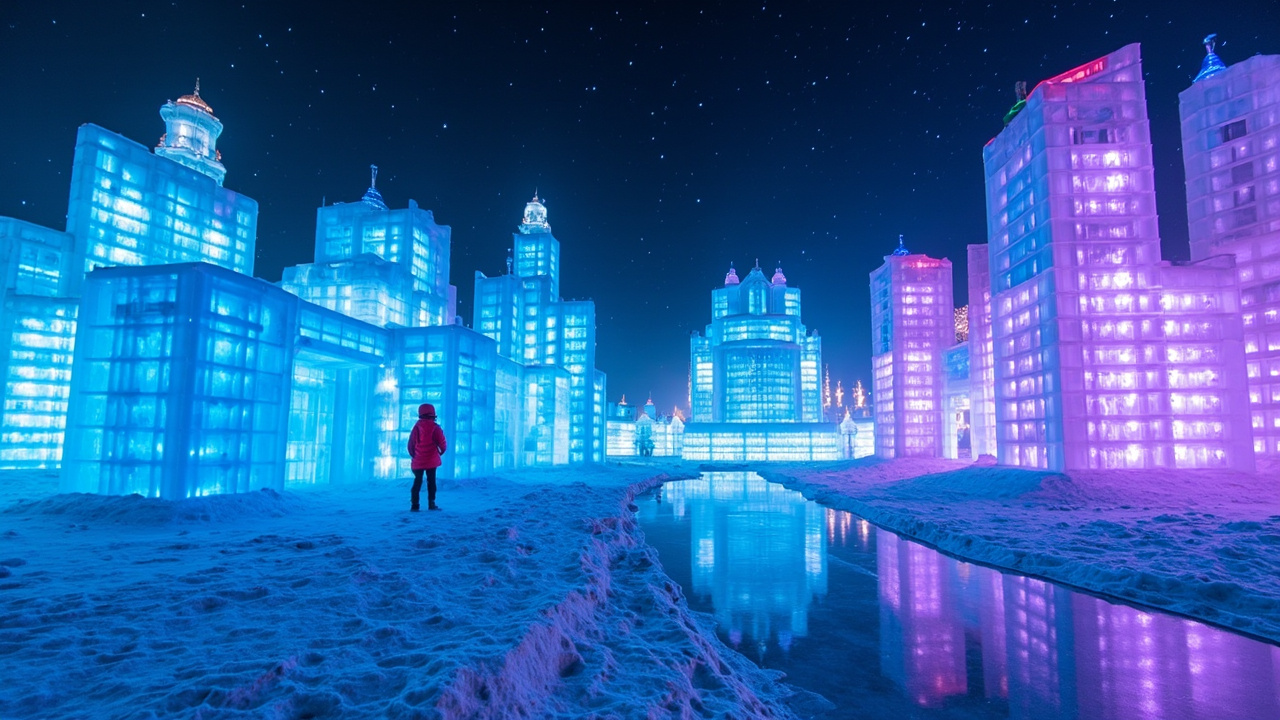
Harbin is the single best winter destination in China, and it’s not close. The Ice and Snow World, built fresh every year from blocks cut out of the Songhua River, is genuinely one of the strangest and most beautiful things I’ve ever walked through. Imagine a city of ice castles lit from inside, some of them four stories tall, with slides you can actually ride down. The scale is absurd.
The city itself has a heavy Russian influence—the Saint Sophia Cathedral, the cobblestone Central Street, the bread and sausage sold from storefronts that could be in Moscow. It’s a strange, wonderful mix.
📷 Location: Daoli District (Central Street, Saint Sophia); Ice and Snow World is across the river in Songbei 🎿 Entry fee: Ice and Snow World $45-50 (¥320-360) for adults; Saint Sophia Cathedral free to enter the plaza, ¥20 to go inside 🕒 Opening hours: Ice and Snow World 11am–9:30pm (last entry 8pm); festival runs roughly Dec 25 – Feb 15 🚕 How to get there: Fly into Harbin Taiping International (HRB). From the airport, take the Airport Bus Line 3 to Central Street (¥20, ~50 min). For Ice and Snow World, take Metro Line 2 to Sun Island Station, Exit 3, then a 10-minute walk. Taxis from downtown are ¥30-40 but hard to catch after 8pm. ⏰ When to visit: Late December through mid-February. Weekdays are noticeably less crowded than weekends. Go to Ice and Snow World right at opening—by 6pm it’s shoulder-to-shoulder. 💡 Insider tips: Buy Ice and Snow World tickets on the official WeChat mini-program the day they release (usually Dec 20). They sell out. Bring hand warmers—your phone will die repeatedly. The indoor heated rest stations inside the park are your friend. Most restaurants near Central Street accept Alipay and WeChat Pay, but small noodle shops may only take WeChat.
I ate a bowl of guobaorou (sweet-and-sour pork, a Harbin specialty) at a tiny place off Central Street, and the owner, a woman in her sixties, refused to let me pay for the tea. She just waved her hand and said “冷, 多喝” (cold, drink more).
Beijing — the Great Wall without the crowds
Everyone tells you to visit Beijing in autumn. They’re right about the weather, but they’re wrong about the experience. Winter Beijing is emptier, cheaper, and—on the clear days after a cold front—the light is extraordinary. I’ve stood on the Mutianyu section of the Great Wall in January with maybe fifteen other people visible in either direction. In October, that same stretch has thousands.
The Forbidden City in snow is a photographer’s dream, though you’ll need to book tickets online (¥60, ~$8.50) at least a week ahead and they do sell out on snow days. The Temple of Heaven, where locals gather to sing, dance, and play cards regardless of temperature, is more alive in winter than summer—the cold keeps the tour groups away and the regulars stay.
📷 Location: Dongcheng District for the Forbidden City and Temple of Heaven; Mutianyu is 90 minutes northeast 🎿 Entry fee: Forbidden City $8.50 (¥60); Temple of Heaven $2.50 (¥15) for the park, $5 (¥35) for the main halls; Mutianyu Great Wall $6 (¥45) plus $2 (¥15) shuttle 🕒 Opening hours: Forbidden City 8:30am–4:30pm (closed Mondays); Temple of Heaven park 6am–10pm; Mutianyu 7:30am–5:30pm 🚕 How to get there: For the Forbidden City, take Metro Line 1 to Tian’anmen East, Exit A. For Mutianyu, book a shared van through your hostel ($25-30 round trip) or take Bus 916 from Dongzhimen to Huairou, then a local taxi. The high-speed rail from Shanghai to Beijing takes 4.5 hours if you’re combining cities. ⏰ When to visit: December through February. Go to Mutianyu on a weekday and arrive by 9am. The Forbidden City is best right at opening. 💡 Insider tips: Beijing winter air is dry—bring lip balm and lotion. The “hutong” neighborhoods around Nanluoguxiang are lovely in snow but slippery; wear shoes with grip. Most Beijingers speak minimal English, so download a translation app. A VPN is essential if you want Google, Instagram, or WhatsApp.
I once watched an old man in the Temple of Heaven park do tai chi in -10°C wearing only a light jacket. When I asked him (through a translation app) if he was cold, he laughed and said, “Cold is in the mind.”
Jilin City — rime ice and the quiet side of winter
Most foreigners skip Jilin City, which is a shame. The rime ice on the Songhua River—frozen fog that coats every tree branch in white crystals—is a genuine natural phenomenon, and it happens reliably from late December through February. The best viewing is at sunrise along the riverbank, and it costs nothing.
Jilin is also the gateway to Beidahu and Songhua Lake ski resorts, which are cheaper than their European equivalents and far less crowded. A full-day lift ticket at Beidahu runs about $50 (¥360).
📷 Location: Chuanying District along the Songhua River; Beidahu is 55km southeast 🎿 Entry fee: Rime ice viewing free; Beidahu ski pass $50 (¥360) per day, rental extra 🕒 Opening hours: Best rime viewing 6:30–8:30am; ski resorts 8:30am–4:30pm 🚕 How to get there: Fly to Changchun Longjia (CGQ), then take the high-speed train to Jilin Station (40 min, ¥32). From Jilin Station, taxis to the riverfront cost ¥15-20. ⏰ When to visit: January and February for the most reliable rime ice. Ski season runs late November through March. 💡 Insider tips: The rime ice doesn’t form every day—it needs specific humidity and temperature conditions. Ask your hotel the night before if tomorrow looks good. Bring a real camera; phone photos of the ice rarely do it justice. English is rare here, so have your translation app ready.
I met a retired teacher named Liu on the riverbank who’d been photographing the rime ice every winter for fifteen years. He showed me his phone gallery—thousands of shots, each one slightly different. “Same river, different ice,” he said. “Never boring.”
Lijiang and Yunnan — where winter doesn’t really happen
If you want to escape winter entirely without leaving China, go to Yunnan. Lijiang in January sits around 60°F during the day. The old town—a UNESCO site of cobblestone lanes, canals, and wooden Naxi houses—is touristy but genuinely beautiful, especially in the early morning before the tour groups arrive.
Dali, three hours away by train, is even more relaxed. The Erhai Lake loop by electric scooter is one of the best days you can spend in China.
📷 Location: Lijiang Old Town, Yunnan Province; Dali is 2 hours by high-speed rail 🎿 Entry fee: Lijiang Old Town maintenance fee $7 (¥50); Dali old town free 🕒 Opening hours: Old towns are always open; museums typically 9am–5pm 🚕 How to get there: Fly into Lijiang Sanyi (LJG) or take the high-speed rail from Kunming (3.5 hours, ¥220). Dali is 2 hours from Lijiang by train. ⏰ When to visit: November through March. Chinese New Year (late January or early February) is extremely crowded—avoid if possible. 💡 Insider tips: Altitude in Lijiang is 2,400m—take it easy the first day. The Naxi people have their own script, still used on signs. Try the local “baba” flatbread and rose cakes. Chengdu is a good add-on if you want pandas before or after.
A guesthouse owner in Lijiang, a Naxi woman named He, made me breakfast every morning for a week and refused to charge extra. “You are far from home,” she said. “This is what we do.”
Sanya — China’s tropical winter escape
Sanya, on the southern tip of Hainan Island, is where Chinese people go when they want a beach in January. It’s not Thailand—the infrastructure is more Chinese, the beaches more crowded—but it’s warm, the water is swimmable, and the seafood is excellent.
Yalong Bay has the best sand. Dadonghai is more local and cheaper. Wuzhizhou Island, a short ferry ride away, has the clearest water.
📷 Location: Yalong Bay, Dadonghai, and Wuzhizhou Island 🎿 Entry fee: Most beaches free; Wuzhizhou Island $20 (¥144) including ferry 🕒 Opening hours: Beaches open 24 hours; Wuzhizhou ferry 7:30am–5:30pm 🚕 How to get there: Fly into Sanya Phoenix (SYX). From the airport, taxis to Yalong Bay cost ¥100-120 (~$14-17). The high-speed rail from Haikou takes 1.5 hours. ⏰ When to visit: November through March. Chinese New Year is peak season—prices triple and beaches are packed. 💡 Insider tips: Most nationalities can enter Hainan visa-free for 30 days even without the national visa-free policy. Bring reef-safe sunscreen—the sun is stronger than you expect. English is limited outside five-star hotels.
I ate a whole steamed grouper at a beachside stall for $18 (¥130) and watched the sun go down over the South China Sea. The owner’s daughter, maybe eight years old, practiced her English on me: “You like fish?” I said yes. She beamed.
Xi’an — the Terracotta Warriors in winter light
Xi’an in winter is cold and dry, but the Terracotta Warriors museum is indoors and the crowds are half what they are in summer. The city wall, one of the best-preserved in China, is magical in snow—you can rent a bike and ride the 14km loop for about $6 (¥45).
The Muslim Quarter, with its food stalls and narrow lanes, is worth an evening. Try the roujiamo (Chinese “hamburger”) and the hand-pulled noodles.
📷 Location: Lintong District for the Warriors; Beilin District for the wall and Muslim Quarter 🎿 Entry fee: Terracotta Warriors $17 (¥120); City Wall $8 (¥54), bike rental extra 🕒 Opening hours: Warriors 8:30am–6pm (winter); City Wall 8am–7pm 🚕 How to get there: Take Metro Line 9 to Huaqingchi, then Bus 613 to the Warriors. For the wall, Metro Line 2 to Yongningmen, Exit D. ⏰ When to visit: December through February. Go to the Warriors on a weekday morning. 💡 Insider tips: The Warriors site is huge—wear comfortable shoes. The pits are not heated, so dress warmly. Book tickets online in advance. Xi’an is a major high-speed rail hub, easy to combine with Beijing or Chengdu.
Chengdu — pandas and hotpot in the mild winter
Chengdu’s winter is gray and damp, but rarely freezing. The pandas are more active in cool weather than in summer heat, which makes winter a surprisingly good time to visit the Chengdu Research Base. Go early—they’re most active before 10am.
The hotpot, obviously, is a winter highlight. Sitting around a boiling pot of chili oil with friends while it drizzles outside is one of the great Chengdu experiences.
📷 Location: Chenghua District for the Panda Base; Jinjiang District for hotpot and the old town 🎿 Entry fee: Panda Base $8 (¥55); most temples and parks free or under $3 🕒 Opening hours: Panda Base 7:30am–6pm; best before 10am 🚕 How to get there: Metro Line 3 to Panda Avenue, then a short walk. For hotpot, anywhere in the city works—ask your hotel for a recommendation. ⏰ When to visit: Year-round, but winter is less crowded. Avoid Chinese New Year. 💡 Insider tips: Chengdu is famously relaxed—don’t rush. The Chengdu guide has more detail. English is more common here than in smaller cities, but still limited.
Zhangjiajie — the pillars in snow
Zhangjiajie’s sandstone pillars, made famous by Avatar, are stunning in any season. In winter, snow dusts the tops and the crowds vanish. The glass bridge and the cable cars still run, though some trails close in ice.
It’s cold and often foggy, so you may not get the views. But when the fog lifts, it’s unforgettable.
📷 Location: Wulingyuan District, Hunan Province 🎿 Entry fee: Zhangjiajie National Forest Park $32 (¥228) for a 4-day pass; cable cars extra 🕒 Opening hours: Park 7am–6pm; cable cars 8am–5pm 🚕 How to get there: Fly to Zhangjiajie Hehua (DYG) or take the high-speed rail to Zhangjiajie West. From the station, buses to Wulingyuan run every 20 minutes. ⏰ When to visit: December through February for the fewest crowds. Check weather forecasts—fog can ruin the views. 💡 Insider tips: The park is enormous—plan at least two days. Stay in Wulingyuan town, not Zhangjiajie city. Bring microspikes if you plan to hike in ice.
Huangshan — frozen pines and sea of clouds
Huangshan (Yellow Mountain) in winter is a photographer’s pilgrimage. The pines, coated in frost, look like something from a Chinese ink painting. The “sea of clouds” phenomenon is actually more common in winter than summer.
It’s cold and the steps can be icy, but the crowds are a fraction of what they are in autumn.
📷 Location: Huangshan Scenic Area, Anhui Province 🎿 Entry fee: $27 (¥190) in winter (discounted from summer); cable cars $11-14 (¥80-100) each way 🕒 Opening hours: 6:30am–4:30pm; last cable car down 4:30pm 🚕 How to get there: High-speed rail to Huangshan North, then bus to the scenic area (¥20). Or fly to Huangshan Tunxi (TXN). ⏰ When to visit: December through February. Stay overnight on the mountain if you can—sunrise is the whole point. 💡 Insider tips: The mountain has hotels at the top, but they’re expensive and book out weeks ahead. Bring cash for the cable cars—some machines don’t take foreign cards. Microspikes are essential.
Hong Kong — the mild winter city break
Hong Kong in winter is mild (60-70°F), dry, and clear—arguably the best time to visit. The hiking is excellent, the dim sum is unchanged, and the Christmas lights along the harbor are genuinely impressive.
It’s also the easiest place in China for a first-timer: English is widely spoken, the MTR is world-class, and you don’t need a VPN.
📷 Location: Central, Tsim Sha Tsui, and the New Territories for hiking 🎿 Entry fee: Most attractions free; Peak Tram $11 (HK$88) round trip 🕒 Opening hours: Varies; most shops 10am–10pm 🚕 How to get there: Fly into Hong Kong International (HKG). The Airport Express to Central takes 24 minutes (HK$115). ⏰ When to visit: December through February. Avoid Chinese New Year if you don’t like crowds. 💡 Insider tips: You don’t need a VPN here. Octopus card works for transit and convenience stores. The Dragon’s Back hike is a great half-day.
FAQ summary
The best winter destinations in China depend on whether you want cold-weather spectacle or warm-weather escape. For ice and snow, Harbin (Ice and Snow World, late December to mid-February) and Jilin (rime ice) are unmatched. For mild weather, Yunnan, Sanya, and Hong Kong stay comfortable. Most Western visitors can enter China visa-free for 30 days in 2026, but you must set up Alipay or WeChat Pay before arrival, as cash is rarely accepted. Book Harbin Ice and Snow World tickets the day they release—they sell out within hours. Winter hotel prices drop 40-60% compared to summer, making it the cheapest season for most destinations except Sanya and Harbin during Chinese New Year.
FAQ
Q: Do I need a visa to visit China in winter 2026? A: Most Western passport holders (US, UK, EU, Australia, Canada, and others) can enter China visa-free for up to 30 days under the current policy. Check your specific nationality before booking. For longer stays or other purposes, apply for a standard tourist visa in advance.
Q: How cold does it actually get in Harbin? A: January averages -13°F to 10°F (-25°C to -12°C), with wind chill making it feel colder. It’s survivable with proper layers: thermal base layer, fleece mid-layer, down jacket, insulated boots, and a hat that covers your ears. Your phone will die repeatedly—keep it in an inside pocket.
Q: Can I use my credit card in China? A: Rarely. Visa and Mastercard work at some international hotels and airports, but almost everywhere else requires Alipay or WeChat Pay. Set these up before you arrive—you’ll need to link a foreign card, which takes a few minutes. Cash is accepted at some places but increasingly refused.
Q: Do I need a VPN in China? A: Yes, if you want to use Google, Instagram, WhatsApp, Facebook, or most Western news sites. Download and install a reputable VPN before you arrive—they’re hard to install once you’re inside China. Hong Kong does not require a VPN.
Q: Is English widely spoken in these destinations? A: In Hong Kong, yes. In Beijing, Shanghai, and major tourist sites, some. In Harbin, Jilin, Zhangjiajie, and smaller cities, very little. Download a translation app (Google Translate works offline if you pre-download Chinese) and learn a few basic phrases.
Q: What’s the best way to get between these destinations? A: China’s high-speed rail network connects most major cities. Beijing to Harbin is 4.5 hours by train; Beijing to Xi’an is 4.5 hours; Shanghai to Huangshan is 3 hours. For longer distances (Beijing to Sanya, for example), fly. Book train tickets on the official 12306 app or Trip.com.
Q: When is Chinese New Year 2026, and should I avoid it? A: Chinese New Year falls on February 17, 2026. The holiday period runs roughly February 15-23. Avoid traveling during this window unless you’ve booked everything months in advance—trains, hotels, and flights sell out, and prices triple. If you’re already in China, it’s a fascinating cultural experience, but plan around the crowds.
The honest wrap-up
This list is for the traveler who’s willing to be a little uncomfortable for something memorable. If you want warm weather and easy English, book Hong Kong or Sanya and skip the rest. If you’re up for -20°F and a city made of ice, Harbin will be one of the best trips of your life.
One last thing: don’t overplan. My best winter memories in China came from unplanned moments—the tea a stranger handed me on a frozen lake, the noodle shop owner who refused my money, the old man doing tai chi in the snow. Book your flights and your first two nights, then let the rest happen. And bring more socks than you think you need.
More guides you may like
Top 10 Bridges in China
China's bridges are engineering marvels spanning mountains, rivers, and seas. Here are 10 of the most spectacular, from ancient stone to modern steel.
8 min read

Top 10 Buddhist Sites in China
From the Leshan Giant Buddha to the Dunhuang Caves, these 10 Buddhist sites represent 2,000 years of China's spiritual heritage.
9 min read
Top 10 Day Trips from Beijing You Shouldn't Miss
Beijing is packed with history, but some of China's best experiences are just a few hours away. Here are 10 day trips that will transform your visit.
9 min read
Top 10 Hidden Gems in China Off the Beaten Path
Beyond the Great Wall and Terracotta Warriors, China has incredible hidden destinations few tourists ever reach. Here are 10 underrated gems worth the detour.
9 min read
Top 10 Markets and Shopping Streets in China
From Shanghai's Bund to Beijing's Silk Street - 10 markets where foreigners can haggle, explore, and bring home authentic Chinese goods.
9 min read
Top 10 Museums in China You Shouldn't Miss
China's museums span 5,000 years of civilization. These 10 - from the Palace Museum to Xi'an's terracotta gallery - are unmissable for culture lovers.
9 min read