
Things to Do in Chongqing
TODO: Extract from article (100-160 chars)
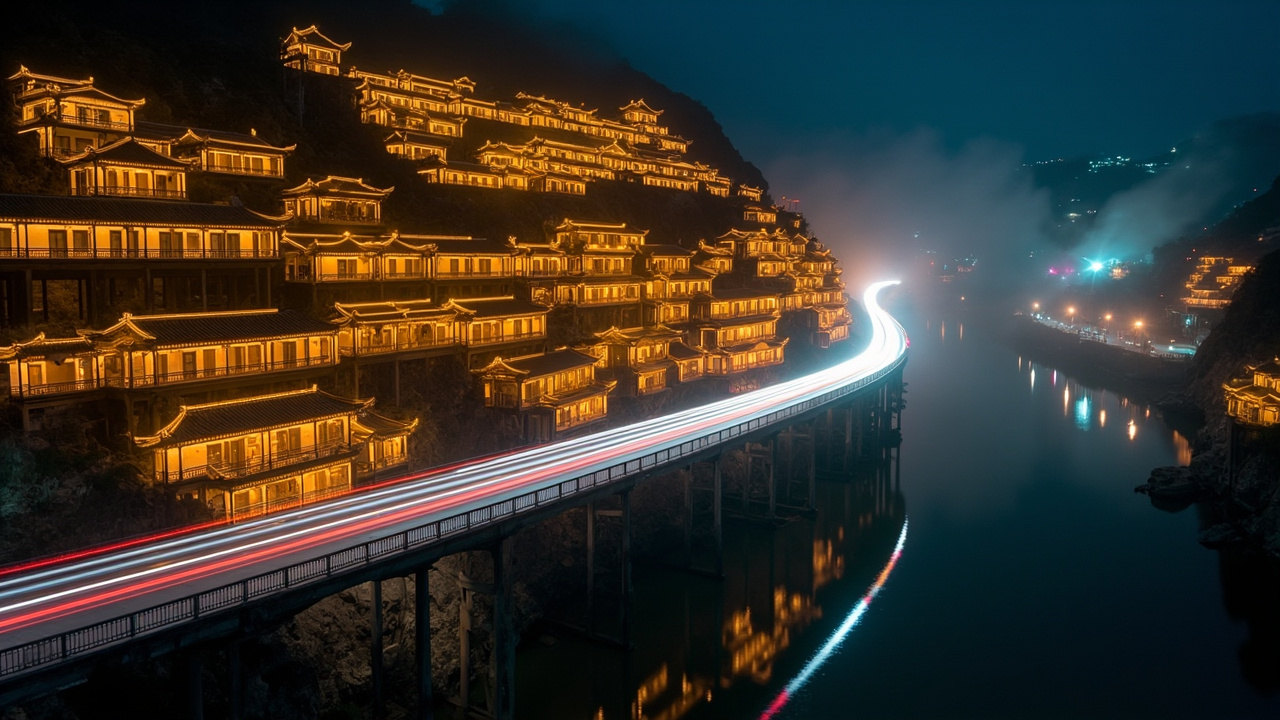
I was standing on a rooftop in Chongqing’s Yuzhong district at 11pm, watching a monorail slide straight through the 8th floor of an apartment building across the street. Nobody else on the roof even looked up. A woman two meters away was hanging laundry. That’s Chongqing — a city of 32 million people where the impossible is just Tuesday.
Most first-timers skip it. They do Beijing, Shanghai, maybe Xi’an, and fly home. That’s a mistake. Chongqing is the most visually insane city in China, and possibly the world. It’s built on steep hills where the Yangtze and Jialing rivers meet, so there’s no flat ground — everything stacks. Roads spiral. Buildings have entrances on three different “ground floors.” A subway station can be 60 meters underground, and the exit you want might dump you on a bridge.
I’ve been back four times now. The first trip I got hopelessly lost in Hongya Cave for two hours and ate hotpot alone at a plastic table while a stranger taught me how to dip beef in oil instead of sesame paste. The fourth trip I brought my parents and watched my dad, a retired engineer, spend twenty minutes trying to figure out how the monorail building actually works.
This guide covers the ten things actually worth your time, with real prices, real transit directions, and the stuff I wish someone had told me before my first bowl of hotpot. If you’re planning your first China trip, pair this with my top 10 must-visit places in China overview, and make sure your Alipay and WeChat Pay setup is done before you land — Chongqing runs on QR codes.
Quick answer
Chongqing is visa-free for most American, European, and Southeast Asian passport holders under China’s 240-hour (10-day) transit policy, and it’s the best city in China for night views, spicy food, and cyberpunk cityscapes. Budget roughly $60–100 (¥430–720) per day including hotel, food, and transport. The best months are March–May and September–November; summer is brutally humid (40°C+) and winter is gray and damp. You need 3–4 full days minimum, and you need a working translation app because English is rare outside five-star hotels.
The Short Version
If you only have 48 hours: do Hongya Cave at night, ride the Yangtze River Cableway, eat hotpot in Jiangbei, and take the Line 2 monorail through Liziba station. Skip the zoo, skip most “ancient towns” within city limits, and don’t waste a day on the Three Gorges unless you’re doing the full cruise. Chongqing rewards walking and getting lost — but wear real shoes, because everything is stairs.
How I Picked These
Four trips between 2019 and 2025, roughly 22 days total in the city. I stayed in three different districts (Yuzhong, Jiangbei, Nan’an) to understand how the geography actually works, and I dragged along a Chongqing-born friend named Wei on two of those trips, who corrected about half my assumptions. I skipped anything that only exists for tour buses, and I re-visited every place on this list at least twice — once on a weekday, once on a weekend — because crowd levels here change everything. Prices are from late 2025 and early 2026, converted at roughly 7.2 CNY to 1 USD.
Comparison Table
| Rank | Place | Best For | Approx Cost (USD) | Time Needed | When to Go |
|---|---|---|---|---|---|
| 1 | Hongya Cave (洪崖洞) | Night photography, first impressions | Free | 2–3 hrs | After 7pm, weekdays |
| 2 | Liziba Monorail Station | The “train through building” shot | $0.30 (¥2) | 30 min | Daytime, any day |
| 3 | Yangtze River Cableway | River views, old Chongqing | $4 (¥30) | 1 hr | Sunset |
| 4 | Ciqikou Ancient Town | Snacks, tea houses, souvenirs | Free | 2–3 hrs | Morning, weekdays |
| 5 | Jiefangbei & Raffles City | Shopping, skyline, observation deck | Free–$18 (¥130) | 2 hrs | Evening |
| 6 | Chongqing Hotpot (Jiangbei) | The reason you came | $15–25 (¥110–180) | 2 hrs | Dinner, any night |
| 7 | Eling Park | Skyline views without crowds | Free | 1.5 hrs | Late afternoon |
| 8 | Three Gorges Museum | History, free entry, AC | Free | 2 hrs | Rainy days |
| 9 | Kuixinglou Steps | The 24-floor staircase | Free | 45 min | Golden hour |
| 10 | Nan’an Riverside Path | Local life, no tourists | Free | 2 hrs | Evening |
1. Hongya Cave — Yes, It’s Touristy. Go Anyway.
The first time I saw Hongya Cave, I thought it was a theme park. Eleven stories of wooden stilt buildings stacked up a cliff face, glowing gold at night, with the Jialing River rushing past below. It’s not a theme park. It’s a real commercial complex built in 2006 on the site of old riverside stilt houses, and it’s become the single most photographed thing in Chongqing.
Here’s the thing nobody tells you: the inside is mostly mediocre restaurants and souvenir shops. The magic is the outside. Walk down to Qiansimen Bridge (千厮门大桥) on the east side and shoot the whole thing from across the water. That’s the photo you’ve seen on Instagram.
Go on a Tuesday or Wednesday if you can. Friday and Saturday nights are genuinely unpleasant — I once waited 40 minutes just to get onto the bridge. And bring cash for the street vendors at the bottom, because some of the older ones don’t take QR codes.
📍 Location: Yuzhong District, on the Jialing River, near Qiansimen Bridge 🎟️ Entry fee: Free to walk through; observation areas free 🕒 Opening hours: Complex open roughly 10am–10pm; exterior lit until around midnight 🚇 How to get there: Metro Line 2 to Linjiangmen Station, Exit A, walk 5 minutes downhill. Or Line 6 to Xiaoshizi, Exit 6, walk 8 minutes. ⏰ When to visit: Weekday evenings, 7–9pm, for the lights without the crush 💡 Insider tips: The best photo spot is on Qiansimen Bridge, not inside. Bring a phone with good low-light mode. The lower levels have less foot traffic and better river views. Don’t eat here — walk 10 minutes to Jiefangbei for better food at half the price.
I met a retired photographer named Mr. Zhou on the bridge who’s been shooting Hongya Cave every week since 2010. He told me the lights changed in 2023 and now use warmer tones. He was right.
2. Liziba Station — The Train That Goes Through a Building
I’ll be honest: this is a 20-minute stop, not an afternoon. But you have to see it. At Liziba station on Metro Line 2, the monorail literally passes through floors 6–8 of a 19-story residential building. The station was built into the building in 2004 because there was no other flat land available. Residents above and below just live with it.
The viewing platform outside the station is free and has a marked photo spot. Trains come every 3–5 minutes, so you won’t wait long. The best angle is from the street level below, looking up — that’s where you get the “train emerging from a building” shot.
What surprised me: the building is dead quiet inside. Engineers used rubber mounts and the trains slow to about 30 km/h through the station. I asked a resident waiting for the elevator and she shrugged and said she doesn’t notice it anymore.
📍 Location: Liziba Station, Metro Line 2, Yuzhong District 🎟️ Entry fee: Free; metro fare $0.30 (¥2) 🕒 Opening hours: Metro runs roughly 6:30am–11pm 🚇 How to get there: Line 2 directly to Liziba Station. Exit B has the viewing platform. ⏰ When to visit: Mid-morning on a weekday for fewer photographers 💡 Insider tips: Ride the line from Jiaochangkou to Liziba for the full cliffside experience. Stand on the right side of the train for river views. The viewing platform gets crowded after 10am — go early. Combine this with Eling Park, which is two stops away.
Small mistake I made: I stood on the wrong side of the platform the first time and missed the train passing through. Watch which direction the crowd is facing.
3. Yangtze River Cableway — The Commuter Route That Became a Tourist Attraction
This was built in 1987 as public transport, and locals still use it to cross the river. That’s what makes it good. You’re not on a tourist ride — you’re on a cable car full of people going to work, carrying groceries, scrolling their phones.
The ride takes about 5 minutes each way across the Yangtze, from Yuzhong to Nan’an. Go at sunset. The light hits the river and the whole city turns orange, then purple, then the lights come on. I rode it three times in one week.
📍 Location: Two stations — Xinhua Road (Yuzhong side) and Shangxinjie (Nan’an side) 🎟️ Entry fee: $4 (¥30) one-way; $7 (¥50) round-trip 🕒 Opening hours: 7:30am–10:30pm daily 🚇 How to get there: Metro Line 1 or 6 to Xiaoshizi, Exit 5, walk 10 minutes to Xinhua Road station ⏰ When to visit: 30 minutes before sunset, weekdays 💡 Insider tips: Buy one-way and take the metro back — it’s cheaper and you see more. The Nan’an side has a riverside path worth walking. Bring small bills if you don’t have Alipay set up. The cable car sways noticeably in wind — fine for most people, but skip it if you’re motion-sensitive.
A woman named Liu shared my cable car and pointed out her apartment building on the far bank. She’s been riding it for 18 years. She said the tourists started around 2018 and now she takes the metro instead.
4. Ciqikou Ancient Town — Go Early or Don’t Go
Ciqikou is a restored Ming and Qing dynasty porcelain port, now a pedestrian street of snack stalls and tea houses. On a weekday morning at 8am, it’s lovely — misty, quiet, old men doing tai chi by the river. On a Saturday at 2pm, it’s a wall of selfie sticks.
The food is the reason to come. Get the ciba (糍粑, glutinous rice cakes), the mahua (fried dough twists), and the freshly ground chili powder that vendors sell by the bag. I bought 200 grams of chili powder here in 2023 and it’s still the best I’ve used.
📍 Location: Shapingba District, northwest of the city center 🎟️ Entry fee: Free 🕒 Opening hours: Streets always open; shops roughly 8am–9pm 🚇 How to get there: Metro Line 1 to Ciqikou Station, Exit 1, walk 3 minutes ⏰ When to visit: Before 9am on a weekday 💡 Insider tips: The main street is a tourist trap — turn left at the temple and walk up the hill for the real neighborhood. Cash is useful for older vendors. Don’t buy “antiques.” The tea houses on the upper streets are calmer and cheaper than the riverside ones. If you’re continuing to Chengdu, this is a good warm-up for that city’s teahouse culture.
I paid ¥80 for a “handmade” tea set that I later saw in a Shapingba market for ¥25. Lesson learned.
5. Jiefangbei & Raffles City — The Skyline You Came For
Jiefangbei is the commercial heart of Chongqing — a pedestrian plaza with the city’s war memorial in the middle, surrounded by malls. It’s not charming. It’s useful. This is where you’ll find international ATMs, decent coffee, and the Raffles City complex with its 250-meter-tall “horizontal skyscraper” connecting four towers.
The observation deck at Raffles City (called “The Crystal”) is $18 (¥130) and gives you a 360-degree view. I think it’s worth it once, at night. The Eling Park alternative (entry #7) is free and honestly almost as good.
📍 Location: Yuzhong District, Jiefangbei pedestrian street 🎟️ Entry fee: Plaza free; Raffles observation deck $18 (¥130) 🕒 Opening hours: Malls 10am–10pm; observation deck 10am–10pm 🚇 How to get there: Metro Line 2 to Linjiangmen, Exit A, walk 5 minutes ⏰ When to visit: Evening for lights; weekday for shopping 💡 Insider tips: The basement food courts in Raffles City are excellent and cheap. Most stores accept Alipay and WeChat Pay but not foreign cards — set up your payment apps before you arrive. The Starbucks on the 3rd floor has the best free view in the building. Skip the observation deck if it’s foggy — you won’t see anything.
6. Chongqing Hotpot — The Whole Point of the Trip
I’m going to be direct: if you don’t eat hotpot in Chongqing, you wasted the trip. This is the city where the dish was invented, and the local version is different from what you’ve had anywhere else. It’s beef tallow-based, not water-based. It’s numbing (málà, 麻辣), not just spicy. And locals dip in oil and garlic, not sesame paste — that’s a northern thing.
Go to Jiangbei district, north of the river. The famous spots are in Yuzhong, but Jiangbei has the neighborhood places where the prices are lower and the broth is better. I ate at a place called Zhao Er Hotpot (赵二火锅) near Guanyinqiao that had no English menu, no English signage, and the best meal of my trip.
📍 Location: Jiangbei District, especially around Guanyinqiao and Jiangbeicheng 🎟️ Entry fee: $15–25 (¥110–180) per person including drinks 🕒 Opening hours: Most hotpot restaurants 11am–2am 🚇 How to get there: Metro Line 3 to Guanyinqiao, Exit 2, walk into the side streets ⏰ When to visit: After 8pm for the full local experience 💡 Insider tips: Ask for “wēi là” (微辣, mildly spicy) if you’re not used to it — even that will be hot. Order iced soy milk, not beer, to cool your mouth. The oil dip is supposed to be oily. Don’t drink the broth. Bring tissues — most places charge for napkins. Point at what you want on the menu; translation apps work fine.
A waiter at Zhao Er named Chen spent ten minutes teaching me the correct order of operations: meat first, then vegetables, then noodles. I’ve been doing it wrong for years.
7. Eling Park — The View Locals Don’t Want You to Know About
Eling Park sits on a hill in Yuzhong with a view of the entire Yuzhong peninsula, both rivers, and the skyline. It’s free, it’s quiet, and it’s where locals actually go to watch the sunset. I found it by accident on my second trip and now it’s the first place I bring people.
The park has old air-raid shelters from WWII, a small botanical garden, and a viewing pavilion at the top. On a clear evening, the light on the rivers is genuinely beautiful. Bring a beer and sit on the wall like the locals do.
📍 Location: Eling Park, Yuzhong District, on Eling Hill 🎟️ Entry fee: Free 🕒 Opening hours: 6am–10pm 🚇 How to get there: Metro Line 2 to Fotuguan Station, Exit B, walk 15 minutes uphill. Or take a taxi — it’s steep. ⏰ When to visit: 1 hour before sunset 💡 Insider tips: The upper viewing platform is less crowded than the lower one. Bring water — the walk up is steep. The park has clean public restrooms near the entrance. Combine with Liziba station, which is one metro stop away. Weekday evenings are almost empty.
8. Three Gorges Museum — The Best Free Thing in Chongqing
I’m not usually a museum person. This one is different. It covers the history of the Three Gorges region, the construction of the dam, and the relocation of over a million people. It’s well-curated, has English signage on most exhibits, and it’s free.
The section on the Ba and Shu cultures (ancient Sichuan basin civilizations) is the standout. So is the room documenting the villages that were flooded by the dam. Bring tissues for that one.
📍 Location: Yuzhong District, next to the Great Hall of the People 🎟️ Entry fee: Free (bring passport for entry) 🕒 Opening hours: 9am–5pm, closed Mondays 🚇 How to get there: Metro Line 2 to Zengjiayan, Exit 2, walk 5 minutes ⏰ When to visit: Weekday mornings; rainy days 💡 Insider tips: You need your passport to enter — no exceptions. Free lockers at the entrance. The audio guide is ¥20 and worth it. The café on the second floor is decent. Combine with the Great Hall of the People next door, which is worth a photo.
9. Kuixinglou Steps — The 24-Floor Staircase
This is the spot that broke the internet in 2021. A staircase in Yuzhong that climbs 24 floors’ worth of elevation, with old apartment buildings on both sides and a view of the river at the top. It’s not a tourist attraction — it’s a residential staircase that became one. People live here.
Walk it at golden hour. The light comes through the buildings in a way that makes the whole thing glow. It takes about 20 minutes to climb if you stop for photos, which you will.
📍 Location: Kuixinglou, Yuzhong District, near the Yangtze River 🎟️ Entry fee: Free 🕒 Opening hours: Always accessible 🚇 How to get there: Metro Line 1 or 2 to Jiaochangkou, Exit 5, walk 10 minutes ⏰ When to visit: Golden hour, weekday 💡 Insider tips: Be quiet — people live here. Don’t block doorways for photos. The top of the stairs connects to a small neighborhood with a few tea shops. Wear shoes with grip — the steps are worn smooth. Combine with Hongya Cave, which is a 15-minute walk downhill.
I watched a man carry a washing machine up these stairs on his back. He did not stop for photos.
10. Nan’an Riverside Path — Where Chongqing Goes to Breathe
The south bank of the Yangtze, in Nan’an district, has a long riverside path that locals use for jogging, fishing, and sitting. There are no tourists here. There’s no English signage. There’s a string of small restaurants and tea stalls, and the view back at the Yuzhong skyline is arguably better than from the north side.
I spent my last evening in Chongqing here, eating grilled fish at a plastic table while a group of retirees played cards nearby. Nobody spoke English. It was perfect.
📍 Location: Nan’an District, along the south bank of the Yangtze 🎟️ Entry fee: Free 🕒 Opening hours: Always accessible; restaurants until late 🚇 How to get there: Metro Line 6 to Shangxinjie, Exit 2, walk 5 minutes to the river ⏰ When to visit: Evening, any day 💡 Insider tips: Bring cash for the small stalls. The grilled fish (烤鱼) is the local specialty — order it whole and share. The path is long; you can walk for an hour in either direction. Taxis back to Yuzhong are cheap after 9pm. This is the best place to decompress after a day of crowds.
FAQ summary
Chongqing is visa-free for most Western and Southeast Asian passport holders under China’s 240-hour transit policy, and it’s best visited in spring or fall. Plan 3–4 days minimum, budget $60–100 (¥430–720) per day, and set up Alipay or WeChat Pay before arrival because foreign cards rarely work. English is uncommon outside hotels, so download a translation app and a VPN before you fly. The must-do experiences are Hongya Cave at night, the Liziba monorail, the Yangtze cableway, and hotpot in Jiangbei.
FAQ
Q: Do I need a visa to visit Chongqing in 2026? A: Most American, European, Australian, and Southeast Asian passport holders can enter China visa-free for up to 240 hours (10 days) under the transit policy, which covers Chongqing. You must have an onward ticket to a third country. Check the visa-free transit guide before booking, because rules change.
Q: How many days do I need in Chongqing? A: Three full days is the minimum to hit the highlights without rushing. Four days lets you add a day trip to the Dazu Rock Carvings or Wulong Karst. Five days is ideal if you want to slow down and eat properly.
Q: Is Chongqing expensive for tourists? A: No — it’s one of the cheapest major cities in China. Budget $60–100 (¥430–720) per day for a mid-range hotel, three meals, and transport. Hotpot for two people runs $25–40 (¥180–290). Metro rides are $0.30–0.60 (¥2–4).
Q: Do people speak English in Chongqing? A: Rarely, outside five-star hotels and international chain restaurants. Download Baidu Translate or Google Translate with offline Chinese before you arrive. Pointing at menus and using translation apps works fine — locals are patient.
Q: Do I need a VPN in Chongqing? A: Yes, if you want to use Google, Instagram, WhatsApp, or Gmail. Install and test your VPN before you fly — they’re hard to download once you’re in China. See the SIM card and internet guide for setup details.
Q: What’s the best way to get around Chongqing? A: The metro is fast, cheap, and covers everything on this list. Buy a transit card or use Alipay’s metro QR code. Taxis are cheap ($2–5 for most trips) but traffic is brutal. Walking is essential but involves stairs — wear real shoes.
Q: Is Chongqing safe for solo travelers? A: Very. Violent crime is rare, and the city is busy late into the night. The main risks are traffic (scooters ignore red lights), pickpocketing in crowded tourist areas, and getting lost in the multi-level street layout. Keep your phone charged and your hotel address saved in Chinese.
The Honest Wrap-up
This list is for travelers who want a city that doesn’t feel like anywhere else — people who don’t mind getting lost, eating things they can’t pronounce, and climbing a lot of stairs. It’s not for people who want a relaxing beach vacation or who need English signage everywhere. Chongqing is loud, humid, chaotic, and occasionally overwhelming. It’s also the most memorable city I’ve visited in China.
If you’re booking the flight: go in October. Bring shoes with grip. Set up Alipay before you leave home. And eat the hotpot even if you think you can’t handle it — order it mild, drink the soy milk, and thank me later.
More guides you may like
Top 10 Bridges in China
China's bridges are engineering marvels spanning mountains, rivers, and seas. Here are 10 of the most spectacular, from ancient stone to modern steel.
8 min read

Top 10 Buddhist Sites in China
From the Leshan Giant Buddha to the Dunhuang Caves, these 10 Buddhist sites represent 2,000 years of China's spiritual heritage.
9 min read
Top 10 Day Trips from Beijing You Shouldn't Miss
Beijing is packed with history, but some of China's best experiences are just a few hours away. Here are 10 day trips that will transform your visit.
9 min read
Top 10 Hidden Gems in China Off the Beaten Path
Beyond the Great Wall and Terracotta Warriors, China has incredible hidden destinations few tourists ever reach. Here are 10 underrated gems worth the detour.
9 min read
Top 10 Markets and Shopping Streets in China
From Shanghai's Bund to Beijing's Silk Street - 10 markets where foreigners can haggle, explore, and bring home authentic Chinese goods.
9 min read
Top 10 Museums in China You Shouldn't Miss
China's museums span 5,000 years of civilization. These 10 - from the Palace Museum to Xi'an's terracotta gallery - are unmissable for culture lovers.
9 min read