
China Toilet Guide for Tourists
TODO: Extract from article (100-160 chars)
China Toilet Guide for Tourists
The first time I really understood the toilet situation in China, I was standing in a noodle shop in Xi’an, holding a fistful of tissues I’d bought from a street vendor for 1 yuan (about $0.15). The shop had no toilet paper. It had no toilet paper, no soap, no paper towels, and a squat toilet with footprints painted on the porcelain so foreigners wouldn’t face the wrong way. A woman at the next table saw me hesitate and just nodded, like, yeah, that’s how it is, you’ll figure it out.
That was seven years ago. I’ve since flushed my way across 40-plus trips through this country, from five-star hotel lobbies in Shanghai to a roadside rest stop in Gansu where the “toilet” was a concrete trench and a bucket of water. I’ve learned which bathrooms to trust, which to avoid, and which ones will genuinely surprise you.
Here’s the thing nobody tells first-timers: China’s public toilet situation is not bad, it’s just different. The infrastructure has improved enormously since the 2015 “toilet revolution,” but the etiquette, the equipment, and the expectations don’t match what you’re used to. This guide covers everything you actually need to know, from squat technique to which apps will save you, so you can stop worrying about bathrooms and start enjoying the trip.
Quick answer
Most public toilets in China are free and easy to find in malls, metro stations, and chain restaurants, but you should always carry your own tissue and hand sanitizer because paper and soap are frequently missing. Squat toilets are still common in older neighborhoods and rural areas, while sit-down toilets dominate in hotels, airports, and modern shopping centers. Download a toilet-finder app like Zhao Ceshou (找厕所) or use Amap (Gaode) to locate the nearest facility, and set up Alipay or WeChat Pay before you arrive, since some paid toilets and most shops only accept mobile payment.
The Short Version
Carry tissues. Always. Carry hand sanitizer. Learn the squat. Use mall and metro toilets when you can, avoid standalone street ones unless desperate. Hotel lobbies are your friend even if you’re not staying there. If you’re on a high-speed train, the toilets are genuinely clean and free. Don’t drink tap water, and don’t expect soap. That’s the whole game.
How I Picked These
I didn’t rank these based on Google reviews or tourism board press releases. I ranked them on where I’ve actually peed, and where I’ve watched other foreigners panic. Over seven years and dozens of trips, I’ve used toilets in Beijing hutongs, Chengdu teahouses, Yunnan mountain villages, Shanghai malls, and more train stations than I can count. I’ve also asked Chinese friends, hostel staff, and taxi drivers where they go when they need a bathroom in a strange city, and their answers have been consistently useful. Everything below is based on firsthand experience, plus a few things I learned the hard way.
Comparison Table
| Rank | Place | Best For | Approx Cost (USD) | Time Needed | When to Go |
|---|---|---|---|---|---|
| 1 | Shopping mall toilets | Clean, free, reliable | $0 | 5-10 min | Any time, all day |
| 2 | Metro station toilets | Convenient, transit-friendly | $0 | 3-5 min | During operating hours |
| 3 | Hotel lobby toilets | Privacy, soap, paper | $0 | 5-10 min | Daytime, avoid peak |
| 4 | High-speed train toilets | Long journeys | $0 | 3-5 min | During ride |
| 5 | Chain restaurant toilets | Quick stop, decent | $0 (with purchase) | 5 min | Meal times |
| 6 | Airport toilets | Pre-flight comfort | $0 | 5-10 min | Before security |
| 7 | Paid public toilets | Street-level emergencies | $0.15-$0.30 (1-2 CNY) | 3-5 min | Daytime |
| 8 | Scenic area toilets | Tourist sites | $0-$0.30 (0-2 CNY) | 5 min | Before hiking |
| 9 | Temple toilets | Cultural sites | $0 | 5 min | Temple hours |
| 10 | Rural/roadside toilets | Road trips | $0-$0.15 (0-1 CNY) | 2-3 min | Emergency only |
Shopping Mall Toilets — Your Safe Harbor in Every City
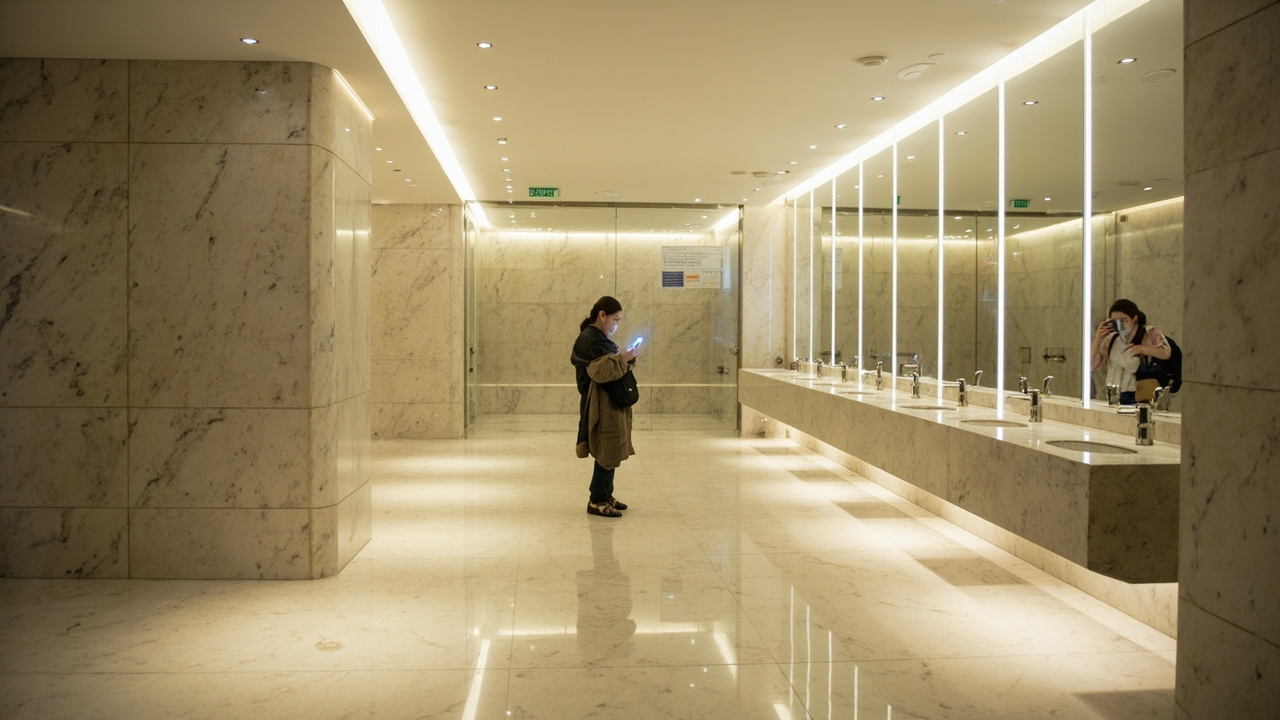
The first time I walked into a mall bathroom in Chengdu, I actually laughed out loud. Marble floors. A little sign telling me which stall was free. Soap. Paper towels. A cleaning lady who mopped the floor every ten minutes. It was cleaner than my apartment.
Shopping malls are the single most reliable toilet option in urban China. Every major city has dozens, and they’re free, well-maintained, and usually have both squat and sit-down options. The bigger chains—Wanda Plaza, Joy City, IFS, MixC—are consistently excellent. Even smaller local malls are usually fine.
📍 Location: Every major city, especially in commercial districts. In Beijing, try SKP near Dawanglu or Joy City in Xidan. In Shanghai, IAPM in Jing’an or Global Harbor in Putuo.
🎫 Entry fee: Free. No purchase required.
🕒 Opening hours: Generally 10:00 AM to 10:00 PM, matching mall hours.
🚇 How to actually get there: Take the metro to the nearest station and follow signs to the mall. In Shanghai, Line 2 to Jing’an Temple, Exit 4, walk into IAPM. In Beijing, Line 1 to Xidan, Exit F, Joy City is right there.
⏰ When to visit: Weekday mornings are quietest. Avoid weekends after 2 PM when families flood in.
💡 Insider tips for foreign visitors: The cleaning staff are usually stationed nearby, so if a stall is out of paper, just ask—they’ll hand you a roll. Many malls have a “family room” or “mother and baby room” with a changing table and sometimes a sit-down toilet, which is great if you’re traveling with kids. Don’t be shy about using the disabled stall if the others are occupied; nobody will care. If you’re lost, the mall information desk will point you in the right direction, though English may be limited—use a translation app.
I once watched a German tourist spend five minutes trying to figure out how to flush a sensor-activated toilet in a Shanghai mall. The sensor was on the wall, not the tank. He was very relieved when I pointed at it.
Metro Station Toilets — The Transit Traveler’s Best Friend
Metro toilets are a mixed bag, but they’ve gotten dramatically better in the last five years. Beijing, Shanghai, Guangzhou, and Shenzhen all have toilets inside most stations now, usually near the ticket gates or at the platform level.
I was in Beijing’s Line 10 at Guomao station last spring, and the bathroom was spotless—tiled walls, working hand dryers, the whole thing. Compare that to a station on Line 1 from 2010, which I remember as a dark, damp room with a single squat toilet and a broken door. The difference is night and day.
📍 Location: Inside metro stations in all major cities. Usually near the customer service center or at the end of the platform.
🎫 Entry fee: Free with a valid metro ticket or transit card.
🕒 Opening hours: Same as metro operating hours, roughly 5:30 AM to 11:00 PM, varying by city.
🚇 How to actually get there: Just follow the signs. In Shanghai, Line 2 to People’s Square, the toilet is near Exit 11. In Beijing, Line 4 to Xidan, look for the restroom sign near the ticket machines.
⏰ When to visit: Avoid rush hour (7:30-9:00 AM and 5:30-7:00 PM) when they get crowded and messy.
💡 Insider tips for foreign visitors: Not all stations have toilets—older lines sometimes don’t. Check the station map before you enter. Bring your own tissue; metro toilets often run out. Some stations have separate squat and sit-down stalls, so peek before you commit. If you’re using a China SIM card, you can use Amap to check which stations have facilities.
A friend of mine once got stuck in a metro toilet in Guangzhou when the automatic door malfunctioned. She had to bang on it until a station attendant came. So yeah, check that the door works before you get comfortable.
Hotel Lobby Toilets — The Polite Loophole
Here’s a secret that has saved me more times than I can count: you can walk into almost any hotel lobby in China and use the bathroom. Nobody will stop you. Nobody will ask if you’re a guest. You just walk in like you belong, find the restroom sign, and go.
I’ve done this in Beijing, Shanghai, Chengdu, Kunming, and a tiny town in Guangxi where I was the only foreigner for miles. The lobby bathrooms in four- and five-star hotels are almost always clean, stocked with paper, and have soap. Some even have cloth towels and lotion.
📍 Location: Any major hotel, especially international chains like Marriott, Hilton, Hyatt, or local luxury brands like Jinjiang.
🎫 Entry fee: Free. No questions asked.
🕒 Opening hours: 24 hours in most hotels, though lobby traffic is lighter during the day.
🚇 How to actually get there: Pick a hotel near your current location. In Beijing, the Peninsula near Wangfujing is a good bet. In Shanghai, the Fairmont Peace Hotel on the Bund. Just walk in through the main entrance and look for signs.
⏰ When to visit: Daytime is easiest. Late at night, security might be more attentive, but they still usually won’t bother you.
💡 Insider tips for foreign visitors: Dress reasonably well—not formal, but not like you just crawled out of a hiking trail. Act confident. If someone asks, say you’re meeting a friend at the bar. Most hotels have a café or restaurant on the ground floor, so it’s a plausible excuse. Avoid using hotel bathrooms during major events or weddings, when staff are more alert.
I once used the bathroom at the Ritz-Carlton in Shanghai, then sat in the lobby for twenty minutes reading a book. Nobody said a word. It’s one of the great unsung perks of traveling in China.
High-Speed Train Toilets — Surprisingly Civilized
If you’re taking a high-speed train between cities, you’re in luck. The toilets on China’s G and D trains are genuinely clean, well-maintained, and free. They’re usually a mix of squat and sit-down, with paper, soap, and running water.
I took the Beijing-Shanghai line last year and used the bathroom twice. Both times, it was cleaner than most restaurants I’ve eaten in. The attendants come through regularly to check and restock.
📍 Location: At the end of each train car, usually between carriages.
🎫 Entry fee: Free for ticketed passengers.
🕒 Opening hours: Available throughout the journey, except during station stops when they may be locked.
🚇 How to actually get there: Just walk to the end of your car. Signs are in Chinese and English.
⏰ When to visit: Avoid the first and last 20 minutes of the journey, when everyone else has the same idea.
💡 Insider tips for foreign visitors: Bring your own tissue just in case. The squat toilets on trains can be tricky if you’re not used to them, but there’s usually at least one sit-down option per train. Don’t flush paper if there’s a sign saying not to—some trains have sensitive plumbing. If the toilet is locked, it usually means the train is approaching a station; wait a few minutes.
I once saw a businessman in a suit do a full morning routine in a train bathroom—shaving, brushing his teeth, changing his shirt. He came out looking like he’d just left a spa. I was impressed.
Chain Restaurant Toilets — Buy a Coffee, Use the Bathroom
Starbucks, McDonald’s, KFC, and local chains like Heytea and Luckin Coffee almost always have clean, free toilets. You don’t technically have to buy anything, but it’s polite to grab a coffee or a snack if you’re using their facilities.
The Starbucks in Beijing’s Sanlitun is a reliable pit stop. So is any McDonald’s in a major city. The bathrooms are usually small but clean, with paper and soap.
📍 Location: Everywhere. Seriously. There are over 6,000 Starbucks in China and thousands of McDonald’s.
🎫 Entry fee: Free, but a purchase is courteous.
🕒 Opening hours: Generally 7:00 AM to 10:00 PM, varying by location.
🚇 How to actually get there: Use Amap or Baidu Maps to find the nearest one. In Shanghai, the Starbucks Reserve Roastery on Nanjing West Road is a good option.
⏰ When to visit: Mid-morning or mid-afternoon, when they’re less crowded.
💡 Insider tips for foreign visitors: The bathroom code is sometimes required—ask the cashier or check your receipt. Some smaller locations don’t have public toilets, so check before you commit. If you’re using a translation app, “洗手间在哪里?” (xǐshǒujiān zài nǎlǐ?) means “Where is the bathroom?”
I once spent an hour in a KFC in Xi’an waiting out a rainstorm, using their bathroom twice and buying a single cup of coffee. The staff didn’t care at all.
Airport Toilets — The Last Clean Stop Before Adventure
Airports in China have excellent bathrooms. Beijing Capital, Shanghai Pudong, Guangzhou Baiyun, and Chengdu Tianfu all have clean, modern facilities with both squat and sit-down options, paper, soap, and sometimes even showers.
I always use the bathroom right before boarding a domestic flight, because you never know what you’ll find at your destination.
📍 Location: Throughout the terminal, especially near gates and food courts.
🎫 Entry fee: Free.
🕒 Opening hours: 24 hours, matching airport operations.
🚇 How to actually get there: Follow the signs. In Beijing Capital, Terminal 3 has bathrooms every few hundred feet.
⏰ When to visit: Before security is usually less crowded. After security, go early—lines can get long near boarding time.
💡 Insider tips for foreign visitors: The accessible stalls are usually larger and have sit-down toilets. If you’re transferring through a Chinese airport, use the bathroom before you go through transit security, as the next one might be farther than you think. Some airports have “rest zones” with reclining chairs near the bathrooms—great for long layovers.
I once met an Australian couple in the Beijing airport bathroom who had just arrived and were visibly stressed. I gave them my spare packet of tissues and told them to buy more at a convenience store. They looked at me like I’d handed them gold.
Paid Public Toilets — When You Really Gotta Go
Standalone public toilets exist all over China, especially in older neighborhoods, parks, and tourist areas. Some are free, some charge a small fee (usually 1-2 CNY, about $0.15-$0.30). Quality varies wildly.
I’ve used paid toilets that were spotless and paid toilets that made me want to burn my shoes. It’s a gamble.
📍 Location: Street corners, parks, scenic areas, and older neighborhoods.
🎫 Entry fee: Usually 1-2 CNY ($0.15-$0.30). Some are free.
🕒 Opening hours: Generally 6:00 AM to 10:00 PM, but some are 24 hours.
🚇 How to actually get there: Look for the universal toilet sign or ask a local. In Beijing’s hutong areas, they’re marked on Amap.
⏰ When to visit: Daytime is safer and cleaner. Avoid late nights unless desperate.
💡 Insider tips for foreign visitors: Carry small bills or coins—some don’t accept mobile payment. Bring your own tissue and hand sanitizer. If the toilet looks bad, trust your instincts and find another. In tourist areas, the paid toilets near major attractions are usually better maintained than random street ones.
I once paid 1 CNY for a toilet in a Beijing hutong that had a squat toilet, no door, and a bucket of water for flushing. It was an experience. I wouldn’t recommend it unless you’re truly desperate.
Scenic Area Toilets — Better Than You’d Expect
Tourist sites in China have improved their bathrooms dramatically in the last decade. Major attractions like the Forbidden City, the Great Wall, and Zhangjiajie now have clean, free toilets with paper and soap.
Smaller sites can still be hit or miss, but the trend is positive.
📍 Location: At major attractions, usually near entrances, exits, and mid-points.
🎫 Entry fee: Free with attraction ticket, or free entirely.
🕒 Opening hours: Same as the attraction.
🚇 How to actually get there: Follow signs or ask staff. At the Great Wall’s Mutianyu section, the toilets near the cable car are the best.
⏰ When to visit: Early morning or late afternoon, before tour groups arrive.
💡 Insider tips for foreign visitors: Use the bathroom before you start hiking or exploring—you never know when the next one will be. At the Great Wall, the toilets at the base are much better than the ones on the wall itself. Bring tissue and sanitizer regardless.
I once watched a woman in high heels attempt the Great Wall in July, then spend twenty minutes looking for a bathroom. She found one, but it was a squat. She was not pleased.
Temple Toilets — Quiet, Free, and Usually Clean
Temples in China often have free public toilets, and they’re usually clean and quiet. They’re a good option if you’re sightseeing in a temple-heavy area like Beijing’s Lama Temple or Shanghai’s Jade Buddha Temple.
📍 Location: Inside or near temple grounds.
🎫 Entry fee: Free, though temple entry may cost money.
🕒 Opening hours: Temple hours, usually 8:00 AM to 5:00 PM.
🚇 How to actually get there: Follow temple signs. In Beijing, the Lama Temple has toilets near the main entrance.
⏰ When to visit: Weekday mornings are quietest.
💡 Insider tips for foreign visitors: Be respectful—these are religious sites. Don’t take photos inside the bathroom. Some temples have separate toilets for monks and visitors, so check the signs.
I once used a temple toilet in Hangzhou that had a small garden outside and a view of a bamboo grove. It was the most peaceful bathroom experience of my life.
Rural and Roadside Toilets — The Wild West
If you’re traveling outside major cities, you’ll eventually encounter a rural or roadside toilet. These are the ones that test your resolve. Some are fine. Some are a concrete trench with a bucket. Some are just… outside.
I’ve used a roadside toilet in Gansu that was a hole in the ground with a piece of cardboard for a door. I’ve also used one in Yunnan that was surprisingly clean, with a working sink and a friendly attendant who charged 1 CNY.
📍 Location: Highway rest stops, rural villages, and remote scenic areas.
🎫 Entry fee: Usually free, sometimes 1 CNY ($0.15).
🕒 Opening hours: Varies. Some are 24 hours, some close at night.
🚇 How to actually get there: You’ll find them at rest stops or ask your driver.
⏰ When to visit: Only when necessary.
💡 Insider tips for foreign visitors: Bring your own everything—tissue, sanitizer, maybe even a small pack of wet wipes. If it looks bad, it probably is. Don’t drink the water. If you’re on a guided tour, ask your guide where the next decent bathroom is.
I once met a French couple at a roadside toilet in Sichuan who had run out of tissue and were using leaves. I gave them a pack of tissues. They gave me a chocolate bar. Fair trade.
FAQ summary
Most public toilets in China are free and reasonably clean, especially in malls, metro stations, hotels, and high-speed trains. The main challenges for foreign visitors are the prevalence of squat toilets, the frequent lack of toilet paper and soap, and the need for mobile payment apps to access some facilities. Carry your own tissue and hand sanitizer, learn the squat technique, and use mall or hotel bathrooms whenever possible. Squat toilets are standard in older areas and rural regions, but sit-down toilets are common in modern buildings. Download Amap or a toilet-finder app to locate facilities, and set up Alipay or WeChat Pay before you arrive.
FAQ
Q: Are there sit-down toilets in China, or only squat toilets? A: Both exist. Sit-down toilets are standard in hotels, airports, malls, and modern restaurants. Squat toilets are still common in older neighborhoods, rural areas, and some public facilities. Most large public restrooms have at least one sit-down stall, often the accessible one.
Q: Do I need to carry toilet paper everywhere in China? A: Yes, absolutely. Many public toilets, including some in metro stations and scenic areas, don’t provide paper. Carry a small pack of tissues or a roll in your day bag at all times. You can buy tissue packets at convenience stores for about 1-2 CNY ($0.15-$0.30).
Q: How do I use a squat toilet without making a mess? A: Face the hood or the wall (whichever end has the tank or plumbing), stand with feet on the footprints, squat fully, and aim carefully. Keep your pants bunched at your knees, not around your ankles. Bring tissue and wet wipes. It gets easier with practice.
Q: Are public toilets in China free? A: Most are free, especially in malls, metro stations, airports, and chain restaurants. Some standalone street toilets and rural facilities charge 1-2 CNY ($0.15-$0.30). Bring small bills or coins just in case.
Q: What if I can’t find a toilet and I’m desperate? A: Head to the nearest shopping mall, hotel lobby, McDonald’s, KFC, or Starbucks. These are reliable and free. If you’re in a tourist area, ask a shopkeeper or use Amap to find the nearest public facility.
Q: Do Chinese toilets have soap and hand dryers? A: Sometimes, but not always. Malls, hotels, and airports usually have soap and dryers or paper towels. Metro stations, parks, and rural toilets often don’t. Carry hand sanitizer as a backup.
Q: Is it okay to use the bathroom in a hotel I’m not staying at? A: Yes, in practice. Walk in confidently, find the restroom, and use it. Nobody will stop you. This is one of the most useful tricks for travelers in China.
The Honest Wrap-up
This guide is for the traveler who wants to be prepared, not paranoid. If you’re the kind of person who needs a pristine bathroom with a bidet and lavender soap, China will challenge you. If you’re willing to carry tissues, learn the squat, and embrace a little discomfort, you’ll be fine.
It’s not for people who refuse to use anything but a sit-down toilet, or who can’t handle a bathroom without English signs. But for everyone else, China’s toilets are just another part of the adventure. My advice: pack tissues, download Amap, set up Alipay, and don’t overthink it. You’ll figure it out. Everyone does.
More guides you may like

Top 10 Bridges in China
China's bridges are engineering marvels spanning mountains, rivers, and seas. Here are 10 of the most spectacular, from ancient stone to modern steel.
8 min read

Top 10 Buddhist Sites in China
From the Leshan Giant Buddha to the Dunhuang Caves, these 10 Buddhist sites represent 2,000 years of China's spiritual heritage.
9 min read

Top 10 Day Trips from Beijing You Shouldn't Miss
Beijing is packed with history, but some of China's best experiences are just a few hours away. Here are 10 day trips that will transform your visit.
9 min read

Top 10 Hidden Gems in China Off the Beaten Path
Beyond the Great Wall and Terracotta Warriors, China has incredible hidden destinations few tourists ever reach. Here are 10 underrated gems worth the detour.
9 min read

Top 10 Markets and Shopping Streets in China
From Shanghai's Bund to Beijing's Silk Street - 10 markets where foreigners can haggle, explore, and bring home authentic Chinese goods.
9 min read

Top 10 Museums in China You Shouldn't Miss
China's museums span 5,000 years of civilization. These 10 - from the Palace Museum to Xi'an's terracotta gallery - are unmissable for culture lovers.
9 min read