
Leshan Giant Buddha Guide
TODO: Extract from article (100-160 chars)
Leshan Giant Buddha Guide
The first thing I noticed wasn’t the Buddha. It was the toenail.
I’d been shuffling down the steep stone staircase carved into the cliff for about forty minutes, wedged between a school group from Chengdu and a German couple who kept apologizing every time they bumped me, and I still couldn’t see the statue’s face. Then the path bent left, and there it was: a single toenail, roughly the size of a dinner plate, with a full-grown man standing on it for scale. That’s when I understood the numbers weren’t marketing. This thing is 71 meters (233 feet) tall. Its shoulders span 28 meters. You could park four buses across the instep of one foot.
I’ve been to a lot of big statues. Most of them are one-and-done photo stops. Leshan is different, because the Buddha isn’t sitting in a plaza somewhere — it’s carved into a river gorge, and the whole experience is about the descent, the crowd, the ferry horns echoing off the cliff, and the smell of incense mixing with diesel from the boats below. It’s a half-day that stays with you.
This guide covers everything: how to get there from Chengdu, whether to take the boat or the stairs, what it actually costs in 2026, and the timing tricks that separate a great visit from a miserable one.
Quick answer
The Leshan Giant Buddha is a 71-meter (233 ft) Tang Dynasty statue carved into a river cliff about 2.5 hours from Chengdu by high-speed rail, and it’s included in China’s 240-hour visa-free transit policy for most Western passport holders. Entry to the scenic area costs ¥80 (about $11) and the boat viewing option costs roughly ¥70-120 ($10-17) depending on the route. Go on a weekday morning in spring or autumn, arrive before 8:30 AM, and book your train ticket on the 12306 app at least two days ahead.
The Short Version
If you only read one paragraph: take an early high-speed train from Chengdu East Station, arrive at Leshan Station by 9 AM, take the boat first (you’ll see the whole Buddha in 30 minutes with zero stairs), then decide if you have the legs and patience for the 2-hour stair descent. Skip the stair queue if it’s over 90 minutes. Eat at a 跷脚牛肉 (qiāojiǎo niúròu, “cross-legged beef”) restaurant before you leave — it’s the local dish and nobody tells foreigners about it.
How I Picked These
I’ve been to Leshan four times since 2019, most recently in October 2025, and I’ve done the Buddha three different ways: the full stair descent, the ferry-only route, and once — stupidly — on a Chinese national holiday, which I do not recommend to anyone. I talked to a ticket office worker named Chen who explained why the morning slots sell out, and a boat captain who told me which side of the ferry to stand on for the best angle. Everything below is from those trips. Where I’m unsure about 2026 pricing, I’ve said so.
Comparison Table
| Rank | Option | Best For | Approx Cost (USD) | Time Needed | When to Go |
|---|---|---|---|---|---|
| 1 | Boat + Stairs combo | First-timers, full experience | $18-28 (¥130-200) | 4-5 hours | Weekday, 8-10 AM |
| 2 | Boat only | Limited mobility, tight schedule | $10-17 (¥70-120) | 2 hours | Any clear day |
| 3 | Stairs only | Budget travelers, hikers | $11 (¥80) | 3-4 hours | Weekday, early |
| 4 | Oriental Buddha Park | Families, second visit | $11 (¥80) | 2-3 hours | Any day |
| 5 | Leshan city + food tour | Foodies, repeat visitors | $15-25 (¥110-180) | Half day | Evening |
The Giant Buddha itself — why the descent matters more than the statue
I almost skipped the stairs. A guy at my hostel in Chengdu told me the queue was “three hours, maybe four,” and I figured the boat photo would be enough. I’m glad I didn’t listen.
The stair path is a narrow, single-file spiral carved into the cliff face in the Tang Dynasty, and it takes you past the Buddha’s head, shoulders, and torso at eye level. You see the drainage channels cut into the rock behind his ears — a 1,200-year-old engineering system that still keeps the statue from eroding. You see the small shrines and graffiti left by pilgrims over centuries. The Buddha’s face is visible from the top of the stairs, but his scale only lands when you’re standing at his feet, looking up.
Why it’s special: this isn’t a statue you admire from a distance. It’s a physical experience — hot, crowded, occasionally claustrophobic, and completely worth it. The Haitong monk who started the project in 713 AD reportedly gouged out his own eyes to protest funding being diverted, which tells you how seriously people took this thing.
📍 Location: Shizhong District, Leshan, Sichuan — the Lingyun Temple scenic area, on the east bank of the Min River.
🎫 Entry fee: ¥80 (about $11) for the scenic area, which includes the stairs and Lingyun Temple. Boat tickets are separate.
🕐 Opening hours: 7:30 AM to 6:30 PM in summer (April-October), 8:00 AM to 5:30 PM in winter. Last entry is 30 minutes before closing.
🚕 How to actually get there: From Chengdu East Station (成都东站), take a high-speed train to Leshan Station (乐山站) — about 1 hour, ¥54-65 ($8-9). From Leshan Station, bus 601 or a DiDi (¥30-40, $4-6) gets you to the scenic area in 25 minutes. If you’re coming from Chengdu, this is a straightforward day trip.
⏰ When to visit: Weekday mornings, April-May or September-October. Avoid Golden Week (Oct 1-7) and Chinese New Year at all costs — I made that mistake once and spent four hours in a queue.
💡 Insider tips: Buy your train ticket on the 12306 app 2-3 days ahead — morning trains sell out. Bring cash for the boat ticket office, which sometimes has card reader issues. The stairs are one-way down; once you start, you finish. Wear shoes with grip — the stone gets slick.
I met a retired teacher named Mr. Wu at the bottom of the stairs who’d been coming every year since 1985. He told me the Buddha “looks different every decade” because of the light and the river level.
The boat route — the smart first move
Here’s the thing nobody tells you: the boat is not the “lazy option.” It’s the strategic option, and I’d argue it’s mandatory for first-timers.
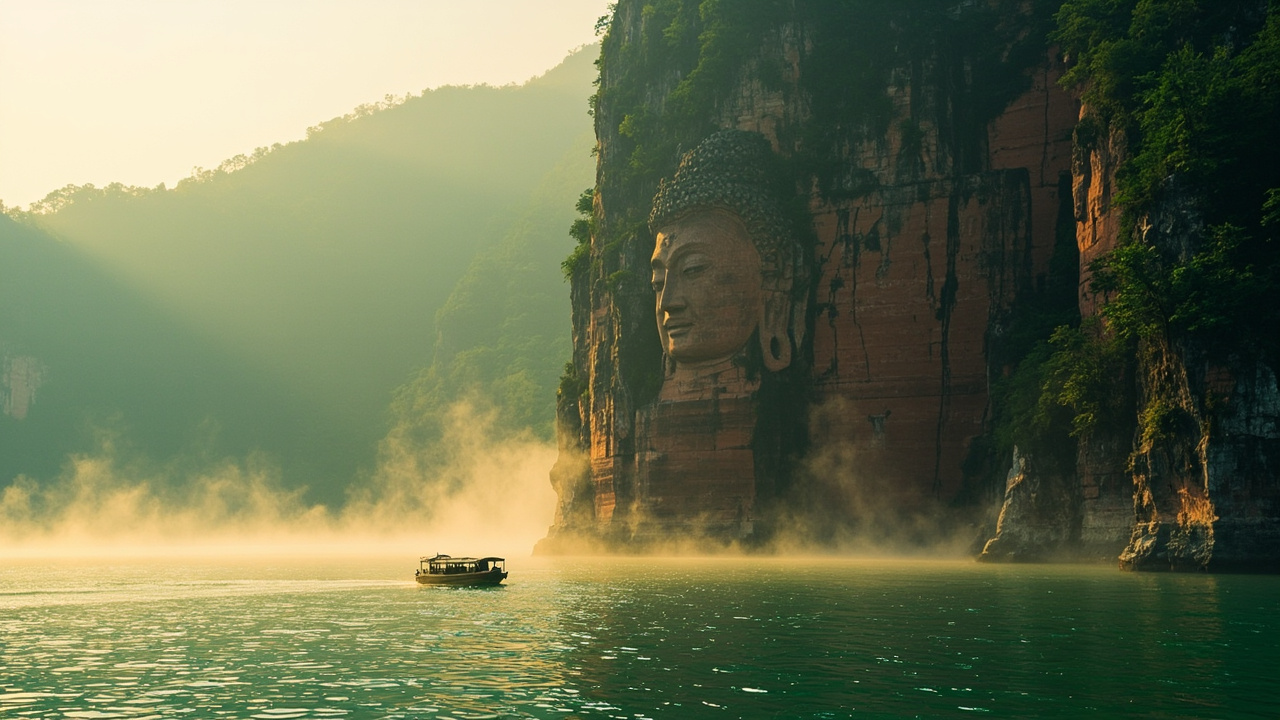
You board at the dock near the scenic area entrance, and the ferry takes you downstream, pauses directly in front of the Buddha for about 5-8 minutes, then turns around and comes back. From the water, you see the entire statue at once — head, shoulders, hands on knees, feet — plus the two 16-meter guardian figures carved into the cliff on either side. It’s the photo everyone wants.
The stairs give you intimacy. The boat gives you the whole picture. Do both.
📍 Location: Boat dock is at the south end of the scenic area, near the main ticket gate.
🎫 Entry fee: ¥70 ($10) for the standard route, ¥120 ($17) for the longer route that also passes the sleeping Buddha rock formation. Cash or WeChat Pay accepted.
🕐 Opening hours: 8:00 AM to 5:30 PM, weather permitting. Boats don’t run in heavy fog or high water.
🚕 How to actually get there: Same as above — from Leshan Station, bus 601 or DiDi. The dock is a 5-minute walk from the main gate.
⏰ When to visit: Right when you arrive, before the stair queue builds. Morning light hits the Buddha’s face best before 10 AM.
💡 Insider tips: Stand on the left side of the boat (facing forward) for the best angle — the captain will tell you, but only in Chinese. The ride is 30 minutes total. If it’s raining, boats may stop running without notice; check the ticket office before you commit.
I paid ¥20 extra once for a “VIP” boat seat and it was identical to the regular one. Don’t bother.
The stair descent — 2 hours of your life, well spent
The stairs are the reason people come back. They’re also the reason people leave angry.
The path is a narrow zigzag carved into the cliff, and it’s strictly one-way down. You enter through the head area (where the Buddha’s ears are), spiral down past his shoulders and torso, and exit at his feet. Total descent: about 1.5-2 hours if the queue moves, 3-4 hours if it doesn’t.
The problem is capacity. The path handles maybe 200 people at a time, and on busy days the queue to enter the stairs can stretch back an hour or more. On my October 2025 visit, the wait was 70 minutes at 9:15 AM — manageable. On a May Saturday in 2023, it was 3.5 hours. I left.
📍 Location: Entry point is near the Buddha’s head, at the top of the Lingyun Temple complex.
🎫 Entry fee: Included in the ¥80 ($11) scenic area ticket.
🕐 Opening hours: Same as the scenic area. The stairs close 30 minutes before the site does.
🚕 How to actually get there: Follow signs from the main gate — it’s a 15-minute uphill walk to the stair entrance.
⏰ When to visit: Arrive at the gate by 8:00 AM and go straight to the stairs before the boat. Or do the boat first and check the queue board — if it says over 90 minutes, skip it.
💡 Insider tips: The stairs are genuinely steep and narrow — no strollers, no wheelchairs, no large backpacks. There’s a free bag check near the entrance. Bring water; there’s one vendor halfway down and the markup is brutal. If you’re claustrophobic, this may not be for you.
A woman from Singapore I met in the queue told me she’d done it three times and the trick was “never on a weekend, never after 10 AM.” She was right.
Lingyun Temple — the part everyone rushes past
Most people treat Lingyun Temple as the gateway to the stairs and nothing more. That’s a mistake.
The temple sits at the top of the cliff, above the Buddha’s head, and it’s where the monk Haitong lived while the statue was being carved. It’s small, quiet, and genuinely old — parts date to the Tang Dynasty, though it’s been rebuilt several times. The incense smoke drifts down over the Buddha’s shoulders on still mornings, and if you stand at the railing behind the main hall, you get a top-down view of the statue’s head that almost nobody photographs.
I spent 40 minutes here on my last trip, mostly sitting on a stone bench watching an old woman light candles. It was the calmest part of the whole day.
📍 Location: Top of the Lingyun Hill, directly above the Buddha’s head.
🎫 Entry fee: Included in the ¥80 scenic area ticket.
🕐 Opening hours: Same as the scenic area.
🚕 How to actually get there: Follow the main path up from the entrance gate — 15 minutes of stairs.
⏰ When to visit: Either first thing (before the stair queue) or after you finish the descent, when the crowds have thinned.
💡 Insider tips: The vegetarian restaurant next to the temple serves a decent ¥30 ($4) lunch — it’s the only affordable food inside the scenic area. Don’t photograph monks without asking. The small donation box near the main hall is legitimate, not a scam.
Oriental Buddha Park — the weird, wonderful alternative
If you’ve done the main Buddha and want more, or if you’re traveling with kids who’ve hit their history limit, Oriental Buddha Park (东方佛都) is a strange and delightful place.
It’s a separate attraction next to the main scenic area, and it’s essentially a modern sculpture park full of replica Buddhas from across Asia — Thai, Tibetan, Japanese, Indian styles — arranged in caves and grottoes. It’s kitsch, it’s over the top, and I loved it. There’s a 170-meter reclining Buddha carved into a hillside that’s genuinely impressive, and the crowds are a fraction of the main site’s.
📍 Location: Adjacent to the main Leshan scenic area, same hill.
🎫 Entry fee: ¥80 ($11), separate from the main Buddha ticket.
🕐 Opening hours: 8:00 AM to 5:30 PM daily.
🚕 How to actually get there: Walk 10 minutes from the main scenic area exit, or take the same bus 601.
⏰ When to visit: Afternoon, after the main Buddha. It’s rarely crowded.
💡 Insider tips: This is a great option if the main stair queue is over 2 hours. The reclining Buddha is at the far end — most people miss it. Bring small bills for the donation boxes.
Leshan city and the food — the real reason to stay overnight
Here’s my honest take: the Buddha is a half-day. The food is why you should stay the night.
Leshan is one of Sichuan’s great food cities, and it’s criminally underrated by foreign tourists who treat it as a Chengdu day trip. The local specialty is 跷脚牛肉 (qiāojiǎo niúròu) — beef and offal simmered in a medicinal herb broth, served with a chili dipping sauce. The name means “cross-legged beef,” supposedly because the original customers ate it sitting on their heels at street stalls. A bowl costs ¥25-40 ($3.50-6). It’s incredible.
The other must-try is 甜皮鸭 (tiánpí yā), a sweet-glazed roast duck that’s crispy on the outside and sticky-sweet. Get it from a street vendor, not a restaurant.
📍 Location: The food streets cluster around Zhanggongqiao (张公桥) and Shanghe Street (上河街) in Shizhong District.
🎫 Entry fee: Free to walk around.
🕐 Opening hours: Food stalls run from about 5 PM to midnight.
🚕 How to actually get there: From Leshan Station, DiDi to Zhanggongqiao takes 20 minutes and costs ¥25 ($3.50).
⏰ When to visit: Evening, obviously. Weeknights are calmer.
💡 Insider tips: Most vendors only take WeChat Pay or Alipay — set up mobile payments before you arrive. Point at what you want; English menus are rare. The 跷脚牛肉 places near the Buddha are tourist traps — go into the city.
Getting there from Chengdu — the logistics that actually matter
The Chengdu-Leshan high-speed line is one of the easiest day trips in Sichuan, but the details trip people up.
Trains leave from Chengdu East Station (成都东站), not Chengdu Station or Chengdu South. The ride is 55-70 minutes depending on the service. Tickets cost ¥54-65 ($8-9) for second class. There are roughly 20 departures a day, starting around 6:30 AM.
You need to book on the 12306 app or at the station. The 12306 app now has an English interface and accepts foreign credit cards — this is a major 2024-2026 improvement. Bring your passport; it’s your ticket. There’s no paper ticket anymore.
📍 Location: Chengdu East Station, Chenghua District.
🎫 Entry fee: N/A.
🕐 Opening hours: Station is open 5:30 AM to midnight.
🚕 How to actually get there: Metro Line 2 or Line 7 to Chengdu East Station. Follow signs for the high-speed rail departure hall.
⏰ When to visit: Book the 7:00-8:00 AM departure window for the best arrival timing.
💡 Insider tips: Arrive at the station 45 minutes early — security lines are long. The high-speed rail system is genuinely excellent, but boarding closes 5 minutes before departure. If you miss your train, you can usually rebook same-day for a small fee.
Practical stuff — money, SIM cards, and language
Leshan is a small city, and English is not widely spoken outside the main tourist sites. Download a translation app (Google Translate works if you have a VPN; Pleco is better for Chinese) and screenshot your hotel address in Chinese.
You’ll need a working SIM and internet setup — a local SIM from China Mobile or China Unicom is easiest, and it comes with a VPN workaround for most apps. Without a VPN, Google, WhatsApp, and Instagram won’t work. WeChat and Alipay work fine either way.
Cash is still useful at small vendors and the boat ticket office. Bring ¥200-300 ($28-42) in small bills.
If you’re on the 240-hour visa-free transit, Leshan is well within the allowed region — it’s in Sichuan province, which is included.
FAQ summary
The Leshan Giant Buddha is a 71-meter Tang Dynasty statue about 2.5 hours from Chengdu by high-speed rail, costing ¥80 ($11) for the scenic area plus ¥70-120 ($10-17) for the boat. Most visitors should take the boat first for the full view, then attempt the 1.5-2 hour stair descent if the queue is under 90 minutes. Go on a weekday morning in spring or fall, arrive by 8:30 AM, and book train tickets 2-3 days ahead on the 12306 app. English is limited, so a translation app and a working SIM card are essential.
FAQ
Q: Do I need a visa to visit the Leshan Giant Buddha? A: Most Western passport holders can visit visa-free under China’s 240-hour transit policy, which covers Sichuan province. You’ll need a confirmed onward ticket to a third country. Check the current visa rules before booking, as policies change.
Q: How much does the Leshan Giant Buddha cost in total? A: Budget about $25-35 (¥180-250) per person for a day trip: ¥80 ($11) scenic area entry, ¥70-120 ($10-17) for the boat, ¥54-65 ($8-9) round-trip train from Chengdu, plus food and local transport. Overnight stays add $30-60 for a mid-range hotel.
Q: Should I take the boat or the stairs? A: Do both if you can. The boat gives you the full statue in one view and takes 30 minutes. The stairs give you the scale and take 1.5-2 hours. If you only have time for one, take the boat — it’s faster and less physically demanding.
Q: What’s the best time of year to visit? A: April-May and September-October. Avoid Chinese national holidays (especially Golden Week, Oct 1-7) when queues can hit 4 hours. Summer is hot and humid; winter is foggy and boats sometimes don’t run.
Q: Is the Leshan Giant Buddha accessible for people with limited mobility? A: The boat route is fully accessible. The stair descent is not — it’s steep, narrow, one-way, and has no elevator alternative. If stairs are a problem, stick to the boat and the temple area at the top.
Q: Can I visit as a day trip from Chengdu? A: Yes, and most people do. Take the 7:30 AM train, arrive by 9 AM, do the boat and stairs, eat lunch in Leshan, and take a 4-5 PM train back. It’s a long day but very doable.
Q: Do I need cash or can I use WeChat Pay/Alipay? A: Both work, but small vendors and the boat ticket office sometimes prefer cash. Set up WeChat Pay or Alipay before you arrive — see our payment guide — and carry ¥200-300 in small bills as backup.
The Honest Wrap-up
This guide is for first-timers who want to see the Buddha without wasting a day in a queue, and for travelers who care more about the experience than the Instagram shot. It’s not for people who want a quiet, uncrowded spiritual moment — Leshan is a major tourist site and it feels like one. If you want that, go to Beijing’s temples or the quieter corners of Sichuan instead.
My one piece of advice: don’t overthink it. Book the early train, take the boat first, and let the stairs be a bonus rather than a requirement. The Buddha has been sitting there for 1,300 years. He’s not going anywhere. You, on the other hand, will be tired, hungry, and ready for a bowl of cross-legged beef by 2 PM. Plan accordingly.
More guides you may like

Top 10 Bridges in China
China's bridges are engineering marvels spanning mountains, rivers, and seas. Here are 10 of the most spectacular, from ancient stone to modern steel.
8 min read

Top 10 Buddhist Sites in China
From the Leshan Giant Buddha to the Dunhuang Caves, these 10 Buddhist sites represent 2,000 years of China's spiritual heritage.
9 min read

Top 10 Day Trips from Beijing You Shouldn't Miss
Beijing is packed with history, but some of China's best experiences are just a few hours away. Here are 10 day trips that will transform your visit.
9 min read

Top 10 Hidden Gems in China Off the Beaten Path
Beyond the Great Wall and Terracotta Warriors, China has incredible hidden destinations few tourists ever reach. Here are 10 underrated gems worth the detour.
9 min read

Top 10 Markets and Shopping Streets in China
From Shanghai's Bund to Beijing's Silk Street - 10 markets where foreigners can haggle, explore, and bring home authentic Chinese goods.
9 min read

Top 10 Museums in China You Shouldn't Miss
China's museums span 5,000 years of civilization. These 10 - from the Palace Museum to Xi'an's terracotta gallery - are unmissable for culture lovers.
9 min read