
China Instagram Worth Places
TODO: Extract from article (100-160 chars)
The first time I tried to photograph the Bund at night, a security guard tapped my shoulder and pointed at my tripod. No tripods on the promenade after 6pm. I’d hauled that thing from a hostel in Jing’an for nothing. So I shot handheld, elbows braced on the railing, and the photo came out sharper than the tripod version ever did. That’s the thing about China’s most photogenic spots: they don’t care about your gear. They care whether you showed up at the right hour, stood in the right place, and knew which way the light was going to fall.
I’ve been based in Beijing for seven years and made more than forty trips around the country, mostly chasing images. Some of those trips were disasters. I once climbed four hours to a famous rice-terrace viewpoint in Guizhou and arrived inside a cloud. I’ve been shoved out of a “perfect” alley in Shanghai by a resident who was tired of tourists blocking her doorway. But I’ve also stood in places that genuinely stopped me, the kind of spots where you put the phone down for a minute and just look.
This guide is those places. Ten of them, ranked by how reliably they deliver a photograph worth posting, with the practical stuff that actually matters: which metro exit, what it costs, when the light is right, and the small local knowledge that separates a good shot from a wasted morning.
Quick answer
The most reliably photogenic places in China for first-time visitors are Zhangjiajie’s Avatar mountains, the Great Wall at Mutianyu, Shanghai’s Bund and Yu Garden, Guilin’s Li River karst scenery, and Chengdu’s panda base. Most Western passport holders can enter China visa-free for up to 30 days in 2026, and a full day of sightseeing plus transport and food typically runs $60–$120 (roughly 430–870 CNY) per person outside Beijing and Shanghai.
The Short Version
If you have ten days, do Beijing, Xi’an, and Shanghai by high-speed rail, then fly to Zhangjiajie or Guilin for the landscape shots. Skip the famous spots at midday. Every single one of them looks better in the two hours after sunrise or the hour before dark. Get Alipay or WeChat Pay working before you land, because almost nothing takes cash anymore, and book timed-entry tickets online the moment your dates are fixed.
How I Picked These
I didn’t use a “most beautiful places” listicle. I went, mostly on my own dime, sometimes on assignment. For each spot here I’ve visited at least twice, in different seasons, and I’ve talked to the people who actually live there: guesthouse owners, a boatman on the Li River, the woman who runs a noodle stall near the Mutianyu parking lot. I ranked them on one blunt question: if a friend flew 12 hours and had one shot at a great photo, would I send them here? Some famous places didn’t make it because they’re overcrowded, overpriced, or just don’t photograph well. A few lesser-known ones did.
Comparison Table
| Rank | Place | Best For | Approx Cost (USD) | Time Needed | When to Go |
|---|---|---|---|---|---|
| 1 | Zhangjiajie | Otherworldly mountain pillars | $60–90 (430–650 CNY) | 2–3 days | Apr–Jun, Sep–Oct |
| 2 | Great Wall (Mutianyu) | Iconic wall shots | $45–70 (330–500 CNY) | 1 day | Apr–May, Sep–Oct |
| 3 | Shanghai (Bund + Yu Garden) | Skyline + old-town contrast | $40–80 (290–580 CNY) | 2 days | Mar–May, Oct–Nov |
| 4 | Guilin / Li River | Karst river scenery | $50–90 (360–650 CNY) | 2 days | Apr–Oct |
| 5 | Chengdu Panda Base | Pandas, obviously | $25–40 (180–290 CNY) | 1 day | Year-round, mornings |
| 6 | Xi’an City Wall + Terracotta Army | History + cycling shots | $50–80 (360–580 CNY) | 2 days | Apr–May, Sep–Oct |
| 7 | Hongcun / Xidi villages | Ink-painting villages | $30–50 (220–360 CNY) | 1–2 days | Mar–Apr, Oct–Nov |
| 8 | Yuanyang Rice Terraces | Layered water mirrors | $40–70 (290–500 CNY) | 2 days | Nov–Mar |
| 9 | Harbin Ice Festival | Winter fantasy | $70–120 (500–870 CNY) | 2 days | Late Dec–Feb |
| 10 | Qinghai Lake | Vast blue high-altitude lake | $40–70 (290–500 CNY) | 2 days | Jun–Sep |
1. Zhangjiajie — The Mountains That Look Fake
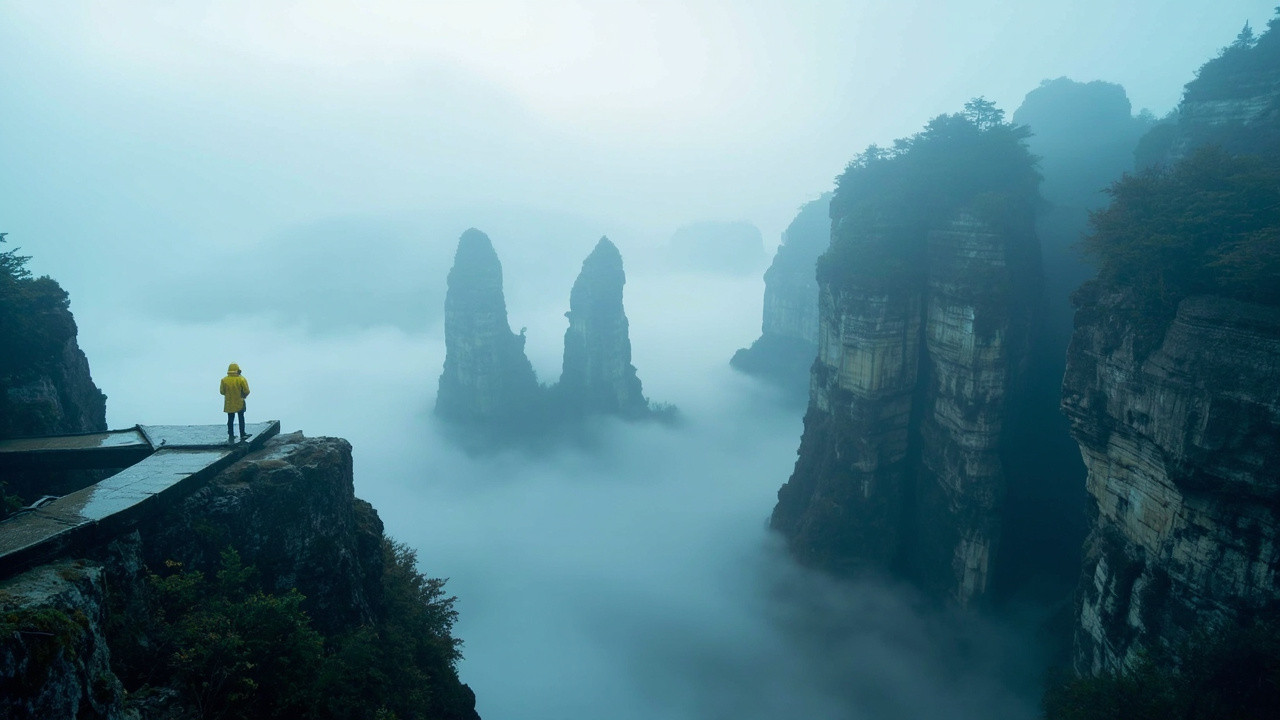
The first time I saw the pillars of Zhangjiajie emerge from the mist, I actually said “no way” out loud. A German couple next to me laughed. They’d had the same reaction. These sandstone columns rise 200 meters straight up, wreathed in cloud, and no photo quite prepares you for the scale.
This is the landscape that inspired the floating mountains in Avatar, and yes, the Chinese parks service leans into that hard. But the real draw is the Yuanjiajie and Tianzi Mountain sections, where you walk on cliff-edge paths with nothing but fog below. It’s genuinely disorienting in the best way.
📍 Location: Wulingyuan District, about 40 minutes by bus from Zhangjiajie city. 🎫 Entry: Main park ticket around $32 (230 CNY), valid four days. Cable cars and the Bailong Elevator are extra, roughly $10–20 (70–145 CNY) each. 🕐 Hours: Park gates open around 7am, close 5–6pm depending on season. 🚕 Getting there: Fly into Zhangjiajie Hehua Airport or take the high-speed rail to Zhangjiajie West. From the city, buses to the Wulingyuan gate leave from the central bus station every 20 minutes. ⏰ When to visit: April to June and September to October. Go at opening. By 10am the tour groups arrive and the cable-car queues hit an hour. 💡 Insider tips: Buy the multi-day park ticket, not single-day. Stay in Wulingyuan town, not Zhangjiajie city, so you’re at the gate before the crowds. Bring a light rain shell, the mist that makes the photos is also the mist that soaks you. Cash is nearly useless here, so sort out Alipay or WeChat Pay first.
I ate a bowl of sour fish soup at a tiny place near the Wulingyuan gate that cost about $4 (30 CNY) and was the best meal of the trip.
2. The Great Wall at Mutianyu — Skip Badaling
Everyone tells you to go to Badaling because it’s the closest. Don’t. I made that mistake on my first trip in 2019 and spent two hours shuffling behind a tour group. Mutianyu is 90 minutes from Beijing, less crowded, and the wall here is restored but still feels like a wall, not a theme park.
The trick is the toboggan. You ride a metal slide down the mountain after your walk, and it’s absurd and wonderful. I did it twice.
📍 Location: Huairou District, about 70 km northeast of central Beijing. 🎫 Entry: Around $6 (45 CNY) for the wall, plus $20 (145 CNY) round-trip cable car. Toboggan down is about $14 (100 CNY). 🕐 Hours: Roughly 7:30am–5:30pm, shorter in winter. 🚕 Getting there: No direct metro. Book a shared van or private car from Beijing, or take bus 916 from Dongzhimen to Huairou and transfer. Most visitors book a day tour, around $40–60 (290–430 CNY) including transport. ⏰ When to visit: Weekday mornings, April–May or September–October. Avoid Chinese public holidays entirely. 💡 Insider tips: Walk left from the cable-car exit for the quieter, steeper section. Bring water, the vendors on the wall charge triple. Wear grippy shoes, the steps are uneven and worn smooth. Check China’s visa-free transit rules if you’re only passing through.
A vendor near the base sold me a “I climbed the Great Wall” medal for $3 (20 CNY). I still have it.
3. Shanghai — The Bund and Yu Garden
Shanghai is the easiest city in China for a first-timer, and the photos are almost unfair. The Bund gives you the colonial-era waterfront on one side and the sci-fi Pudong skyline on the other. Yu Garden, twenty minutes away, is all curved roofs and koi ponds.
I’ve shot the Bund maybe thirty times. The move is the elevated walkway near the Peninsula Hotel at blue hour, when the towers light up and the sky goes deep blue behind them.
📍 Location: The Bund is in Huangpu District along the river; Yu Garden is in the Old City, near Yuyuan Garden metro. 🎫 Entry: The Bund is free. Yu Garden is about $6 (45 CNY). 🕐 Hours: Bund is always open. Yu Garden roughly 8:45am–4:45pm, closed Mondays sometimes. 🚕 Getting there: Metro Line 2 or 10 to East Nanjing Road, Exit 2, then walk east 10 minutes to the river. For Yu Garden, Line 10 to Yuyuan Garden, Exit 1. ⏰ When to visit: Blue hour for the Bund, right at opening for Yu Garden to dodge crowds. 💡 Insider tips: No tripods on the Bund promenade after 6pm. Get a local SIM or eSIM because Google Maps is unreliable here. Yu Garden’s teahouse is worth the $8 (60 CNY) for the view over the pond. See the full Shanghai guide for more.
I once watched a bride and groom do a full photo shoot on the Bund at 6am, completely alone. Smart couple.
4. Guilin and the Li River — The Karst Postcard
The Li River cruise from Guilin to Yangshuo is the single most photographed stretch of scenery in China, and it earns it. Limestone peaks rise straight out of the water, farmers work rice paddies on the banks, and the whole thing looks like a scroll painting come to life.
The 4-hour cruise is the classic move, but honestly the bamboo raft section near Yangshuo is where the best shots are.
📍 Location: Cruise departs from Zhujiang Pier, Guilin. Rafts run from Yangshuo’s Xingping area. 🎫 Entry: Cruise around $30–45 (220–330 CNY). Bamboo raft about $20 (145 CNY) per person. 🕐 Hours: Cruises depart mid-morning, rafts run daylight hours. 🚕 Getting there: High-speed rail to Guilin or Yangshuo station, then taxi to the pier. From Yangshuo, buses to Xingping take 45 minutes. ⏰ When to visit: April to October, early morning for the mist that makes the peaks glow. 💡 Insider tips: Sit on the right side of the cruise boat heading downstream. The 20-yuan note features this exact scenery, a fun photo to recreate. Xingping’s viewpoint requires a short, steep hike, worth it. Bring mosquito repellent in summer.
A boatman named Lao Chen told me the mist is best after rain, and he was right.
5. Chengdu Panda Base — Go at Feeding Time
I’m not a panda person. Or I wasn’t. Then I watched a cub tumble off a log at the Chengdu Research Base and I understood the obsession. The base is genuinely well-run, and the pandas are active in the cool morning hours.
📍 Location: Chenghua District, about 30 minutes northeast of central Chengdu. 🎫 Entry: Around $8 (55 CNY). Cub nursery costs extra. 🕐 Hours: 7:30am–6pm, but pandas nap by 11am. Go early. 🚕 Getting there: Metro Line 3 to Panda Avenue, then a shuttle bus. Or a 30-minute taxi from downtown. ⏰ When to visit: Arrive at opening, year-round. Avoid weekends. 💡 Insider tips: Feedings are around 8–9am, when they’re most active. The red panda section is quieter and underrated. Book tickets online in advance, they cap daily entries. See the Chengdu guide for the rest of the city.
I paid $2 (15 CNY) for a panda-shaped steamed bun outside the gate and regret nothing.
6. Xi’an — City Wall and Terracotta Army
Xi’an is where China’s history gets heavy. The Terracotta Army is the headline, but the 600-year-old City Wall is the better photo. You rent a bike and cycle the full 14 km loop at sunset, with the old town glowing below.
The Terracotta Army itself is impressive but crowded and dimly lit. The pit is huge, the warriors are real, but photographically it’s a challenge. The wall wins.
📍 Location: City Wall circles the old town center; Terracotta Army is 40 km east in Lintong. 🎫 Entry: Wall about $8 (55 CNY), bike rental $6 (45 CNY) for two hours. Terracotta Army about $17 (120 CNY). 🕐 Hours: Wall roughly 8am–10pm. Army site 8:30am–5pm. 🚕 Getting there: Metro Line 2 to Yongningmen for the wall. For the army, bus 306 from Xi’an railway station, about an hour. ⏰ When to visit: Wall at sunset, army right at opening. 💡 Insider tips: Rent the bike, don’t walk, the loop is long. The army site has three pits, see Pit 1 last, it’s the biggest. Bring your passport, it’s your ticket.
I cycled the wall at dusk and a local kid raced me on his bike for a full kilometer.
7. Hongcun and Xidi — The Ink-Painting Villages
These two UNESCO villages in Anhui province are the reason Chinese landscape paintings look the way they do. Whitewashed walls, black-tiled roofs, a crescent pond, and mountains behind. Hongcun is the more famous, Xidi the quieter.
📍 Location: Yi County, Anhui province, near Huangshan. 🎫 Entry: Hongcun about $15 (110 CNY), Xidi about $12 (90 CNY). 🕐 Hours: Daylight hours, roughly 7:30am–5:30pm. 🚕 Getting there: High-speed rail to Huangshan North, then bus or taxi, about 1 hour. ⏰ When to visit: March–April or October–November, early morning for mist over the pond. 💡 Insider tips: Stay overnight, the day-trippers leave by 5pm and the village empties. The Moon Pond in Hongcun is the classic shot. Bring cash for small vendors.
An old woman sold me tea in her courtyard and refused to let me pay full price.
8. Yuanyang Rice Terraces — Water Mirrors at Dawn
The Hani rice terraces in Yunnan turn into thousands of reflecting pools in winter, and sunrise here is one of the best light shows in Asia. It’s remote, high-altitude, and worth every bumpy bus ride.
📍 Location: Yuanyang County, southern Yunnan, near the Vietnam border. 🎫 Entry: Around $10–15 (70–110 CNY) for the scenic area. 🕐 Hours: Viewpoints open before dawn for sunrise. 🚕 Getting there: Fly to Kunming, then a 6-hour bus to Yuanyang, then local transport to viewpoints. ⏰ When to visit: November to March, when the terraces are flooded. 💡 Insider tips: Duoyishu is the sunrise viewpoint, Bada the sunset one. It’s cold at dawn, bring layers. Altitude is around 1,800m, take it easy.
I watched the sun rise here with a French photographer who’d come three years in a row.
9. Harbin Ice Festival — Winter Fantasy Land
Every winter, Harbin builds a city out of ice and lights it up in neon. It’s kitsch, it’s freezing, and it’s spectacular. Temperatures hit -20°C (-4°F), so dress like you mean it.
📍 Location: Sun Island and Zhaolin Park areas, Harbin, Heilongjiang. 🎫 Entry: Main Ice and Snow World around $45–60 (330–430 CNY). 🕐 Hours: Evenings are best, roughly 11am–9pm. 🚕 Getting there: Fly or high-speed rail to Harbin, then taxi to the festival sites. ⏰ When to visit: Late December to February. 💡 Insider tips: Go at night for the lights. Hand warmers are essential. The ice slides are worth the queue.
My phone battery died in 10 minutes flat. Keep it in an inside pocket.
10. Qinghai Lake — The Blue That Goes On Forever
Qinghai Lake is the largest lake in China, a vast high-altitude blue ringed by mountains and grassland. It’s a place that makes you quiet. In summer, the rapeseed fields bloom yellow against the water and the contrast is almost too much.
📍 Location: Qinghai province, about 2 hours west of Xining. 🎫 Entry: Around $15 (110 CNY) for main scenic areas. 🕐 Hours: Daylight hours, seasonal closures in deep winter. 🚕 Getting there: Fly or train to Xining, then a bus or chartered car. ⏰ When to visit: June to September, rapeseed blooms in July. 💡 Insider tips: Altitude is 3,200m, acclimatize in Xining first. The lake is huge, pick one section, don’t try to circle it. Bring sun protection, the UV is fierce.
I sat by the shore for an hour without taking a single photo. Sometimes that’s the point.
FAQ summary
The most Instagram-worthy places in China are Zhangjiajie, the Great Wall at Mutianyu, Shanghai’s Bund, Guilin’s Li River, and Chengdu’s panda base, with Harbin and Yuanyang as seasonal standouts. Most Western visitors can enter China visa-free for up to 30 days in 2026, and a typical day of sightseeing costs $60–$120 (430–870 CNY) per person. Book timed-entry tickets online in advance, get Alipay or WeChat Pay working before you arrive, and shoot every major spot at sunrise or blue hour to avoid crowds and bad light.
FAQ
Q: Do I need a visa to visit China in 2026? A: Most Western passport holders, including US, UK, and EU citizens, can enter China visa-free for up to 30 days as of 2026. Check the latest rules before booking, since policies change, and see the visa guide for details.
Q: How much does a China trip cost per day? A: Budget $60–$120 (430–870 CNY) per person per day for accommodation, food, transport, and entry fees outside Beijing and Shanghai. Beijing and Shanghai run higher, closer to $100–$150 (720–1,080 CNY).
Q: Can I use my phone and Google Maps in China? A: Google services are blocked, so you’ll need a VPN set up before you arrive, or use local apps like Amap and Baidu Maps. Get a local SIM or eSIM for data, and see the internet guide.
Q: Do I need cash in China? A: Almost no. Alipay and WeChat Pay are accepted everywhere, and you can link an international card. Carry a little cash, around $30 (220 CNY), for small vendors in rural areas.
Q: What’s the best time of year to visit China for photos? A: Spring (April–May) and autumn (September–October) give the best light and weather across most of the country. Winter is best for Harbin and Yuanyang, summer for Qinghai Lake.
Q: Is English widely spoken at these places? A: In Beijing, Shanghai, and major tourist sites, some English is spoken, but outside those areas it’s limited. Download a translation app like Pleco or Google Translate offline before you go.
Q: How do I book tickets for popular sites like Zhangjiajie and the panda base? A: Book online in advance through official WeChat mini-programs or platforms like Trip.com. Many sites cap daily entries, especially in peak season, so reserve as soon as your dates are set.
The Honest Wrap-up
This list is for the traveler who wants photos that actually look like the place, not a filtered version of it. It’s not for someone who wants a relaxed, unstructured trip, because half these spots demand early starts and long transfers. If you hate crowds and planning, stick to Shanghai and Chengdu. If you’re chasing the shots, do the work: book ahead, wake up early, and learn to use Alipay before you land. One last thing. Put the phone down for a minute at each place. The best photo you’ll remember is the one you didn’t take.
More guides you may like
Top 10 Bridges in China
China's bridges are engineering marvels spanning mountains, rivers, and seas. Here are 10 of the most spectacular, from ancient stone to modern steel.
8 min read

Top 10 Buddhist Sites in China
From the Leshan Giant Buddha to the Dunhuang Caves, these 10 Buddhist sites represent 2,000 years of China's spiritual heritage.
9 min read
Top 10 Day Trips from Beijing You Shouldn't Miss
Beijing is packed with history, but some of China's best experiences are just a few hours away. Here are 10 day trips that will transform your visit.
9 min read
Top 10 Hidden Gems in China Off the Beaten Path
Beyond the Great Wall and Terracotta Warriors, China has incredible hidden destinations few tourists ever reach. Here are 10 underrated gems worth the detour.
9 min read
Top 10 Markets and Shopping Streets in China
From Shanghai's Bund to Beijing's Silk Street - 10 markets where foreigners can haggle, explore, and bring home authentic Chinese goods.
9 min read
Top 10 Museums in China You Shouldn't Miss
China's museums span 5,000 years of civilization. These 10 - from the Palace Museum to Xi'an's terracotta gallery - are unmissable for culture lovers.
9 min read