
Gansu Travel Guide
TODO: Extract from article (100-160 chars)
Gansu Travel Guide
The old man at the noodle stall in Lanzhou handed me a bowl of beef noodles at 7:15 in the morning and pointed at the chili oil. I dumped in two spoonfuls. He shook his head, took the spoon back, and added three more. Then he stood there watching until I took the first bite. That’s Lanzhou. That’s Gansu, honestly — a province that doesn’t coddle you but feeds you like family and expects you to keep up.
Gansu is the long, skinny province that stretches across China’s northwest like a stretched arm, from the edge of Inner Mongolia down toward the Tibetan Plateau. Most first-time visitors skip it entirely. They fly to Beijing, take the train to Xi’an, then head to Shanghai or Chengdu. Gansu sits in the middle of that map and gets ignored.
That’s a mistake. This is the province where the Silk Road actually happened — not the tourist version, the real one. The Hexi Corridor, the string of oasis towns that traders used for 2,000 years, runs right through it. You get Buddhist cave art that predates most of what you’ll see in Europe, desert dunes you can sled down, a Tibetan monastery town at 9,500 feet, and the best bowl of noodles in China for about a dollar.
I’ve been through Gansu four times now, most recently in October 2025. This guide is what I’d tell a friend who’s never been to China and is thinking about adding it to their itinerary.
Quick answer
Gansu is best visited between May and October, with September and October offering the best weather and fewest crowds. Most foreign visitors can enter China visa-free for up to 30 days under the current policy (check your nationality), and Gansu is fully connected by high-speed rail — Lanzhou to Dunhuang takes about 7 hours on the D-class train. Budget around $60–90 per day (430–650 CNY) for mid-range travel including hotels, food, and transport.
The Short Version
If you only have one week in Gansu, do this: fly into Lanzhou, eat the noodles, take the train to Zhangye for the rainbow mountains, then continue to Dunhuang for the Mogao Caves and the dunes. Skip Jiayuguan unless you’re a fortress nerd. Bring cash backup because some small restaurants still don’t take foreign cards, and set up Alipay and WeChat Pay before you land. The province is huge — don’t try to do it in five days.
How I Picked These
I’ve been through Gansu four times since 2019, twice solo and twice with a friend who speaks better Mandarin than I do. I don’t rank places by Instagram potential. I rank them by whether I’d go back, whether the logistics actually work for a foreigner without a Chinese friend holding your hand, and whether the experience justifies the travel time. Some famous spots got cut — I think the Jiayuguan fortress is overrated for the effort, and I’ll say so below. Some smaller places made it because a local told me about them and they delivered. Everything here I’ve either visited myself or vetted with people who live there.
Comparison Table
| Rank | Place | Best For | Approx Cost (USD) | Time Needed | When to Go |
|---|---|---|---|---|---|
| 1 | Dunhuang (Mogao Caves + dunes) | Silk Road history, desert | $120–180 | 3 days | Sep–Oct |
| 2 | Lanzhou | Food, gateway city | $40–70 | 1–2 days | Apr–Oct |
| 3 | Zhangye | Rainbow mountains, Danxia | $60–100 | 1–2 days | Jun–Sep |
| 4 | Xiahe (Labrang Monastery) | Tibetan culture | $70–110 | 2 days | Jun–Sep |
| 5 | Jiayuguan | Great Wall fortress | $50–80 | 1 day | May–Oct |
| 6 | Langmusi | Hiking, monastery town | $50–90 | 2 days | Jun–Sep |
| 7 | Maijishan Grottoes | Buddhist cave art | $40–60 | 1 day | Apr–Oct |
| 8 | Kongtong Mountain | Taoist temples, hiking | $40–70 | 1 day | May–Oct |
| 9 | Gannan grasslands | Nomad scenery | $50–80 | 1–2 days | Jul–Aug |
| 10 | Yellow River Stone Forest | Geological oddity | $50–80 | 1 day | May–Oct |
Dunhuang — Where the Silk Road Actually Feels Real
I stood in front of Cave 96 at Mogao at 8:40 in the morning, before the tour groups arrived, and the giant Buddha inside was still half in shadow. The guide whispered. Nobody took photos because you can’t. That silence is the whole point.
Dunhuang is the reason most people come to Gansu, and it earns it. The Mogao Caves hold 735 painted caves carved between the 4th and 14th centuries, and you only get to see 8 of them on a standard ticket. That sounds like a rip-off until you realize each cave is a painted chapel that’s survived 1,000+ years of desert wind. The nearby Mingsha Shan dunes are the postcard image — crescent-shaped sand hills with a small lake at the bottom.
📍 Location: Dunhuang is in far western Gansu, about 7 hours by high-speed train from Lanzhou. The caves are 25 km southeast of the city center; the dunes are just south of town.
🎫 Entry fee: Mogao Caves standard ticket is about $33 (238 CNY) in peak season, $20 (140 CNY) off-season. You must book online in advance — tickets sell out 1–2 weeks ahead in summer. Mingsha Shan dunes are $17 (120 CNY).
🕐 Opening hours: Mogao runs 8:00–18:00 in peak season (May–Oct), 9:00–17:30 off-season. Closed some Mondays for maintenance — check the official site.
🚕 How to actually get there: Fly into Dunhuang Mogao International Airport (DNH) from Lanzhou, Xi’an, or Beijing. Or take the D-class train from Lanzhou West Station — around 7 hours, $40–55 (290–400 CNY) second class. From Dunhuang city, take bus 12 to the Mogao Caves or a taxi for about $8 (60 CNY).
⏰ When to visit: September and October are perfect — warm days, cool nights, no sandstorms. July and August are brutally hot and crowded. Winter is cold but the caves are nearly empty.
💡 Insider tips: Book Mogao tickets on the official WeChat mini-program at least 10 days out. The English tour is worth it — the Chinese tour moves too fast. Bring a scarf for the dunes; the sand gets into everything. The night market on Shazhou Night Market street has good grilled lamb skewers for about $1 each (7 CNY). Cash still works at some stalls, but set up Alipay before you come.
I paid a taxi driver named Ma 80 CNY to wait for me at the dunes while I watched the sunset, and he refused to take more even though I offered. He just pointed at the sky and said “mei” — beautiful.
Lanzhou — The City That Exists for One Bowl of Noodles
The first time I ordered beef noodles in Lanzhou, I asked for “small.” The woman behind the counter laughed and gave me a regular bowl anyway. It cost 8 CNY. I ate the whole thing and ordered another.
Lanzhou is not a pretty city. It’s an industrial river town wedged between mountains, and the air in winter is rough. But it’s the gateway to everything else in Gansu, and it has the single best regional dish in China — Lanzhou beef noodles (兰州牛肉面). The broth is clear, the beef is paper-thin, the noodles are pulled to order, and the chili oil is non-negotiable. Locals eat it for breakfast, usually before 9 AM.
📍 Location: Lanzhou is the capital, in central Gansu on the Yellow River. The main noodle shops cluster around the Chengguan district and near the train station.
🎫 Entry fee: Free to wander. The Gansu Provincial Museum is free with ID/passport (book online). The Yellow River Mother statue and Zhongshan Bridge are free.
🕐 Opening hours: Noodle shops open around 6:30 AM and close when the broth runs out, usually by 2 PM. The museum is 9:00–17:00, closed Mondays.
🚕 How to actually get there: Lanzhou Zhongchuan Airport (LHW) has direct flights from Beijing, Shanghai, Chengdu, and Xi’an. The high-speed rail station is Lanzhou West — high-speed trains connect to Xi’an in 3 hours, Zhangye in 4.5 hours, Dunhuang in 7 hours. From the airport, the airport express train runs to Lanzhou Station every 30 minutes for $3 (20 CNY).
⏰ When to visit: April through October. Winter air quality is bad and it’s cold. Go for breakfast — the noodle shops are the whole point.
💡 Insider tips: The best shops are the ones with a line of locals at 7 AM. Try “Maanpull” (马安坡) or “Wu Mu Le” (吾穆勒) — both near the city center. Ask for “er xi” (二细) noodles if you want medium thickness. Add vinegar, not just chili. The Gansu Provincial Museum has the famous “Flying Horse of Gansu” bronze — worth 90 minutes. English is limited; download a translation app before you arrive.
I watched a man in a suit eat three bowls in a row at 7:30 AM, check his phone, and then order a fourth. That’s Lanzhou.
Zhangye — The Rainbow Mountains Are Not Photoshopped
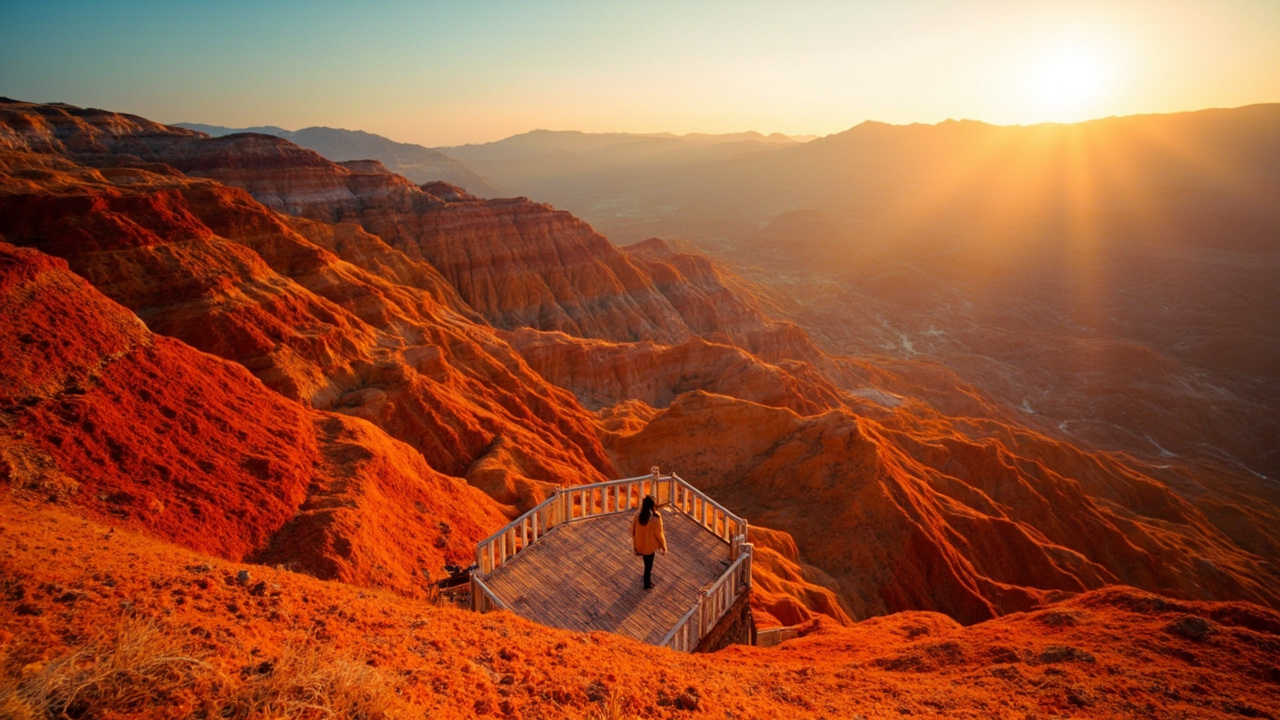
I’ll be honest: I expected the Zhangye Danxia landform to be a letdown. The photos online look oversaturated, like someone cranked the contrast slider. Then I saw it at 5 PM with the sun at a low angle, and the stripes were genuinely that red, that orange, that yellow. It’s real.
The Danxia National Geopark is a series of striped sandstone hills that formed over 24 million years. There are four viewing platforms connected by shuttle buses, and the fourth one is the best. Most tour groups rush through in 90 minutes. Give it three hours and stay for sunset.
📍 Location: About 40 km west of Zhangye city in Gansu’s Hexi Corridor. The park has two entrances — the west gate is less crowded.
🎫 Entry fee: $10 (75 CNY) for the park plus $3 (20 CNY) for the shuttle bus.
🕐 Opening hours: 6:00–18:00 in summer, 7:30–17:00 in winter. Last shuttle up is 90 minutes before closing.
🚕 How to actually get there: Zhangye has a high-speed rail station (Zhangye West) with trains from Lanzhou (4.5 hours, $35 / 250 CNY) and Dunhuang (3 hours, $25 / 180 CNY). From Zhangye West, take a taxi to the park for about $15 (110 CNY) each way, or join a shared minibus from the bus station for $8 (55 CNY).
⏰ When to visit: June through September for the best light. Avoid midday — the colors wash out. Sunset is the money shot. Weekdays are noticeably quieter.
💡 Insider tips: The park is at 1,500m elevation, so bring a layer even in summer. The shuttle stops at four platforms in order; get off at every one, but spend the most time at platform 4. There’s a separate “Binggou” scenic area nearby that’s less famous but has better hiking. Bring your passport — you need it to buy tickets. The nearby Zhangye Giant Buddha Temple in the city is worth an hour and costs $6 (40 CNY).
I met a retired couple from Guangzhou at platform 4 who had driven 2,000 km to see this. The wife told me, in slow Mandarin, “Photos don’t work. You have to stand here.” She was right.
Xiahe — Tibetan Gansu, 9,500 Feet Up
The morning prayer at Labrang Monastery starts at 6:30 AM, and if you stand outside the main hall you can hear 600 monks chanting at once. It’s a low, rolling sound that vibrates through the wooden floor. I stayed for 40 minutes and didn’t understand a word.
Xiahe is a small Tibetan town in southern Gansu, technically in the Gannan Tibetan Autonomous Prefecture. It’s home to Labrang Monastery, one of the six great monasteries of the Gelug school of Tibetan Buddhism. The town feels more like Tibet than most of the Tibet Autonomous Region does — pilgrims in traditional dress, butter lamps, prayer wheels, and yak butter tea that tastes like salty soup.
📍 Location: Xiahe is 4 hours by bus from Lanzhou, in the Gannan prefecture near the Tibetan Plateau.
🎫 Entry fee: Labrang Monastery entry is $5 (40 CNY) for foreigners, plus $10 (70 CNY) for a guided tour (required for foreigners in some areas). The surrounding kora (pilgrimage circuit) is free.
🕐 Opening hours: Monastery grounds open 6:00–18:00. The morning prayer is 6:30–8:00. Tour times vary — check at the entrance.
🚕 How to actually get there: There’s no train. Take a bus from Lanzhou South Bus Station — 4 hours, $12 (85 CNY). Or fly to Gannan Xiahe Airport (GXH) from Lanzhou or Xi’an. From the bus station in Xiahe, walk 15 minutes to the monastery.
⏰ When to visit: June through September. The altitude is 2,900m (9,500 ft), so give yourself a day to acclimatize. The Labrang Monlam Festival in February is spectacular but freezing.
💡 Insider tips: Walk the kora clockwise — going counterclockwise is disrespectful. Don’t photograph monks without asking. The yak butter tea at the small teahouses near the monastery is an acquired taste; try it once. Bring cash — ATMs are limited. Altitude sickness is real; drink water and don’t rush.
An old monk stopped me on the kora and asked where I was from. When I said “America,” he smiled and said “Obama.” Then he kept walking. That was the whole conversation.
Jiayuguan — The Fortress at the End of the Wall
Here’s my honest take: Jiayuguan Fort is impressive in a textbook way, but the experience is thin. You walk through a reconstructed Ming dynasty fortress, read some plaques, take photos of the desert, and leave. It’s not bad. It’s just not worth a special trip.
That said, if you’re already on the train between Zhangye and Dunhuang, it’s a 3-hour stop and the fortress is genuinely the westernmost major pass of the Ming Great Wall. The “Overhanging Great Wall” section nearby is a steep 20-minute climb with good views.
📍 Location: Jiayuguan city, western Gansu, on the Hexi Corridor between Zhangye and Dunhuang.
🎫 Entry fee: $17 (120 CNY) combined ticket for the fortress and Overhanging Great Wall. The Great Wall Museum is free.
🕐 Opening hours: 8:30–18:00 in summer, 9:00–17:00 in winter.
🚕 How to actually get there: Jiayuguan South Station is on the high-speed line — 2 hours from Zhangye, 3.5 hours from Dunhuang. From the station, taxi to the fortress is about $10 (70 CNY).
⏰ When to visit: May through October. Summer afternoons are brutally hot with no shade.
💡 Insider tips: The fortress is more interesting if you read up on the Ming dynasty’s western frontier first. The Overhanging Great Wall is a better photo than the fortress itself. Skip the “Jiayuguan” tourist street outside the fortress — it’s a fake. If you’re short on time, skip Jiayuguan entirely and spend the extra day in Dunhuang.
I paid a taxi driver 100 CNY to take me to both sites and wait. He fell asleep in the car while I climbed the wall. Fair enough.
Langmusi — The Monastery Town Nobody Talks About
Langmusi is a tiny town straddling the Gansu-Sichuan border, with two monasteries, one on each side, and a sky burial site on the hill above. It’s the kind of place where you walk out of your guesthouse and a horse wanders past.
I came here because a Tibetan guesthouse owner in Xiahe told me to. I stayed three nights instead of one. The hiking around Langmusi is the real draw — you can walk up to the sky burial site (respectfully, from a distance) or do a full-day loop through the grasslands. The town itself has maybe 3,000 people and shuts down by 9 PM.
📍 Location: Langmusi is in Gannan prefecture, about 3 hours south of Xiahe by bus, right on the Sichuan border.
🎫 Entry fee: Free to walk around. The two monasteries charge about $4 (30 CNY) each for entry.
🕐 Opening hours: Monasteries open around 7:00 and close at dusk. The town has no real “hours.”
🚕 How to actually get there: Bus from Xiahe (3 hours, $10 / 70 CNY) or from Hezuo (2 hours, $7 / 50 CNY). No train. Roads are winding and can be slow in rain.
⏰ When to visit: June through September. July and August are greenest. Winter is snowed in and many guesthouses close.
💡 Insider tips: Bring cash — there are no ATMs that work with foreign cards. Guesthouses are basic; expect shared bathrooms. Don’t photograph the sky burial site — it’s a real funeral practice, not a tourist attraction. The local yogurt with honey is excellent. Altitude is 3,300m (10,800 ft), higher than Xiahe.
I ate breakfast with a French couple who had been traveling for 14 months. They said Langmusi was their favorite place in China. I don’t know if I’d go that far, but I understood the impulse.
Maijishan Grottoes — The Caves on a Cliff
Maijishan is a 142-meter-high cliff covered in 194 caves carved between the 4th and 19th centuries, with Buddha statues and painted murals. The walkways up the cliff are narrow and steep, and if you’re afraid of heights, this will test you.
It’s less famous than Mogao, less crowded, and honestly the setting is more dramatic — the caves are stacked vertically on a sheer rock face, and you climb wooden staircases between them. The statues are mostly clay, which is unusual, and many are remarkably well-preserved.
📍 Location: About 45 km southeast of Tianshui city, in southeastern Gansu.
🎫 Entry fee: $12 (90 CNY) for the main caves, plus $15 (110 CNY) for the special caves (worth it).
🕐 Opening hours: 8:00–17:30 in summer, 8:30–17:00 in winter. Closed some Mondays.
🚕 How to actually get there: Take the high-speed train to Tianshui South Station (from Lanzhou, 1.5 hours, $15 / 110 CNY). From Tianshui, bus 34 goes to Maijishan in about an hour, or a taxi costs $20 (140 CNY).
⏰ When to visit: April through October. Summer weekends are busy with domestic tourists.
💡 Insider tips: The special caves require a separate ticket and a guide — book at the entrance. Wear shoes with grip; the staircases are steep and sometimes wet. The walkways are one-way in places, so don’t rush. There’s a small vegetarian restaurant at the base that’s decent. English signage is limited.
I watched a woman in heels climb the entire cliff. I have no idea how she did it. I was gripping the railing the whole way.
Kongtong Mountain — Taoist Temples in the Clouds
Kongtong Mountain is a Taoist holy site with temples built into cliff faces, connected by narrow stone staircases. It’s less famous than the Buddhist caves, but the vibe is completely different — quieter, more mysterious, and the fog rolls in and out all day.
The main temple complex is at the top, reached by a cable car or a 90-minute hike. The “Imperial City” temple is the highlight, built into a natural arch in the rock. It’s the kind of place where you turn a corner and there’s a 500-year-old pavilion hanging over a 300-meter drop.
📍 Location: About 12 km west of Pingliang city, eastern Gansu.
🎫 Entry fee: $16 (110 CNY) entry, plus $8 (55 CNY) for the cable car each way.
🕐 Opening hours: 7:00–18:00 in summer, 8:00–17:00 in winter.
🚕 How to actually get there: High-speed train to Pingliang Station (from Lanzhou, 3 hours, $30 / 220 CNY). From Pingliang, bus 13 goes to the mountain entrance in 30 minutes, or a taxi is $8 (55 CNY).
⏰ When to visit: May through October. Avoid rainy days — the staircases get slippery. Weekday mornings are quiet.
💡 Insider tips: The hike from the base to the top is steep but doable in 90 minutes if you’re reasonably fit. Bring water — there are few vendors. The Taoist monks are used to visitors but don’t love being photographed. The “Tower of the Immortals” at the top has the best view. English is almost nonexistent here; bring a translation app.
An old Taoist caretaker at the Imperial City temple gave me a cup of tea and pointed at the fog. “Wait,” he said. Ten minutes later the fog cleared and I could see the whole valley. Then it rolled back in.
Gannan Grasslands — Nomad Country
The Gannan grasslands are high-altitude pastures dotted with yaks, nomad tents, and the occasional monastery. Driving through them in July, the grass is green, the sky is enormous, and you’ll pass more yaks than cars.
This isn’t a “destination” with a ticket booth. It’s a region you drive through, ideally between Xiahe and Langmusi or between Hezuo and the Sichuan border. The best experiences are stopping at a nomad tent for yogurt and butter tea, or just pulling over to watch the light change.
📍 Location: Gannan Tibetan Autonomous Prefecture, southern Gansu, roughly between Hezuo, Xiahe, and Langmusi.
🎫 Entry fee: Free. Nomad tent visits usually involve buying tea or yogurt, about $3–5 (20–35 CNY).
🕐 Opening hours: Daylight hours. Nomads are out with the herds from early morning.
🚕 How to actually get there: Hire a car and driver from Xiahe or Hezuo for the day — about $60–80 (430–570 CNY). Or take a long-distance bus and get off at a small town.
⏰ When to visit: July and August only. The rest of the year it’s brown, cold, and often snowed in.
💡 Insider tips: Don’t drive yourself unless you’re comfortable with mountain roads and yaks crossing randomly. Bring cash for nomad tents. Ask before photographing people. The altitude is 3,000m+, so pace yourself. The butter tea is salty — it’s supposed to be.
I sat in a nomad tent with a family who spoke no Mandarin and no English. We communicated by pointing at things and nodding. They gave me yogurt with sugar. I gave them a pack of gum. Everybody was happy.
Yellow River Stone Forest — The Weird One
The Yellow River Stone Forest is a landscape of towering rock formations carved by the river over millions of years. It looks like a smaller, stranger version of Zhangjiajie, except almost no foreign tourists go there. I saw zero other Westerners in a full day.
You take a boat down the river between the rock walls, then walk a loop through the formations. Some of the rocks have names like “Camel Peak” and “General’s Stone.” It’s a bit kitschy but the geology is genuinely striking.
📍 Location: About 70 km north of Lanzhou, in Jingtai County.
🎫 Entry fee: $8 (55 CNY) entry, plus $12 (85 CNY) for the boat.
🕐 Opening hours: 8:00–18:00, roughly. Hours vary by season.
🚕 How to actually get there: From Lanzhou, take a bus to Jingtai (2 hours, $8 / 55 CNY), then a taxi to the site ($15 / 110 CNY). Or hire a car for the day from Lanzhou for about $70 (500 CNY).
⏰ When to visit: May through October. The boat doesn’t run in winter.
💡 Insider tips: The boat is the best part — don’t skip it. Bring sun protection; there’s no shade. The site is remote and English is nonexistent. Pack snacks and water. If you’re short on time in Gansu, this is the one to cut.
I got lost on the way back and ended up in a village where a woman sold me a bag of dried jujubes for 5 CNY. Best snack of the trip.
FAQ summary
Gansu is a large, dry northwestern province best visited May–October, with September and October offering the best combination of weather and manageable crowds. Most foreign visitors can enter China visa-free for up to 30 days under the current policy, and the province is well-connected by high-speed rail — Lanzhou is the main hub, with trains running west to Dunhuang in about 7 hours. Budget roughly $60–90 per day (430–650 CNY) for mid-range travel, and set up Alipay or WeChat Pay before you arrive, since many small businesses don’t accept foreign cards. English is limited outside major hotels; a translation app is essential.
FAQ
Q: Do I need a visa to visit Gansu as an American or European tourist? A: As of 2026, most citizens of the US, UK, EU, Australia, and several other countries can enter China visa-free for up to 30 days for tourism. Check the latest policy before booking — it has been extended and adjusted several times. If your nationality isn’t covered, apply for a standard L visa at a Chinese embassy, which takes about 4–7 business days.
Q: How do I get to Gansu from Beijing or Shanghai? A: Fly into Lanzhou Zhongchuan Airport (LHW) — direct flights from Beijing take about 2.5 hours ($120–200 / 850–1,400 CNY) and from Shanghai about 3 hours ($150–250 / 1,050–1,750 CNY). High-speed trains connect Lanzhou to Xi’an in 3 hours and to Beijing in about 9 hours. Once in Gansu, the high-speed rail line runs the length of the province.
Q: Is Gansu safe for solo foreign travelers? A: Yes, very safe. Violent crime is rare, and solo female travelers report feeling comfortable in most areas. The main risks are altitude sickness in Xiahe and Langmusi, dehydration in the desert, and getting lost in remote areas with no English signage. Register your stay with local police if your hotel doesn’t do it for you.
Q: Can I use Alipay or WeChat Pay in Gansu? A: Yes, both work throughout the province, including small noodle shops and taxis. Set them up before you arrive — you’ll need to link an international credit card. Some very small vendors in rural areas still prefer cash, so carry 200–300 CNY ($28–42) as backup. ATMs that accept foreign cards are available in Lanzhou, Dunhuang, and Zhangye.
Q: Do I need a VPN in Gansu? A: Yes, if you want to use Google, Instagram, WhatsApp, or most Western apps. Install a reputable VPN before you land — they’re hard to download once you’re in China. The China SIM and internet guide covers the details. Local Wi-Fi works for Chinese apps but won’t help with Google Maps or Gmail.
Q: How much does a typical Gansu trip cost? A: Mid-range travelers should budget $60–90 per day (430–650 CNY), covering a 3-star hotel ($30–50 / 220–360 CNY), meals ($10–20 / 70–140 CNY), and transport. Add $30–50 per day for tours, entry fees, and trains between cities. A 7-day Gansu trip runs about $600–900 (4,300–6,500 CNY) per person, excluding international flights.
Q: What’s the best time of year to visit Gansu? A: September and October are ideal — warm days, cool nights, clear skies, and fewer crowds than summer. May and June are also good. July and August are hot in the desert and crowded at major sites. Winter is cold and some attractions close, but Dunhuang and Lanzhou remain visitable with proper gear.
The Honest Wrap-up
This guide is for travelers who want the real Silk Road, not a theme park version of it. It’s for people who don’t mind eating noodles at 7 AM, who can handle a 7-hour train ride, and who understand that “remote” sometimes means “no English menu and no ATM.” If you want resort comfort and guided everything, Gansu will frustrate you — go to Shanghai instead.
If you’re on the fence, here’s my advice: book the flight to Lanzhou, spend two days there eating noodles and adjusting, then take the train west. Don’t overplan. The province rewards slow travel and curiosity. And bring an extra stomach — you’ll need it.
More guides you may like

Top 10 Bridges in China
China's bridges are engineering marvels spanning mountains, rivers, and seas. Here are 10 of the most spectacular, from ancient stone to modern steel.
8 min read

Top 10 Buddhist Sites in China
From the Leshan Giant Buddha to the Dunhuang Caves, these 10 Buddhist sites represent 2,000 years of China's spiritual heritage.
9 min read

Top 10 Day Trips from Beijing You Shouldn't Miss
Beijing is packed with history, but some of China's best experiences are just a few hours away. Here are 10 day trips that will transform your visit.
9 min read

Top 10 Hidden Gems in China Off the Beaten Path
Beyond the Great Wall and Terracotta Warriors, China has incredible hidden destinations few tourists ever reach. Here are 10 underrated gems worth the detour.
9 min read

Top 10 Markets and Shopping Streets in China
From Shanghai's Bund to Beijing's Silk Street - 10 markets where foreigners can haggle, explore, and bring home authentic Chinese goods.
9 min read

Top 10 Museums in China You Shouldn't Miss
China's museums span 5,000 years of civilization. These 10 - from the Palace Museum to Xi'an's terracotta gallery - are unmissable for culture lovers.
9 min read