
Chinese Breakfast Guide
TODO: Extract from article (100-160 chars)
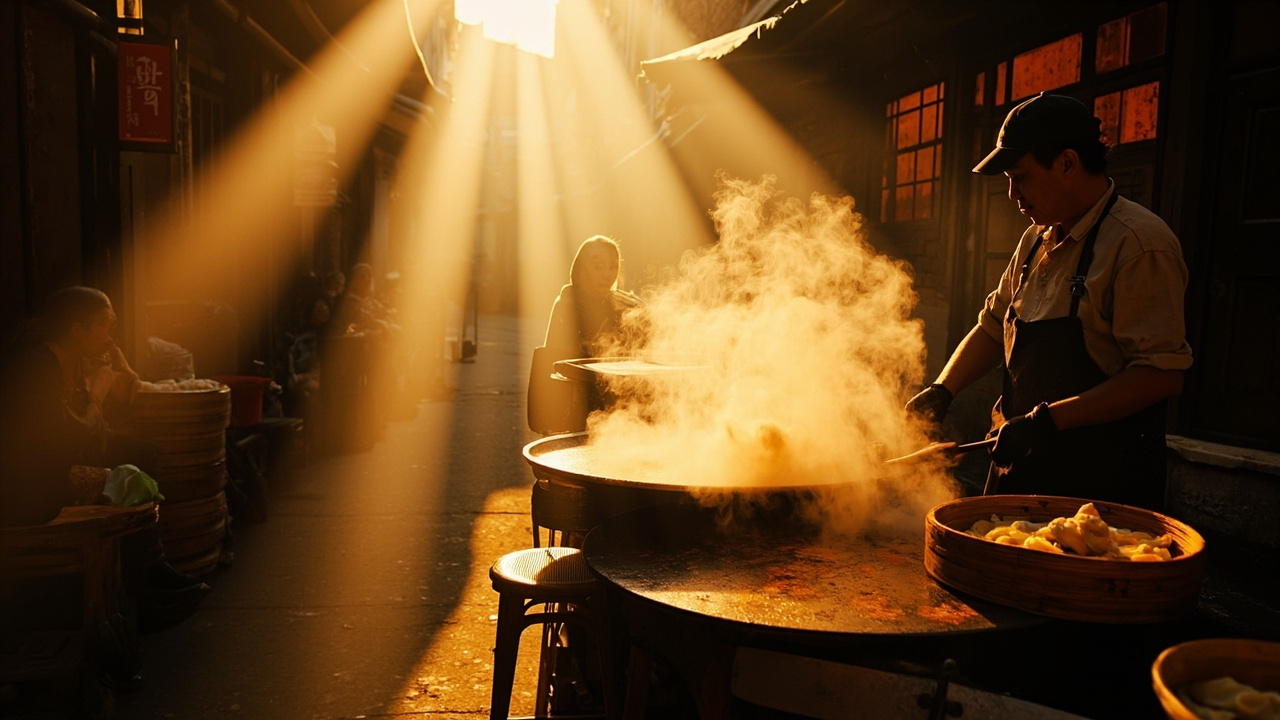
The first time I tried to order breakfast in Beijing, I pointed at a steamer basket and said “zhege” (this one) about six times in a row. The woman behind the counter laughed, handed me a plastic bag with two baozi in it, and refused to take my money until I’d eaten one in front of her. That was eight years ago. I’ve since eaten breakfast in maybe forty Chinese cities, and I still think the morning meal is the single best way to understand a place here.
Breakfast in China isn’t a meal you sit down for with a menu and a waiter. It’s a street corner, a plastic stool, a bowl of something hot, and a line of people in work clothes who all know exactly what they’re doing. It costs almost nothing. It happens fast. And it tastes like nothing you’ll find at a hotel buffet.
This guide covers ten breakfast experiences worth planning a morning around, from Tianjin’s famous jianbing stalls to a Cantonese teahouse where you’ll spend two hours over tiny plates. I’ve included real prices, specific metro exits, and the mistakes I made so you don’t have to.
Quick answer
Chinese breakfast is cheap (usually $0.70–3.50 / ¥5–25), fast, and eaten standing up or on a plastic stool between roughly 6:00 and 9:30 AM. The best options for first-timers are jianbing (savory crepe), baozi (steamed buns), youtiao with soy milk, and Cantonese dim sum if you want a sit-down experience. Most stalls are cashless — set up Alipay or WeChat Pay before you arrive, because many vendors won’t take cash or foreign cards.
The Short Version
Eat breakfast out. Every day. It’s the cheapest, most delicious, most human part of a China trip. Skip the hotel buffet. Walk five minutes in any direction from where you’re staying, find the stall with the longest line of locals, and point at what they’re eating. Budget $2 a morning. Learn the words for “soy milk” (dòujiāng) and “egg” (jīdàn) and you’ll survive anywhere.
How I Picked These
I’ve spent seven years living in Beijing and traveled through China more than forty times, mostly by high-speed rail, which means I’ve eaten a lot of 7 AM breakfasts near train stations. The ten entries below are places I’ve personally eaten at, usually more than once, sometimes with a hangover. I asked local friends and taxi drivers where they eat on their days off. I avoided anywhere that primarily serves tourists. A few of these are famous (Tianjin jianbing, Yangzhou morning tea), but I’ve tried to give you the specific stall or neighborhood rather than just the city name.
Comparison Table
| Rank | Place | Best For | Approx Cost (USD) | Time Needed | When to Go |
|---|---|---|---|---|---|
| 1 | Jianbing stalls, Tianjin | The classic Chinese street breakfast | $1.50 (¥10) | 15 min | 6:30–9:00 AM, any day |
| 2 | Youtiao & soy milk, Beijing hutongs | First-timers, easy ordering | $1.20 (¥8) | 20 min | 6:00–9:30 AM |
| 3 | Cantonese morning tea, Guangzhou | A slow, sit-down feast | $8–15 (¥55–105) | 2 hours | 7:00–11:00 AM, weekends |
| 4 | Baozi shops, Shanghai | Quick, portable, everywhere | $1.50 (¥10) | 10 min | 6:30–9:00 AM |
| 5 | Beef noodle soup, Lanzhou | A hearty northwestern start | $2.50 (¥18) | 25 min | 7:00 AM–noon |
| 6 | Wuhan hot dry noodles | Spicy, cheap, local pride | $1.20 (¥8) | 15 min | 6:00–10:00 AM |
| 7 | Yangzhou morning tea | Refined Jiangnan breakfast | $6–10 (¥45–70) | 90 min | 7:00–10:00 AM |
| 8 | Congee & dim sum, Hong Kong | Comfort food, English-friendly | $5–12 (¥35–85) | 45 min | 6:30–11:00 AM |
| 9 | Xi’an Muslim Quarter breakfast | Hui Muslim flavors | $2–4 (¥15–30) | 30 min | 7:00–10:00 AM |
| 10 | Chengdu dan dan noodles | A Sichuan wake-up call | $1.50 (¥10) | 20 min | 7:00–10:30 AM |
1. Jianbing Stalls, Tianjin 鈥?The Breakfast That Made Me Late for Work
I once missed a train because of a jianbing. Not because the line was long, but because I ate it too slowly, standing on a corner in Tianjin, watching the woman who made it flip eggs with one hand and fold scallions with the other. It was worth missing the train.
Jianbing is a thin crepe made from mung bean and wheat flour, cooked on a round griddle, cracked with an egg, brushed with hoisin and chili sauce, folded around a crispy fried cracker, and handed to you in a paper bag. Tianjin is where it was invented, and the local version is stricter than what you’ll find in Beijing or Shanghai. No lettuce. No sausage. Just the essentials.
The best stalls are in the old neighborhoods around Nanshi Food Street and along the streets off Nanjing Road. Look for a cart with a single griddle and a line of office workers. If there’s a QR code taped to the cart, you’re in the right place.
📍 Location: Scattered across Heping and Nankai districts; the cluster near Nanshi Food Street is a good starting point 🎫 Entry fee: Free to walk around; jianbing costs about $1.50 (¥10) 🕒 Opening hours: Roughly 6:00–9:30 AM; many stalls close once they sell out 🚇 How to get there: Take Metro Line 2 to Gulou Station, Exit B, walk 8 minutes south toward Nanshi ⏰ When to visit: Weekday mornings; weekends have longer lines and slightly higher prices 💡 Insider tips: Say “bù yào là” (no chili) if you can’t handle heat. Ask for “jiā dàn” (extra egg) for about $0.30 more. Bring small bills as backup, but most stalls now take WeChat Pay.
The woman who made mine had been at the same corner for eleven years. She told me she’d made over 200,000 jianbing. I believed her.
2. Youtiao and Soy Milk in a Beijing Hutong 鈥?The Breakfast I Eat Most Often
There’s a stall near my old apartment in Beijing’s Dongcheng district that opens at 5:45 AM. The owner, a man everyone calls Uncle Liu, fries youtiao (dough sticks) in a huge wok of oil while his wife ladles hot soy milk into plastic cups. I ate there probably 300 times over four years. He never learned my name, but he always knew my order.
Youtiao are long, airy, slightly salty fried dough sticks. You dip them in warm soy milk, or wrap them in a jianbing, or just eat them plain while you walk. The soy milk comes sweet (tián) or savory (xián) 鈥?the savory version has bits of pickled vegetable and dried shrimp in it, and it’s an acquired taste. Start with sweet.
This is the breakfast I’d recommend to any first-timer because it’s everywhere, it’s cheap, and the ordering is simple. Point at the youtiao. Hold up fingers for how many. Say “dòujiāng” for soy milk. Pay with your phone.
📍 Location: Hutongs around Dongsi, Beixinqiao, and Nanluoguxiang in Dongcheng district 🎫 Entry fee: Free; breakfast costs about $1.20 (¥8) for two youtiao and a soy milk 🕒 Opening hours: 5:30–9:30 AM; many stalls close by 10 🚇 How to get there: Take Metro Line 5 to Beixinqiao Station, Exit C, and walk into any hutong going east ⏰ When to visit: Early. By 8:30 AM the best stalls are sold out. 💡 Insider tips: Youtiao are best within five minutes of coming out of the oil. Don’t let them sit. If you see a stall with a long line of older men in slippers, that’s the one. Cash is accepted but awkward; set up Alipay before you arrive.
Uncle Liu once gave me a free youtiao because I helped him carry a bag of flour. I’ve been chasing that feeling ever since.
3. Cantonese Morning Tea in Guangzhou 鈥?The Two-Hour Breakfast
Cantonese morning tea is not really about the tea. It’s about sitting for two hours with a pot of pu’er and a rotating parade of small plates, and nobody rushing you out the door. I went to a teahouse in Guangzhou’s Liwan district with a local friend and her grandmother, and we ordered seventeen dishes. The grandmother corrected my chopstick grip twice.
The dishes arrive in waves: har gow (shrimp dumplings), siu mai, cheung fun (rice noodle rolls), chicken feet, turnip cake, egg tarts. You tick boxes on a paper menu, and servers bring things as they’re ready. It’s loud. It’s chaotic. It’s one of the great breakfast experiences in the world.
This is a sit-down meal, so budget more time and money. But it’s worth doing at least once on any China trip, especially if you’re already planning to visit Guangzhou or the south.
📍 Location: Liwan and Yuexiu districts; famous spots include Guangzhou Restaurant and Panxi Restaurant 🎫 Entry fee: Free; expect $8–15 (¥55–105) per person depending on how much you order 🕒 Opening hours: 6:30–11:00 AM for morning tea; some places serve it until 2 PM 🚇 How to get there: Take Metro Line 1 to Changshou Road Station, Exit B, and walk 5 minutes to Panxi ⏰ When to visit: Weekday mornings are calmer; weekends require a reservation or a long wait 💡 Insider tips: Pour tea for others before yourself 鈥?it’s a small ritual. Tap two fingers on the table to say thanks. The trolley ladies will bring things you didn’t order; you can say no. English menus exist at bigger restaurants but not at neighborhood spots.
The grandmother told me, through my friend, that she’d been coming to that same teahouse since 1978. She ordered the same eight dishes every time.
4. Shanghai Baozi Shops 鈥?The Breakfast I Grab on the Way to the Metro
Shanghai does baozi better than anywhere else in China, and I’ll argue about this with anyone. The soup dumplings (xiaolongbao) get all the attention, but for breakfast, the everyday move is a plain pork baozi or a vegetable one, eaten out of a paper bag while you walk to the subway.
There’s a chain called Yang’s Fry Dumplings that tourists love, and it’s fine, but the real breakfast baozi are at neighborhood shops with no English signage. Look for a steamer stack taller than the person running it. The baozi come out scalding hot, and the dough is slightly sweet.
I lived in Shanghai for six months and ate baozi for breakfast maybe four days a week. My favorite shop was near Jing’an Temple, on a side street off Nanjing West Road. The owner, a woman in her sixties, would hand me a baozi before I’d even paid.
📍 Location: Jing’an, Huangpu, and Xuhui districts; every neighborhood has a good shop 🎫 Entry fee: Free; baozi cost about $0.40–0.70 (¥3–5) each 🕒 Opening hours: 6:00–9:30 AM; some shops reopen at lunch 🚇 How to get there: Take Metro Line 2 or 7 to Jing’an Temple Station, Exit 4, and walk into the side streets ⏰ When to visit: Before 8:30 AM; the best shops sell out 💡 Insider tips: Ask for “ròu bāo” (pork) or “cài bāo” (vegetable). Bite a small hole first to let the steam out, or you’ll burn your mouth. Most shops don’t have seating. Cash works but slows everyone down.
I once watched a man in a suit eat four baozi in under a minute while checking his phone. That’s the Shanghai breakfast pace.
5. Lanzhou Beef Noodle Soup 鈥?The Breakfast That Changed My Mind About Morning Food
I used to think noodle soup was a lunch thing. Then I went to Lanzhou in November, walked into a shop at 7 AM, and watched a room full of people slurping beef noodles in total silence. It was 20 degrees outside. The soup was perfect.
Lanzhou beef noodle soup is a northwestern specialty: hand-pulled noodles in a clear beef broth, topped with sliced beef, radish, chili oil, cilantro, and scallions. The noodles come in different thicknesses, and you choose when you order. The broth simmers overnight. It’s one of the great breakfasts of China, and it costs less than a coffee in the US.
You’ll find Lanzhou noodle shops all over China now, but the best ones are still in Gansu province. In Lanzhou itself, look for shops with a crowd of taxi drivers at 6:30 AM.
📍 Location: Lanzhou’s Chengguan district; also widely available in Xi’an and other northwestern cities 🎫 Entry fee: Free; a bowl costs about $2.50 (¥18) 🕒 Opening hours: 6:00 AM–2:00 PM; some shops close when the broth runs out 🚇 How to get there: In Lanzhou, take Metro Line 1 to Xiguan Station, Exit A, and walk 3 minutes ⏰ When to visit: Early morning; the broth is best in the first two hours 💡 Insider tips: Specify your noodle width: “xì” (thin), “èr xì” (medium), or “dà kuān” (wide). Say “bù là” for no chili. The vinegar on the table is for the noodles, not the soup. Cash is fine here.
The man next to me at the counter had come every morning for nine years. He ordered the same bowl every time. “It’s not breakfast,” he said. “It’s the start of the day.”
6. Wuhan Hot Dry Noodles 鈥?The Spicy Breakfast Locals Are Obsessed With
Wuhan has a breakfast culture that borders on religion. The city’s signature dish is hot dry noodles (rè gān miàn): chewy alkaline noodles tossed with sesame paste, soy sauce, chili oil, and pickled vegetables. No soup. Just noodles, sauce, and heat. Locals eat them standing up, often in under five minutes, before work.
I tried them on a humid July morning and immediately understood why Wuhan people are so defensive about them. They’re not pretty. They’re not subtle. They’re perfect.
The best stalls are in the old neighborhoods around Hankou and Wuchang. Look for a cart with a big bowl of sesame paste and a line of people who all look like they’ve done this a thousand times.
📍 Location: Hankou and Wuchang districts; the streets around Jianghan Road are a good starting point 🎫 Entry fee: Free; a bowl costs about $1.20 (¥8) 🕒 Opening hours: 6:00–10:00 AM 🚇 How to get there: Take Metro Line 2 to Jianghan Road Station, Exit C, and walk into the side streets ⏰ When to visit: Weekday mornings; weekends are busier but the vibe is better 💡 Insider tips: Mix the noodles thoroughly before eating or the sauce won’t be evenly distributed. Ask for “shǎo là” (less chili) if you’re not used to heat. The pickled radish on the side is essential. Bring tissues; there’s no napkin culture here.
A woman at the next stall told me she’d eaten hot dry noodles every morning for twenty years. “If I skip a day, I feel wrong,” she said.
7. Yangzhou Morning Tea 鈥?The Refined Jiangnan Breakfast
Yangzhou morning tea is the opposite of a street stall. It’s a slow, elegant meal served in teahouses, with tiny steamed dumplings, cold dishes, and a pot of green tea. I went to Fuchun Teahouse on a rainy Tuesday in March and spent two hours there. It was one of the best mornings of my life.
The signature dish is a soup dumpling the size of your fist, with a straw stuck into it so you can drink the broth. It’s called a “crab roe soup dumpling” (pángxiè huáng tāngbāo), and it costs about $5 (¥35). You drink the soup first, then eat the dumpling. There’s a technique. I got it wrong the first time and burned my chin.
This is a breakfast for people who want to sit down, take their time, and eat something beautiful. It’s not cheap by Chinese standards, but it’s still cheaper than a mediocre brunch in New York.
📍 Location: Yangzhou’s Hanjiang district; Fuchun Teahouse and Yechun Teahouse are the classics 🎫 Entry fee: Free; expect $6–10 (¥45–70) per person 🕒 Opening hours: 7:00–10:00 AM 🚇 How to get there: Yangzhou has no metro; take a taxi or DiDi to Fuchun Teahouse on Deshengqiao Road ⏰ When to visit: Weekday mornings; weekends require a reservation 💡 Insider tips: Use the straw carefully 鈥?the soup is hotter than it looks. Order the “three diced” cold dish (sān dīng bāo) alongside. English menus are available at Fuchun. Set up WeChat Pay before you go; smaller teahouses don’t take cards.
The waiter at Fuchun told me he’d worked there for twenty-two years. He said the recipe for the dumpling broth hasn’t changed since 1885.
8. Hong Kong Congee and Dim Sum 鈥?The Easiest Breakfast for First-Timers
Hong Kong is the easiest place in China to eat breakfast as a foreigner. English is widely spoken, menus are in English, and the food is familiar enough to be comforting but different enough to feel like a trip. I go to a congee shop in Sheung Wan every time I’m in the city.
The classic breakfast is a bowl of congee (rice porridge) with a side of youtiao, plus a few dim sum items. The congee is silky and mild, usually topped with scallions, ginger, and a century egg if you want it. It’s the perfect thing to eat when you’re jet-lagged and your stomach isn’t sure what time zone it’s in.
Hong Kong also has excellent cha chaan teng (tea restaurants), which serve a hybrid Chinese-Western breakfast: scrambled eggs, toast, macaroni soup, and milk tea. It’s not traditional Chinese breakfast, but it’s delicious and very Hong Kong.
📍 Location: Sheung Wan, Central, and Mong Kok; everywhere, really 🎫 Entry fee: Free; breakfast costs $5–12 (¥35–85) 🕒 Opening hours: 6:30–11:00 AM for most congee shops; cha chaan tengs open earlier 🚇 How to get there: Take the MTR Island Line to Sheung Wan Station, Exit A2, and walk 3 minutes ⏰ When to visit: Any morning; Hong Kong breakfast culture runs seven days a week 💡 Insider tips: Congee shops often have no English menu, but pointing works. Cha chaan tengs have English menus. Octopus card works everywhere; you don’t need cash. Tip is not expected.
I once sat next to an elderly man in a congee shop who told me, in perfect English, that he’d been eating the same breakfast for forty years. “It’s not boring,” he said. “It’s reliable.”
9. Xi’an Muslim Quarter Breakfast 鈥?The Hui Muslim Start to the Day
Xi’an’s Muslim Quarter is famous for its evening food scene, but the breakfast is just as good and much less crowded. I walked through the quarter at 7:30 AM on a cool October morning and had one of the best breakfasts of my life: a bowl of lamb soup with a piece of flatbread torn into it, plus a cup of sweet soy milk.
The Hui Muslim community in Xi’an has its own breakfast traditions, influenced by Central Asian and Middle Eastern cooking. The lamb soup (yángròu pàomó) is the classic: you tear the flatbread into tiny pieces yourself, then the vendor pours hot lamb broth over it. It’s a hands-on breakfast, and it’s deeply satisfying.
This is also a great breakfast for people who want something savory and substantial before a day of sightseeing. Xi’an is home to the Terracotta Warriors and one of the best-preserved city walls in China, so you’ll want energy.
📍 Location: Beiyuanmen Street and the surrounding lanes in Lianhu district 🎫 Entry fee: Free; breakfast costs $2–4 (¥15–30) 🕒 Opening hours: 7:00–10:00 AM for breakfast stalls; the quarter stays busy all day 🚇 How to get there: Take Metro Line 2 to Zhonglou Station, Exit B, and walk 10 minutes west ⏰ When to visit: Weekday mornings; the quarter gets very crowded after 10 AM 💡 Insider tips: Tear the bread into small pieces 鈥?the smaller, the better. Ask for “bù là” if you don’t want chili. The vendors are used to tourists but appreciate a “xièxie” (thank you). Cash is accepted but WeChat Pay is faster.
The vendor who served me had been making lamb soup for thirty years. He told me his father had done it before him, and his son would do it after.
10. Chengdu Dan Dan Noodles 鈥?The Sichuan Breakfast That Wakes You Up
Chengdu does breakfast with a kick. The city’s signature morning dish is dan dan noodles: thin noodles topped with minced pork, chili oil, Sichuan peppercorns, and scallions. It’s numbing, spicy, and completely addictive. I ate it every morning for a week and never got tired of it.
Chengdu is a city that takes food seriously, and breakfast is no exception. The best dan dan noodle shops are small, family-run, and have been in the same spot for decades. You sit on a low stool, order a small bowl, and eat it in about three minutes. Then you order another one.
This is a breakfast for people who like heat. If you don’t, Chengdu also has plenty of milder options: congee, baozi, and sweet soy milk. But the dan dan noodles are the reason to come.
📍 Location: Jinjiang and Qingyang districts; the streets around Chunxi Road are a good starting point 🎫 Entry fee: Free; a bowl costs about $1.50 (¥10) 🕒 Opening hours: 7:00–10:30 AM 🚇 How to get there: Take Metro Line 2 or 3 to Chunxi Road Station, Exit D, and walk into the side streets ⏰ When to visit: Weekday mornings; weekends are busier but the atmosphere is fun 💡 Insider tips: Ask for “xiǎo wǎn” (small bowl) if you want to try more than one thing. The Sichuan peppercorns will numb your mouth 鈥?that’s the point. Drink the soy milk alongside to cool your tongue. Set up Alipay or WeChat Pay before you arrive.
A man at the next table told me he’d eaten dan dan noodles for breakfast every day for fifteen years. “It’s not just food,” he said. “It’s how I wake up.”
FAQ summary
Chinese breakfast is cheap ($0.70–3.50 / ¥5–25 for street food, $6–15 / ¥45–105 for sit-down teahouse meals), fast, and mostly cashless — set up Alipay or WeChat Pay before you arrive. The easiest first-timer options are jianbing, baozi, youtiao with soy milk, and Cantonese morning tea. Most breakfast stalls open around 6:00 AM and close by 9:30 or 10:00 AM, so plan to eat early. English is rarely spoken at street stalls; a translation app and pointing will get you through.
FAQ
Q: Is Chinese breakfast safe for foreigners with sensitive stomachs? A: Generally yes, especially at busy stalls where food turns over quickly. Stick to cooked food, avoid raw vegetables, and drink bottled water. If you have a very sensitive stomach, start with baozi, youtiao, and congee, which are all mild.
Q: How much should I budget for breakfast in China? A: Street breakfast costs $0.70–3.50 (¥5–25) per person. A sit-down Cantonese morning tea or Yangzhou teahouse meal runs $6–15 (¥45–105). Budget $2–3 per morning for street food and you’ll eat very well.
Q: Do I need cash, or can I pay with my phone? A: Most stalls now prefer WeChat Pay or Alipay, and many don’t accept foreign cards or cash. Set up Alipay or WeChat Pay before you arrive. Keep ¥100–200 in small bills as backup.
Q: What time do breakfast stalls open and close? A: Most open between 5:30 and 6:30 AM and close by 9:30 or 10:00 AM. The best food is usually gone by 8:30. Sit-down teahouses serve breakfast until 11:00 AM or later.
Q: Do I need a VPN or a local SIM card for breakfast? A: Yes, if you want to use Google Maps or WhatsApp. Buy a local SIM card at the airport or set up an eSIM before you arrive. See our China SIM card and internet guide for details.
Q: Is English spoken at breakfast stalls? A: Rarely. A translation app (Pleco or Google Translate with offline Chinese) and pointing will get you through. Learn “zhège” (this one), “dòujiāng” (soy milk), and “xièxie” (thank you).
Q: Do I need a visa to visit China for breakfast? A: Many nationalities can now enter China visa-free for up to 30 days, and 144-hour or 240-hour transit visa-free policies apply at major airports. Check our China visa-free transit guide for current rules.
The Honest Wrap-up
This list is for people who want to eat breakfast like a local, not like a tourist. It’s not for people who need air conditioning, English menus, and a waiter who speaks fluent English. If that’s you, Hong Kong and Guangzhou are your best bets. For everyone else, pick two or three of these, plan your mornings around them, and don’t be afraid to eat standing up.
One last thing: bring tissues. Almost no breakfast stall in China provides napkins. You’ll thank me later.
More guides you may like
Top 10 Bridges in China
China's bridges are engineering marvels spanning mountains, rivers, and seas. Here are 10 of the most spectacular, from ancient stone to modern steel.
8 min read

Top 10 Buddhist Sites in China
From the Leshan Giant Buddha to the Dunhuang Caves, these 10 Buddhist sites represent 2,000 years of China's spiritual heritage.
9 min read

Top 10 Day Trips from Beijing You Shouldn't Miss
Beijing is packed with history, but some of China's best experiences are just a few hours away. Here are 10 day trips that will transform your visit.
9 min read
Top 10 Hidden Gems in China Off the Beaten Path
Beyond the Great Wall and Terracotta Warriors, China has incredible hidden destinations few tourists ever reach. Here are 10 underrated gems worth the detour.
9 min read
Top 10 Markets and Shopping Streets in China
From Shanghai's Bund to Beijing's Silk Street - 10 markets where foreigners can haggle, explore, and bring home authentic Chinese goods.
9 min read
Top 10 Museums in China You Shouldn't Miss
China's museums span 5,000 years of civilization. These 10 - from the Palace Museum to Xi'an's terracotta gallery - are unmissable for culture lovers.
9 min read