
Mount Wutai Travel Guide
TODO: Extract from article (100-160 chars)
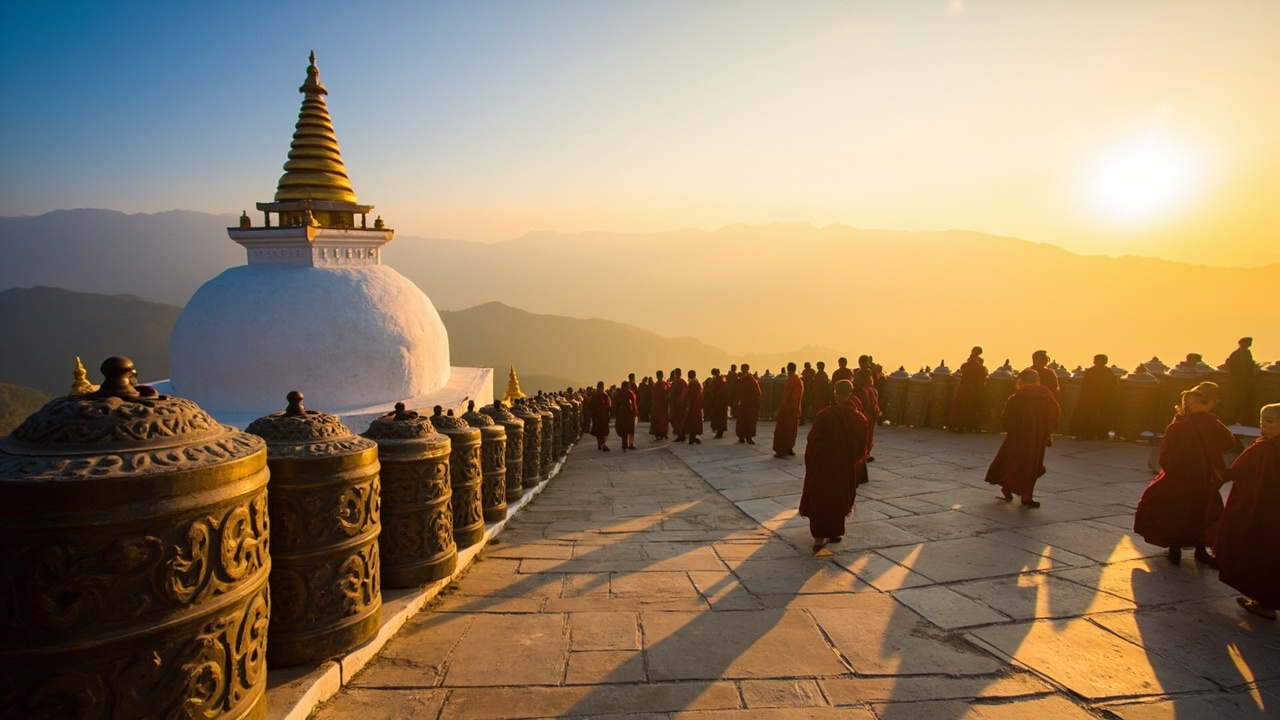
Mount Wutai Travel Guide
The first thing I noticed wasn’t the temples. It was the cold. I’d stepped off the overnight bus from Taiyuan at 5:40 a.m. in July, wearing a t-shirt, and my breath was visible. A monk in a gray robe walked past me toward the gate of Tayuan Temple, hands folded, completely unbothered by the temperature. I stood there shivering for a minute before I remembered I had a fleece somewhere in my bag.
Mount Wutai, or Wutai Shan, sits at around 2,000 meters in Shanxi Province, which is not the Shanxi you’re thinking of if you’re American. This is the northern one, the coal province, the one with the oldest wooden buildings in China. Wutai is one of the Four Sacred Buddhist Mountains of China, and for Chinese Buddhists it’s arguably the most important of the four. It’s the earthly home of Manjushri, the bodhisattva of wisdom. Pilgrims have been walking up here for over 1,600 years.
What surprised me is how few Western tourists I saw. In three days I counted maybe eight. Meanwhile there were thousands of Chinese pilgrims doing full prostrations up the 1,080 steps to Dailuoding, and tour groups from Beijing and Shanghai filling every guesthouse in Taihuai town. This is a major domestic destination that international travelers have almost entirely overlooked.
This guide covers the five terraces themselves, the temple town of Taihuai, the logistics of getting here from Beijing or Taiyuan, and the specific things I got wrong on my first visit so you don’t repeat them.
Quick answer
Mount Wutai is a sacred Buddhist mountain in Shanxi Province, about 4 hours by bus from Taiyuan or 5-6 hours from Beijing by high-speed rail plus bus. Entry to the scenic area costs ¥135 (about $19) plus ¥50 ($7) for the internal shuttle bus, and most foreign visitors can now enter China visa-free for 30 days under the 2025-2026 expanded policy. The best months are June through September; outside that window many temples close and roads can be icy.
The Short Version
Come for the temples, not the hiking. The five terraces themselves are mostly a jeep-and-prayer affair, and the real experience is in Taihuai town and the surrounding monastery cluster. Give it two nights minimum. Bring layers even in summer. Learn to say “Amituofo” and you’ll make friends. Skip it if you want nightlife, Western food, or a relaxing vacation. This is a working pilgrimage site, not a resort.
How I Picked These
I’ve been to Wutai three times now, twice in summer and once in late October (mistake). I stayed in Taihuai each time, ate at the same noodle shop near Shuxiang Temple on two of those trips, and once got roped into a 4 a.m. chanting session by a monk who saw me wandering around jet-lagged. I’ve also talked to a Beijing-based tour operator who runs pilgrim groups here, and a Tibetan monk from Xiahe who was doing a month-long retreat at Pusading. The ten entries below are the places that stuck with me, ranked roughly by how much they’re worth your limited time.
Comparison Table
| Rank | Place | Best For | Approx Cost (USD) | Time Needed | When to Go |
|---|---|---|---|---|---|
| 1 | Taihuai Town | Base camp, temples, food | Free (lodging $25-80/night) | 2 nights | Jun-Sep |
| 2 | Dailuoding | The climb, the view | $1.50 (¥10) | 2-3 hours | Morning |
| 3 | Pusading (Temple of the Five Terraces) | Imperial history, Tibetan Buddhism | $1.50 (¥10) | 1-2 hours | Any time |
| 4 | Tayuan Temple | The white stupa, photos | Free | 1 hour | Sunset |
| 5 | Shuxiang Temple | The giant Manjushri statue | $1.50 (¥10) | 1 hour | Midday |
| 6 | Xiantong Temple | Scale, oldest monastery | Free | 1.5 hours | Morning |
| 7 | Foguang Temple | Tang dynasty architecture | $2 (¥15) | Half day trip | Any |
| 8 | Nanchan Temple | Oldest wooden building in China | $2 (¥15) | 1 hour | Any |
| 9 | The Five Terraces (East Peak) | Sunrise, altitude | $30-50 (¥200-350) jeep | Half day | Sunrise |
| 10 | Pusa Ding night chanting | Atmosphere, no tourists | Free (donation) | 1 hour | Evening |
Taihuai Town 鈥?the base you’ll actually live in
I checked into a guesthouse called Yuanzhao Binguan on my first trip, mostly because the woman at the bus station ticket window pointed at it when I asked for something cheap. It cost ¥180 ($25) a night for a room with two beds, a thermos of hot water, and a shared bathroom down the hall. The owner, a woman in her fifties named Auntie Wang, made me drink three cups of jasmine tea before she’d let me go to my room.
Taihuai is not a pretty town. It’s a strip of guesthouses, vegetarian restaurants, souvenir shops selling prayer beads and fake antiques, and a surprising number of shops selling down jackets to underprepared tourists (me). But it’s the only real base for the mountain, and once you accept that, it’s genuinely charming. The whole town is ringed by temples, and you can walk from one end to the other in about 25 minutes.
The food situation is better than I expected. There’s a vegetarian restaurant near the main roundabout that does a mushroom hotpot for ¥60 ($8) that I still think about. The noodle shops are cheap and good. There’s one Sichuan place that will absolutely wreck you if you ask for “extra spicy” 鈥?I did, and I regretted it.
馃搷 Location: Taihuai Zhen, Wutai County, Shanxi. The town sits inside the scenic area boundary. 馃帿 Entry fee: Free to walk around. You pay the scenic area fee once at the gate. 馃晲 Opening hours: Always open, but most restaurants close by 9 p.m. 馃殕 How to get there: From Taiyuan, buses leave from Taiyuan East Bus Station at 7 a.m. and 9 a.m., ¥85 ($12), 4 hours. From Beijing, take the high-speed train to Xinzhou West (2.5 hours, ¥180-260 / $25-36), then a bus to Taihuai (2 hours, ¥50 / $7). 鈴?When to visit: June through September. July and August are peak 鈥?book lodging a week ahead. 馃挕 Insider tips: Bring cash for small shops; many don’t take foreign cards and some don’t take WeChat Pay from foreign accounts. Set up Alipay or WeChat Pay before you come 鈥?I’ve watched tourists get stuck at the bus station because their card wouldn’t work. Download offline maps; signal is spotty on the mountain. Buy a down jacket here rather than at home if you’re coming in shoulder season 鈥?they’re ¥150-300 ($20-42) and perfectly fine.
The mistake I made: I assumed I could find an ATM. There’s one, near the entrance to Xiantong Temple, and it only takes UnionPay. Bring enough cash.
Dailuoding 鈥?the 1,080 steps that will humble you
Halfway up the steps, a woman in her seventies passed me. She was doing the full prostration thing 鈥?down on her knees, forehead to stone, stand up, step forward, repeat 鈥?and she was still faster than me. I stopped pretending I was in good shape somewhere around step 400.
Dailuoding is the temple on the ridge above Taihuai, reached by a stone staircase of 1,080 steps. It’s the single most memorable thing I did on the mountain. The temple at the top is small, almost modest, but the view over the valley and the white stupa of Tayuan below is the postcard shot of Wutai. There’s also a cable car if you genuinely can’t do the steps (¥50 up, ¥45 down), but I’d argue the steps are the point.
The temple itself is dedicated to Manjushri and dates back to the Tang dynasty, though the current structure is mostly Ming and Qing. There’s a small hall where pilgrims leave offerings of fruit and incense. I watched a young couple from Chengdu light three sticks of incense and bow nine times each. They looked like they were in their twenties, dressed in streetwear, and completely sincere.
馃搷 Location: Ridge above Taihuai, northeast of the town center. 馃帿 Entry fee: ¥10 ($1.50). Cable car extra. 馃晲 Opening hours: 6 a.m. to 6 p.m. in summer, 7 a.m. to 5 p.m. in winter. 馃殕 How to get there: From Taihuai main street, walk east past Tayuan Temple for about 10 minutes to the base of the stairs. You’ll see the sign. 鈴?When to visit: Early morning, ideally before 8 a.m., to beat the tour groups and the heat. Avoid weekends in July and August. 馃挕 Insider tips: There’s a small tea stall about two-thirds of the way up that sells hot water for ¥5 鈥?fill your bottle here. Bring a small offering if you want to participate respectfully; fruit or flowers are traditional. The cable car closes earlier than the stairs in shoulder season, so check before you commit. Wear shoes with grip 鈥?the steps are worn smooth in places.
The food: at the bottom of the stairs there’s a vendor selling yam and red bean paste buns for ¥5 ($0.70). Get two.
Pusading 鈥?the temple the emperors cared about
Pusading is the temple you’ll see on every Wutai postcard, the one with the yellow-tiled roofs that look almost imperial. That’s because they are. Qing dynasty emperors, including Kangxi and Qianlong, stayed here on their pilgrimages, and the temple was expanded specifically to host them.
This is the most important Tibetan Buddhist temple on the mountain, and it’s where you’ll see the strongest Tibetan influence 鈥?prayer wheels, butter lamps, monks in maroon robes. It’s also the busiest. I went twice, once at 9 a.m. (crowded) and once at 4 p.m. (much better). The main hall houses a statue of Manjushri riding a lion, and the smaller halls behind it have some genuinely beautiful thangka paintings.
What I liked most was watching the mix of pilgrims. There were Han Chinese tourists in matching family outfits, Tibetan pilgrims in traditional dress, and a group of Thai monks who I ended up sharing a bench with for twenty minutes without either of us speaking the other’s language. Buddhism does that.
馃搷 Location: North end of Taihuai town, up the hill from the main street. 馃帿 Entry fee: ¥10 ($1.50). 馃晲 Opening hours: 7 a.m. to 6 p.m. daily. 馃殕 How to get there: From the main roundabout in Taihuai, walk north up the hill for about 8 minutes. It’s signposted. 鈴?When to visit: Late afternoon, around 4-5 p.m., when the tour groups have left. 馃挕 Insider tips: Don’t photograph monks without asking; some will say yes, some won’t, and it’s respectful to ask. There’s a small shop inside selling prayer beads that are actually made locally, not imported from Yiwu 鈥?the monk at the counter will tell you which is which if you ask. The butter lamps are worth watching being refilled. If you want to attend a morning chanting session, ask at the office near the entrance the day before.
I met a monk here named Geshe Lobsang who had been at Pusading for eleven years. He asked where I was from, nodded when I said America, and said “good, come back in winter, it’s quieter.”
Tayuan Temple 鈥?the white stupa you’ll navigate by
The big white stupa at Tayuan Temple is the landmark of Taihuai. You can see it from almost anywhere in town, and I used it as my compass for three days. It’s a Tibetan-style chorten, about 50 meters tall, built in the Ming dynasty to house relics.
The temple around it is smaller than Pusading or Xiantong, but the stupa itself is the draw. Pilgrims walk clockwise around it, spinning the prayer wheels at the base, and the sound of the wheels is one of those things that stays with you. I sat on a bench near the entrance for maybe 40 minutes just watching people circle.
The best time to come is sunset, when the white of the stupa catches the last light and the whole thing goes gold for about ten minutes. I got some of my best photos here, and I’m not really a photo person.
馃搷 Location: Center of Taihuai, just east of the main street. 馃帿 Entry fee: Free. 馃晲 Opening hours: 6 a.m. to 7 p.m. in summer, 7 a.m. to 5:30 p.m. in winter. 馃殕 How to get there: You can’t miss it. From the bus station, walk west for 5 minutes. 鈴?When to visit: Sunset. Any day, but weekdays are less crowded. 馃挕 Insider tips: Walk clockwise around the stupa, not counterclockwise 鈥?this is the Tibetan tradition and locals will notice if you get it wrong. The prayer wheels should be spun with your right hand. There’s a small vegetarian restaurant attached to the temple on the east side that does a decent lunch for ¥30 ($4). If you’re here during a festival (especially the June 15th festival, which follows the lunar calendar), the whole area fills with pilgrims and it’s spectacular but chaotic.
The mistake I made: I walked counterclockwise on my first loop. An elderly woman gently took my arm and turned me around. She didn’t say anything, just smiled.
Shuxiang Temple 鈥?the one with the giant statue
Shuxiang Temple is home to a 9-meter-tall statue of Manjushri riding a lion, which is the largest of its kind in China. The statue is in a hall that was built around it, and walking in and looking up is genuinely impressive. It’s not subtle. It’s not meant to be.
The temple itself is one of the older ones on the mountain, founded in the Tang dynasty, though like most things here it’s been rebuilt several times. What I liked about Shuxiang is that it feels less like a museum and more like a working monastery. There were monks doing actual monk things 鈥?sweeping, chanting, arguing about something in the courtyard 鈥?rather than just posing for photos.
I went on a Tuesday morning and had the main hall almost to myself for fifteen minutes. That’s rare here.
馃搷 Location: Between Tayuan Temple and Dailuoding, on the east side of Taihuai. 馃帿 Entry fee: ¥10 ($1.50). 馃晲 Opening hours: 7 a.m. to 6 p.m. daily. 馃殕 How to get there: From Tayuan Temple, walk east for about 6 minutes. It’s on your left. 鈴?When to visit: Weekday mornings. Avoid the 10 a.m. to 2 p.m. tour group window. 馃挕 Insider tips: The statue is best viewed from the back of the hall, where you can see the whole thing without craning your neck. There’s a small room to the left of the main hall with some interesting old manuscripts 鈥?most tourists walk right past it. If you want to make an offering, there’s a box near the entrance; small amounts are fine and expected.
The food: there’s a tiny shop across the street selling fried dough sticks and soy milk for breakfast. ¥8 ($1.10) total. Best breakfast I had on the mountain.
Xiantong Temple 鈥?the biggest and oldest
Xiantong Temple is the largest monastery complex on Mount Wutai, and it’s been here since 68 AD, which makes it one of the oldest Buddhist temples in China. The current buildings are mostly Ming and Qing, but the site itself has been continuously used for nearly two thousand years. That’s a hard thing to wrap your head around.
The complex is huge 鈥?you can easily spend two hours wandering through the halls, courtyards, and side chapels. There’s a bronze hall, a white marble hall, and a hall with a 10-meter-tall bronze statue of Manjushri. There’s also a small museum section with some genuinely old artifacts.
I’ll be honest: by the time I got here I was templed out. I’d seen Pusading, Tayuan, Shuxiang, and Dailuoding in two days. Xiantong is impressive but it’s more of the same, and if you’re only here for two nights I’d prioritize it below the others. If you have three days, absolutely come.
馃搷 Location: West end of Taihuai, past the main roundabout. 馃帿 Entry fee: Free. 馃晲 Opening hours: 7 a.m. to 6:30 p.m. in summer, 8 a.m. to 5 p.m. in winter. 馃殕 How to get there: From the main roundabout, walk west for about 10 minutes. You’ll pass the ATM on your right. 鈴?When to visit: Morning, before the crowds. It’s big enough that even when busy it doesn’t feel packed. 馃挕 Insider tips: The bronze hall is the highlight 鈥?it’s a fully cast bronze building, which is unusual. There’s a small tea house in the back courtyard that serves free tea to visitors; it’s a nice place to sit and rest. The temple has a resident English-speaking monk on some days, but not reliably 鈥?don’t count on it. The exit at the back leads to a path that connects to several smaller temples if you want to keep walking.
I met a retired teacher from Xi’an here who insisted on giving me a bag of dried jujubes. I tried to refuse. She wouldn’t let me.
Foguang Temple 鈥?the Tang dynasty masterpiece
Foguang Temple is not in Taihuai. It’s about 30 km southwest, near the town of Doucun, and it requires a separate trip. But if you care about architecture at all, it’s the single most important building on this list. The main hall dates to 857 AD, during the Tang dynasty, and it’s one of only four surviving Tang wooden buildings in China.
I hired a driver from Taihuai for ¥300 ($42) round trip, which took most of a morning. The temple is small, quiet, and almost empty of tourists. The hall itself is low and wide, with enormous wooden brackets and a set of Tang dynasty sculptures inside that are genuinely breathtaking. The colors are faded but the proportions are perfect.
The caretaker, an older man named Mr. Li, gave me a 20-minute tour in Mandarin that I understood maybe 40% of. He was clearly proud of the place and kept pointing at details 鈥?the original beams, the repaired sections, the inscriptions on the pillars.
馃搷 Location: Doucun Town, Wutai County, about 30 km from Taihuai. 馃帿 Entry fee: ¥15 ($2). 馃晲 Opening hours: 8 a.m. to 5:30 p.m., closed Mondays in winter. 馃殕 How to get there: Hire a driver from Taihuai (¥250-350 / $35-50 round trip) or take a local bus toward Doucun and walk the last 2 km. The driver option is much easier. 鈴?When to visit: Any time, but mornings are best for light in the main hall. 馃挕 Insider tips: Bring a translation app 鈥?there’s almost no English signage. The temple is a UNESCO World Heritage site, so photography is allowed but no flash inside the main hall. There’s a small shop selling local walnuts that are worth buying. If you’re into architecture, budget at least two hours; if you’re not, one is enough.
The food: there’s a noodle shop in Doucun village that does a Shanxi-style knife-cut noodle for ¥15 ($2). It’s worth the stop.
Nanchan Temple 鈥?the oldest wooden building in China
Nanchan Temple is even further out than Foguang, about 22 km southwest of Taihuai, and it holds the title of oldest surviving wooden building in China 鈥?the main hall dates to 782 AD. It’s tiny. It’s almost laughably small compared to Xiantong or Pusading. But it’s the real thing.
I went on a rainy Tuesday and was the only visitor. The caretaker unlocked the main hall for me, and I stood inside a building that has been standing for over 1,200 years. The sculptures inside are original Tang dynasty, and they’re protected behind glass, but you can still see them clearly.
This is not a place for everyone. If you don’t care about architectural history, skip it. If you do, it’s a pilgrimage in itself.
馃搷 Location: Lijiazhuang Village, Wutai County, about 22 km from Taihuai. 馃帿 Entry fee: ¥15 ($2). 馃晲 Opening hours: 8 a.m. to 5 p.m., closed Mondays. 馃殕 How to get there: Same as Foguang 鈥?hire a driver (¥250-350 / $35-50 round trip) or take a local bus and walk. Combine with Foguang if you’re hiring a car. 鈴?When to visit: Any time. It’s never crowded. 馃挕 Insider tips: The caretaker will open the main hall for you if you ask 鈥?it’s usually locked. Bring small bills for the entry fee; they don’t always have change. There’s no food nearby, so eat before you come or bring snacks. The drive itself is pretty, through terraced fields and small villages.
The mistake I made: I didn’t combine this with Foguang on the same trip, so I paid for two separate drivers. Do them together.
The Five Terraces 鈥?the actual peaks
Here’s the thing nobody tells you: the “five terraces” that give the mountain its name are not really a hiking destination. They’re five flat-topped peaks arranged around Taihuai, and reaching them requires either a long, poorly-marked hike or a jeep ride on rough roads. Most pilgrims visit one or two, usually the East Peak for sunrise.
I did the East Peak sunrise trip on my second visit. A driver picked me up at 3:30 a.m. from my guesthouse, and we drove for about 50 minutes on a road that was more pothole than pavement. We got to the top around 4:30, and there were already maybe 30 people there, mostly Chinese tourists wrapped in blankets. The sunrise was genuinely spectacular 鈥?layers of mountains fading into blue, a sea of clouds below, and the temperature around 5°C in July.
Is it worth ¥300 ($42) and a 3:30 a.m. wake-up? For me, yes. For you, maybe. If you’re not a sunrise person, skip it.
馃搷 Location: East Peak (Dongtai) is the most accessible; the others require longer drives. 馃帿 Entry fee: Jeep hire ¥200-350 ($28-50) depending on peak and negotiation. 馃晲 Opening hours: Drivers go whenever you want, but sunrise trips are standard. 馃殕 How to get there: Arrange through your guesthouse the night before. Don’t try to drive yourself. 鈴?When to visit: Sunrise, June through September. Winter trips are possible but cold and sometimes dangerous. 馃挕 Insider tips: Negotiate the price before you get in the car, and confirm whether it’s round trip. Bring more layers than you think you need 鈥?it’s 10-15°C colder up there than in town. There are no toilets at the top, so plan accordingly. The drivers usually stop at a small tea house on the way back for breakfast; the porridge is fine.
The food: instant noodles at the summit tea house, ¥15 ($2). Somehow they taste incredible at 5 a.m. at 2,800 meters.
Pusa Ding night chanting 鈥?the thing most tourists miss
On my third night in Taihuai, I couldn’t sleep and went for a walk around 8:30 p.m. I ended up near Pusading and heard chanting coming from inside. The gate was open. I walked in, and there were maybe 20 monks in the main hall doing evening prayers, with a handful of laypeople sitting on cushions at the back.
I sat down. Nobody asked me to leave. I stayed for about 45 minutes. It was one of the most peaceful experiences I’ve had in China, and it cost nothing.
This isn’t an advertised attraction. It’s just something that happens. But if you’re respectful, quiet, and don’t take photos, you’re welcome to sit at the back.
馃搷 Location: Pusading main hall, north end of Taihuai. 馃帿 Entry fee: Free (donation appreciated but not required). 馃晲 Opening hours: Evening chanting typically starts around 7:30 or 8 p.m., varies by season. 馃殕 How to get there: Same as Pusading 鈥?walk north up the hill from the main roundabout. 鈴?When to visit: Any evening, but check with the temple office during the day to confirm timing. 馃挕 Insider tips: Dress modestly 鈥?long pants, covered shoulders. Sit at the back and don’t move around. Don’t take photos or video. If you want to leave early, leave quietly between chants. A small donation in the box near the door is appropriate.
I met a woman from Guangzhou here who had come specifically for the chanting. She’d been to Wutai four times. She said it was the only reason she kept coming back.
FAQ summary
Mount Wutai is a sacred Buddhist mountain in Shanxi Province, reachable in about 4 hours from Taiyuan or 5-6 hours from Beijing via high-speed rail and bus. The scenic area entry fee is ¥135 (about $19) plus ¥50 ($7) for the internal shuttle, and most foreign visitors can enter China visa-free for 30 days under current 2025-2026 policies. The best time to visit is June through September, and two nights in Taihuai town is the minimum for a meaningful trip. Bring cash, layers, and a translation app; English is rarely spoken and foreign payment apps don’t always work in small shops.
FAQ
Q: Do I need a visa to visit Mount Wutai? A: Most foreign visitors from the US, UK, EU, Australia, and much of Southeast Asia can enter China visa-free for up to 30 days under the expanded 2025-2026 policy. Check your specific nationality before booking, and carry your passport at all times 鈥?you’ll need it to enter the scenic area. If you’re not eligible, apply for a standard tourist visa at least a month ahead.
Q: How do I get to Mount Wutai from Beijing? A: Take the high-speed train from Beijing West or Beijing Fengtai to Xinzhou West (about 2.5 hours, ¥180-260 / $25-36), then a bus from Xinzhou to Taihuai (about 2 hours, ¥50 / $7). Total travel time is 5-6 hours. Alternatively, overnight buses run from Beijing’s Liuliqiao station, but I don’t recommend them 鈥?the train is much more comfortable. See the China train travel guide for booking details.
Q: How much does a trip to Mount Wutai cost? A: Budget about $60-100 per day for lodging, food, and local transport, plus the ¥135 ($19) scenic area entry and ¥50 ($7) shuttle. A two-night trip from Beijing including train and bus comes to roughly $300-450 total. You can do it cheaper (hostels, noodle shops) or more expensively (nicer hotels, private drivers).
Q: Is English spoken at Mount Wutai? A: Almost never. Bring a translation app 鈥?I use Pleco for Chinese and it’s been reliable. Hotel staff at the nicer places may speak a few words, but assume you’ll be pointing at menus and using your phone. Download offline maps before you arrive; signal is patchy on the mountain.
Q: Do I need a VPN or a Chinese SIM card? A: Yes to both, ideally. Google, WhatsApp, Instagram, and most Western apps are blocked in China, so you’ll need a VPN set up before you arrive (I use LetsVPN, but do your own research). For a local SIM, China Unicom and China Mobile both sell tourist SIMs at the airport with your passport. See the China SIM and internet guide for the full rundown.
Q: Can I pay with Alipay or WeChat Pay at Mount Wutai? A: Sometimes. Bigger hotels and restaurants accept both, but small shops, guesthouses, and temple donation boxes often don’t 鈥?or they only take Chinese bank accounts. Bring at least ¥500-800 ($70-110) in cash for a two-night trip. Set up Alipay or WeChat Pay before you arrive, but don’t rely on it exclusively.
Q: What should I pack for Mount Wutai? A: Layers, always. Even in July, mornings are around 10°C and the peaks can be near freezing at sunrise. Bring a fleece or light down jacket, comfortable shoes with grip, a refillable water bottle, sunscreen, and a small daypack. If you’re coming in shoulder season, add a hat and gloves. You can buy a cheap down jacket in Taihuai for ¥150-300 ($20-42) if you forget.
Q: Is Mount Wutai worth visiting for non-Buddhists? A: Yes, if you’re interested in history, architecture, or just seeing a major Chinese pilgrimage site in action. No, if you want a relaxing vacation or a hiking-focused trip. It’s a working religious site, not a resort. The temples are genuinely beautiful and the atmosphere is unlike anywhere else in China, but it’s not for everyone.
The Honest Wrap-up
Mount Wutai is for travelers who are curious about how religion actually works in China, who don’t mind cold mornings and noodle-shop dinners, and who are willing to put in a bit of logistical effort to get somewhere most foreigners don’t go. It’s not for people who want a polished resort experience, English menus, or a checklist of Instagram spots.
If you’re on the fence, here’s my advice: go in June or September, book two nights in Taihuai, and don’t overplan. The best moments I had here were unplanned 鈥?sitting in on evening chanting, sharing tea with a monk, watching the sunrise from a potholed road. Give yourself room for that.
One last thing: bring cash. I know I said it already. I’m saying it again because I watched a guy from Germany spend 40 minutes at the bus station trying to buy a ticket with a card that didn’t work. Don’t be that guy.
More guides you may like
Top 10 Bridges in China
China's bridges are engineering marvels spanning mountains, rivers, and seas. Here are 10 of the most spectacular, from ancient stone to modern steel.
8 min read

Top 10 Buddhist Sites in China
From the Leshan Giant Buddha to the Dunhuang Caves, these 10 Buddhist sites represent 2,000 years of China's spiritual heritage.
9 min read
Top 10 Day Trips from Beijing You Shouldn't Miss
Beijing is packed with history, but some of China's best experiences are just a few hours away. Here are 10 day trips that will transform your visit.
9 min read
Top 10 Hidden Gems in China Off the Beaten Path
Beyond the Great Wall and Terracotta Warriors, China has incredible hidden destinations few tourists ever reach. Here are 10 underrated gems worth the detour.
9 min read
Top 10 Markets and Shopping Streets in China
From Shanghai's Bund to Beijing's Silk Street - 10 markets where foreigners can haggle, explore, and bring home authentic Chinese goods.
9 min read
Top 10 Museums in China You Shouldn't Miss
China's museums span 5,000 years of civilization. These 10 - from the Palace Museum to Xi'an's terracotta gallery - are unmissable for culture lovers.
9 min read