
China Cultural Etiquette Guide
TODO: Extract from article (100-160 chars)
China Cultural Etiquette Guide
I was standing in a noodle shop in Chengdu when I committed my first real etiquette sin. The owner had set down a bowl of dan dan noodles, and I did what any American would do — I picked up the chopsticks, stuck them straight up in the bowl while I reached for my phone, and started scrolling. The woman at the next table leaned over and, in careful English, said: “That is for dead people.” She wasn’t angry. She was almost gentle about it. But I’ve never forgotten it. That’s the thing about Chinese etiquette — most of it isn’t about strict rules you’ll get yelled at for breaking. It’s about small signals that tell people whether you’re paying attention. Nobody expects a foreigner to be perfect. They do notice when you try.
This guide is for first-timers who’ve never set foot in China and are quietly worried they’ll do something wrong. You won’t. But there are maybe twenty small things — chopstick placement, how to hand over a business card, why nobody finishes the last dumpling — that will make your trip smoother and get you treated noticeably better. I’ve been coming here for years, and I still learn something new every trip. Here’s what I wish someone had told me before my first one.
Quick answer
The single most important etiquette rule in China is to receive and give things — money, business cards, gifts, drinks — with both hands, or at least with your right hand while your left supports your forearm. Beyond that: don’t stick chopsticks upright in rice, don’t point at people, don’t lose your temper in public, and always let the host order first at a meal. Most Chinese people are extremely forgiving of foreign mistakes and will quietly correct you rather than take offense. Learn five of these rules well and you’ll be treated like a guest rather than a tourist.
The Short Version
Both hands for everything. Don’t stab your chopsticks into rice. Let the host order and pay the first round. Don’t touch people’s heads or point with your finger. Say “bù hǎo yì si” (不好意思) when you bump someone — it means “excuse me” and it’s the single most useful phrase you’ll learn. Dress slightly nicer than you think you need to. Tip nobody. And if someone offers you tea, take it, even if you don’t want it.
How I Picked These
I’ve been based in Beijing for seven years and traveled through China more than forty times, from Harbin in January to Hainan in August. Everything here comes from things that actually happened to me or that Chinese friends corrected me on — the tea-tapping thing, the way you’re supposed to hold a bowl, the fact that you should never give a clock as a gift. I also asked a dozen Chinese friends, from a Chengdu taxi driver named Liu to a Shanghai hotel manager, what foreigners get wrong most often. A few of them laughed before answering. That’s usually a good sign the answer is real.
Comparison Table
| Rank | Etiquette Area | Best For | Approx Cost (USD) | Time Needed | When It Matters Most |
|---|---|---|---|---|---|
| 1 | Dining & chopsticks | Everyone, every meal | Free | 10 min to learn | Every restaurant, every day |
| 2 | Receiving & giving with both hands | Business, gifts, money | Free | 2 min to learn | Cards, cash, tea, gifts |
| 3 | Tipping & paying | Budget planning | $0 (don’t tip) | 5 min to learn | Taxis, restaurants, hotels |
| 4 | Personal space & touching | Crowded cities | Free | 5 min to learn | Subways, markets, queues |
| 5 | Gift-giving rules | Meeting hosts, families | $10–30 (70–210 CNY) | 15 min to learn | Home visits, business |
| 6 | Temple & religious sites | Cultural sightseeing | Free–$8 (0–60 CNY) | 10 min to learn | Buddhist/Daoist temples |
| 7 | Bathroom & hygiene norms | Daily comfort | Free–$1 (0–7 CNY) | 5 min to learn | Public restrooms |
| 8 | Queuing & public behavior | Transit, tourist sites | Free | 5 min to learn | Stations, attractions |
| 9 | Drinking & toasting | Business dinners, banquets | Varies | 15 min to learn | Formal meals, baijiu |
| 10 | Language & tone | Everywhere | Free | Ongoing | All interactions |
Dining Etiquette — Where Most Foreigners Slip Up
The chopstick thing is real, and it’s worth getting right on day one. Never stick your chopsticks vertically into a bowl of rice — it mimics incense at a funeral and genuinely unsettles people. Don’t pass food chopstick-to-chopstick either; that echoes a funeral ritual too. When you’re not using them, rest them on the chopstick rest or across the top of your bowl, not on the table.
The bigger surprise for most visitors is the shared-plate system. Dishes come to the center, everyone takes from them, and your personal rice bowl stays yours. Don’t dig around in a shared dish looking for the best piece — take what’s nearest. If there are serving chopsticks (公筷, gōngkuài), use them; more restaurants have them now than five years ago, especially post-2020. And here’s the one nobody warns you about: the host will keep putting food in your bowl. You can’t really stop them. You can, however, leave a tiny bit of rice at the end of the meal to signal you’re full — finishing every grain means you want more.
One more: don’t start eating before the eldest person at the table, and don’t flip a whole fish over to get at the other side if you’re in a coastal city. Flipping the fish is said to capsize the fisherman’s boat. I’ve watched a Guangzhou uncle gently stop a tourist from doing exactly this. He was polite about it. But he stopped him.
Receiving and Giving — The Two-Hand Rule
This is the single most useful physical habit you can build before you land. In China, you give and receive almost everything with both hands, or with your right hand while your left hand lightly supports your right forearm. Business cards. Money. Gifts. A cup of tea. A menu. It signals respect and attention, and it takes about a day to become automatic.
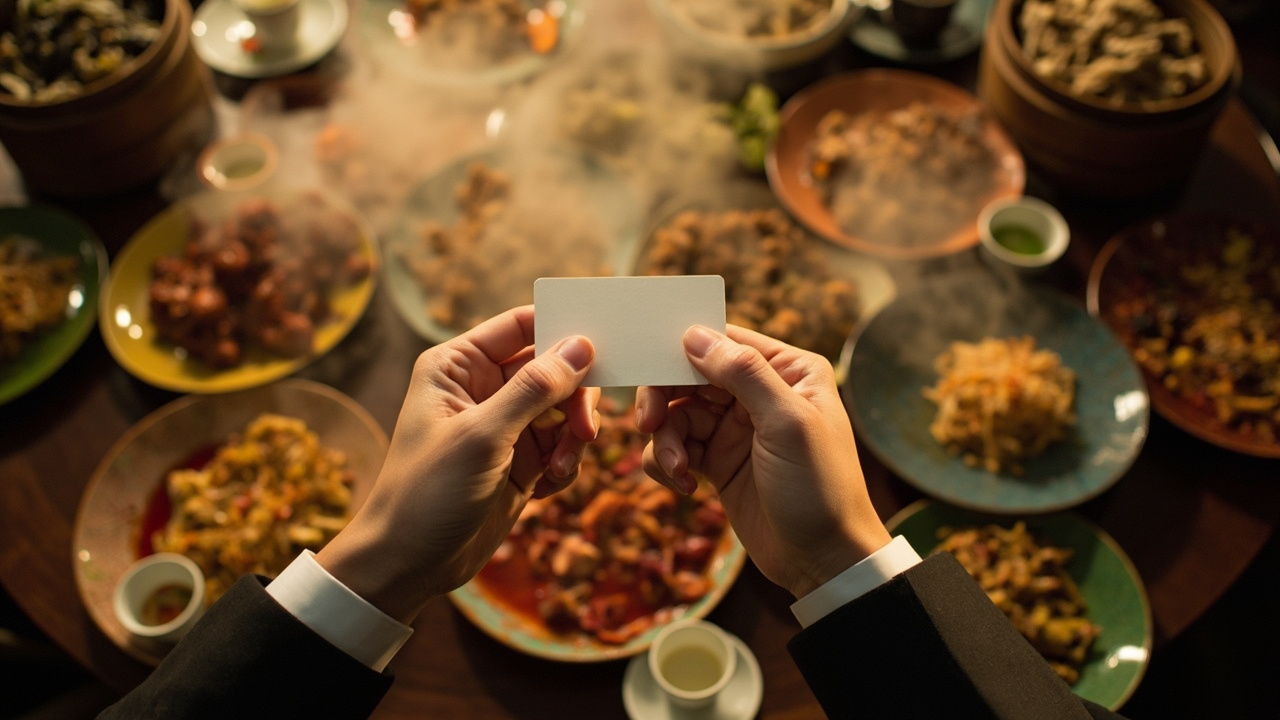
Business cards deserve their own note. Hand yours over with both hands, text facing the recipient so they can read it without turning it. Then — and this is the part Westerners forget — actually look at it for a few seconds before putting it away. Don’t shove it straight into your pocket. Don’t write on it. If you’re at a meeting, leave it on the table in front of you for the duration. I watched a German colleague slide a card into his back pocket without looking, and the room went slightly cold for the rest of the meeting. Nobody said anything. They didn’t have to.
For cash, the same applies: hand it over with both hands, or place it on the counter rather than pressing it directly into someone’s palm. WeChat Pay and Alipay have made most of this moot for daily transactions — see our China payment apps guide for setup — but cash still matters at temples, small stalls, and anywhere with a “no scan” sign.
Tipping, Paying, and the Bill Fight
Do not tip. This is not a “tip less” situation — it’s a “tipping is genuinely awkward” situation. Restaurants, taxis, hotels, tour guides: no tip expected, and in some cases offering one causes mild confusion or even offense. The price is the price. If you want to show appreciation, a warm thank-you and a five-star review on the app matter more.
The bill fight is a real thing you’ll witness. When a group of Chinese friends or colleagues eat together, someone will grab the bill, someone else will physically try to stop them, and there’s a brief choreographed struggle near the cashier. This is not fake. It’s a genuine social ritual about who gets to be generous. If you’re the guest, let your host win — trying to pay as a foreign guest can come across as refusing hospitality. If you’re hosting, you may need to be quietly sneaky: excuse yourself to the “bathroom” and pay on the way. I’ve done this. It works.
Personal Space, Touching, and Public Behavior
China is a high-contact culture in some ways and a low-contact one in others, and it takes a week to feel the difference. On the subway at rush hour, strangers will press against you without apology — that’s just density, not rudeness. But outside of crowds, don’t touch people casually: no hand on the shoulder, no friendly back-slap, no ruffling a kid’s hair without asking. Don’t touch anyone’s head at all, actually. The head is considered the most sacred part of the body in traditional belief.
Pointing with a single finger is considered rude — use an open hand, or nod in the direction. Beckoning someone with your index finger curled upward is also a no; use your whole hand, palm down, fingers waving gently toward you. And the big one: don’t lose your temper in public. Raising your voice, arguing loudly, or making a scene causes everyone around you to lose face, including the person you’re angry at. If something goes wrong — a wrong order, a bad taxi route — stay calm, smile, and use a translation app. It works better than volume every single time.
Gift-Giving — What to Bring and What to Never Bring
If you’re visiting a Chinese home or meeting a business contact, bring a small gift. Good options: nice tea, imported chocolate, a bottle of wine or whiskey from your home country, or something regional and hard to find in China. Wrap it in red or gold if you can — those are lucky colors. Avoid white and black wrapping, which are associated with funerals.
Things to never give: clocks (sounds like “attending a funeral” in Chinese), sharp objects like knives or scissors (they cut relationships), umbrellas (sounds like “separation”), and anything in sets of four (the number four sounds like “death”). Pears are also avoided for the same reason as umbrellas. If you’re giving money, put it in a red envelope (红包, hónghbāo) — never hand cash directly as a gift.
When you receive a gift, don’t open it immediately in front of the giver unless they insist. Set it aside, thank them warmly, and open it later. This is the opposite of Western custom and it trips people up constantly. I once opened a gift in front of a host and watched her face flicker — not offended, just surprised. She recovered instantly. But I learned.
Temple and Religious Site Etiquette
At Buddhist and Daoist temples, dress modestly — shoulders and knees covered, no beachwear. Walk clockwise around pagodas and stupas. Don’t point at statues of Buddha or bodhisattvas, and don’t turn your back to them for photos. If you want to take a photo of monks or worshippers, ask first with a gesture; many will say yes, some will say no, and both are fine.
Incense is offered with three sticks, lit, and held with both hands while bowing three times. You can participate if you want, or just watch respectfully. Don’t step on the raised thresholds at temple doorways — step over them. This is one of those small things that locals notice immediately. And if you’re at a working temple rather than a tourist site, keep your voice down. I’ve seen tourists take phone calls inside the main hall of a temple in Hangzhou. The monks didn’t say anything. Everyone else stared.
Bathrooms, Hygiene, and the Practical Stuff
Public restrooms in China range from spotless (malls, airports, high-speed rail stations) to genuinely rough (rural bus stations, some parks). Carry your own tissue — it’s rarely provided. Many stalls are squat toilets; if you’ve never used one, the trick is to face the hooded end and squat fully, not hover. Some places have both squat and Western-style; look for the sign with a seated figure.
Don’t flush toilet paper in older buildings — put it in the bin next to the toilet. In newer malls and hotels, flushing is fine, but the bin is still there as a backup. Hand sanitizer is your friend. And if you’re heading to a smaller city or rural area, download an offline translation app before you go — English signage drops off sharply outside Beijing, Shanghai, and the main tourist corridors. For connectivity, see our China SIM card and internet guide.
Queuing, Transit, and Public Order
Chinese cities are orderly in a way that surprises first-timers. Subway queues are marked with arrows on the platform floor, and people actually follow them. High-speed rail boarding is by car number and seat, and it’s calm. The chaos you’ve heard about happens mostly at tourist sites, holiday crowds, and bus stations — not in daily city life.
That said, personal space in queues is tighter than in the West. People will stand closer than you’re used to. Don’t take it personally and don’t step back aggressively; you’ll just end up at the back of the line. On escalators, stand right, walk left. On the subway, let people off before you get on. These small things make you invisible in the best way. If you’re planning rail travel, our China high-speed rail guide covers the ticketing quirks.
Drinking and Toasting — The Baijiu Problem
At a formal dinner, toasting matters. The host will toast the table, then individuals. When someone toasts you, stand if they’re standing, hold your glass with both hands (or right hand supporting the base), and clink the rim of your glass below the rim of theirs — lower is more respectful. Say “gānbēi” (干杯) if you’re drinking it all, or “suíbiàn” (随便) if you’re sipping.
Baijiu is the trap. It’s a clear sorghum liquor, often 40–60% alcohol, and it’s served in tiny glasses that refill fast. You are not expected to keep up. The polite move is to sip, not down it, and to say “wǒ jiǔliàng bù hǎo” (我酒量不好) — “my alcohol tolerance is bad.” Nobody will force you. If you don’t drink at all, that’s fine too; just toast with tea or juice and nobody blinks. I’ve done entire business dinners on sparkling water and been treated perfectly well.
Language, Tone, and the Magic Phrases
You don’t need Mandarin to travel in China. You do need three phrases: “nǐ hǎo” (你好, hello), “xièxie” (谢谢, thank you), and “bù hǎo yì si” (不好意思, excuse me / sorry / my bad). That last one is the workhorse. It covers bumping into someone, arriving late, asking a stranger for help, and getting out of an awkward moment. Say it with a small smile and you’ll get a smile back almost every time.
Don’t shout English at people who don’t understand it. Use a translation app, type your question, and show the screen. This is normal and nobody finds it strange. If someone tries to practice English with you, that’s usually friendly, not a scam — though if they immediately invite you to a “tea ceremony,” walk away. That’s a known tourist trap in Beijing and Shanghai. For everything else, see our Beijing guide and Shanghai guide for city-specific norms.
FAQ summary
The most important etiquette takeaways for first-time visitors to China are: use both hands to give and receive things, never stick chopsticks upright in rice, don’t tip, and stay calm in public even when frustrated. Gift-giving has specific taboos (no clocks, umbrellas, sharp objects, or sets of four), and temple visits require modest dress and quiet behavior. English is workable in major cities with a translation app, but learning “bù hǎo yì si” will carry you further than any other phrase. Most Chinese people are forgiving of foreign mistakes and will quietly correct you rather than take offense.
FAQ
Q: Do I need to speak Mandarin to travel in China? A: No, but you need a translation app. Google Translate works if you have a VPN; otherwise download Pleco or Baidu Translate before you arrive. Learn “nǐ hǎo,” “xièxie,” and “bù hǎo yì si” and you’ll handle 90% of daily interactions. English signage is common in Beijing, Shanghai, and major tourist sites, but drops off fast elsewhere.
Q: Is it rude to not finish all the food on my plate? A: Actually, leaving a small amount of rice at the end of a meal is a polite signal that you’re full. Cleaning your bowl completely can suggest you want more. That said, don’t leave half a plate of food — that reads as dislike of the cooking. Aim for a few grains of rice left, and everything else finished.
Q: Should I tip taxi drivers and restaurant staff? A: No. Tipping is not customary in mainland China and can cause confusion or mild offense. Prices are fixed, service charges are included, and staff are paid wages. If you want to show appreciation, a warm thank-you or a five-star review in the app is more meaningful.
Q: What should I never give as a gift in China? A: Avoid clocks (associated with funerals), umbrellas (associated with separation), sharp objects like knives (they “cut” relationships), pears (same as umbrellas), and anything in sets of four (the number four sounds like “death”). Good gifts are tea, imported chocolate, wine, or regional items from your home country. Wrap in red or gold, never white or black.
Q: Can I take photos inside temples? A: Usually yes for the buildings and grounds, but never photograph monks or worshippers without asking first. Don’t point at Buddha statues, don’t turn your back to them for selfies, and don’t use flash inside main halls. If you see a “no photography” sign, respect it — these are working religious sites, not just tourist attractions.
Q: Do I need a VPN in China? A: Yes, if you want to use Google, Instagram, WhatsApp, or most Western news sites. Install and test your VPN before you fly — once you’re in China, VPN websites are often blocked and you can’t download one. Alternatively, use Chinese apps: WeChat for messaging, Baidu Maps for navigation, and Didi for ride-hailing.
Q: What’s the most common mistake foreigners make in China? A: Honestly? Losing their temper in public. Traffic, wrong orders, and language barriers will happen, and raising your voice causes everyone around you to lose face. Stay calm, smile, use your translation app, and you’ll get better results every time. The second most common is forgetting to use both hands when handing over money or a card.
The Honest Wrap-up
This guide is for the traveler who wants to do it right without turning into a nervous wreck about it. It’s not for someone who wants a rigid rulebook — China doesn’t work that way. The rules bend, the corrections are gentle, and the people are far more forgiving than the internet makes them sound. If you remember nothing else, remember this: use both hands, don’t stab your rice, don’t tip, and stay calm. That’s 80% of it. The other 20% you’ll learn by watching the people around you, which is exactly how everyone else learned it too. Book the flight. You’ll be fine.
More guides you may like

Top 10 Bridges in China
China's bridges are engineering marvels spanning mountains, rivers, and seas. Here are 10 of the most spectacular, from ancient stone to modern steel.
8 min read

Top 10 Buddhist Sites in China
From the Leshan Giant Buddha to the Dunhuang Caves, these 10 Buddhist sites represent 2,000 years of China's spiritual heritage.
9 min read

Top 10 Day Trips from Beijing You Shouldn't Miss
Beijing is packed with history, but some of China's best experiences are just a few hours away. Here are 10 day trips that will transform your visit.
9 min read

Top 10 Hidden Gems in China Off the Beaten Path
Beyond the Great Wall and Terracotta Warriors, China has incredible hidden destinations few tourists ever reach. Here are 10 underrated gems worth the detour.
9 min read

Top 10 Markets and Shopping Streets in China
From Shanghai's Bund to Beijing's Silk Street - 10 markets where foreigners can haggle, explore, and bring home authentic Chinese goods.
9 min read

Top 10 Museums in China You Shouldn't Miss
China's museums span 5,000 years of civilization. These 10 - from the Palace Museum to Xi'an's terracotta gallery - are unmissable for culture lovers.
9 min read