
Shaanxi Travel Guide
TODO: Extract from article (100-160 chars)
Shaanxi Travel Guide
The old man at the noodle stall in Xi’an’s Muslim Quarter didn’t speak a word of English, and I didn’t speak enough Shaanxi dialect to order properly. So he just pointed at my empty bowl, then at the giant cauldron of bubbling lamb broth, and raised his eyebrows. I nodded. He filled it up. I paid 12 yuan (about $1.70). That was my third bowl of yangrou paomo in two days, and I’d already decided I wasn’t leaving Shaanxi until I’d eaten it at least five more times.
Shaanxi is the province most first-time visitors to China skip — and it’s the one they shouldn’t. This is where the Silk Road started, where 13 dynasties parked their capitals, and where a farmer digging a well in 1974 accidentally uncovered an army of 8,000 terracotta soldiers that had been buried for 2,200 years. Xi’an, the provincial capital, was the largest city on earth in the 8th century. Today it’s a 13-million-person sprawl with a 600-year-old city wall you can rent a bike on for $6.
What follows is what I’d tell a friend: where to go, what to skip, how much things actually cost in 2026, and the specific mistakes I made so you don’t have to.
Quick answer
Shaanxi’s must-see is Xi’an, home to the Terracotta Army, the Ming city wall, and the Muslim Quarter food scene — plan 3–4 days minimum. Most Western passport holders can enter China visa-free for up to 30 days (check your nationality), and Xi’an is reachable from Beijing by high-speed rail in 4.5 hours ($75–115 / ¥540–830). Best seasons are April–May and September–October; summer is brutally hot (40°C/104°F) and winter air quality is poor.
The Short Version
If you have 90 seconds: fly or train into Xi’an, stay inside the city wall near the Bell Tower, do the Terracotta Army on a weekday morning, eat your way through the Muslim Quarter at night, and if you have two extra days, take the high-speed train to Huashan for the plank walk and to Yan’an if you care about modern Chinese history. Skip the Tang Dynasty dinner shows unless you love kitsch. Budget $80–120/day including hotel, food, and tickets.
How I Picked These
I’ve been through Shaanxi five times since 2019, most recently in October 2025. Everything here I’ve either done myself or vetted with people who live there — a Xi’an-based tour guide named Wang who I met on a train, a hostel manager in Hancheng, a Chengdu friend whose family is from Baoji. I’ve eaten at the tourist traps and the local spots. I’ve paid too much for a taxi from the airport (don’t — take the metro). I’ve also skipped things on purpose: the Huaqing Hot Springs show, the “Tang Dynasty” banquet, most of the souvenir markets. What’s left is the stuff I’d actually send a friend to.
Comparison Table
| Rank | Place | Best For | Approx Cost (USD) | Time Needed | When to Go |
|---|---|---|---|---|---|
| 1 | Xi’an | Food, history, city wall, Terracotta Army | $70–120/day | 3–4 days | Apr–May, Sep–Oct |
| 2 | Terracotta Army (Lintong) | The single most important archaeological site in China | $17 (¥120) entry | Half day | Weekday morning |
| 3 | Mount Hua (Huashan) | Hiking, plank walk, sunrise | $25–50 + cable car | 1–2 days | Apr–Jun, Sep–Oct |
| 4 | Muslim Quarter, Xi’an | Street food, atmosphere | $10–20 for a full meal crawl | 2–3 hours | Evening, any day |
| 5 | City Wall bike ride | Best intro to Xi’an | $6 (¥45) rental | 2 hours | Late afternoon |
| 6 | Big Wild Goose Pagoda | Tang history, fountain show | $7 (¥50) | 2 hours | Evening |
| 7 | Shaanxi History Museum | Context before Terracotta Army | Free (reserve ahead) | 3 hours | Weekday |
| 8 | Yan’an | Modern Chinese history, caves | $50–80/day | 1–2 days | May–Oct |
| 9 | Hancheng | Ancient town without tourists | $40–60/day | 1 day | Apr–Oct |
| 10 | Famen Temple | Buddhist relic, underground palace | $17 (¥120) | Half day | Any |
1. Xi’an — The City That Doesn’t Get Enough Credit
I landed in Xi’an on a Tuesday afternoon in October, checked into a hostel near the South Gate, and walked out to find a man in his 70s doing tai chi on top of the city wall while a drone hovered above him filming. That’s Xi’an in one image: 3,000 years of history, and someone’s always filming it.
Most foreigners treat Xi’an as a two-night stopover on the Beijing–Shanghai–Guilin circuit. That’s a mistake. The city was the eastern terminus of the Silk Road and the capital of 13 dynasties, including the Tang, when it was called Chang’an and had a population over a million — larger than any city in Europe at the time. The Muslim Quarter exists because Arab and Persian traders settled here in the 7th century and never left. Their descendants still run the food stalls.
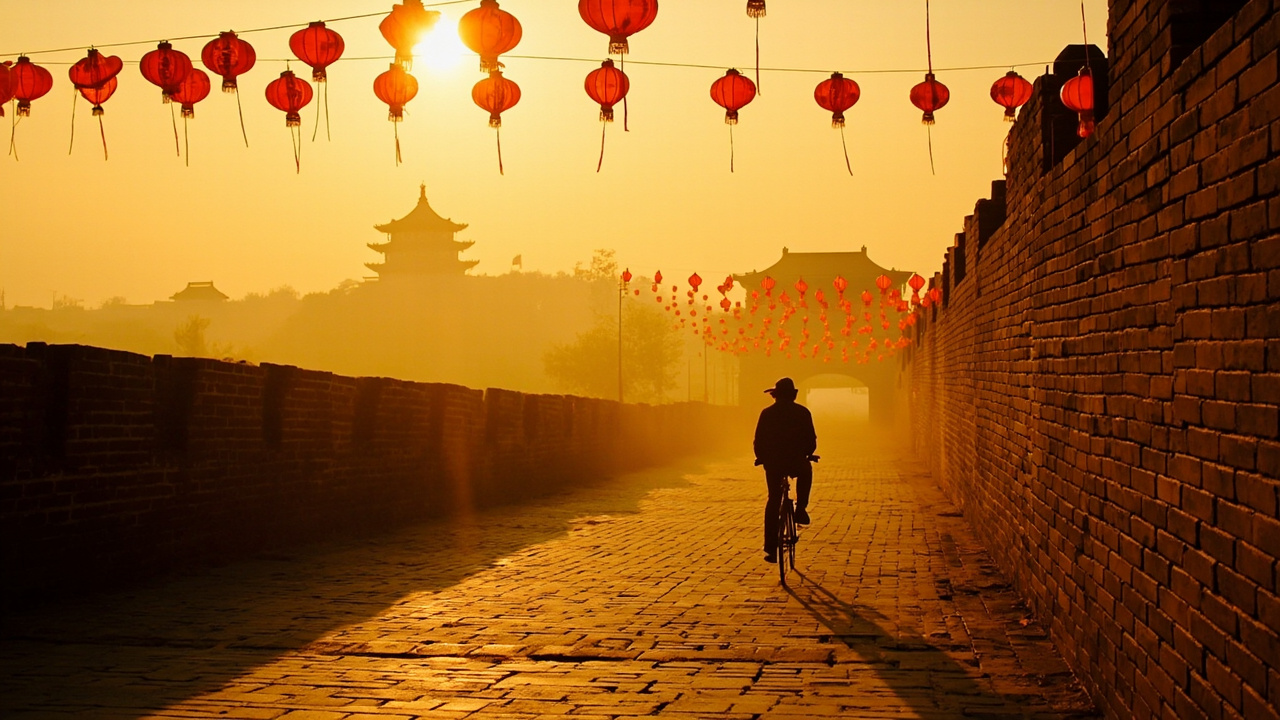
The city wall is the best-preserved in China, 14 km (8.7 mi) around, and you can rent a bike on top for ¥45 ($6) for 90 minutes. Do it at sunset. The Bell and Drum Towers anchor the center; the Drum Tower has a drum performance most afternoons around 5pm that’s worth 20 minutes.
📍 Location: City center, Beilin District. Most sights are inside or just outside the wall. 🎫 Entry fee: City wall ¥54 ($7.50); Bell Tower ¥30 ($4); Drum Tower ¥30 ($4); combined ticket ¥50 ($7). 🕒 Opening hours: Wall 8am–10pm (last bike rental 8pm); towers 8:30am–9pm. 🚇 How to get there: From Xi’an Xianyang Airport, take the Airport Intercity Line to Beikezhan, transfer to Metro Line 2, exit at Yongningmen (South Gate). About 70 minutes, ¥16 ($2.20). From Xi’an North Railway Station (high-speed rail), Metro Line 2 direct to Yongningmen, 25 minutes. ⏰ When to visit: April–May and September–October. Avoid July–August (40°C/104°F) and December–February (bad air). Weekdays are noticeably calmer. 💡 Insider tips: Buy the Shaanxi History Museum ticket online 3 days ahead — it’s free but sells out. Set up Alipay or WeChat Pay before you arrive; almost nothing takes cash now. Download a VPN before you land. English is limited outside hotels, so have a translation app ready.
The bowl of yangrou paomo I mentioned at the top — lamb soup with torn-up flatbread you crumble in yourself — cost me ¥38 ($5.30) at a place near the Drum Tower with no English menu. Point at what the person next to you is eating. It works.
2. Terracotta Army — Worth Every Cliché
I’d seen the photos a hundred times. I still wasn’t ready. Pit 1 is the size of an aircraft hangar, and the soldiers are lined up in battle formation, and every single face is different. A guide pointed out one with a slight mustache, another with a crooked nose, another who looks about 19. They were modeled on real people. That detail hit me harder than the scale.
The site (officially the Emperor Qinshihuang’s Mausoleum Site Museum) is in Lintong, 40 km east of Xi’an. It was discovered in 1974 by farmers digging a well — you can still see the well site. Three pits are open; Pit 1 is the largest and most impressive. Pit 2 has the cavalry and archers, Pit 3 is the command post. The bronze chariots in the exhibition hall are worth 20 minutes.
📍 Location: Lintong District, 40 km east of Xi’an. 🎫 Entry fee: ¥120 ($17) peak season (Mar–Nov), ¥90 ($13) low season. Includes all pits. 🕒 Opening hours: 8:30am–6pm (Mar 16–Nov 15), 8:30am–5:30pm (Nov 16–Mar 15). Last entry 1 hour before close. 🚇 How to get there: Take Metro Line 9 to Huaqingchi, then bus 613 (¥5, 15 min) to the site. Or book a shared van from your hotel (~¥100 round trip). Do NOT take the “Tourist Bus 5” (306) from Xi’an Railway Station unless you want to be dropped at a jade factory first. ⏰ When to visit: Arrive by 8:30am on a weekday. By 10am the tour groups arrive and Pit 1 becomes a scrum. Avoid Chinese public holidays entirely. 💡 Insider tips: Hire a licensed guide at the entrance (¥150–200 / $21–28 for 2 hours) — without context it’s just statues. Bring your passport; you need it to buy the ticket. The on-site restaurant is terrible; eat before you go.
The mistake I made: I booked a “small group tour” for $45 that included two forced shopping stops. Just go independently. It’s easy.
3. Mount Hua (Huashan) — For People Who Like Heights and Fear
I am scared of heights. I did the plank walk anyway. My hands were sweating so badly I had to re-grip the harness three times. Worth it.
Huashan is one of China’s five sacred Taoist mountains, about 120 km east of Xi’an, and it’s the most dramatic day trip in Shaanxi. The peaks are granite spires rising 2,154 m (7,067 ft), connected by ridgelines with chain handrails and, in places, wooden planks bolted to vertical cliffs. The famous “plank walk in the sky” is a 30-meter stretch of boards over a 1,000-meter drop, with a harness you clip to a cable. It costs ¥30 ($4.30) extra and takes 15 minutes.
📍 Location: Huayin City, Weinan, 120 km east of Xi’an. 🎫 Entry fee: ¥160 ($23) peak, ¥100 ($14) low season. Cable cars ¥80–140 ($11–20) each way depending on route. 🕒 Opening hours: 7am–7pm (peak), 9am–5pm (winter). Overnight climbing is allowed for sunrise. 🚄 How to get there: High-speed train from Xi’an North to Huashan North, 30 minutes, ¥55 ($8). From the station, free shuttle to the visitor center, then a 40-minute bus to the cable car base. ⏰ When to visit: April–June and September–October. Avoid summer weekends (crowds) and winter (ice on the chains). 💡 Insider tips: Take the West Peak cable car up and hike down — saves your knees. Bring gloves; the chains are cold and rough. There are basic guesthouses on the summit (¥150–300 / $21–42) if you want sunrise. Cash is still useful at the summit stalls.
I met a retired teacher from Zhengzhou on the West Peak who had climbed Huashan 14 times. She told me the sunrise from the East Peak is the only one worth getting up for. I believed her.
4. Muslim Quarter — Eat First, Ask Later
The Muslim Quarter (Huimin Jie) is not a single street — it’s a grid of alleys northwest of the Drum Tower, and the food is the point. I ate there four nights in a row and never repeated a dish.
This is the descendant community of Silk Road traders, and the food reflects it: lamb, cumin, hand-pulled noodles, and flatbreads. Must-try: roujiamo (often called a Chinese hamburger, ¥15 / $2), yangrou paomo (lamb soup with torn bread, ¥38 / $5.30), liangpi (cold noodles in chili oil, ¥10 / $1.40), and bianshi (a chewy noodle dish unique to Shaanxi, ¥15 / $2). The pomegranate juice stalls are everywhere and cost ¥10.
📍 Location: Lianhu District, northwest of the Drum Tower. 🎫 Entry fee: Free to walk; food ¥10–50 per item ($1.40–7). 🕒 Opening hours: Busiest 5pm–11pm. Some stalls open at 10am. 🚇 How to get there: Metro Line 2 to Bell Tower, Exit B, walk northwest 5 minutes. ⏰ When to visit: Evening, any day. Friday evenings are busiest because of prayers at the Great Mosque. 💡 Insider tips: The Great Mosque (¥25 / $3.50) is a working mosque and worth a quiet visit — dress modestly. Skip the front-row stalls on Beiyuanmen Street; the best food is one alley deeper. Bring small bills; some stalls don’t take cards.
The specific mistake: I bought a “lamb skewer” from a stall with a giant photo menu and paid ¥30 for three skewers. The stall next door, with no menu, charged ¥10 for the same thing. Walk one alley in.
5. City Wall Bike Ride — The Best Two Hours in Xi’an
Rent a bike on top of the Ming city wall at sunset and ride the full 14 km loop. I did this on my first evening in Xi’an and it reset my whole sense of the city — you see the moat, the towers, the neighborhoods inside and outside, and the sun going down over the Drum Tower.
The wall was built in 1370 and is 12–14 meters thick at the base, wide enough for chariots. It’s the most complete ancient city fortification in China. Bikes rent for ¥45 ($6) for 90 minutes (single) or ¥90 ($13) for a tandem. There are four main gates; South Gate (Yongningmen) has the biggest bike rental operation.
📍 Location: Around the old city, Beilin District. 🎫 Entry fee: ¥54 ($7.50) to access the wall; bike rental extra. 🕒 Opening hours: 8am–10pm (last bike rental 8pm). 🚇 How to get there: Metro Line 2 to Yongningmen, Exit D, walk to the South Gate. ⏰ When to visit: Late afternoon, 1–2 hours before sunset. Weekdays are much quieter. 💡 Insider tips: The wall is uneven in places — watch for the brick joints. Bring water; there are few vendors up there. If you’re not a confident cyclist, walk a section instead; it’s still worth it.
6. Big Wild Goose Pagoda — Tang Dynasty, Evening Fountains
The pagoda is 1,300 years old and was built to house Buddhist scriptures brought back from India by the monk Xuanzang — the real historical figure behind Journey to the West. The surrounding square has a fountain show most evenings at 8:30pm that’s genuinely fun, especially for kids.
📍 Location: Yanta District, south of the city center. 🎫 Entry fee: ¥50 ($7) to enter the temple grounds; ¥30 ($4) extra to climb the pagoda. 🕒 Opening hours: 8am–6:30pm (temple), fountain show 8:30pm (schedule varies seasonally). 🚇 How to get there: Metro Line 3 or 4 to Dayanta, Exit C. ⏰ When to visit: Late afternoon for the temple, stay for the fountain show. 💡 Insider tips: The fountain show is free and very crowded — arrive 30 minutes early for a good spot. The pagoda itself is a climb up narrow stairs; skip it if you’re claustrophobic.
7. Shaanxi History Museum — Do This Before the Terracotta Army
I did this backwards — I saw the Terracotta Army first, then the museum. Do it the other way. The museum gives you the context (Zhou, Qin, Han, Tang dynasties) that makes the army make sense. It’s free but you must reserve online 3 days ahead with your passport number, and tickets vanish fast.
📍 Location: Yanta District, next to the Big Wild Goose Pagoda. 🎫 Entry fee: Free (reservation required). 🕒 Opening hours: 9am–5:30pm, closed Mondays. 🚇 How to get there: Metro Line 2 to Xiaozhai, Exit D, walk 10 minutes. ⏰ When to visit: Weekday morning, right at opening. 💡 Insider tips: The Tang dynasty gold and silver galleries are the highlight. English audio guide ¥30 ($4).
8. Yan’an — For History Nerds Only
Yan’an is where the Chinese Communist Party based itself from 1935 to 1948, and it’s a pilgrimage site for domestic tourists. If you care about 20th-century Chinese history, it’s fascinating. If you don’t, skip it — it’s a 2.5-hour high-speed train from Xi’an and there’s not much else to do.
📍 Location: Northern Shaanxi, 300 km north of Xi’an. 🎫 Entry fee: Most sites free or ¥20–50 ($3–7). 🚄 How to get there: High-speed rail from Xi’an North, 2.5 hours, ¥110 ($16). ⏰ When to visit: May–October. 💡 Insider tips: The cave dwellings (yaodong) are the visual highlight. English signage is limited.
9. Hancheng — The Ancient Town Nobody Visits
Hancheng is a well-preserved Ming-Qing town 3 hours from Xi’an by train, and I saw maybe four other foreign tourists in two days. The Sima Qian Temple (honoring the “father of Chinese history”) and the ancient city walls are the draw. It’s quiet, cheap, and feels like the China people imagine before they arrive.
📍 Location: Southeastern Shaanxi, near the Yellow River. 🎫 Entry fee: ¥60 ($8.50) combined ticket for main sites. 🚄 How to get there: High-speed rail from Xi’an North to Hancheng, ~2.5 hours, ¥100 ($14). ⏰ When to visit: April–October. 💡 Insider tips: Stay overnight — the town empties at 5pm and it’s magical. Very little English; bring a translation app.
10. Famen Temple — The Buddhist Relic
Famen Temple houses what’s believed to be a finger bone of the Buddha, discovered in 1987 in an underground palace sealed for 1,100 years. The modern complex (built 2009) is enormous and a bit Disneyfied, but the relic and the Tang dynasty treasures in the museum are the real deal.
📍 Location: Fufeng County, 120 km west of Xi’an. 🎫 Entry fee: ¥120 ($17). 🕒 Opening hours: 8:30am–5:30pm. 🚄 How to get there: High-speed rail from Xi’an North to Famen Temple Station, 40 minutes, ¥45 ($6.50), then shuttle. ⏰ When to visit: Any season; weekday mornings are quietest. 💡 Insider tips: The relic is only displayed on certain days (check ahead). The underground palace museum is the highlight.
FAQ summary
Shaanxi’s core trip is Xi’an (3–4 days) plus a day trip to the Terracotta Army, with Mount Hua as an optional 1–2 day extension. Most Western visitors can enter China visa-free for up to 30 days in 2026, and Xi’an is 4.5 hours from Beijing by high-speed rail. Budget $80–120/day. You need Alipay or WeChat Pay set up before arrival, a VPN installed before you land, and a translation app — English is limited outside hotels. Best months are April–May and September–October.
FAQ
Q: Do I need a visa to visit Shaanxi in 2026? A: Most Western passport holders (US, UK, EU, Australia, Canada) can enter China visa-free for up to 30 days as of 2026 — check your specific nationality, as the policy has been extended and adjusted several times. If you’re not eligible, apply for a standard tourist visa at a Chinese embassy. See our visa guide for details.
Q: How do I get from Beijing to Xi’an? A: High-speed rail from Beijing West to Xi’an North takes 4.5–5.5 hours and costs ¥540–830 ($75–115) for second class. Trains run every 30–60 minutes from about 7am to 7pm. Book on Trip.com or the official 12306 app with your passport.
Q: Is Xi’an safe for solo travelers? A: Yes — Xi’an is very safe, including at night in the Muslim Quarter. Petty theft is rare. The main annoyances are aggressive souvenir sellers near the Terracotta Army and unlicensed taxis at the airport. Use the metro or Didi (China’s Uber).
Q: How much does a day in Xi’an cost? A: Budget $80–120 per day including a mid-range hotel ($40–70), three meals ($15–25), tickets ($15–30), and transport ($5–10). Backpackers can do $50/day; luxury hotels push it to $250+.
Q: Do I need a VPN in Shaanxi? A: Yes, if you want Google, Instagram, WhatsApp, or Gmail. Install a VPN before you arrive — they’re hard to download once you’re inside China. See our SIM and internet guide.
Q: What’s the best time of year to visit? A: April–May and September–October. Summer is 35–40°C (95–104°F) with heavy crowds; winter has poor air quality and many attractions run reduced hours.
Q: Is English widely spoken? A: Not outside major hotels and tourist sites. Download a translation app (Baidu Translate or Google Translate offline) and learn a few phrases. Younger people in Xi’an often speak some English.
The Honest Wrap-up
This guide is for travelers who want to eat well, walk a lot, and don’t mind a language barrier. It’s not for people who want a resort vacation or who need everything in English. If that’s you, Shaanxi will frustrate you — and that’s fine, it’s not for everyone.
If you’re on the fence: go. Xi’an is one of the great underrated cities in Asia, and the Terracotta Army is one of the few tourist sites on earth that actually exceeds the hype. Book the flight. Learn to say xièxie (thank you). Order the lamb soup. You’ll figure out the rest.
More guides you may like

Top 10 Bridges in China
China's bridges are engineering marvels spanning mountains, rivers, and seas. Here are 10 of the most spectacular, from ancient stone to modern steel.
8 min read

Top 10 Buddhist Sites in China
From the Leshan Giant Buddha to the Dunhuang Caves, these 10 Buddhist sites represent 2,000 years of China's spiritual heritage.
9 min read

Top 10 Day Trips from Beijing You Shouldn't Miss
Beijing is packed with history, but some of China's best experiences are just a few hours away. Here are 10 day trips that will transform your visit.
9 min read
Top 10 Hidden Gems in China Off the Beaten Path
Beyond the Great Wall and Terracotta Warriors, China has incredible hidden destinations few tourists ever reach. Here are 10 underrated gems worth the detour.
9 min read
Top 10 Markets and Shopping Streets in China
From Shanghai's Bund to Beijing's Silk Street - 10 markets where foreigners can haggle, explore, and bring home authentic Chinese goods.
9 min read
Top 10 Museums in China You Shouldn't Miss
China's museums span 5,000 years of civilization. These 10 - from the Palace Museum to Xi'an's terracotta gallery - are unmissable for culture lovers.
9 min read