
China Hot Pot Guide
The first time I ate hot pot in China, I was in a basement restaurant in Chongqing with no English menu, no idea what I was doing, and a pot of bubbling red…
China Hot Pot Guide
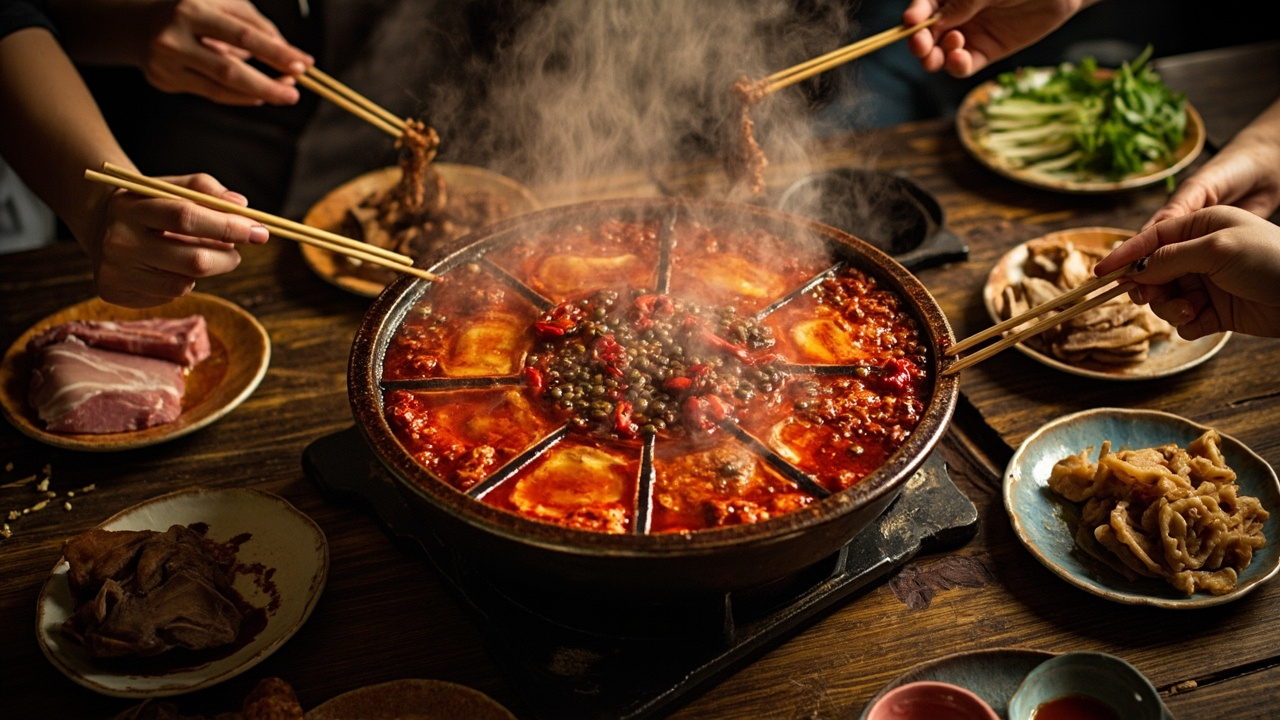
The first time I ate hot pot in China, I was in a basement restaurant in Chongqing with no English menu, no idea what I was doing, and a pot of bubbling red oil that looked like it could strip paint. The waiter brought me a small bowl of sesame paste and garlic, I nodded like I understood, and then I watched the table next to me for ten minutes before I dared put anything in. By the end of the meal my shirt smelled like chili and I’d burned my tongue twice. I went back the next night.
That’s the thing about hot pot. It looks intimidating from the outside, and honestly, the first time is a little chaotic. But once you understand the rhythm — what goes in first, how long things cook, how to build your dipping sauce — it becomes one of the most social, most satisfying meals you can have in China. It’s also one of the cheapest. A full meal for two people, with beer, usually runs $20–35 (¥145–255).
This guide covers the regional styles worth seeking out, what to order, how to pay, and the small things that trip up first-timers. I’ve eaten hot pot in maybe fifteen cities over seven years here. Some of it was incredible. Some of it was fine. I’ll tell you which is which.
Quick answer
Hot pot is a shared meal where you cook raw ingredients in a simmering pot of broth at your table; the two main styles are Sichuan/Chongqing (numbing-spicy beef tallow broth) and Beijing-style instant-boiled mutton (mild, copper pot, dipped in sesame sauce). Expect to pay $12–25 (¥85–180) per person at a mid-range restaurant, and most chains have picture menus or English ordering via QR code, so you don’t need fluent Mandarin. If you’re on a visa-free transit or a standard tourist visa, no special setup is needed — just make sure Alipay or WeChat Pay is linked to your card before you sit down, because many hot pot places are cashless.
The Short Version
If you only have time for one hot pot meal, make it Chongqing-style, in Chongqing, at a place with plastic stools and no English sign. Order the nine-grid pot, get beef tallow (牛油) not vegetable oil, and ask for mild (微辣) even if you think you can handle spice — Chinese “mild” is not Western mild. Skip the tourist-facing chains in Chengdu’s Jinli area. They’re fine. They’re not the point.
How I Picked These
I’ve eaten hot pot in Chongqing, Chengdu, Beijing, Xi’an, Guangzhou, Kunming, Harbin, and a handful of smaller cities, usually dragged there by friends or coworkers who insisted I hadn’t tried the real version yet. I asked a Chengdu taxi driver named Liu where he takes his family, and he drove me forty minutes outside the ring road to prove a point. I’ve also made mistakes — ordering “medium spicy” in Chongqing, which I do not recommend, and once paying $60 for a meal that should have cost $18 because I didn’t check the menu prices first. The places below are the ones I’d send a friend to, ranked by how worth-the-detour they are.
Comparison Table
| Rank | Place | Best For | Approx Cost (USD) | Time Needed | When to Go |
|---|---|---|---|---|---|
| 1 | Chongqing (citywide) | The real thing, beef tallow, nine-grid | $15–25 | 2 hrs | Oct–Apr |
| 2 | Chengdu | Sichuan hot pot, ma la balance, English menus | $15–25 | 2 hrs | Sep–Nov, Mar–May |
| 3 | Beijing | Instant-boiled mutton, copper pot, mild | $20–35 | 1.5 hrs | Nov–Feb |
| 4 | Guangzhou | Cantonese seafood hot pot, mild broth | $25–40 | 2 hrs | Nov–Mar |
| 5 | Kunming | Mushroom hot pot, wild fungi | $20–35 | 2 hrs | Jun–Oct |
| 6 | Xi’an | Lamb hot pot, Muslim Quarter style | $12–20 | 1.5 hrs | Oct–Apr |
| 7 | Harbin | Northeast style, big portions, hearty | $15–25 | 2 hrs | Dec–Feb |
| 8 | Shanghai | Upscale/fusion hot pot, clean, pricey | $35–60 | 2 hrs | Year-round |
| 9 | Chaoshan (Shantou) | Beef hot pot, clear broth, subtle | $20–35 | 2 hrs | Oct–Mar |
| 10 | Yunnan border towns | Ethnic minority styles, sour/spicy | $10–20 | 2 hrs | Year-round |
Chongqing — Where Hot Pot Was Invented (Probably)
I ate my first real Chongqing hot pot in a basement on a side street off Jiefangbei, and I remember the smell before I remember anything else — beef tallow and chili hitting a hot wok, thick enough to hang in the air. The pot came out with a solid block of red fat that melted into liquid over five minutes. The waiter pointed at the nine-grid insert and said something I didn’t catch. I nodded.
Why it’s special: Chongqing is the spiritual home of the spicy hot pot style, and locals will tell you Chengdu’s version is a watered-down copy. They’re not entirely wrong. The broth here is beef tallow (牛油), not vegetable oil, which gives it a heavier, richer mouthfeel and a heat that clings to your lips. The nine-grid (九宫格) pot isn’t decorative — different sections hold different temperatures, so you cook quick items in the outer rings and slow items in the center.
📍 Location: Everywhere, but the best cluster is in Yuzhong District around Jiefangbei and the older neighborhoods of Nan’an across the river.
🍽️ Entry fee: No entry fee. Meal cost $15–25 (¥110–180) per person.
🕐 Opening hours: Most open 11am–2am, some 24 hours.
🚇 How to get there: Take Metro Line 2 to Linjiangmen Station, Exit A, walk 8 minutes north into the side streets. Or Line 1 to Jiaochangkou, Exit 4.
⏰ When to visit: October to April. Summer is brutally hot and the hot pot makes it worse. Go on a weekday before 6pm to avoid the queue.
💡 Insider tips: Ask for 微辣 (wēi là, mild) even if you like spice. Order 油碟 (yóu dié) — a bowl of sesame oil and garlic — to dip cooked meat in; it cools the heat. The 毛肚 (tripe) cooks in 15 seconds, not 2 minutes. Don’t wear anything you care about.
I once watched a Chongqing local eat an entire bowl of raw garlic cloves alongside his meal and then order a second bowl. I did not attempt this.
Chengdu — The Gentler, More Accessible Version
Chengdu hot pot is what I’d recommend to a first-timer who’s nervous. The broth is still spicy, but it’s usually a 50/50 split of red and clear, and the restaurants are more used to foreigners. My friend Liu, the taxi driver, took me to a place in the Wuhou district that had no English menu but a picture menu on the wall, and I pointed at things for twenty minutes.
Why it’s special: Chengdu’s version uses more vegetable oil and a broader spice blend, so it’s less heavy than Chongqing’s. The city also has a huge hot pot culture — there are chains with hundreds of locations, plus small family spots that have been running for decades. It’s a good place to learn the mechanics without feeling like you’re failing a test.
📍 Location: Wuhou District and Jinjiang District have the highest concentration. Avoid the Jinli Ancient Street tourist strip.
🍽️ Entry fee: No entry fee. Meal cost $15–25 (¥110–180) per person.
🕐 Opening hours: Typically 11am–midnight.
🚇 How to get there: Metro Line 3 to Gaoshengqiao Station, Exit B, walk 10 minutes. Or Line 1 to Nijiaqiao, Exit C.
⏰ When to visit: September–November or March–May. Avoid Chinese New Year week, when many small places close.
💡 Insider tips: Order 鸳鸯锅 (yuānyāng guō) — the split pot — if you’re with someone who can’t handle spice. The 香油 (sesame oil) dipping bowl is standard here. Ask for 冰粉 (bīng fěn), a cold jelly dessert, to cool your mouth between bites. Most places accept WeChat Pay and Alipay but not foreign cards directly.
The first time I ordered “medium” spice in Chengdu, I spent the next day unable to taste anything. Order mild.
Beijing — Instant-Boiled Mutton and Copper Pots
Beijing hot pot is a completely different animal. No chili, no red oil — just a copper pot with a chimney, filled with clear water and a few scallions, and paper-thin slices of lamb that cook in about eight seconds. I ate this on a freezing January night in a hutong restaurant near Dongsi, and it was one of the best meals I’ve had in China.
Why it’s special: This is the original northern Chinese hot pot, and it’s about the quality of the lamb, not the broth. The meat is sliced so thin it’s almost translucent. You dip it in a thick sesame paste (麻酱) mixed with fermented tofu and chives, and the whole thing is mild, nutty, and deeply warming. It’s also much easier on the stomach than Sichuan style.
📍 Location: Dongcheng District, especially around Dongsi and the hutongs north of the Forbidden City.
🍽️ Entry fee: No entry fee. Meal cost $20–35 (¥145–255) per person.
🕐 Opening hours: 11am–10pm, some until midnight.
🚇 How to get there: Metro Line 5 to Dongsi Station, Exit C, walk 6 minutes north into the hutong alleys.
⏰ When to visit: November–February. This is winter food. Go on a weekday evening.
💡 Insider tips: Order 手切羊肉 (hand-cut lamb), not the machine-sliced stuff — it’s worth the extra cost. The sesame dipping sauce is not optional; build it yourself from the condiment bar. Ask for 糖蒜 (sweet pickled garlic) on the side. Most Beijing hot pot places have English menus in tourist areas.
If you’re spending time in Beijing, this fits naturally into a full Beijing itinerary — do it after a cold day at the Great Wall.
Guangzhou — Cantonese Seafood Hot Pot
Guangzhou hot pot is what you eat when you want hot pot but not spice. The broth is usually a clear chicken or pork base, sometimes with herbs, and the star ingredients are seafood — shrimp, fish balls, clams, and sliced fish. I ate this with a coworker’s family during Lunar New Year, and it was the most relaxed hot pot meal I’ve had.
Why it’s special: Cantonese cooking is about freshness and restraint, and their hot pot reflects that. You taste the ingredients, not the seasoning. It’s also a great option if you’re traveling with kids or anyone who can’t handle chili.
📍 Location: Tianhe District and Yuexiu District.
🍽️ Entry fee: No entry fee. Meal cost $25–40 (¥180–290) per person.
🕐 Opening hours: 11am–10pm.
🚇 How to get there: Metro Line 1 to Tiyu Xilu Station, Exit D, walk 5 minutes.
⏰ When to visit: November–March.
💡 Insider tips: Order the 鱼片 (sliced fish) and cook it for 30 seconds only. The 虾滑 (shrimp paste) is a must. Ask for 酱油 (soy sauce) and 姜丝 (shredded ginger) as your dipping sauce, not sesame paste.
Kunming — Mushroom Hot Pot and Wild Fungi
Yunnan is China’s mushroom capital, and from June to October the markets overflow with wild fungi that don’t exist anywhere else. Mushroom hot pot here is a completely different experience — earthy, fragrant, and sometimes slightly psychedelic if you order the wrong thing. I’m not joking about that last part.
Why it’s special: The broth is usually chicken or pork based, and you cook a dozen varieties of fresh mushrooms in it. The flavors are deep and foresty, nothing like the spicy styles. It’s also one of the few hot pot styles that vegetarians can fully enjoy.
📍 Location: Wuhua District, especially around the Zhuanxin Farmers’ Market area.
🍽️ Entry fee: No entry fee. Meal cost $20–35 (¥145–255) per person.
🕐 Opening hours: 11am–9pm.
🚇 How to get there: Metro Line 2 to Dongfeng Square Station, Exit A, walk 10 minutes.
⏰ When to visit: June–October for wild mushroom season.
💡 Insider tips: Only eat at restaurants that cook the mushrooms for you — some wild varieties are toxic if undercooked, and the restaurant will time it. Ask which mushrooms are safe. Don’t buy wild mushrooms at the market to cook yourself.
Xi’an — Lamb Hot Pot in the Muslim Quarter
Xi’an’s hot pot is influenced by its large Muslim population, so it’s lamb-heavy and often served with hand-pulled noodles. The style is closer to Beijing’s than Sichuan’s — mild broth, sesame dipping sauce, and lots of lamb.
Why it’s special: It’s a good middle ground between the northern and western styles, and the Muslim Quarter setting makes it a memorable meal. The lamb here is excellent.
📍 Location: Lianhu District, in and around the Muslim Quarter.
🍽️ Entry fee: No entry fee. Meal cost $12–20 (¥85–145) per person.
🕐 Opening hours: 11am–10pm.
🚇 How to get there: Metro Line 2 to Zhonglou Station, Exit A, walk 8 minutes west into the Muslim Quarter.
⏰ When to visit: October–April.
💡 Insider tips: Order 羊肉串 (lamb skewers) alongside — they’re grilled, not boiled, and they’re the best thing on the menu. The 酸梅汤 (sour plum drink) cuts the richness. Cash is more accepted here than in bigger cities.
Harbin — Northeast Style, Big Portions
Harbin hot pot is hearty, salty, and designed for -20°C weather. The portions are enormous, the broth is usually a pork bone base, and there’s often sauerkraut (酸菜) involved. I ate this after a day at the Ice Festival and it was exactly what I needed.
Why it’s special: It’s the most filling hot pot style in China, and it pairs perfectly with Harbin’s brutal winters. The flavors are simpler than Sichuan but deeply satisfying.
📍 Location: Daoli District, near Central Street.
🍽️ Entry fee: No entry fee. Meal cost $15–25 (¥110–180) per person.
🕐 Opening hours: 11am–10pm.
🚇 How to get there: Metro Line 2 to Central Street Station, Exit 3, walk 5 minutes.
⏰ When to visit: December–February.
💡 Insider tips: Order the 酸菜 (pickled cabbage) — it’s the regional specialty. The 血肠 (blood sausage) is traditional but not for everyone. Bring cash as backup; some smaller places don’t take foreign-linked payment apps.
Shanghai — Upscale and Fusion
Shanghai has the most expensive and most “international” hot pot in China. You’ll find everything from high-end Japanese-style shabu-shabu to fusion places with truffle broth. It’s not where I’d send someone for their first hot pot, but it’s a good option if you’re already in the city and want something clean and easy.
Why it’s special: The quality is high, the service is polished, and English menus are standard. It’s also the easiest place to eat hot pot if you’re nervous about the whole experience.
📍 Location: Jing’an District and Huangpu District.
🍽️ Entry fee: No entry fee. Meal cost $35–60 (¥255–435) per person.
🕐 Opening hours: 11am–11pm.
🚇 How to get there: Metro Line 2 to Jing’an Temple Station, Exit 1, walk 3 minutes.
⏰ When to visit: Year-round.
💡 Insider tips: Book ahead on weekends. The 鸳鸯锅 (split pot) is standard here. Tipping is not expected. If you’re doing a Shanghai city break, this is a good dinner option after a day of walking.
Chaoshan (Shantou) — Beef Hot Pot, Clear Broth
Chaoshan beef hot pot is the most subtle style in China, and arguably the most refined. The broth is clear — sometimes just water with a few herbs — and the entire meal is about the beef, which is sliced into a dozen different cuts, each with a specific cooking time measured in seconds.
Why it’s special: It’s the opposite of Sichuan hot pot. No spice, no heavy oil, just clean beef flavor. If you’ve ever had high-end Japanese beef, this is the Chinese equivalent.
📍 Location: Shantou, Guangdong Province, Jinping District.
🍽️ Entry fee: No entry fee. Meal cost $20–35 (¥145–255) per person.
🕐 Opening hours: 11am–10pm.
🚇 How to get there: Shantou has no metro; take a taxi from the city center, about 15 minutes.
⏰ When to visit: October–March.
💡 Insider tips: Each cut of beef has a recommended cooking time — usually 8–15 seconds. Ask the server to explain. The dipping sauce is usually just soy sauce and sesame. Don’t over-order; the beef is rich.
Yunnan Border Towns — Ethnic Minority Styles
In the smaller towns along Yunnan’s borders with Myanmar, Laos, and Vietnam, you’ll find hot pot styles that don’t exist anywhere else — sour fish broth, lemongrass, fermented vegetables, and herbs I couldn’t identify. I ate one in a town near Ruili that I still think about.
Why it’s special: These are the least commercialized hot pot styles in China, and they reflect the influence of Dai, Jingpo, and other minority cuisines. The flavors are sour, herbal, and often quite spicy in a different way from Sichuan.
📍 Location: Ruili, Tengchong, and smaller towns along the border.
🍽️ Entry fee: No entry fee. Meal cost $10–20 (¥70–145) per person.
🕐 Opening hours: Varies; usually 10am–9pm.
🚇 How to get there: Domestic flights or long-distance buses from Kunming.
⏰ When to visit: Year-round, but avoid the rainy season (June–August).
💡 Insider tips: Bring a translation app — English is rare here. Ask what’s in the broth before ordering. The 柠檬草 (lemongrass) and 香茅 (citronella) flavors are common. Cash is king.
FAQ summary
The most important things to know: hot pot is a shared, cook-your-own meal where you order raw ingredients and boil them in broth at your table; the two main styles are spicy Sichuan/Chongqing (beef tallow, numbing chili) and mild northern Beijing-style (clear broth, lamb, sesame dipping sauce). Expect $12–25 per person at mid-range places, and almost all restaurants are cashless — set up Alipay or WeChat Pay before you go. You don’t need fluent Mandarin; picture menus and QR-code ordering are common, but a translation app helps in smaller cities.
FAQ
Q: Do I need to speak Chinese to eat hot pot? A: No, but it helps. Most mid-range and chain restaurants have picture menus or QR-code ordering with English options. In smaller cities or older family restaurants, you may need a translation app like Pleco or Baidu Translate. Pointing at what the next table is eating works surprisingly well.
Q: How spicy is Sichuan hot pot really? A: Spicier than most foreigners expect. “Mild” (微辣) in Chongqing is roughly what Americans would call medium-hot. If you’re not used to Sichuan peppercorn, the numbing sensation (麻) can be surprising — it’s not just heat, it’s a tingling feeling. Order the split pot (鸳鸯锅) if you’re unsure.
Q: What should I order on my first visit? A: Start with thinly sliced beef or lamb, tofu skin (豆腐皮), enoki mushrooms, potato slices, and leafy greens. Add 虾滑 (shrimp paste) and 毛肚 (tripe) if you’re feeling adventurous. Skip the blood sausage and intestines until you know you like them.
Q: How do I pay at a hot pot restaurant? A: Almost all use QR-code payment through WeChat Pay or Alipay. Set these up before your trip — see our China payment guide for the setup process. Some smaller restaurants still take cash, but don’t count on it.
Q: Is hot pot safe for vegetarians? A: Yes, but you need to be careful. Many broths are meat-based, so ask for 清汤 (clear broth) or a mushroom base. Vegetable and tofu options are plentiful. In Yunnan, mushroom hot pot is naturally vegetarian-friendly.
Q: How long does a hot pot meal take? A: Plan for 1.5–2 hours. It’s a slow meal — you cook, eat, talk, cook more. Don’t rush it. Locals often spend three hours at the table.
Q: Do I need a VPN or SIM card for hot pot restaurants? A: You’ll need a working phone for QR-code menus and payment. Get a local SIM or eSIM before you arrive. A VPN is useful for Google and WhatsApp, but not required for the meal itself.
The Honest Wrap-up
This guide is for people who want to eat hot pot the way locals do, not the way a hotel concierge recommends. If you’re looking for a quiet, air-conditioned, English-speaking experience with a wine list, Shanghai is your city. If you want the real thing — plastic stools, no English, a pot of red oil that scares you a little — go to Chongqing. My one piece of advice: order mild the first time, even if you think you can handle it. You can always go spicier on the second visit. And there will be a second visit.
More guides you may like

Top 10 Bridges in China
China's bridges are engineering marvels spanning mountains, rivers, and seas. Here are 10 of the most spectacular, from ancient stone to modern steel.
8 min read

Top 10 Buddhist Sites in China
From the Leshan Giant Buddha to the Dunhuang Caves, these 10 Buddhist sites represent 2,000 years of China's spiritual heritage.
9 min read

Top 10 Day Trips from Beijing You Shouldn't Miss
Beijing is packed with history, but some of China's best experiences are just a few hours away. Here are 10 day trips that will transform your visit.
9 min read

Top 10 Hidden Gems in China Off the Beaten Path
Beyond the Great Wall and Terracotta Warriors, China has incredible hidden destinations few tourists ever reach. Here are 10 underrated gems worth the detour.
9 min read

Top 10 Markets and Shopping Streets in China
From Shanghai's Bund to Beijing's Silk Street - 10 markets where foreigners can haggle, explore, and bring home authentic Chinese goods.
9 min read

Top 10 Museums in China You Shouldn't Miss
China's museums span 5,000 years of civilization. These 10 - from the Palace Museum to Xi'an's terracotta gallery - are unmissable for culture lovers.
9 min read