
Jiuzhaigou Valley Travel Guide
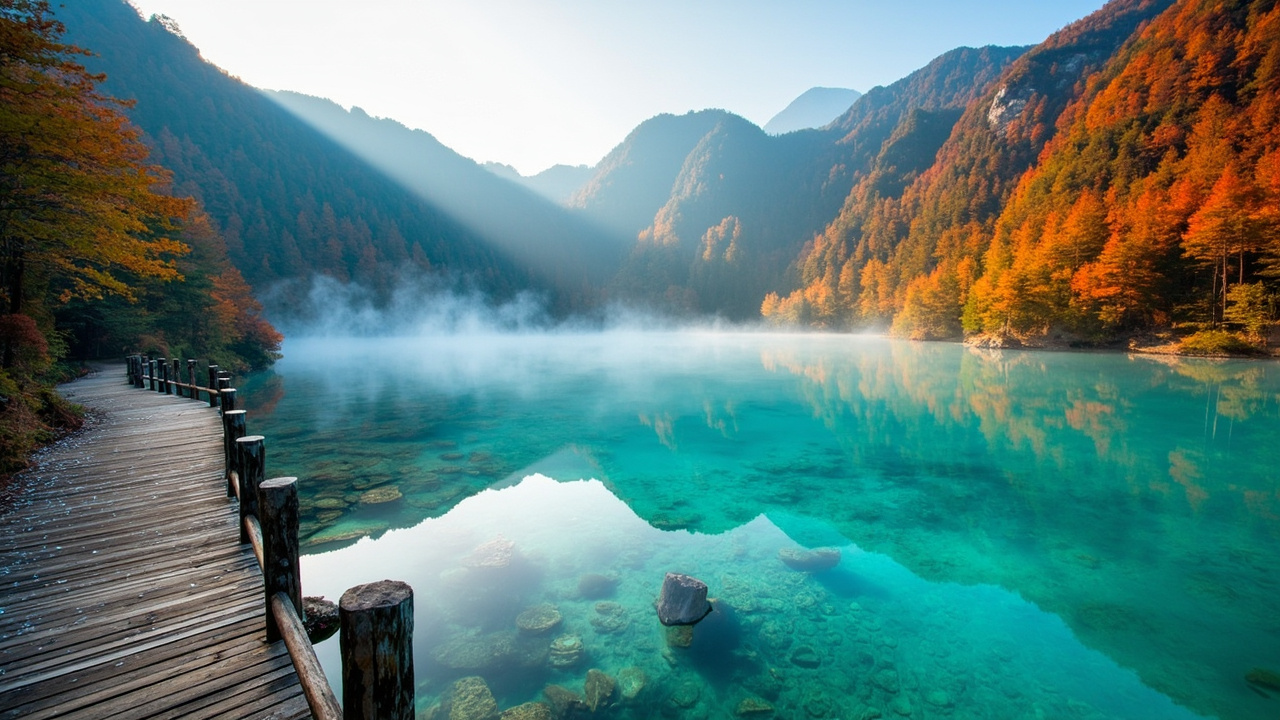
I was standing on the wooden boardwalk at Five Flower Lake when a woman next to me started crying. Not quietly either. She just looked at that water —…
Jiuzhaigou Valley Travel Guide
I was standing on the wooden boardwalk at Five Flower Lake when a woman next to me started crying. Not quietly either. She just looked at that water — turquoise, then green, then blue, then turquoise again, all in the same lake — and started sobbing. Her husband patted her shoulder and said something in Mandarin I didn’t catch. I pretended not to notice and took about forty photos of the same tree stump.
That’s Jiuzhaigou. It does something to people.
The valley sits in northern Sichuan, about 430 km (267 miles) north of Chengdu, wedged into the Min Mountains near the Gansu border. It’s a UNESCO World Heritage Site, a national park, and honestly one of the few places in China where the hype is actually justified. The Tibetan name means “Valley of Nine Villages” — seven of those villages still exist inside the park, and around 1,000 Tibetan residents live there year-round.
The lakes here are the main event. They’re called haizi in Chinese — “sons of the sea” — and the color comes from calcium carbonate deposits and dissolved minerals that scatter light in a very specific way. That’s the science. The experience is different. You walk from lake to lake for hours, and each one is somehow more absurd than the last.
This guide covers everything I wish I’d known before my first trip: how to actually get there, what to skip, where to eat, how much it costs, and the one mistake almost every foreign tourist makes on day one.
Quick answer
Jiuzhaigou Valley is a UNESCO-listed national park in northern Sichuan, best visited between late September and late October when autumn colors peak. Entry costs approximately $25–30 USD (¥180–220 CNY) per day plus a mandatory shuttle bus fee of around $13 USD (¥90 CNY), and the park is roughly a 7–8 hour bus ride or a 1-hour flight from Chengdu. Most foreign visitors can now enter China visa-free for up to 30 days under the 2025–2026 expanded visa-free policy, so no advance visa is needed for most American, European, and Southeast Asian passport holders.
The Short Version
Go in late October. Fly from Chengdu to Jiuzhai Huanglong Airport if you can afford it — the bus takes all day and the mountain roads are rough. Stay two full days minimum, three if you’re slow like me. Book your park ticket online in advance through the official WeChat mini-program; walk-up tickets are technically possible but you’ll waste half a morning. Bring cash for small vendors and set up Alipay or WeChat Pay before you arrive. Altitude is real — the park sits between 2,000 and 3,100 meters (6,500–10,200 ft) — so don’t sprint up the stairs on day one.
How I Picked These
I’ve been to Jiuzhaigou three times: once in summer (mistake), once in late October (perfect), and once in early April when half the park was still closed from snow. I’ve stayed in Zhangzha Town, in a Tibetan homestay inside the park, and once in a hotel so cheap I could hear the neighbors’ TV through the wall. I talked to park rangers, a Tibetan woman named Zhuoma who runs a small teahouse near Shuzheng Village, and about a dozen other travelers who all had strong opinions. Everything below comes from those trips. Where I’m unsure about a current price, I say so.
Comparison Table
| Rank | Place | Best For | Approx Cost (USD) | Time Needed | When to Go |
|---|---|---|---|---|---|
| 1 | Five Flower Lake (五花海) | The iconic photo | Included in park ticket | 45 min | Oct, early morning |
| 2 | Long Lake (长海) | Scale and silence | Included | 1 hour | Sep–Oct, midday |
| 3 | Nuorilang Waterfall (诺日朗瀑布) | Waterfalls | Included | 30 min | Jun–Oct |
| 4 | Shuzheng Lakes (树正群海) | Easy walking, villages | Included | 2 hours | Any season |
| 5 | Mirror Lake (镜海) | Reflections | Included | 30 min | Oct, before 9am |
| 6 | Pearl Shoal Waterfall (珍珠滩瀑布) | Up-close waterfall | Included | 45 min | Jun–Oct |
| 7 | Panda Lake (熊猫海) | Wildlife lore | Included | 30 min | Sep–Oct |
| 8 | Arrow Bamboo Lake (箭竹海) | Quiet corners | Included | 45 min | Oct |
| 9 | Zharu Valley (扎如沟) | Trekking, fewer crowds | Separate permit ~$15 | Half day | May–Oct |
| 10 | Huanglong Scenic Area (黄龙) | Travertine terraces | ~$25 (¥170) | Full day | Jun–Oct |
Five Flower Lake — The One That Made a Stranger Cry
I’ve seen a lot of “famous” lakes. Most of them are fine. Five Flower Lake is not fine. It’s genuinely strange.
The water is so clear you can see fallen tree trunks 12 meters down, lying crisscrossed on the bottom like someone dropped a box of matches. The color shifts depending on where the sun is — deep teal in the shade, almost neon turquoise in direct light, and a greenish-gold near the edges where the mineral shelf rises.
Here’s what most people don’t realize: the lake is only about 5 meters deep at its deepest point, but the optical illusion makes it look bottomless. The calcium carbonate at the bottom reflects light back up through the water column. That’s why it looks like it’s glowing.
📍 Location: Central Jiuzhaigou, on the Rize Valley branch, about 2 km south of Panda Lake. 🎫 Entry fee: Included in the main park ticket (~$25–30 USD / ¥180–220 CNY). 🕒 Opening hours: Park opens 7:00am, last entry 4:00pm. Five Flower Lake is accessible from park opening. 🚕 How to get there: Take the park shuttle bus from the main entrance to the Rize Valley terminus, then walk downhill 15 minutes. Or walk up from Pearl Shoal if you’re feeling ambitious. ⏰ When to visit: Late October, and get there before 9:30am. By 11am the tour groups arrive and the boardwalk becomes a slow-moving queue. 💡 Insider tips: The best viewing platform is the upper one, not the one right at the bus stop. Most people stop at the first platform and never walk the extra 200 meters. Also, the reflection is best when the water is still — early morning before the wind picks up. Bring a polarizing filter if you shoot photos; it cuts the glare and reveals the submerged logs. 🍜 Food note: There’s a small snack stall near the bus stop selling yak jerky and instant noodles. The noodles are ¥15 ($2 USD) and honestly pretty good when you’re cold.
Long Lake — Where the Valley Just Ends
Long Lake is the largest and deepest lake in Jiuzhaigou — 4,340 meters long, 88 meters deep, sitting at 3,060 meters elevation. It’s also the least colorful. That’s the point.
I sat on a rock here for about an hour in October 2023, watching the light shift across the far end of the valley. No one was talking. A Tibetan guide was quietly explaining something to a small group in Mandarin, and even the kids were silent. It’s that kind of place.
The lake has no visible outlet, which puzzled hydrologists for decades. Water seeps out through underground channels and reappears 20 km away. The local Tibetan story is that a monster lives at the bottom. I have no evidence either way.
📍 Location: The southern end of Zechawa Valley, the highest point most visitors reach. 🎫 Entry fee: Included in the park ticket. 🕒 Opening hours: Same as park hours (7:00am–6:00pm, last entry 4:00pm). 🚕 How to get there: Shuttle bus from the main entrance to the Zechawa Valley terminus. About 30 minutes. ⏰ When to visit: Midday, when the sun is high and the far mountains are lit. Late October for snow-dusted peaks. 💡 Insider tips: Altitude here is 3,060 meters. If you’re coming straight from Chengdu (500m), take it slow. The stairs down to the lake edge are steep and there’s no handrail in places. The small Tibetan prayer flag area on the left side of the viewing platform is a real active shrine — walk around it, not through it. There’s a public toilet about 100 meters back toward the bus stop. 🧣 What I wore: A down jacket in October. It was 3°C at 10am.
Nuorilang Waterfall — The Wide One
Nuorilang is 320 meters wide and 24 meters tall, which makes it one of the widest waterfalls in China. It’s not the tallest, not the most dramatic, but it has a certain presence.
The first time I saw it, I was underwhelmed. I’d just come from Pearl Shoal, which is more intimate and honestly more fun. But then I walked to the lower viewing platform and the whole thing opened up — the water spreads across the entire cliff face like a curtain, and the sound is a low constant roar that you feel in your chest.
📍 Location: Central Jiuzhaigou, at the junction of Rize and Zechawa valleys. It’s the main transfer point for shuttle buses. 🎫 Entry fee: Included. 🕒 Opening hours: Park hours. 🚕 How to get there: Every shuttle bus passes through Nuorilang. It’s impossible to miss. ⏰ When to visit: June through October for full water flow. In winter it partially freezes, which is beautiful but very different. 💡 Insider tips: The upper viewing platform is crowded. Walk down to the lower one — most tour groups don’t bother. There’s a small café near the bus stop that sells surprisingly decent coffee for ¥25 ($3.50 USD). The bathrooms here are the cleanest in the park; use them. 📸 Photo tip: Shoot from the left side of the lower platform. The right side gets backlit in the afternoon.
Shuzheng Lakes — Where You Actually See How People Live
This is the part of Jiuzhaigou that most guides skip, and I think that’s a mistake.
The Shuzheng Lakes are a series of terraced pools connected by small waterfalls, running through Shuzheng Village. There are actual people living here — Tibetan families in traditional wooden houses, with prayer flags strung across the water and yaks grazing on the hillside above. It’s not a museum. It’s a neighborhood.
I met a woman named Zhuoma here who runs a tiny teahouse out of her front room. She poured me butter tea without asking and refused to take money. We sat for twenty minutes while she told me about her grandson who’d gone to Chengdu for university. I understood maybe 30% of it. She didn’t seem to mind.
📍 Location: Lower Jiuzhaigou, near the main entrance. About 3 km from the gate. 🎫 Entry fee: Included. 🕒 Opening hours: Park hours. 🚕 How to get there: Shuttle bus to Shuzheng stop, or walk up from the main entrance (about 45 minutes, mostly flat). ⏰ When to visit: Any season. It’s lower altitude, so it stays open year-round. 💡 Insider tips: Walk the boardwalk between the lakes rather than taking the bus. It’s about 2 km and takes an hour at a slow pace. The Tibetan houses on the far side of the water are private residences — don’t walk up to the doors. If someone offers you butter tea, accept it; refusing is considered rude. Cash is useful here; some small vendors don’t take mobile payments. 🍵 What I drank: Butter tea. It tastes like salty, buttery milk. I liked it. My travel companion did not.
Mirror Lake — The One You Have to Get Up Early For
Mirror Lake is exactly what it sounds like. On a still morning in October, the water is so flat it doubles the mountains above it perfectly. The effect lasts about 90 minutes after sunrise, then the wind picks up and it’s gone.
I got there at 8:15am on my second trip and the reflection was already breaking up. On my third trip I was there at 7:20am and it was perfect. The difference between those two mornings was about 55 minutes and roughly 400 photos.
📍 Location: Rize Valley, just below Five Flower Lake. 🎫 Entry fee: Included. 🕒 Opening hours: Park hours. 🚕 How to get there: Shuttle to Mirror Lake stop, or walk down from Five Flower Lake (20 minutes). ⏰ When to visit: October, before 8:30am. Weekdays are noticeably quieter than weekends. 💡 Insider tips: The bus schedule means you can’t get to Mirror Lake before about 7:15am unless you’re staying inside the park. If reflections are the priority, book a homestay inside the park (see below). Otherwise, accept that you’ll get a partial reflection and enjoy it anyway. 🏨 Where I stayed: A Tibetan homestay inside the park, ¥450/night ($62 USD), booked through a Chinese friend. Not easy to book as a foreigner without help.
Pearl Shoal Waterfall — The Fun One
Pearl Shoal is not the biggest waterfall in the park but it’s the most interactive. The boardwalk goes right alongside it, close enough that you get sprayed. The water tumbles over a wide, shallow shelf of travertine, breaking into thousands of tiny droplets that look like — you guessed it — pearls.
The first time I walked this boardwalk, I got completely soaked and didn’t care. The second time, I brought a rain jacket. Learn from me.
📍 Location: Rize Valley, between Mirror Lake and Five Flower Lake. 🎫 Entry fee: Included. 🕒 Opening hours: Park hours. 🚕 How to get there: Shuttle to Pearl Shoal stop. The boardwalk starts right at the bus stop. ⏰ When to visit: June–October for maximum flow. Late October for fewer crowds. 💡 Insider tips: You will get wet. Bring a light rain jacket even on sunny days. The boardwalk is one-way in peak season — you can’t turn around, so commit. There’s a small viewing platform at the bottom that most people miss; look for the stairs on the left. 💦 What happened to me: I dropped my phone trying to take a selfie. It survived. Barely.
Panda Lake — No, There Are No Pandas
Let me save you the disappointment: there are no pandas at Panda Lake. The name comes from the fact that the lake’s three-tiered shape supposedly resembles a panda, and wild pandas were once spotted in the surrounding forest. You will not see one. I’ve tried. Three times.
What you will see is a beautiful three-tiered lake with clear water and a small waterfall between the tiers. It’s worth 30 minutes.
📍 Location: Rize Valley, above Five Flower Lake. 🎫 Entry fee: Included. 🕒 Opening hours: Park hours. 🚕 How to get there: Shuttle to Panda Lake stop. ⏰ When to visit: September–October. 💡 Insider tips: The upper tier has the best color. Most people stop at the lower tier and take a photo, then leave. Walk up the stairs. Also, this is a good spot to use the bathroom — there’s one near the bus stop and it’s usually less crowded than the ones at Five Flower Lake. 🐼 Reality check: If you want actual pandas, go to the Chengdu Research Base of Giant Panda Breeding. Different trip.
Arrow Bamboo Lake — The Quiet One
Arrow Bamboo Lake is where I go when I need to get away from people. It’s not on most tour itineraries, and the shuttle bus stop is easy to walk past. That’s the point.
The lake is named for the arrow bamboo that grows on the surrounding slopes — the same bamboo that pandas eat. The water is a deep green, and the reflections here are almost as good as Mirror Lake, without the crowd.
📍 Location: Rize Valley, above Panda Lake. 🎫 Entry fee: Included. 🕒 Opening hours: Park hours. 🚕 How to get there: Shuttle to Arrow Bamboo Lake stop, then walk 5 minutes downhill. ⏰ When to visit: Any time. It’s never crowded. 💡 Insider tips: There’s a small wooden viewing deck on the far side of the lake that you reach by walking around the left shore. It takes 15 minutes and you’ll probably have it to yourself. Bring a book. 📖 What I did: Read for 40 minutes. Best afternoon of the trip.
Zharu Valley — The Trekking Side
Zharu Valley is the only part of Jiuzhaigou where you can do actual hiking without a guide, and it requires a separate permit. Most tourists don’t know it exists.
The trail runs about 12 km through forest and past small Tibetan settlements, with views back into the main valley. It’s not technical, but it’s steep in places and the altitude is real.
📍 Location: Eastern side of the park, accessed from the Zharu Valley entrance near the main gate. 🎫 Entry fee: Separate permit, approximately $15 USD (¥100 CNY). Book at the park entrance office. 🕒 Opening hours: 8:00am–3:00pm, May–October only. 🚕 How to get there: Walk 10 minutes east from the main park entrance to the Zharu Valley gate. ⏰ When to visit: May–October. Avoid July–August (rainy season). 💡 Insider tips: You need to register with your passport at the gate. Bring water — there’s nothing to buy on the trail. The trail is marked but not in English, so download an offline map. Solo hiking is allowed but tell someone where you’re going. 🥾 What I learned: My “quick hike” turned into 5 hours. Bring more water than you think you need.
Huanglong Scenic Area — The Day Trip That’s Actually Worth It
Huanglong is a separate park about 100 km from Jiuzhaigou, and most people combine the two. It’s famous for its travertine terraces — hundreds of shallow, terraced pools cascading down a mountainside, each one a different shade of gold, green, and blue.
Here’s the honest truth: Huanglong is beautiful but it’s a lot of walking at high altitude (3,500+ meters). If you’re short on time or not acclimatized, skip it. If you have an extra day and you’re feeling good, go.
📍 Location: Songpan County, about 2 hours by bus from Jiuzhaigou. 🎫 Entry fee: ~$25 USD (¥170 CNY) plus cable car ~$12 USD (¥80 CNY). 🕒 Opening hours: 8:00am–5:00pm, April–November. 🚕 How to get there: Direct shuttle bus from Jiuzhaigou park entrance, or from Jiuzhai Huanglong Airport. ⏰ When to visit: June–October. Late October for autumn color. 💡 Insider tips: Take the cable car up and walk down. Doing it the other way is brutal. The altitude at the top is 3,600 meters — if you have any heart or lung issues, don’t do this. There’s a small oxygen station near the top cable car station; it’s free. 🚡 What I’d do differently: I walked up. Don’t walk up.
FAQ summary
Jiuzhaigou Valley is best visited in late October, costs roughly $40–50 USD per day in park fees plus accommodation, and is reachable from Chengdu by a 1-hour flight or 7–8 hour bus. Most foreign visitors can enter China visa-free for up to 30 days under the current policy, and the park requires advance online ticket booking through the official WeChat mini-program. Altitude (2,000–3,100m) is the main physical challenge, and two full days inside the park is the minimum to see the highlights without rushing.
FAQ
Q: Do I need a visa to visit Jiuzhaigou as a foreign tourist? A: Most American, European, and Southeast Asian passport holders can enter China visa-free for up to 30 days under the expanded 2025–2026 policy. Check your specific nationality before booking, and see our visa-free transit guide for details.
Q: How do I get from Chengdu to Jiuzhaigou? A: The fastest option is a 1-hour flight from Chengdu Tianfu International Airport to Jiuzhai Huanglong Airport (¥700–1,200 / $95–165 USD), then a 90-minute bus to the park. The cheapest option is a 7–8 hour bus from Chengdu Chadianzi Bus Station (¥145 / $20 USD). See our China train and transport guide for longer-distance connections.
Q: How much does Jiuzhaigou cost per day? A: Park entry is ¥180–220 ($25–30 USD) plus a mandatory shuttle bus fee of ¥90 ($13 USD). Add accommodation in Zhangzha Town (¥200–600 / $28–83 USD per night), meals (¥80–150 / $11–21 USD), and transport. Budget $80–120 USD per day total.
Q: Is Jiuzhaigou safe for foreigners? A: Yes, very safe. Violent crime is essentially nonexistent, and the park is well-managed. The main risks are altitude sickness, slippery boardwalks, and getting separated from your group in the crowds.
Q: Can I pay with Alipay or WeChat Pay? A: Yes, both work throughout the park and in Zhangzha Town. Set them up before you arrive — see our Alipay and WeChat Pay guide for the step-by-step process.
Q: Do I need a VPN or local SIM card? A: Yes, if you want to use Google, WhatsApp, or Instagram. Download a VPN before you arrive (they’re hard to get once you’re in China), and buy a local SIM at Chengdu airport. See our SIM card and internet guide.
Q: How many days do I need in Jiuzhaigou? A: Two full days inside the park is the minimum. Three days lets you add Huanglong or Zharu Valley without rushing. One day is possible but you’ll only see about half the highlights.
The Honest Wrap-up
This guide is for people who want to see one of the genuinely extraordinary natural places on earth and are willing to deal with some logistics to get there. It’s not for people who want a relaxing beach vacation, or who hate crowds, or who can’t handle altitude. If you’re in the first group, book the flight for late October and don’t overthink it. If you’re in the second group, that’s fine — Jiuzhaigou will still be there.
One last thing: bring cash. Not much, maybe ¥500 ($70 USD). Some small vendors, especially in the Tibetan villages, don’t take mobile payments, and you’ll want yak jerky and butter tea without a hassle. And bring a real jacket. The photos make it look warm. It isn’t.
More guides you may like
Top 10 Bridges in China
China's bridges are engineering marvels spanning mountains, rivers, and seas. Here are 10 of the most spectacular, from ancient stone to modern steel.
8 min read

Top 10 Buddhist Sites in China
From the Leshan Giant Buddha to the Dunhuang Caves, these 10 Buddhist sites represent 2,000 years of China's spiritual heritage.
9 min read
Top 10 Day Trips from Beijing You Shouldn't Miss
Beijing is packed with history, but some of China's best experiences are just a few hours away. Here are 10 day trips that will transform your visit.
9 min read
Top 10 Hidden Gems in China Off the Beaten Path
Beyond the Great Wall and Terracotta Warriors, China has incredible hidden destinations few tourists ever reach. Here are 10 underrated gems worth the detour.
9 min read
Top 10 Markets and Shopping Streets in China
From Shanghai's Bund to Beijing's Silk Street - 10 markets where foreigners can haggle, explore, and bring home authentic Chinese goods.
9 min read
Top 10 Museums in China You Shouldn't Miss
China's museums span 5,000 years of civilization. These 10 - from the Palace Museum to Xi'an's terracotta gallery - are unmissable for culture lovers.
9 min read