
Best Street Food in Beijing
The first thing I ate in Beijing was a mistake. I'd landed at Capital Airport after 14 hours, taken the Airport Express to Dongzhimen, and stumbled out onto…
Best Street Food in Beijing
The first thing I ate in Beijing was a mistake. I’d landed at Capital Airport after 14 hours, taken the Airport Express to Dongzhimen, and stumbled out onto the street at 11pm convinced I needed something safe and familiar. I bought a lukewarm hot dog from a Family Mart. Two days later, standing on a plastic stool at a jianbing cart near the Drum Tower, watching a woman named Auntie Zhang crack an egg onto a crepe with one hand while collecting cash with the other, I understood what I’d done wrong. That hot dog cost me 12 yuan. The jianbing cost 8 (about $1.10) and was one of the best things I’ve eaten in seven years of living here.
Beijing street food isn’t a tourist attraction. It’s breakfast for construction workers, a 2am snack for taxi drivers, and the reason I stopped cooking dinner on Tuesdays. Most of it costs less than a coffee in Brooklyn. The catch is that the good stuff isn’t always where the guidebooks point you — and the famous spots are sometimes famous for the wrong reasons.
This guide covers the ten places I actually send friends to when they visit. Not the ones with the longest lines on Xiaohongshu. The ones where I’ve eaten at least four times, where I know roughly what time the good vendor shows up, and where I’ve watched a foreigner successfully order without pointing at a picture. I’ll tell you what to eat, what to skip, and the specific mistakes I made so you don’t have to.
Quick answer
Beijing’s best street food clusters around five areas: the hutongs near Gulou/Drum Tower for jianbing and chuan’r, Niujie for halal Muslim snacks, Wangfujing for first-timer convenience (but not the best quality), the Dongzhimen area for late-night eats, and the university district around Wudaokou for cheap student food. Budget $5–10 (35–70 CNY) per person for a full street food crawl. Most vendors are cashless — set up Alipay or WeChat Pay before you arrive, because many stalls no longer accept cash at all. Best time to go is breakfast (6:30–9am) or after 6pm; midday is dead.
The Short Version
If you only have one night: go to the Gulou hutongs around 7pm, get a jianbing from a cart, then find a chuan’r (lamb skewer) grill and eat standing up. That’s Beijing in one meal. Skip Wangfujing’s “snack street” — it’s a tourist trap with scorpions on sticks. Skip anything with a photo menu in English and a host waving you in. The best food has a hand-painted sign, a queue of locals, and no English at all. Bring your translation app and a sense of humor.
How I Picked These
I’ve lived in Beijing since 2019, first in Chaoyang, now in Dongcheng, and I’ve eaten at every place on this list at least four times — most of them dozens. I don’t trust single visits. A cart can be great on a Tuesday and gone by Friday, so I’ve gone back at different hours, different seasons, and after the vendor changed hands. I also asked the people who actually know: the woman who runs my local fruit stand, a Didi driver named Liu who grew up in Niujie, and a hostel receptionist in Gulou who has fed roughly 4,000 confused foreigners. Three places I originally planned to include got cut because they’d gotten worse since 2023 — more tourists, smaller portions, higher prices. I’d rather send you to nine great spots than ten mediocre ones.
Comparison Table
| Rank | Place | Best For | Approx Cost (USD) | Time Needed | When to Go |
|---|---|---|---|---|---|
| 1 | Gulou Hutong Jianbing Carts | Breakfast, first-timer intro | $1–2 (7–15 CNY) | 20 min | 6:30–9am |
| 2 | Niujie Halal Snack Street | Meat lovers, Muslim food | $5–8 (35–60 CNY) | 1.5 hrs | Lunch or early dinner |
| 3 | Baochao Hutong Chuan’r Grills | Late-night skewers | $6–10 (45–70 CNY) | 1 hr | 7pm–1am |
| 4 | Wangfujing Snack Street | Convenience, photos | $8–15 (60–110 CNY) | 45 min | 5–9pm |
| 5 | Dongzhimen Late-Night Row | Post-bar food | $4–7 (30–50 CNY) | 45 min | 10pm–3am |
| 6 | Wudaokou Student Alley | Cheap eats, variety | $3–6 (20–45 CNY) | 1 hr | 11am–10pm |
| 7 | Huguosi Snack Street | Traditional Beijing snacks | $5–9 (35–65 CNY) | 1 hr | 10am–8pm |
| 8 | Longfusi Temple Market | Trendy, photogenic | $8–14 (60–100 CNY) | 1.5 hrs | Weekends |
| 9 | Qingnian Gou Breakfast Row | Local breakfast, no tourists | $2–4 (15–30 CNY) | 30 min | 6–9am |
| 10 | Sanlitun Back Alleys | Expat-friendly, mixed | $10–18 (70–130 CNY) | 1.5 hrs | 8pm–midnight |
1. Gulou Hutong Jianbing Carts — The Breakfast That Ruined All Other Breakfasts
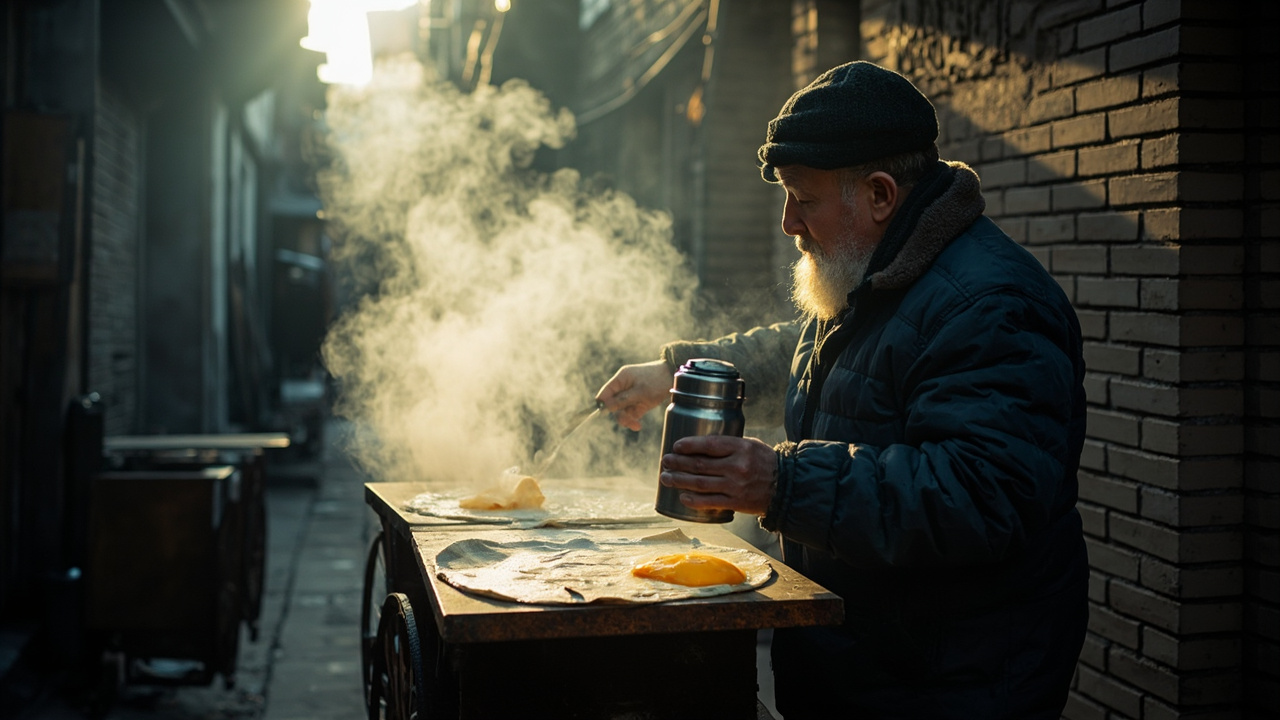
I once watched a man in a suit eat three jianbing in a row at 7am while checking his phone. That’s the energy here. The carts start appearing around 6:30am along the lanes west of the Drum Tower, and by 8am there’s usually a queue of office workers, delivery riders, and the occasional lost tourist.
Jianbing is a thin crepe spread with egg, brushed with sweet bean sauce and chili paste, folded around a crispy cracker, and wrapped in paper. It costs 7–15 CNY ($1–2) depending on how many extras you add. The version I get has two eggs, extra cilantro, and a sausage, which runs about 12 CNY. It’s hot, salty, slightly sweet, and gone in four minutes.
What makes the Gulou carts special isn’t the recipe — it’s the consistency. Auntie Zhang, who sets up near the west entrance of the Drum Tower, has been there for at least six years. She remembers regulars. She’ll ask if you want it spicy by holding up the chili jar and raising her eyebrows, which is the entire language barrier solved in one gesture.
📍 Location: Hutongs around Gulou (Drum Tower), Dongcheng District — specifically the lanes off Gulou Dongdajie 🍜 Entry fee: Free (you pay per item, $1–2) 🕐 Opening hours: 6:30–9:30am, daily (vendors sometimes skip in heavy rain) 🚕 How to actually get there: Take Line 8 to Shichahai Station, Exit A2, walk north 5 minutes toward the Drum Tower. Carts are on the side streets. ⏰ When to visit: Weekday mornings before 8am. Weekends are busier and the good vendors sell out by 9. 💡 Insider tips: Bring small bills as backup even if you’re paying by phone. Say “bu yao la” (不要辣) if you don’t want chili. The cracker inside gets soggy fast — eat it within 10 minutes. If a cart has no queue, that’s usually a bad sign. The mistake I made: I once asked for “extra sauce” by pointing at the bottle, and got a jianbing so salty I had to buy water from the next stall. Point at the chili, not the bean sauce.
2. Niujie Halal Snack Street — Where the Taxi Driver Told Me to Go
Didi driver Liu, who grew up three streets from Niujie, told me in 2021 that if I wanted to understand Beijing food, I should stop eating in Dongcheng and go west. He was right. Niujie is the city’s historic Muslim quarter, centered on the Niujie Mosque, and the food here is a completely different tradition from the Han Chinese snacks you’ll find elsewhere.
The specialty is beef and lamb — grilled, braised, skewered, and stuffed into pastries. The must-try is a beef pancake (牛肉饼), flaky and hot, about 8 CNY ($1.10). Then get lamb skewers from any grill with visible smoke, and finish with a bowl of lamb soup if it’s cold. A full crawl runs $5–8 (35–60 CNY).
This isn’t a tourist area. English is rare. Signs are in Chinese and Arabic. The vendors are friendly but busy, and they will not slow down for you. Have your translation app ready and your payment QR code open.
📍 Location: Niujie Street, Xicheng District, around the Niujie Mosque 🍜 Entry fee: Free 🕐 Opening hours: Most vendors 10am–8pm; grills run later on weekends 🚕 How to actually get there: Take Line 7 to Guang’anmennei Station, Exit B, walk north 8 minutes. Or Line 4 to Caishikou, Exit C, walk west 12 minutes. ⏰ When to visit: Friday around noon, when the mosque lets out and the whole street eats at once. Avoid during Ramadan fasting hours unless you know the etiquette. 💡 Insider tips: Look for the stalls with the longest local queues — usually the beef pancake and the lamb soup. Cash is accepted here more than in Dongcheng, but still bring your phone. Don’t photograph people praying near the mosque. The lamb skewers are best eaten immediately; they get tough in 10 minutes. The food I tried: A lamb soup so rich I had to sit down on a stoop for five minutes afterward. Worth it.
3. Baochao Hutong Chuan’r Grills — The 11pm Skewer Ritual
Baochao Hutong, just east of the Drum Tower, turns into a low-key grill corridor after dark. Not the flashy kind — the kind where plastic stools appear on the sidewalk, a guy with a fan works a long charcoal trough, and the smell of cumin and lamb fat settles into your jacket for the rest of the trip.
Chuan’r (串儿) means skewers, and the format is simple: you grab a plastic basket, load it with raw skewers from a fridge, hand it to the grill guy, and he brings them to your table when done. Lamb is the classic, but beef tendon, chicken wings, eggplant, and enoki mushrooms all work. A typical order for two people runs 45–70 CNY ($6–10), including beer.
This is the most social street food in Beijing. You sit at a tiny table with strangers, someone inevitably offers you a skewer, and by midnight you’ve learned three Chinese words and made a friend from Shenyang.
📍 Location: Baochao Hutong and surrounding lanes, Dongcheng District 🍜 Entry fee: Free (pay per skewer, roughly $0.30–1 each) 🕐 Opening hours: 7pm–1am, most nights; some grills close Mondays 🚕 How to actually get there: Line 8 to Shichahai, Exit A2, walk east into the hutongs. Follow the smoke. ⏰ When to visit: Thursday or Sunday nights are calmer. Friday and Saturday after 9pm get crowded and loud. 💡 Insider tips: Order in rounds — the skewers come fast and cold ones are sad. Ask for “bu la” (不辣) if you can’t handle heat. Beer is cheaper than water here. Bring tissues; napkins are scarce. Many grills now take WeChat Pay only, so set up your payment app before you come. The person I met: A retired teacher named Mr. Chen who insisted I try the chicken cartilage. I did. I don’t need to again, but I’m glad I did once.
4. Wangfujing Snack Street — Yes, It’s a Tourist Trap. Go Anyway (Once).
I’m going to be honest: I think Wangfujing Snack Street is overrated. The scorpions-on-sticks are a gimmick, the prices are double what you’d pay elsewhere, and half the stalls are selling the same fried squid. But if it’s your first night in Beijing and you’re jet-lagged and you just want to see something, it’s fine. It’s a 20-minute walk from the Forbidden City and it’s open late.
The trick is to skip the “exotic” stalls and go for the ones with actual locals eating. The candied fruit (tanghulu) is legit, the lamb skewers are okay, and the fried dumplings are decent. Budget $8–15 (60–110 CNY) if you eat a full meal here, which is 2–3x what you’d spend at a real street food spot.
📍 Location: Wangfujing Street, Dongcheng District, near Wangfujing Station 🍜 Entry fee: Free 🕐 Opening hours: 10am–10pm daily, later in summer 🚕 How to actually get there: Line 1 to Wangfujing Station, Exit A, walk north 3 minutes. You’ll see the signs. ⏰ When to visit: Weekday evenings before 7pm. Weekends are packed with tour groups. 💡 Insider tips: Don’t buy the scorpions or starfish — they’re for photos, not eating. Bring cash as backup but expect to pay by phone. The adjacent Wangfujing bookstore has clean bathrooms. If you want better food nearby, walk 10 minutes east to the Donghuamen night market area instead. The mistake I made: I paid 40 CNY for a “Beijing specialty” pancake that was just a scallion pancake with extra oil. Learn from me.
5. Dongzhimen Late-Night Row — For When You’ve Had a Few Drinks
Dongzhimen is where Beijing goes after the bars close. The row of stalls and small restaurants along the streets near the Dongzhimen subway interchange stays open until 3am, feeding taxi drivers, night-shift workers, and slightly drunk expats.
The food here is functional and good: noodle soups, fried rice, grilled skewers, and a Beijing classic called “chao gan” (stir-fried liver) that I’d only recommend if you already like liver. A bowl of beef noodles runs 25–35 CNY ($3.50–5). Skewers are cheap. It’s not the best food in the city, but at 1am it might as well be.
📍 Location: Streets around Dongzhimen Station, Dongcheng District 🍜 Entry fee: Free 🕐 Opening hours: 10pm–3am, most nights 🚕 How to actually get there: Line 2 or Line 13 to Dongzhimen Station, Exit C, walk east 3 minutes ⏰ When to visit: After 11pm on a Friday or Saturday 💡 Insider tips: Stick to places with visible cooking. Avoid anything pre-made and sitting under a heat lamp. Cash is more accepted here than in the hutongs. If a place has English on the menu, it’s probably fine but pricier. The food I tried: A bowl of lamb noodle soup at 1:30am that I still think about. The vendor, a man in his 60s, didn’t speak a word to me and it was perfect.
6. Wudaokou Student Alley — Cheap, Chaotic, and Genuinely Good
Wudaokou, in Haidian District, is where Beijing’s universities cluster — Tsinghua, Peking University, and a dozen others. The food scene reflects that: cheap, fast, and surprisingly international. You’ll find Korean fried chicken, Xinjiang noodles, Sichuan hotpot, and Japanese ramen all within a 10-minute walk.
The standout is the Xinjiang food — lamb skewers, hand-pulled noodles (laghman), and a dish called “da pan ji” (big plate chicken) that feeds three people for 80 CNY ($11). Student prices mean you can eat extremely well for $3–6 (20–45 CNY).
📍 Location: Around Wudaokou Station, Haidian District 🍜 Entry fee: Free 🕐 Opening hours: 11am–10pm, most stalls 🚕 How to actually get there: Line 13 to Wudaokou Station, Exit A, walk north 5 minutes ⏰ When to visit: Weekday lunch or early dinner. Weekends are quieter because students go home. 💡 Insider tips: Many students speak some English and are happy to help you order. The Xinjiang noodle shops are cash-friendly. This is a great area if you’re staying near the universities or visiting Beijing’s top sights and want a break from tourist pricing. The person I met: A Tsinghua student named Wei who ordered for me because I couldn’t read the menu. She refused to let me pay for her noodles.
7. Huguosi Snack Street — The Old Beijing Classics
Huguosi Street, near Ping’anli, is one of the few places left where you can eat traditional Beijing snacks that aren’t aimed at tourists. The specialty here is “Beijing snacks” (北京小吃) — a category that includes some things foreigners love and some things they don’t.
Must-try: zhajiangmian (noodles with soybean paste), douzhi (fermented mung bean drink — an acquired taste), and wandouhuang (yellow pea cake). The douzhi is famously divisive. I hated it the first time and now I drink it. Budget $5–9 (35–65 CNY) for a full snack crawl.
📍 Location: Huguosi Street, Xicheng District 🍜 Entry fee: Free 🕐 Opening hours: 10am–8pm, some shops close Mondays 🚕 How to actually get there: Line 4 or 6 to Ping’anli Station, Exit B, walk north 6 minutes ⏰ When to visit: Weekday afternoons. Weekends get busy with domestic tourists. 💡 Insider tips: Try the douzhi once, but don’t feel bad if you don’t finish it. The zhajiangmian here is better than most tourist restaurants. Cash works at older shops. This is a good stop if you’re already visiting the nearby Beijing sights. The food I tried: Douzhi. I described it to a friend as “sour milk that’s been to war.” I’ve since had it eight more times.
8. Longfusi Temple Market — The Trendy One
Longfusi, near Dongsi, is a restored temple complex that’s been converted into a market with food stalls, cafes, and small shops. It’s photogenic, it’s clean, and the food is better than you’d expect from a place this Instagram-friendly.
Prices are higher than street level — expect $8–14 (60–100 CNY) for a meal — but the quality is consistent and the setting is pleasant. Good for a weekend afternoon when you want to eat well without hunting.
📍 Location: Longfusi, Dongcheng District, near Dongsi Station 🍜 Entry fee: Free 🕐 Opening hours: 10am–10pm, weekends busiest 🚕 How to actually get there: Line 5 or 6 to Dongsi Station, Exit G, walk 5 minutes ⏰ When to visit: Weekday afternoons are calm; weekends are packed 💡 Insider tips: The best stalls are in the back, not the entrance. Bring your phone for payment. There are clean bathrooms here, which is rare for a street food area. The food I tried: A Sichuan-style cold noodle dish that was better than anything I’ve had at similar markets in Shanghai.
9. Qingnian Gou Breakfast Row — The One Tourists Never Find
Qingnian Gou, in Chaoyang District, is a residential breakfast street that almost no foreigners visit. It’s not pretty. It’s not on any list. It’s just where people who live nearby eat breakfast, and it’s excellent.
The specialty is youtiao (fried dough sticks) with soy milk, and baozi (steamed buns) with various fillings. A full breakfast runs $2–4 (15–30 CNY). The vendors start at 6am and are usually gone by 9.
📍 Location: Qingnian Gou, Chaoyang District 🍜 Entry fee: Free 🕐 Opening hours: 6–9am, daily 🚕 How to actually get there: Line 6 to Qingnianlu Station, Exit A, walk 4 minutes ⏰ When to visit: Any weekday morning before 8am 💡 Insider tips: Almost no English is spoken. Have your translation app ready. Cash is fine here. Don’t expect seating — most people eat standing or take it away. The person I met: An elderly man named Mr. Wang who bought me a second youtiao after I finished my first. He wouldn’t take money for it.
10. Sanlitun Back Alleys — Where Expats and Locals Actually Mix
Sanlitun is Beijing’s nightlife district, but the back alleys behind the main bar street have a genuinely good mix of street food — Korean, Japanese, Sichuan, and Beijing classics all within a few blocks. It’s more expensive than the hutongs, but it’s convenient if you’re staying nearby.
Budget $10–18 (70–130 CNY) for a full meal. The quality varies more than other areas on this list, so stick to places with visible cooking and a mix of locals and expats.
📍 Location: Back alleys off Sanlitun Road, Chaoyang District 🍜 Entry fee: Free 🕐 Opening hours: 8pm–midnight, most nights 🚕 How to actually get there: Line 10 to Tuanjiehu Station, Exit A, walk 10 minutes west ⏰ When to visit: Thursday or Sunday nights 💡 Insider tips: Avoid the places with touts outside. The best food is on the second floors of buildings with no English signage. Bring your phone for payment. Get a SIM card with data before you arrive — you’ll need it for translation and maps. The mistake I made: I paid 120 CNY for a plate of skewers that cost 30 CNY in the hutongs. Same food, different postcode.
FAQ summary
Beijing street food is cheap, cashless, and best in the morning or late evening. Budget $5–10 (35–70 CNY) per person for a full crawl, set up Alipay or WeChat Pay before you arrive, and focus on the Gulou hutongs, Niujie, and Baochao Hutong for the best quality. Skip Wangfujing’s gimmick stalls and anything with a photo menu in English. Most vendors don’t speak English, so a translation app is essential. The best food is where locals queue, not where tourists pose.
FAQ
Q: Is Beijing street food safe for foreigners? A: Yes, generally. Stick to stalls with high turnover and visible cooking. Avoid pre-made food sitting under heat lamps. If you have a sensitive stomach, start with cooked items like jianbing and skewers before trying cold dishes.
Q: Do I need cash for street food in Beijing? A: Mostly no. Almost all vendors now accept WeChat Pay or Alipay, and some no longer take cash at all. Set up Alipay or WeChat Pay before you arrive — it takes about 10 minutes with a foreign card. Bring 100–200 CNY in cash as backup for older vendors.
Q: How much should I budget for a street food meal in Beijing? A: A full meal runs $3–8 (20–55 CNY) at most street food spots. A jianbing is $1–2 (7–15 CNY). Skewers are $0.30–1 each. Wangfujing and Sanlitun are 2–3x more expensive.
Q: Do I need a VPN in Beijing? A: Yes, if you want to use Google, Instagram, WhatsApp, or most Western apps. Install a VPN before you arrive — they’re hard to download once you’re in China. Alternatively, use a Chinese SIM with a data plan and rely on local apps like Amap and Dianping.
Q: What’s the best time of day for street food in Beijing? A: Breakfast (6:30–9am) for jianbing and baozi, or after 7pm for skewers and late-night noodles. Midday is the worst time — many vendors close between 10am and 5pm.
Q: Can I visit Beijing without a visa in 2026? A: Many nationalities can now enter China visa-free for up to 30 days, and there’s also a 240-hour visa-free transit policy for travelers passing through to a third country. Check your specific nationality before booking.
Q: Is English spoken at street food stalls? A: Almost never. Learn a few phrases — “duo shao qian” (how much), “bu la” (not spicy), “xie xie” (thank you) — and have a translation app ready. Pointing works fine.
The Honest Wrap-up
This list is for the traveler who wants to eat where locals eat, doesn’t mind standing up, and is willing to point at things they can’t pronounce. It’s not for someone who needs a menu in English, a chair, or a guarantee that the food will look like the photo. If that’s you, Beijing’s restaurant scene is excellent and I’d point you there instead.
For everyone else: book the flight. Set up your payment apps the week before. Learn “bu la” and “xie xie.” Then go to the Gulou hutongs at 7am, find the longest queue, and order whatever the person in front of you ordered. That’s the whole guide, really. The rest is just details.
One last thing — bring a pack of tissues. Every street food veteran in Beijing carries their own.
More guides you may like

Top 10 Bridges in China
China's bridges are engineering marvels spanning mountains, rivers, and seas. Here are 10 of the most spectacular, from ancient stone to modern steel.
8 min read

Top 10 Buddhist Sites in China
From the Leshan Giant Buddha to the Dunhuang Caves, these 10 Buddhist sites represent 2,000 years of China's spiritual heritage.
9 min read

Top 10 Day Trips from Beijing You Shouldn't Miss
Beijing is packed with history, but some of China's best experiences are just a few hours away. Here are 10 day trips that will transform your visit.
9 min read

Top 10 Hidden Gems in China Off the Beaten Path
Beyond the Great Wall and Terracotta Warriors, China has incredible hidden destinations few tourists ever reach. Here are 10 underrated gems worth the detour.
9 min read

Top 10 Markets and Shopping Streets in China
From Shanghai's Bund to Beijing's Silk Street - 10 markets where foreigners can haggle, explore, and bring home authentic Chinese goods.
9 min read

Top 10 Museums in China You Shouldn't Miss
China's museums span 5,000 years of civilization. These 10 - from the Palace Museum to Xi'an's terracotta gallery - are unmissable for culture lovers.
9 min read