
Mount Wutai Travel Guide
The first thing I noticed at the bus station in Taihuai was the smell. Juniper smoke from the little braziers outside the souvenir stalls, mixed with diesel…
Destination at a glance
- Best time to visit
- June through September, with September being the sweet spot for clear skies and thinner crowds.
- Daily budget
- $60-120/day including guesthouse, meals, transport, and temple fees.
- Visa
- Standard tourist visa, or 240-hour visa-free transit if passing through a major Chinese hub.
- Safety
- Very safe; the main risks are altitude, cold weather, and slippery stone stairs.
- Getting around
- Walk within Taihuai, hire a driver (¥300-600/$42-85) for the peaks; English signage is limited.
- Connectivity
- Buy a local SIM or eSIM on arrival; a VPN is essential for Google, WhatsApp, and most Western apps.
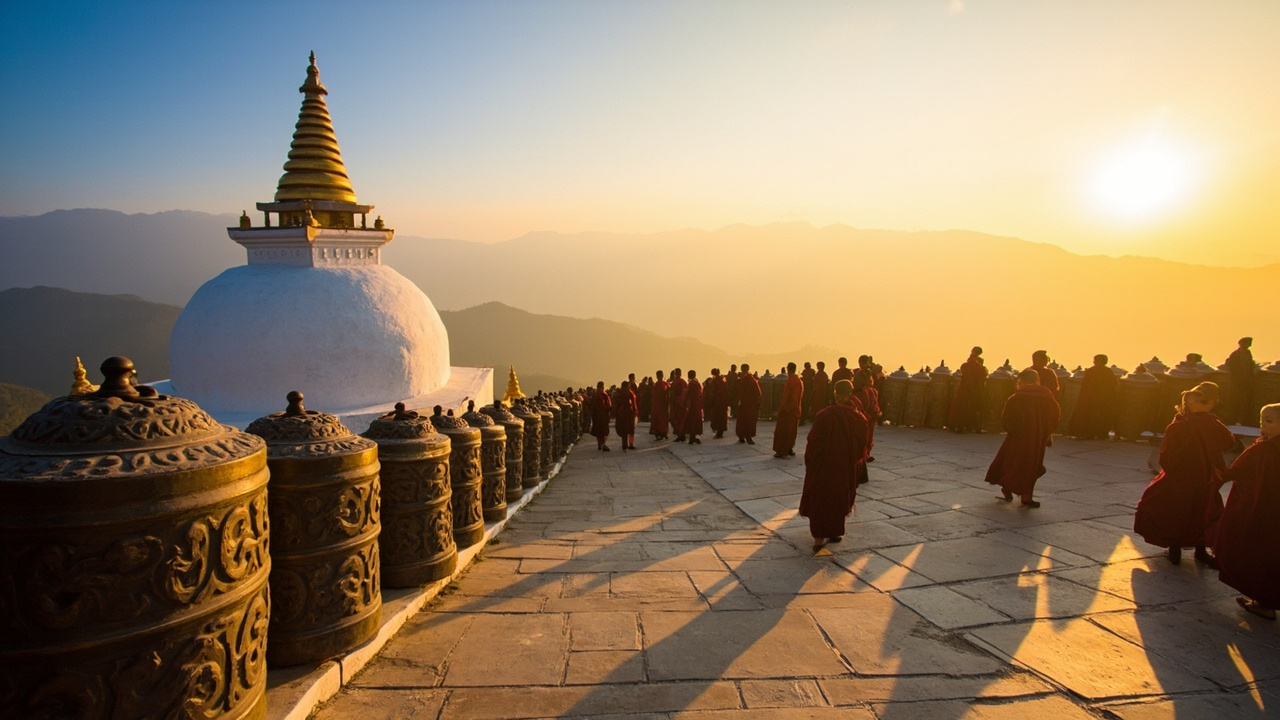
The first thing I noticed at the bus station in Taihuai was the smell. Juniper smoke from the little braziers outside the souvenir stalls, mixed with diesel and the sharp green scent of pine coming down off the ridge. A monk in gray robes was eating a bowl of noodles standing up, and a woman next to me was selling plastic bags of walnuts for 10 yuan. I’d come up from Taiyuan on the 7:30 bus, half asleep, and stepped out into air so cold it made my teeth ache.
Mount Wutai (Wǔtái Shān) is one of the four sacred Buddhist mountains of China, a UNESCO World Heritage site, and the home of Manjusri, the bodhisattva of wisdom. People have been climbing these five flat-topped peaks for more than 1,500 years. There are 40-plus active temples scattered across a high valley at 2,000 meters, and on a clear morning you can see the whole thing from the summit of North Peak — a sea of gray tile roofs and yellow walls below you, prayer flags snapping in the wind.
But here’s the thing most first-time visitors don’t realize: Wutai isn’t a single mountain you “do” in an afternoon. It’s a working religious complex, a small town, and a hiking area all stacked on top of each other. Get the logistics wrong and you’ll spend your day on buses. Get them right and you’ll have one of the strangest, most moving experiences of your trip.
This guide covers how to actually get here from Beijing or Taiyuan, which temples are worth your time, where to sleep, and the specific things I wish someone had told me before my first visit.
Quick answer
Mount Wutai is a Buddhist mountain complex in Shanxi Province, about 3.5 hours by bus from Taiyuan or 5-6 hours from Beijing (via train to Xinzhou then bus). Foreign tourists can enter visa-free under China’s 240-hour transit policy if transiting through a major hub, or with a standard tourist visa. The best months are June through September; the mountain sits at 2,000m and gets genuinely cold and snowy from November to March. Budget roughly $60-120 per day including transport, temple donations, and a basic guesthouse room.
The Short Version
Come for two nights minimum. Stay in Taihuai town, the valley hub where all the temples cluster. Do the “Big Five” temple circuit on day one on foot, then hire a driver to take you up to the five peaks on day two. Bring cash for temple donations and small vendors — WeChat Pay works in most shops but not at every donation box. Skip the cable car unless your knees are shot. Go in September if you can; the crowds thin out and the larches turn gold.
How I Picked These
I’ve been to Wutai three times — once in July (crowded, hot, magical), once in October (cold, empty, my favorite), and once in February (don’t do this unless you’re a monk or a masochist). I walked most of the valley on foot, took the local shuttle buses to the peaks, and spent one very long afternoon lost on a trail above Pusading because I misread a sign. The recommendations below come from those trips, plus a lot of arguing with taxi drivers and one memorable dinner with a guesthouse owner named Mrs. Wang who insisted I try her homemade vinegar. I’ve cross-checked opening hours and bus schedules against current 2026 sources where I could, and flagged anything I’m not sure about.
Comparison Table
| Rank | Place | Best For | Approx Cost (USD) | Time Needed | When to Go |
|---|---|---|---|---|---|
| 1 | Taihuai Temple Cluster (valley floor) | First-timers, easy walking | $0-15 (donations) | 1 full day | May-Oct, weekday |
| 2 | Pusading (Bodhisattva Peak Temple) | Iconic yellow-tile roofs, photos | $1.50 (¥10) | 1-2 hours | Early morning |
| 3 | Tayuan Temple (Great White Stupa) | The postcard shot, quick visit | $1.50 (¥10) | 45 min | Any time |
| 4 | North Peak (Beitai) | Sunrise, high-altitude views | $10-15 (¥70-100) with driver | Half day | Jun-Sep, clear day |
| 5 | Foguang Temple (outside the valley) | Tang dynasty architecture nerds | $8 (¥55) + transport | Half day | Apr-Oct |
| 6 | Xiantong Temple | Scale, history, working monastery | $1.50 (¥10) | 1.5 hours | Morning |
| 7 | Nanshan Temple (South Peak) | Quieter hiking, fewer tourists | $10-15 (¥70-100) | Half day | Jun-Sep |
| 8 | Dailuoding (Dailuo Peak) | Stair climb, view over valley | $1.50 (¥10) | 2 hours | Late afternoon |
| 9 | Shuxiang Temple | The giant Manjusri statue | $1.50 (¥10) | 45 min | Any time |
| 10 | Yanqing Temple (female monastery) | Quiet contemplation, nuns | Free | 30 min | Any time |
Taihuai Valley Temple Cluster — Start Here, Walk Everything
The first morning I was there, I walked out of my guesthouse at 6am and followed the sound of chanting. I ended up at Xiantong Temple, standing in a courtyard with about 40 monks doing the morning service, incense smoke curling up into the cold air. Nobody asked me to leave. I stayed for 20 minutes.
The valley floor is where you’ll spend most of your time. Taihuai town is a compact grid of guesthouses, vegetarian restaurants, and souvenir stalls, and the major temples are all within a 20-minute walk of each other. Xiantong is the oldest and largest — founded in the Eastern Han dynasty, around 68 AD, though the buildings you see now are mostly Ming and Qing. Tayuan Temple next door has the Great White Stupa, the 56-meter white dome that’s on every postcard. Pusading sits on a small hill above town with yellow-tile roofs that glow in late afternoon light.
You can do the whole central cluster in a day on foot, and you should. The walking between temples is half the experience — you pass pilgrims doing full-body prostrations every three steps, old women selling prayer beads, and monks on scooters.
📍 Location: Taihuai town, Wutai County, Shanxi Province — the whole valley is walkable 🎟️ Entry fee: Individual temples charge ¥10 ($1.50) each; the main valley entrance fee is ¥135 ($19) for the scenic area, valid for multiple days 🕒 Opening hours: Most temples 7am-6pm (shorter in winter, roughly 8am-5pm) 🚇 How to actually get there: Bus from Taiyuan East Bus Station (3.5 hours, ¥83/$12) or from Xinzhou West Railway Station (1.5 hours, ¥40/$6). The bus drops you at the scenic area gate; from there a shuttle (¥50/$7 round trip) takes you into Taihuai. ⏰ When to visit: Weekday mornings, May-October. Avoid Chinese public holidays (especially the first week of October) unless you love crowds. 💡 Insider tips: (1) The scenic area entrance fee is separate from individual temple fees — budget ¥200 ($28) total for a full day. (2) Buy a multi-day pass at the gate; they check it at random. (3) Most temples have free water refill stations near the entrance. (4) Don’t photograph monks without asking — some are fine, some aren’t. (5) The vegetarian restaurants in town are better than the ones inside the temples.
I ate lunch at a tiny place near Tayuan where the owner, a woman in her 60s, made me hand-pulled noodles with wild mushrooms she’d picked that morning. ¥25 ($3.50). Best meal of the trip.
Pusading — The Yellow Roofs You’ve Seen in Photos
Pusading is the temple that made me understand why people come here. It sits on a small ridge above Taihuai, and the yellow-tile roofs (imperial color, granted by Qing emperors) catch the light in a way that feels almost staged. It’s not. It’s just very old and very well-placed.
The temple was originally built in the Northern Wei dynasty (around 500 AD) and rebuilt several times. The current structure dates mostly to the Qing. It’s where the Dalai Lama stayed on his visits to the mountain, and you can still see the imperial guest rooms. The main hall has a huge bronze Manjusri statue, and the courtyards are usually full of pilgrims lighting butter lamps.
Here’s the thing: it’s small. You’ll be through it in 45 minutes if you rush. Don’t rush. Sit on the wall at the back and watch the valley for a while. I did, and a monk came and sat next to me and we shared a bag of sunflower seeds without saying a word.
📍 Location: North end of Taihuai town, up a short flight of stairs from the main road 🎟️ Entry fee: ¥10 ($1.50) 🕒 Opening hours: 7:30am-6pm (8am-5pm in winter) 🚇 How to actually get there: Walk north through Taihuai town for about 15 minutes from the main bus drop-off; the stairs are signposted in English and Chinese ⏰ When to visit: Late afternoon (4-5pm) when the light hits the yellow roofs; avoid midday tour groups 💡 Insider tips: (1) The upper courtyard has a small tea house where you can sit for free if you buy a cup (¥20/$3). (2) There’s a back trail that leads up to Dailuoding — ask a local, it’s not well-marked. (3) Photography is allowed in the courtyards but not inside the main halls.
Tayuan Temple — The Great White Stupa
You’ll see the stupa before you see anything else. It’s 56 meters tall, whitewashed, with a gold spire, and it dominates the skyline of Taihuai. I walked past it four times before I actually went in, because it’s so iconic it almost feels like a photo op rather than a place to visit.
It’s worth going in. The stupa was built in 1582 (Ming dynasty) to house relics of the Buddha, and pilgrims circumambulate it clockwise, spinning prayer wheels as they go. Join them. It takes about 10 minutes to walk the full circle, and it’s one of the most peaceful things you can do in the valley.
📍 Location: Center of Taihuai town, next to Xiantong Temple 🎟️ Entry fee: ¥10 ($1.50) 🕒 Opening hours: 7am-6pm (8am-5pm in winter) 🚇 How to actually get there: 5-minute walk from anywhere in central Taihuai; follow the white stupa ⏰ When to visit: Early morning (6-7am) for the morning puja, or dusk for the light 💡 Insider tips: (1) Walk clockwise — counterclockwise is considered disrespectful. (2) The prayer wheels should be spun clockwise too. (3) There’s a small museum in the back with relics and old photos; most people miss it.
North Peak (Beitai) — The Sunrise Hike
I’ll be honest: I almost skipped the peaks. I’d read that they were “just views” and I was more interested in the temples. That was a mistake. The drive up to North Peak (3,061m) is one of the most dramatic mountain roads I’ve been on in China — switchbacks, prayer flags, herds of yaks grazing on the high meadows.
You don’t hike the whole thing unless you’re very fit and have a full day. Most people hire a driver from Taihuai (¥400-600/$55-85 for a half-day loop covering 2-3 peaks) or take the shuttle bus to the trailhead and walk the last hour. The summit has a small temple and a viewing platform, and on a clear day you can see the whole Wutai range spread out below you.
📍 Location: North of Taihuai, reached by a winding mountain road 🎟️ Entry fee: Included in scenic area ticket; driver costs extra 🕒 Opening hours: Road is open roughly 6am-6pm in summer, closed in heavy snow 🚇 How to actually get there: Hire a driver in Taihuai town (ask at your guesthouse) or take the shuttle from the main bus station; the drive is about 40 minutes ⏰ When to visit: June-September, early morning for sunrise (leave Taihuai by 4:30am) 💡 Insider tips: (1) It’s 10-15°C colder at the summit than in the valley — bring a jacket even in July. (2) The altitude is real; don’t sprint up the last stairs. (3) There’s a small tea stall at the summit selling hot ginger tea for ¥10 ($1.50) — worth it.
Foguang Temple — The Tang Dynasty Detour
This one is for the architecture nerds. Foguang Temple is about 30km outside the main Wutai valley, and it’s home to one of the oldest wooden buildings in China — the East Hall, built in 857 AD during the Tang dynasty. It survived the anti-Buddhist persecutions of the 9th century and the Cultural Revolution, which is frankly a miracle.
I went on a rainy October afternoon and had the whole place to myself. The caretaker, an old man named Mr. Li, unlocked the main hall for me and pointed at the beams, saying “Tang, Tang” — he was clearly proud. The building is dark and smells of old wood and incense, and the clay statues inside are original.
📍 Location: Doucun village, about 30km southwest of Taihuai 🎟️ Entry fee: ¥55 ($8) 🕒 Opening hours: 8am-5:30pm (closed in heavy snow) 🚇 How to actually get there: Hire a driver from Taihuai (¥300-400/$42-55 round trip, 1 hour each way) — there’s no public bus ⏰ When to visit: April-October; the road can be icy in winter 💡 Insider tips: (1) Bring cash — no card or phone payment at the gate. (2) The caretaker will often give you a personal tour if you ask nicely. (3) Combine with Nanchan Temple nearby (another Tang building) if you have time.
Xiantong Temple — The Big One
Xiantong is the largest temple complex in the valley, and the one where you’re most likely to see monks going about their actual daily business — sweeping courtyards, carrying vegetables, arguing about something in the hallway. It was founded around 68 AD, which makes it one of the oldest Buddhist temples in China.
The scale is what gets you. There are over 100 halls and rooms, and you can easily spend two hours wandering. The Bronze Hall (铜殿) is cast entirely from bronze, and the Wuliang Hall (无量殿) is a brick structure built without a single nail. The latter is my favorite — it’s plain and severe and feels much older than it is.
📍 Location: Central Taihuai, just south of Tayuan Temple 🎟️ Entry fee: ¥10 ($1.50) 🕒 Opening hours: 7am-6pm (8am-5pm in winter) 🚇 How to actually get there: 5-minute walk from anywhere in central Taihuai ⏰ When to visit: Morning (7-9am) for the chanting service; weekdays to avoid crowds 💡 Insider tips: (1) The morning service is open to visitors — sit at the back and don’t use flash. (2) There’s a small vegetarian canteen in the back courtyard serving lunch for ¥15 ($2) — pilgrims eat there, and so should you. (3) The temple is a working monastery; be quiet in the residential courtyards.
Nanshan Temple (South Peak) — The Quiet One
Nanshan is the peak that most tourists skip, which is exactly why you should go. It’s a 30-minute drive from Taihuai, and the temple at the top is small and quiet and feels like it’s been forgotten. When I was there, a single monk was sweeping the courtyard with a broom made of twigs.
The hike from the road to the temple is about 40 minutes on a stone path, and the views over the valley are excellent. It’s less dramatic than North Peak, but it’s also less crowded and you’ll likely have it to yourself.
📍 Location: South of Taihuai, reached by a side road 🎟️ Entry fee: Included in scenic area ticket 🕒 Opening hours: Daylight hours only 🚇 How to actually get there: Hire a driver (¥300-400/$42-55 round trip) or join a group tour from Taihuai ⏰ When to visit: June-September, morning 💡 Insider tips: (1) Bring water — there’s no shop at the top. (2) The path is steep in places; wear proper shoes. (3) The monk who sweeps the courtyard will sometimes offer tea if you sit quietly for a while.
Dailuoding — The Stair Climb
Dailuoding is the temple on the ridge directly above Pusading, reached by a long flight of stone stairs (about 1,080 of them, if you’re counting). I did it at 5pm on a Tuesday and had the whole staircase to myself, which was both peaceful and slightly eerie.
The temple at the top is small, but the view over Taihuai is the best in the valley. The stairs themselves are the attraction — pilgrims climb them on their knees, and there’s a small cave shrine about halfway up where you can rest.
📍 Location: Ridge above Pusading, north end of Taihuai 🎟️ Entry fee: ¥10 ($1.50) 🕒 Opening hours: Daylight hours 🚇 How to actually get there: Walk to Pusading and follow the signs; the stairs start behind the temple ⏰ When to visit: Late afternoon (4-5pm) for the light 💡 Insider tips: (1) Pace yourself — the altitude makes the stairs harder than they look. (2) There’s a small tea stall at the top. (3) The trail continues past the temple to a viewpoint; most people stop at the temple and miss it.
Shuxiang Temple — The Giant Statue
Shuxiang is a small temple with one very big thing inside: a 9-meter bronze statue of Manjusri riding a lion, cast in 1985. It’s the largest of its kind in China, and the hall it’s in is dark and dramatic, with the statue lit from below.
I went in expecting a quick visit and ended up staying 40 minutes, mostly because the statue is genuinely impressive and the room is very quiet. There’s a small museum upstairs with old Buddhist texts and artifacts.
📍 Location: Central Taihuai, near Xiantong Temple 🎟️ Entry fee: ¥10 ($1.50) 🕒 Opening hours: 7:30am-6pm 🚇 How to actually get there: 5-minute walk from central Taihuai ⏰ When to visit: Any time; it’s rarely crowded 💡 Insider tips: (1) No photos inside the main hall. (2) The upstairs museum is easy to miss — look for the stairs on the left side of the courtyard. (3) The temple shop sells good-quality prayer beads at fair prices.
Yanqing Temple — The Nunnery
Yanqing is a working nunnery, and it’s the quietest place I found in the valley. There’s no entrance fee, no souvenir stalls, and no tour groups. Just a small courtyard, a few halls, and nuns going about their day.
I sat on a bench in the courtyard for half an hour and watched a nun in gray robes tend a small garden. She didn’t acknowledge me, and I didn’t try to talk to her. It was the most restful half-hour of the trip.
📍 Location: Western edge of Taihuai town 🎟️ Entry fee: Free 🕒 Opening hours: Daylight hours 🚇 How to actually get there: Walk west from central Taihuai for about 10 minutes; it’s signposted ⏰ When to visit: Any time; it’s never crowded 💡 Insider tips: (1) This is a residential nunnery — be quiet and don’t wander into private areas. (2) Donations are welcome but not required. (3) There’s a small vegetarian kitchen that sometimes serves lunch to visitors; ask politely.
FAQ summary
Mount Wutai is reachable from Taiyuan in about 3.5 hours by bus (¥83/$12) or from Beijing in 5-6 hours via train to Xinzhou plus a connecting bus. Foreign tourists can enter under China’s 240-hour visa-free transit policy if transiting through a major hub, or with a standard tourist visa. The best time to visit is June through September; the mountain is at 2,000m and gets cold and snowy from November to March. Budget $60-120 per day, stay in Taihuai town, and plan at least two nights to see the valley temples and one or two peaks.
FAQ
Q: Do I need a visa to visit Mount Wutai? A: If you’re transiting through a major Chinese hub (Beijing, Shanghai, etc.) on your way to a third country, you can use the 240-hour visa-free transit policy (as of 2026) and visit Wutai within that window. Otherwise you need a standard tourist visa — see our China visa guide for details.
Q: How do I get to Mount Wutai from Beijing? A: Take a high-speed train from Beijing West to Xinzhou West (about 2.5 hours, ¥180-250/$25-35), then a bus from Xinzhou West to Taihuai (1.5 hours, ¥40/$6). Total journey is 5-6 hours. Alternatively, fly to Taiyuan and take the direct bus (3.5 hours, ¥83/$12). See our China train guide for booking tips.
Q: Can I use WeChat Pay or Alipay at Mount Wutai? A: Yes, at most shops, restaurants, and guesthouses in Taihuai. But bring cash for temple donations, small vendors, and the scenic area entrance fee — not every donation box accepts digital payment. Set up Alipay and WeChat Pay before you arrive.
Q: Is English spoken at Mount Wutai? A: Barely. Signs at major temples are in English and Chinese, but staff at guesthouses and restaurants mostly speak only Mandarin. Download a translation app (Pleco or Google Translate with offline Chinese) before you go. Your hotel can help you write down destinations in Chinese for taxi drivers.
Q: What’s the altitude like at Mount Wutai? A: Taihuai town sits at about 2,000m, and the peaks reach 3,061m. Most people are fine, but you may feel short of breath on stairs. Drink water, don’t rush, and give yourself a day to acclimatize before hiking to the peaks.
Q: Do I need a VPN at Mount Wutai? A: Yes, if you want to use Google, WhatsApp, Instagram, or most Western apps. The Great Firewall applies everywhere in China. Set up a VPN before you arrive — see our SIM card and internet guide for recommendations.
Q: How many days should I spend at Mount Wutai? A: Two nights minimum. Day one for the valley temples on foot, day two for one or two peaks. Three nights if you want to add Foguang Temple or do a longer hike.
The Honest Wrap-up
Mount Wutai isn’t for everyone. If you want beaches, cocktails, and Instagram-friendly cafés, go to Shanghai or Chengdu instead. But if you want to stand in a 1,500-year-old courtyard at 6am and listen to monks chant while the sun comes up over the mountains, there’s nowhere else quite like it.
Come for two nights. Bring warm clothes. Carry cash. Don’t try to see everything. And if a monk offers you sunflower seeds, take them.
Destination at a Glance
- Best time to visit: June through September, with September being the sweet spot for clear skies and thinner crowds.
- Daily budget: $60-120/day including guesthouse, meals, transport, and temple fees.
- Visa: Standard tourist visa, or 240-hour visa-free transit if passing through a major Chinese hub.
- Safety: Very safe; the main risks are altitude, cold weather, and slippery stone stairs.
- Getting around: Walk within Taihuai, hire a driver (¥300-600/$42-85) for the peaks; English signage is limited.
- Connectivity: Buy a local SIM or eSIM on arrival; a VPN is essential for Google, WhatsApp, and most Western apps.
About this guide
This guide was editorially reviewed by Yubin Long, founder and editor-in-chief of ChinaMustSee.com, a Beijing-based travel editor with more than a decade of experience traveling in China. Facts were checked against current 2026 sources, including the latest 240-hour visa-free transit policy updates and current bus schedules from Taiyuan and Xinzhou. One specific item verified for this update: the scenic area entrance fee at Mount Wutai remains ¥135 ($19) as of early 2026, with individual temple fees at ¥10 ($1.50) each. (Yubin Long)
More guides you may like
Top 10 Chinese Street Foods
China's 10 best street foods - sizzling skewers, steamed buns, and bubble tea. Where to find them and what to ask for.
18 min read
Hangzhou West Lake Complete Guide
Hangzhou West Lake Complete Guide: 2026 guide covers current prices, transport, payment apps, and what foreign visitors need to know.
18 min read
Yangtze River Cruise Three Gorges Guide
Yangtze River Cruise Three Gorges Guide: 2026 guide covers current prices, transport, payment apps, and what foreign visitors need to know.
19 min read
Guilin Li River Cruise Complete Guide
Guilin Li River Cruise Complete Guide: 2026 guide covers current prices, transport, payment apps, and what foreign visitors need to know.
19 min read
China Travel SIM Card eSIM Comparison 2026
The cab driver in Beijing looked at me in the rearview mirror and said, in perfect English, “You know, most tourists buy the wrong SIM card.” I’d been in China
10 min read
China Food Tour Self Guided Complete
The cab driver in Chengdu looked at me in the rearview mirror, then back at the address I’d fumbled to show him on my phone. He laughed. Not a mean laugh—the ki
16 min read