
Best Time to Visit Yunnan
The cab driver in Kunming looked at me like I was insane. It was late February, and I'd just told him I wanted to drive three hours north to see snow on the mou.
The cab driver in Kunming looked at me like I was insane. It was late February, and I’d just told him I wanted to drive three hours north to see snow on the mountains. “You came to Yunnan for snow?” he asked, half-laughing, half-confused. I nodded. He shrugged, threw the car into gear, and we spent the next few hours climbing from the city’s mild 15°C (59°F) warmth into a white landscape that felt completely disconnected from the subtropical greenery we’d left behind. That’s Yunnan for you. It’s not one place with one season. It’s a province the size of California that stacks alpine peaks, tropical rainforest, ancient towns, and highland lakes on top of each other, sometimes within a single day’s drive.
For first-time visitors, this variety is both the appeal and the problem. When do you go? What should you pack? Is it safe to travel in the rainy season? I’ve been through Yunnan more times than I can count, and I still get the answer wrong occasionally. This guide is built from those trips, the good calls and the bad ones. You’ll get the honest breakdown of each season, what it actually costs, and where to go when. No fluff, just what I’d tell a friend before they booked the flight.
Quick answer
The best time to visit Yunnan is March through May (spring) or September through November (autumn), when temperatures sit between 15–25°C (59–77°F) and rainfall is minimal. For the most reliable weather in the popular areas like Dali, Lijiang, and Shangri-La, aim for April or October. If you’re planning around China’s visa-free transit policy, remember that the 240-hour visa-free entry applies in Kunming, so you can see a lot of the province without a full tourist visa.
The Short Version
If you have 90 seconds, here’s the deal: go in April or October. These months give you clear skies, comfortable temperatures, and fewer crowds than the summer holidays. Avoid Chinese National Day (October 1–7) and the May Day holiday (May 1–5) unless you enjoy queuing for photos. Winter is cold in the north but perfect for the tropical south around Xishuangbanna. Summer is rainy but the landscape is at its greenest. Pack layers, always, because Yunnan’s altitude means the weather changes faster than a toddler’s mood.
How I Picked These
I’ve spent the better part of seven years living in Beijing and traveling through Yunnan on a regular basis. For this guide, I went back through my notes from over a dozen trips: the time I got caught in a June downpour in Shangri-La, the October morning I watched sunrise over Erhai Lake with zero other tourists, the February afternoon I ate mango sticky rice in a Xishuangbanna market while my friends shivered in Lijiang. I also talked to guesthouse owners, taxi drivers, and tea farmers along the way. Their advice, combined with my own mistakes, forms the backbone of what follows. I’m not pulling from a tourism board brochure. I’m pulling from muddy boots and sunburned cheeks.
Comparison Table
| Rank | Place | Best For | Approx Cost (USD) | Time Needed | When to Go |
|---|---|---|---|---|---|
| 1 | Dali & Erhai Lake | Cycling, lakeside views, relaxed vibe | $30–50/day | 2–3 days | Mar–May, Sep–Nov |
| 2 | Lijiang Old Town | Ancient architecture, nightlife, day trips | $25–40/day | 2–3 days | Apr–Jun, Sep–Oct |
| 3 | Shangri-La | Tibetan culture, high-altitude scenery | $35–55/day | 2–3 days | May–Jun, Sep–Oct |
| 4 | Xishuangbanna | Tropical rainforest, Dai culture | $25–45/day | 3–4 days | Nov–Feb |
| 5 | Kunming | City break, Stone Forest, spring weather | $20–35/day | 1–2 days | Year-round |
| 6 | Yuanyang Rice Terraces | Photography, sunrise views | $20–30/day | 2 days | Dec–Mar |
| 7 | Tiger Leaping Gorge | Hiking, dramatic canyon scenery | $25–40/day | 2 days | Apr–May, Sep–Oct |
| 8 | Meili Snow Mountain | Sacred peaks, sunrise views | $40–60/day | 2–3 days | Oct–Dec |
| 9 | Puzhehei | Quiet lakes, karst landscapes | $15–25/day | 1–2 days | Apr–Oct |
| 10 | Jianshui | Old town, Confucian temple, tofu | $15–25/day | 1–2 days | Mar–Nov |
Dali & Erhai Lake — The One That Gets Under Your Skin
I remember sitting on a rooftop in Dali’s old town, watching the sun drop behind Cangshan Mountain, the lake turning from silver to gold. A woman next to me was playing a guzheng, and the whole scene felt so staged it couldn’t be real. But it was. Dali has that effect. It’s the place travelers come for a few days and stay for a month.
The old town is charming, sure, but the real draw is Erhai Lake. Rent a bicycle or electric scooter and ride the eastern shore. You’ll pass through Xizhou, a Bai minority village with traditional courtyard homes, and stop at the small fishing village of Shuanglang. The lake is massive, so give yourself a full day to do the loop properly.
📍 Location: Dali Old Town, 15 km (9 mi) from Dali Railway Station 🎫 Entry fee: Free for the lake and old town; some villages charge 10–20 CNY ($1.50–$3) 🕒 Opening hours: Always open 🚕 Getting there: High-speed train from Kunming (2 hours, ~$25/180 CNY). From Dali Station, take bus 8 to the old town (30 minutes, 3 CNY/$0.50) 🔔 When to visit: March–May for spring flowers; October for clear skies and harvest colors 💡 Insider tips:
- Rent a bike from outside the old town walls, not inside. You’ll pay half the price.
- The “Three Pagodas” are visible from the lakeside path, so you can skip the 121 CNY ($17) entry fee.
- Try “suan la yu” (sour and spicy fish) at a lakeside restaurant in Xizhou. It’s the local specialty.
- Cash is rarely needed. WeChat Pay and Alipay work everywhere, but set them up before you arrive. See my payment guide for the setup process.
- English is limited outside the main tourist streets. Download a translation app before you go.
I once spent an entire afternoon at a tea house in Xizhou with an old Bai woman who didn’t speak a word of English. We communicated through gestures and shared cups of pu’er tea. She eventually showed me how to roast sunflower seeds. I still think about that afternoon.
Lijiang Old Town — Beautiful, Crowded, and Worth It Anyway
Lijiang is the tourist trap everyone warns you about. And they’re right. The old town is packed, the souvenir shops all sell the same trinkets, and the “authentic” Naxi music performances feel like they’re performed for busloads of tour groups. But here’s the thing: it’s still beautiful. The canals, the stone bridges, the snow-capped Jade Dragon Mountain looming over the rooftops. Go at 7 AM, before the day-trippers arrive, and you’ll understand why UNESCO put it on the list.
The best part of Lijiang isn’t the old town itself. It’s what’s around it. The Jade Dragon Snow Mountain is a day trip away, and the Blue Moon Valley at its base looks like a swimming pool someone poured turquoise dye into. If you’re fit, hike the Tiger Leaping Gorge from here. If you’re not, take a cable car up the mountain and enjoy the view.
📍 Location: Lijiang Old Town, 30 km (19 mi) from Lijiang Airport 🎫 Entry fee: Old town is free; Jade Dragon Snow Mountain is 100 CNY ($14) plus cable car 120–180 CNY ($17–25) 🕒 Opening hours: Old town always open; mountain cable car 8:00–17:00 🚕 Getting there: Fly into Lijiang Airport (direct flights from Beijing, Shanghai, Chengdu). From the airport, take the airport shuttle (20 CNY/$3) to the old town 🔔 When to visit: April–June for rhododendrons; October for clear mountain views 💡 Insider tips:
- The old town charges a “maintenance fee” of 50 CNY ($7) at some entrances. Walk in through the south gate after 6 PM and it’s usually not enforced.
- Skip the “impression Lijiang” show. It’s overpriced and underwhelming.
- The Black Dragon Pool Park offers the classic postcard view of Jade Dragon Mountain. It’s 5 minutes from the old town.
- For a quieter experience, stay in Shuhe Old Town, 4 km (2.5 mi) north. It’s cheaper and less crowded.
- If you’re coming from abroad, remember that China’s visa-free transit policy can cover a short stay here if you’re transiting through Kunming.
I got hopelessly lost in Lijiang’s maze of alleys at 11 PM one night. A Naxi grandmother saw me wandering and wordlessly took my arm, walked me to my guesthouse, and disappeared before I could thank her. The kindness of strangers in Yunnan is a recurring theme.
Shangri-La — High Altitude, Higher Expectations
The name alone sets expectations. Shangri-La, the mythical Himalayan paradise from James Hilton’s novel. The real town, formerly called Zhongdian, is a mix of Tibetan monasteries, new Chinese architecture, and a main street that feels like a frontier town. It’s not paradise, but it’s close if you get out of the town center.
The Songzanlin Monastery is the largest Tibetan Buddhist monastery in Yunnan, and it’s worth the visit. The real magic, though, is in the surrounding countryside. Drive out to the Pudacuo National Park, where alpine lakes sit beneath forested hills, or hike to the Napa Lake wetlands where yaks graze against a backdrop of snow peaks. The altitude here is no joke. At 3,300 meters (10,800 ft), you’ll feel it. Take it slow, drink lots of water, and don’t plan anything strenuous for your first day.
📍 Location: Shangri-La City, Diqing Prefecture, 170 km (106 mi) north of Lijiang 🎫 Entry fee: Songzanlin Monastery 115 CNY ($16); Pudacuo National Park 100 CNY ($14) plus shuttle 80 CNY ($11) 🕒 Opening hours: Monastery 8:00–18:00; park 8:00–17:00 🚕 Getting there: 4-hour bus from Lijiang (65 CNY/$9). Or fly into Diqing Shangri-La Airport (direct flights from Kunming, Chengdu, Chongqing) 🔔 When to visit: May–June for wildflowers; September–October for clear skies and autumn colors 💡 Insider tips:
- Acclimatize in Lijiang (2,400 m) for a day before coming up. It makes a difference.
- The monastery’s morning prayer session (around 6:30 AM) is open to visitors. It’s a humbling experience.
- Bring cash. ATMs are scarce, and some smaller shops don’t take cards.
- The local specialty is yak butter tea. It’s salty, not sweet, and it’s an acquired taste. Try it once.
- If you’re hiking at altitude, consider buying a local SIM card with data so you can access maps and translation apps offline.
I made the mistake of running up the monastery’s 143 steps on my first day at altitude. I spent the next hour gasping like a fish out of water while a Tibetan monk watched me with a knowing smile. Lesson learned.
Xishuangbanna — The Tropical South That Feels Like Another Country
If you want to escape the cold, Xishuangbanna is your answer. This autonomous prefecture in the far south borders Laos and Myanmar, and it feels more Southeast Asia than China. The Dai minority culture dominates here, with their stilt houses, banana plantations, and water-splashing festivals. The capital, Jinghong, is a laid-back city where the Mekong River (called the Lancang here) flows through town.
The highlight is the tropical rainforest. The Wangtianshu Scenic Area has a canopy walkway that takes you 40 meters (130 ft) above the forest floor. It’s not for the faint of heart, but the views are worth it. The Dai villages around Ganlanba offer a glimpse into traditional life, and the night market in Jinghong is one of the best in China for street food. Try the bamboo rice, the grilled fish wrapped in banana leaves, and the pineapple rice served in a hollowed-out pineapple.
📍 Location: Jinghong City, Xishuangbanna Dai Autonomous Prefecture 🎫 Entry fee: Wangtianshu 55 CNY ($8); Ganlanba villages free 🕒 Opening hours: Wangtianshu 8:00–17:30 🚕 Getting there: Fly into Xishuangbanna Gasa Airport (direct flights from Kunming, 1 hour). Or take the high-speed train from Kunming (3.5 hours, ~$30/220 CNY) 🔔 When to visit: November–February for dry season and comfortable temperatures 💡 Insider tips:
- The Water Splashing Festival (mid-April) is the Dai New Year. It’s chaotic, wet, and unforgettable. Book accommodation months in advance.
- English is even less common here than in the north. The translation app is your best friend.
- The night market starts around 6 PM. Go early to avoid the crowds and get the freshest food.
- Mosquito repellent is essential, especially in the rainforest areas.
- The border town of Mohan is a 2-hour drive away. You can day-trip to the border crossing, but you’ll need your passport.
I ate a bowl of “sa” (a Dai-style cold noodle dish) at a street stall in Jinghong and ended up in a conversation with the owner, a Dai woman who’d never left the province. She asked me where I was from, and when I said “America,” she laughed and said, “Too far!” We shared a plate of grilled pork and she taught me how to eat it with the raw vegetables and dipping sauce. Food is the universal language.
Kunming — The City of Eternal Spring (That Sometimes Forgets)
Kunming gets its nickname from its mild climate, but don’t let that fool you. The city can swing from 25°C (77°F) to 5°C (41°F) in a single day, and the UV rays at 1,900 meters (6,200 ft) altitude will burn you without warning. It’s a transit hub more than a destination, but it deserves a day or two of your time.
The Stone Forest (Shilin) is the big draw, a karst landscape of limestone pillars that looks like something from another planet. It’s a UNESCO World Heritage Site and it’s genuinely impressive, but it’s also packed with tour groups. Go early, or better yet, spend the night in the nearby town and enter at opening time. Back in the city, the Green Lake Park is a pleasant place for a stroll, and the Yunnan University campus has some lovely old buildings.
📍 Location: Kunming City, Yunnan Province 🎫 Entry fee: Stone Forest 130 CNY ($18); Green Lake Park free 🕒 Opening hours: Stone Forest 8:00–18:00 🚕 Getting there: Kunming Changshui Airport is the main gateway. Stone Forest is a 1.5-hour train ride from Kunming Railway Station (34 CNY/$5) 🔔 When to visit: Year-round, but March is best for the cherry blossoms 💡 Insider tips:
- The Stone Forest gets crowded by 10 AM. Enter at 8 AM and head straight to the “Lotus Peak” area before the tour groups arrive.
- Kunming’s “crossing the bridge” noodles (guoqiao mi xian) are a local institution. Try them at the famous Jianxinyuan restaurant.
- The city’s UV index is brutal. Sunscreen and a hat are non-negotiable.
- If you’re using the 240-hour visa-free transit, Kunming is your entry point. Plan your route carefully to maximize your time.
- The airport is 25 km (16 mi) from the city center. The subway (Line 6) connects them in 40 minutes for 5 CNY ($0.70).
I once watched a group of Chinese tourists take photos of me taking photos of the Stone Forest. We all laughed about it. Tourism is a mirror, I guess.
Yuanyang Rice Terraces — The Photographer’s Obsession
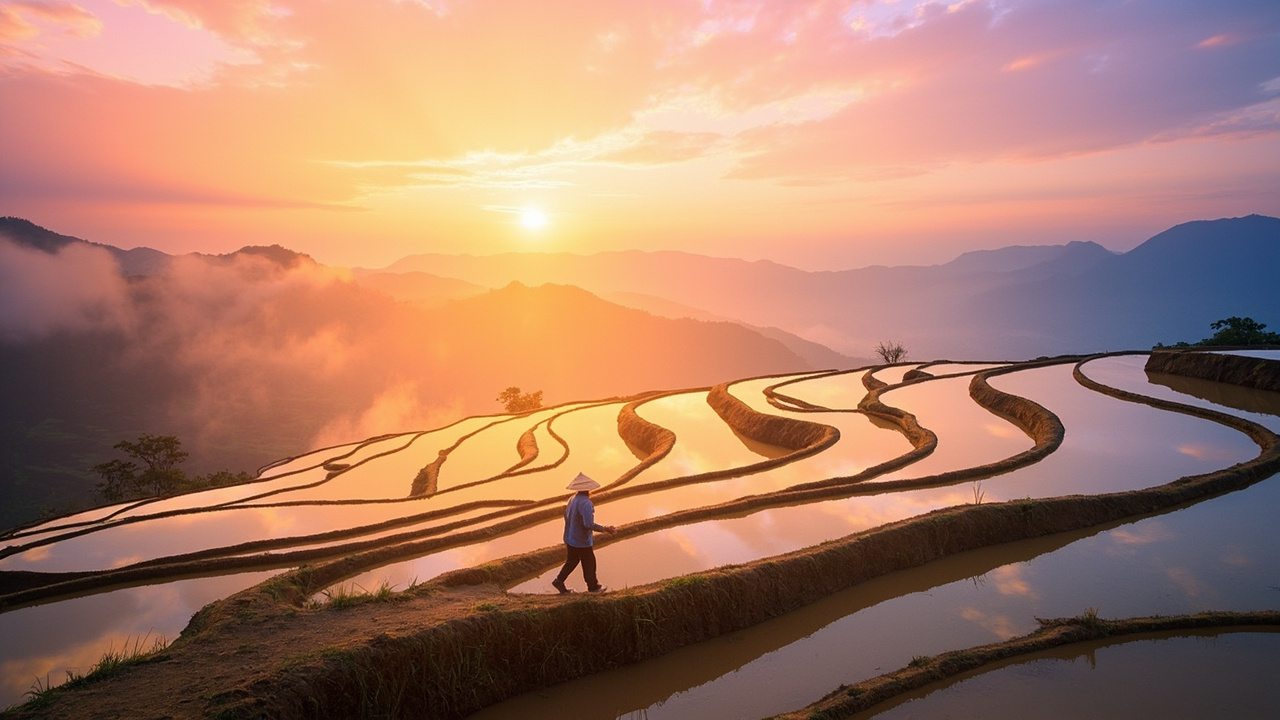
The Yuanyang rice terraces are the kind of place that makes you question your life choices. Why am I standing on a muddy hillside at 6 AM in the cold and fog? Then the sun rises, the mist clears, and the terraces ignite in shades of gold, green, and silver. You stop questioning. You just stare.
The terraces were carved by the Hani people over 1,300 years, and they’re still in use today. The best viewpoints are along the ridge between the villages of Duoyishu and Laohuzui. Sunrise at Duoyishu is the classic shot, but the sunset at Bada is equally spectacular. The villages themselves are worth exploring, with their traditional mushroom-shaped houses and the slow rhythm of rural life.
📍 Location: Yuanyang County, Honghe Prefecture, 320 km (200 mi) south of Kunming 🎫 Entry fee: 100 CNY ($14) for a multi-day pass covering all viewpoints 🕒 Opening hours: Viewpoints open at sunrise (around 6:30 AM in winter) 🚕 Getting there: 6-hour bus from Kunming’s South Bus Station (100 CNY/$14). Or take the high-speed train to Jianshui (2 hours) and then a 2-hour bus to Yuanyang 🔔 When to visit: December–March, when the terraces are flooded and reflect the sky 💡 Insider tips:
- The fog can roll in at any moment. Wait it out. The best shots often come after the fog clears.
- Stay in the village of Duoyishu to be at the viewpoint for sunrise without the early morning drive.
- The “Blue Terraces” at Aichun are a hidden gem. Go in the late afternoon for the best color.
- Local Hani women will offer to pose for photos for a small fee (10 CNY/$1.50). It’s their livelihood, so it’s worth paying.
- The terraces are slippery after rain. Wear proper shoes, not sandals.
I spent three mornings at the Duoyishu viewpoint, and only one of them had clear skies. That one morning, though, was worth all the cold, foggy hours. The terraces looked like a giant’s staircase made of mirrors.
Tiger Leaping Gorge — The Hike That Changes You
Tiger Leaping Gorge is one of the deepest canyons in the world, carved by the Jinsha River between the Jade Dragon and Haba snow mountains. The hike along the high trail is the most famous trek in Yunnan, and for good reason. It’s challenging, it’s beautiful, and it’s surprisingly accessible for anyone with reasonable fitness.
The trail runs about 22 km (14 mi) from Qiaotou to Tina’s Guesthouse, and most people do it in two days, staying overnight at a guesthouse along the way. The views are constant: the river roaring below, the snow peaks above, and the terraced fields of the Naxi farmers in between. The “28 Bends” section is the toughest part, a steep climb that will test your legs and your lungs. But the payoff, the view from the top, is worth every step.
📍 Location: Between Qiaotou and Haba Village, 60 km (37 mi) north of Lijiang 🎫 Entry fee: 45 CNY ($6) 🕒 Opening hours: Trail accessible year-round, but check conditions in winter 🚕 Getting there: 2-hour bus from Lijiang to Qiaotou (30 CNY/$4). The trail starts at the Qiaotou entrance 🔔 When to visit: April–May and September–October for the best weather 💡 Insider tips:
- Start early (before 9 AM) to avoid the heat and make it to the halfway guesthouse by late afternoon.
- The “Halfway Guesthouse” is a legend among hikers. The food is good, the views are better, and the apple pie is a welcome treat.
- Carry at least 2 liters of water. There are springs along the way, but they’re not always marked.
- The trail is well-marked, but download an offline map anyway. Phone signal is spotty.
- If you’re not up for the full hike, the lower trail to the river viewpoint is a 1-hour round trip that’s much easier.
I did this hike in a pair of worn-out sneakers and paid for it with blisters that took a week to heal. Wear proper boots. Your feet will thank you.
Meili Snow Mountain — The Sacred Peak You Can’t Climb
Meili Snow Mountain is sacred to the Tibetan people, and climbing it is forbidden. That’s fine, because the best way to experience it is to sit and watch. The main viewpoint is at Feilai Temple, where you can see the entire mountain range, including the 6,740-meter (22,110 ft) Kawagarbo peak, from a terrace that’s a 5-minute walk from the village.
The moment that gets everyone is sunrise. If the clouds cooperate, the peaks turn pink and gold in the early morning light. It’s called “Golden Mountain” by the locals, and it’s one of the most beautiful things I’ve ever seen. The catch is that the clouds rarely cooperate. I’ve been three times and seen the full sunrise once. That one time was enough to keep me coming back.
📍 Location: Deqin County, Diqing Prefecture, 180 km (112 mi) north of Shangri-La 🎫 Entry fee: Feilai Temple viewpoint 60 CNY ($8); Mingyong Glacier 150 CNY ($21) 🕒 Opening hours: Viewpoint always open 🚕 Getting there: 4-hour bus from Shangri-La to Deqin (50 CNY/$7), then a 20-minute taxi to Feilai Temple 🔔 When to visit: October–December for the clearest skies 💡 Insider tips:
- The sunrise happens around 7:30 AM in winter. Get to the viewpoint by 7 AM to secure a spot.
- The weather can change in minutes. If the peaks are clouded over, wait. The clouds often clear by mid-morning.
- The Mingyong Glacier is one of the few glaciers in the world that descends into a subtropical forest. It’s worth the extra day.
- Buy your bus ticket to Deqin the day before. The morning buses fill up fast.
- This is a remote area. A local SIM card with data is essential for navigation and translation.
I sat next to a Tibetan pilgrim at the Feilai Temple viewpoint, and he offered me a piece of dried yak meat. We didn’t share a language, but we shared the sunrise. Some things don’t need translation.
Puzhehei — The Quiet Lake That Nobody Talks About
Puzhehei is what Dali was 20 years ago. It’s a cluster of karst peaks rising from a network of lakes and rivers, and it’s almost completely unknown to international tourists. The name means “the place where fish and shrimp grow” in the Yi language, and it’s a fitting description. The fishing villages here are sleepy, the water is clear, and the scenery is stunning.
The best way to explore is by boat. You can hire a local fisherman to take you through the waterways, past lotus fields and limestone outcrops, stopping at small villages along the way. It’s a slow, peaceful experience that feels a world away from the tourist bustle of Lijiang. There’s also a hiking trail that climbs to a viewpoint overlooking the entire lake system.
📍 Location: Qiubei County, Wenshan Prefecture, 300 km (186 mi) southeast of Kunming 🎫 Entry fee: 100 CNY ($14) for the boat tour; hiking trail free 🕒 Opening hours: Boats operate 8:00–17:00 🚕 Getting there: 3-hour high-speed train from Kunming to Puzhehei Station (80 CNY/$11), then a 20-minute taxi to the lake 🔔 When to visit: April–October for warm weather and lotus blooms 💡 Insider tips:
- The boat tours are negotiable. Agree on a price before you get in.
- The lotus flowers bloom in July and August. It’s the most beautiful time to visit.
- Stay in one of the village guesthouses. The sunset over the karst peaks is magical.
- English is almost nonexistent here. You’ll rely on your translation app and hand gestures.
- The local specialty is lotus root, prepared in dozens of ways. Try the stir-fried version with chili.
I took a boat ride with an old fisherman who didn’t say a word for the first hour. Then he pointed at a heron standing in the shallows and said, “My friend.” We watched it together until it flew away.
Jianshui — The Old Town That Time Forgot
Jianshui is a hidden gem that most tourists skip, and that’s exactly why you should go. It’s a small city with a well-preserved old town, a Confucian temple that rivals the one in Qufu, and a reputation for the best tofu in Yunnan. The pace is slow, the food is excellent, and the prices are a fraction of what you’d pay in Dali or Lijiang.
The old town is centered around the Chaoyang Tower, a Ming dynasty gate that looks like a smaller version of Beijing’s Tiananmen. The Confucian temple is the second-largest in China, and it’s almost always empty. The real highlight, though, is the tofu. Jianshui’s tofu is made with water from local wells, and it has a distinctive texture and flavor. You can watch it being made in the streets and eat it fresh off the grill.
📍 Location: Jianshui County, Honghe Prefecture, 220 km (137 mi) south of Kunming 🎫 Entry fee: Old town free; Confucian temple 60 CNY ($8); Chaoyang Tower 20 CNY ($3) 🕒 Opening hours: Temple 8:00–18:00 🚕 Getting there: 2-hour high-speed train from Kunming (60 CNY/$8), then a 15-minute taxi to the old town 🔔 When to visit: March–November for pleasant weather 💡 Insider tips:
- The tofu is best in the evening, when the street vendors set up their grills.
- The “Jianshui clay pots” are a local craft. You can buy small ones as souvenirs.
- The nearby Tuanshan Village has traditional houses that are worth a half-day trip.
- The old town is walkable. No need for taxis or buses.
- The local “guoqiao” (crossing the bridge) noodles here are different from Kunming’s version. Try both and decide for yourself.
I sat at a tofu stall in Jianshui and watched the vendor flip the cubes on a charcoal grill with chopsticks, faster than I could follow. He handed me a piece, and it was the best tofu I’ve ever eaten. I’ve been chasing that taste ever since.
FAQ summary
Yunnan’s best travel windows are spring (March–May) and autumn (September–November), with April and October offering the most reliable weather. The province’s diversity means winter is ideal for the tropical south (Xishuangbanna) while summer brings rain to the north. Budget travelers should expect to spend $30–50 per day, and the 240-hour visa-free transit policy at Kunming can cover a short trip. Pack layers, set up Alipay or WeChat Pay before arriving, and download a translation app.
FAQ
Q: What is the best month to visit Yunnan? A: April is the sweet spot. The weather is warm but not hot, the flowers are blooming, and the crowds haven’t arrived yet. October is a close second, with clear skies and comfortable temperatures.
Q: Is Yunnan too crowded during Chinese holidays? A: Yes. Avoid the first week of October (National Day) and the first week of May (Labor Day) if you can. Domestic tourism explodes during these periods, and prices for hotels and transport double or triple.
Q: Do I need a visa to visit Yunnan? A: Most nationalities need a visa, but the 240-hour visa-free transit policy applies at Kunming Changshui Airport. This allows eligible travelers to stay for up to 10 days if they’re transiting to a third country. Check the visa-free transit guide for details.
Q: Can I use credit cards in Yunnan? A: Not reliably. China is a cashless society, and most places only accept Alipay or WeChat Pay. Set these up before you arrive and link them to your international card. See my payment guide for step-by-step instructions.
Q: Is it safe to travel alone in Yunnan? A: Yes, Yunnan is one of the safest provinces in China. Violent crime is virtually nonexistent, and the main risks are altitude sickness, food allergies, and getting lost. Use common sense, and you’ll be fine.
Q: What should I pack for a trip to Yunnan? A: Layers are essential. The temperature can swing 15°C (27°F) in a single day, especially at altitude. Pack a warm jacket for the mornings, a light shirt for the afternoons, and comfortable walking shoes. Sunscreen and a hat are non-negotiable.
Q: Is English widely spoken in Yunnan? A: Not really. In the major tourist areas like Dali and Lijiang, you’ll find some English speakers in hotels and restaurants. Elsewhere, you’ll rely on translation apps. Download one before you arrive, and consider getting a local SIM card for reliable internet access.
The Honest Wrap-up
Yunnan isn’t a place you visit once. It’s a place you return to, because no matter when you go, you’ll miss something. I’ve been a dozen times, and I still haven’t seen the full sunrise at Meili Snow Mountain or hiked the entire Tiger Leaping Gorge trail. But that’s the point. Yunnan rewards patience and punishes rushed itineraries. If you have two weeks, pick three or four places and take your time. If you have a month, you can see a lot more. The best advice I can give you is this: don’t try to do everything. The province is too big, too varied, and too beautiful to be rushed. Pick a region, go deep, and leave the rest for next time. Because there will be a next time.
Topics
More guides you may like
Top 10 Bridges in China
China's bridges are engineering marvels spanning mountains, rivers, and seas. Here are 10 of the most spectacular, from ancient stone to modern steel.
8 min read

Top 10 Buddhist Sites in China
From the Leshan Giant Buddha to the Dunhuang Caves, these 10 Buddhist sites represent 2,000 years of China's spiritual heritage.
9 min read

Top 10 Day Trips from Beijing You Shouldn't Miss
Beijing is packed with history, but some of China's best experiences are just a few hours away. Here are 10 day trips that will transform your visit.
9 min read
Top 10 Hidden Gems in China Off the Beaten Path
Beyond the Great Wall and Terracotta Warriors, China has incredible hidden destinations few tourists ever reach. Here are 10 underrated gems worth the detour.
9 min read

Top 10 Markets and Shopping Streets in China
From Shanghai's Bund to Beijing's Silk Street - 10 markets where foreigners can haggle, explore, and bring home authentic Chinese goods.
9 min read
Top 10 Museums in China You Shouldn't Miss
China's museums span 5,000 years of civilization. These 10 - from the Palace Museum to Xi'an's terracotta gallery - are unmissable for culture lovers.
9 min read