
Yunnan Loop Itinerary
The cab driver in Kunming looked at my itinerary on my phone and laughed. Not a mean laugh, but the kind you get when you've done something adorably naive.
The cab driver in Kunming looked at my itinerary on my phone and laughed. Not a mean laugh, but the kind you get when you’ve done something adorably naive. “You want to see all of Yunnan in ten days?” he asked, in the patient tone you’d use with a child. “That’s like trying to eat a whole hotpot by yourself.” He had a point. Yunnan is roughly the size of California, and it stacks snow-capped mountains against tropical jungles, Tibetan plateaus against rice terraces carved by hand over centuries. It’s the most geographically diverse province in China, and it’s where I’ve spent more time than anywhere else in the country over the past seven years.
This guide is the loop I’ve refined over multiple trips, the one I’d send my own parents on if they were flying in from Ohio. It’s a clockwise circuit from Kunming that hits the ten places I think matter most for a first-time visitor, with the exact logistics I wish someone had given me before my first attempt. You’ll get specific train times, honest opinions on what’s overrated, and the small details that make the difference between a good trip and a great one.
Quick answer
The classic Yunnan loop runs Kunming → Dali → Lijiang → Shangri-La → (fly back to Kunming), taking 8-12 days and costing roughly $700-1,200 per person excluding international flights. Most Western passport holders can enter China visa-free for up to 30 days through 2026, and if you’re transiting through a major city you may qualify for the 240-hour visa-free transit policy. The best seasons are March-May and September-November, when the weather is dry and the skies are clear.
The Short Version
Do the loop clockwise: Kunming (1 day), Dali (2 days), Lijiang (3 days), Shangri-La (2 days), then fly back to Kunming from Shangri-La’s tiny airport. Skip the Stone Forest unless you’re desperate, take the high-speed train between cities, and book your Lijiang guesthouse in the old town but not right on Sifang Street unless you enjoy being woken up by tour groups at 7am. The food alone is worth the trip, and you haven’t lived until you’ve eaten a proper Crossing-the-Bridge noodles in Kunming or yak butter tea in Shangri-La.
How I Picked These
I’ve done this loop four times in full and countless variations since I moved to Beijing in 2019. I’ve been stranded in Dali during a rainstorm, negotiated with a Tibetan driver who spoke no English in Shangri-La, and eaten my weight in mushroom hotpot in Kunming. I’ve also made the mistakes I’ll warn you about, like trying to “just walk” between Lijiang’s old town and the Black Dragon Pool when my legs were already dead from Jade Dragon Snow Mountain. Every entry here is a place I’ve visited personally, and where I’ve talked to locals and other travelers about what works and what doesn’t. I’ve left out a few famous spots because I genuinely think they’re not worth your limited time.
Comparison Table
| Rank | Place | Best For | Approx Cost (USD) | Time Needed | When to Go |
|---|---|---|---|---|---|
| 1 | Dali Old Town | Slow living, lake views | $30-50/day | 2 days | Mar-May, Sep-Nov |
| 2 | Lijiang Old Town | Ancient architecture, nightlife | $40-60/day | 2 days | Year-round, avoid Chinese holidays |
| 3 | Jade Dragon Snow Mountain | Alpine scenery, glaciers | $60-80 | 1 day | Nov-Mar for snow, May-Oct for hiking |
| 4 | Shangri-La | Tibetan culture, monasteries | $40-60/day | 2 days | May-Oct |
| 5 | Kunming | Gateway, food, parks | $30-50/day | 1-2 days | Year-round, “Spring City” |
| 6 | Tiger Leaping Gorge | Hiking, dramatic canyon | $15-20 | 1-2 days | Mar-Jun, Sep-Nov |
| 7 | Xizhou | Bai architecture, quiet streets | $20-30 | Half day | Mar-May, Sep-Nov |
| 8 | Shaxi | Unspoiled old town | $25-35 | 1 day | Mar-May, Sep-Nov |
| 9 | Yuanyang Rice Terraces | Epic landscapes | $25-30 | 2 days | Nov-Apr (mirror season) |
| 10 | Songzanlin Monastery | Tibetan Buddhism | $15-20 | Half day | May-Oct |
Kunming — The Gateway That Deserves More Than a Layover
The first thing you notice about Kunming is the air. After Beijing or Shanghai, it feels like someone opened a window. At 1,890 meters above sea level, the city sits in a basin surrounded by green hills, and the locals call it the “Spring City” because the temperature barely swings all year. My first meal here was a bowl of Crossing-the-Bridge noodles at a shop near Green Lake Park, and I watched the old men playing cards under the willow trees while I slurped broth that had been simmering since dawn.
Most travelers treat Kunming as a transit hub and leave within hours. That’s a mistake. The city has a relaxed, almost provincial charm that’s vanished from China’s bigger metropolises. Green Lake Park is where retired people gather to sing opera, dance, and play traditional instruments, and it’s free. The Yunnan Provincial Museum is genuinely excellent, with a collection that spans the province’s ethnic minority cultures.
📍 Location: Central Kunming, around Green Lake Park and Nanping Street 🎫 Entry fee: Free for parks; museum approximately $5 (¥35) 🕒 Opening hours: Parks open all day; museum 9am-5pm, closed Mondays 🚇 How to get there: Take Metro Line 3 to Wuyi Road Station, Exit C, walk 10 minutes east to Green Lake Park 📅 When to visit: Any time of year; mornings are best for the park 💡 Insider tips: Download the Dianping app (Chinese Yelp) for food recommendations. The “Guandu Ancient Town” is a tourist trap, skip it. Kunming’s airport is far from the city, budget 45-60 minutes by Metro Line 6 or taxi. Try the wild mushroom hotpot if you’re here between June and September. The flower market at Dounan is worth a morning if you like photography.
I once spent an afternoon with a retired teacher named Mr. Chen who insisted on buying my lunch because I was “the first foreigner who asked him about the city instead of just directions.” He ordered three dishes I’d never heard of and told me stories about Kunming in the 1980s.
Dali Old Town — Where I Keep Coming Back
I’ve been to Dali four times, and I still don’t fully understand why it pulls me back. Maybe it’s the way the Cangshan Mountains rise directly behind the town, so close you feel like you could reach out and touch the pine trees. Maybe it’s Erhai Lake, that huge blue eye of water that the town faces. Or maybe it’s just that Dali has the best coffee scene in Yunnan, and I’m weak for a good flat white after a week of instant Nescafe in mountain guesthouses.
The old town is a grid of stone streets lined with white-walled, grey-roofed Bai houses, many of which have been converted into cafes, galleries, and guesthouses. It’s touristy, sure, but it’s touristy in a way that works. The vibe is relaxed in a way that Lijiang, its more famous neighbor, lost years ago. Rent a bicycle and ride along the lake, or hike partway up Cangshan for views that make the whole town look like a model village.
📍 Location: Dali Old Town, Dali Bai Autonomous Prefecture 🎫 Entry fee: Free to enter the old town; Cangshan cable car approximately $30 (¥210) 🕒 Opening hours: Old town always open; cable car 8:30am-5pm 🚇 How to get there: High-speed train from Kunming (2 hours, approximately $35/¥250). From Dali Station, take bus 8 or taxi (15 minutes) to the old town 📅 When to visit: March-May for spring flowers; September-November for clear skies 💡 Insider tips: Rent a bike from your guesthouse, not the street vendors. The Three Pagodas are impressive but the entrance fee is steep; you can see them from the park across the road for free. Eat at the night market near the south gate. The “Foreigner Street” is mostly souvenir shops now, don’t bother. If you want quiet, stay in the northern part of the old town.
I met a French woman named Claire who had come to Dali for a week in 2019 and was still there when I visited in 2024. She runs a small bakery near the east gate. “The mountains,” she said, shrugging, when I asked why she stayed. “They don’t let you leave.”
Lijiang Old Town — Beautiful, Crowded, and Worth It
Lijiang is the place I have the most complicated feelings about. It’s stunning, genuinely one of the most beautiful old towns I’ve ever seen, with its cobblestone lanes, canals running alongside every street, and Naxi architecture that dates back centuries. It’s also, during peak season, absolutely packed with tour groups, selfie sticks, and loudspeaker-wielding guides shouting in Mandarin. I’ve been here when it felt like a theme park, and I’ve been here in February when the crowds thinned and I could hear the water running in the canals.
The trick is to go early in the morning, before the tour buses arrive, and again late at night after they leave. The middle of the day is for hiding in a tea house or escaping to the Black Dragon Pool, which is a short walk north and offers the classic postcard view of Jade Dragon Snow Mountain reflected in the water. The old town is a UNESCO World Heritage site, and it deserves that status, even if the souvenir shops have multiplied like rabbits.
📍 Location: Lijiang Old Town, Lijiang City 🎫 Entry fee: Free to enter (the “maintenance fee” was abolished in 2017); Black Dragon Pool approximately $8 (¥55) 🕒 Opening hours: Always open; Black Dragon Pool 7am-7pm 🚇 How to get there: High-speed train from Dali (1.5 hours, approximately $25/¥180). From Lijiang Station, take bus 4 or taxi (20 minutes) to the old town 📅 When to visit: February-March for fewer crowds; avoid Chinese national holidays (May 1-5, October 1-7) 💡 Insider tips: Stay in a guesthouse inside the old town but not on Sifang Street, which is loud until midnight. The Naxi Orchestra performs traditional music nightly, it’s touristy but authentic. Try the local specialty, Lijiang baba, a fried flatbread that’s better than it sounds. The “Mu Palace” at the south end is worth the entrance fee. Don’t buy silver jewelry from street vendors, most of it is fake.
I got hopelessly lost in Lijiang’s maze of alleys one night, and a Naxi grandmother who didn’t speak a word of English walked me back to my guesthouse, holding my arm and muttering something that I choose to believe was “tourists, honestly.”
Jade Dragon Snow Mountain — Bring Layers and Patience
The mountain dominates the horizon above Lijiang, its 5,596-meter peak often hidden behind clouds that cling to the summit like they own it. When it’s clear, it’s one of the most dramatic sights in China, a white pyramid floating above the green valleys. The cable car that takes you up to 4,506 meters is one of the highest in Asia, and the views from the top are the kind that make you forget you’re standing in a line with two hundred other tourists.
The honest truth is that the experience is a bit of a logistical exercise. You need to book tickets in advance, especially during peak season, and the weather can shut things down at a moment’s notice. I’ve been up there on a crystal-clear day where I could see for a hundred kilometers, and I’ve been up there in a whiteout where I couldn’t see my own feet. If the weather looks bad, reschedule. It’s not worth the $60 ticket to stand in a cloud.
📍 Location: Approximately 25km north of Lijiang Old Town 🎫 Entry fee: Approximately $60 (¥420) including cable car and shuttle bus; oxygen canisters $5 (¥35) extra 🕒 Opening hours: 7am-6pm, but cable car tickets are time-slotted 🚇 How to get there: Take a taxi or Didi from Lijiang Old Town (30 minutes, approximately $15/¥100); there’s also a tourist bus from the old town 📅 When to visit: November-March for snow; May-October for hiking trails 💡 Insider tips: Buy oxygen at your hotel in Lijiang before you go, it’s half the price. The altitude sickness is real, even if you’re young and fit, take it slow. The Blue Moon Valley at the base is included in the ticket and is worth an hour. Bring sunglasses, the glare off the snow is intense. The cable car queues can be 2+ hours in summer, go as early as possible.
I watched a group of Australian backpackers try to run up the boardwalk at 4,500 meters and immediately regret it, collapsing onto benches with their oxygen canisters. I’d just walked up slowly, the way a Tibetan monk I’d met at the base had advised. “The mountain is not going anywhere,” he said. “Neither should you.”
Shangri-La — Tibet Without the Visa Hassle
Shangri-La is the name James Hilton invented in “Lost Horizon,” and the Chinese government officially renamed this Tibetan town after the fictional paradise in 2001. It’s a marketing move, sure, but there’s something to it. At 3,280 meters, surrounded by snow-capped peaks and yak pastures, this place feels like another world. The old town is a reconstruction after a fire destroyed much of it in 2014, but the Tibetan character is unmistakable, in the prayer flags, the stupas, and the faces of the people.
The main draw is Songzanlin Monastery, the largest Tibetan Buddhist monastery in Yunnan, often called the “Little Potala Palace.” It’s a working monastery, and you’ll see monks in their red robes going about their daily business alongside the tourists. The atmosphere is genuinely spiritual, even if you’re not Buddhist. The view from the monastery’s hilltop location, looking down on the town and the surrounding mountains, is worth the climb alone.
📍 Location: Shangri-La City, Diqing Tibetan Autonomous Prefecture 🎫 Entry fee: Old town free; Songzanlin Monastery approximately $15 (¥110) including shuttle bus 🕒 Opening hours: Monastery 8am-6pm; old town always open 🚇 How to get there: Fly from Kunming (1 hour, approximately $80-150/¥600-1100) or take the new high-speed train from Lijiang (1 hour, approximately $20/¥140) 📅 When to visit: May-October for warm weather; November-April for snow and fewer crowds 💡 Insider tips: The altitude is no joke, spend your first day taking it easy. The yak butter tea is an acquired taste, but try it anyway. The old town’s prayer wheel is one of the largest in the world, and spinning it three times is said to bring good luck. Dress in layers, the temperature can swing 20 degrees in a day. If you’re here in summer, the nearby Pudacuo National Park is worth a day trip.
A young monk at Songzanlin showed me around the monastery’s main hall, explaining the murals with a mix of English and hand gestures. When I asked him if he liked living here, he grinned. “It’s quiet,” he said. “Good for thinking.”
Tiger Leaping Gorge — The Hike That Earns Its Reputation
Tiger Leaping Gorge is one of the deepest gorges in the world, carved by the Jinsha River between the Jade Dragon and Haba snow mountains. The hiking trail along the gorge’s northern rim is one of China’s classic treks, and it’s the kind of place that makes you feel small in the best possible way. The path is narrow, cut into the cliff face, with the river roaring hundreds of meters below you.
The full hike takes 2-3 days if you’re doing it properly, but you can do the most spectacular section, from Qiaotou to the Halfway Guesthouse, in a day. The trail passes through tiny villages, terraced fields, and sections where you’re walking on a ledge barely wide enough for one person. The views of the snow-capped mountains on both sides are the kind that make you stop and just stand there, breathing.
📍 Location: Between Lijiang and Shangri-La, approximately 60km north of Lijiang 🎫 Entry fee: Approximately $15 (¥105) for the gorge entrance 🕒 Opening hours: Trail always open; guesthouses operate year-round 🚇 How to get there: Take a bus from Lijiang to Qiaotou (2 hours, approximately $10/¥70); the trail starts from Qiaotou town 📅 When to visit: March-June and September-November for the best weather; avoid July-August rainy season 💡 Insider tips: The trail is well-marked but you’ll want good shoes, not sneakers. The Halfway Guesthouse is legendary among trekkers, book ahead in peak season. Carry more water than you think you need. The “Tiger Leaping Stone” viewpoint at the bottom involves a steep descent and climb, worth it if your knees are up for it. Don’t attempt the trail in winter without proper gear, sections can be icy.
I met a Korean solo traveler named Ji-ho at the Halfway Guesthouse who was doing the hike in flip-flops. He made it, somehow, and we celebrated with beers on the terrace watching the sun set over the gorge. “My feet hate me,” he said, grinning. “But my soul is happy.”
Xizhou — The Bai Town That Time Forgot
Xizhou is a small Bai ethnic minority town about 20 kilometers north of Dali, and it’s the kind of place that makes you wonder why everyone is crammed into Dali’s old town when this exists. The streets are quiet, the architecture is beautifully preserved, and the pace of life is so slow you can almost hear the minutes passing. The town’s main street is lined with traditional Bai houses, their white walls decorated with intricate paintings and calligraphy.
The highlight is the Yan Family Compound, a sprawling mansion built by a wealthy merchant in the early 20th century that’s now a museum. It’s a maze of courtyards, gardens, and rooms that gives you a sense of how the wealthy lived here a century ago. The town also has a famous market that’s been running for centuries, where farmers from the surrounding villages come to sell produce, livestock, and handmade goods.
📍 Location: Xizhou Town, approximately 20km north of Dali Old Town 🎫 Entry fee: Yan Family Compound approximately $8 (¥55); town itself free 🕒 Opening hours: Compound 8:30am-5:30pm; market on specific days (ask locally) 🚇 How to get there: Take bus 2 from Dali Old Town to Xizhou (40 minutes, approximately $1/¥8) or rent a scooter/e-bike 📅 When to visit: March-May for the best weather; market days are more lively 💡 Insider tips: The market is the real deal, not a tourist attraction, so be respectful with your camera. Try the local specialty, Xizhou baba, a savory flatbread that’s famous throughout Yunnan. The town is walkable in 2-3 hours, perfect for a half-day trip. If you’re here on a market day, get there early before the crowds. The best views of the town are from the small hill at the north end.
I bought a hand-painted fan from an elderly Bai woman at the market who refused to let me pay more than the local price, even though I tried. “You are guest,” she said firmly. “Guest does not pay tourist price.”
Shaxi — The Old Town That Survived
Shaxi is what Lijiang was thirty years ago, before the tour buses and the souvenir shops. It’s a small market town on the ancient Tea Horse Road, the trading route that connected China to Tibet and Southeast Asia, and it’s been remarkably well-preserved. The old town centers on Sideng Street, a cobblestone lane lined with traditional buildings that house a mix of cafes, guesthouses, and shops selling local crafts.
The town’s history as a trading post is still visible in its architecture, from the old inns where merchants would have stayed to the Xingjiao Temple at the end of the street, which dates back to the Ming Dynasty. Shaxi is quiet, almost sleepy, and that’s exactly its appeal. It’s the kind of place where you can sit in a cafe for an afternoon, watching the light change on the old buildings, and feel like you’ve stepped back in time.
📍 Location: Shaxi Town, Jianchuan County, approximately 130km north of Dali 🎫 Entry fee: Free to enter the old town 🕒 Opening hours: Always open; Xingjiao Temple 8am-6pm 🚇 How to get there: Take a bus from Dali to Jianchuan (2.5 hours, approximately $15/¥100), then a local bus or taxi to Shaxi (30 minutes) 📅 When to visit: March-May and September-November; avoid the rainy season 💡 Insider tips: The Friday market is the town’s big event, when locals come in from surrounding villages to trade. Stay overnight if you can, the town is magical after the day-trippers leave. The nearby Stone Treasure Grottoes are a short drive away and worth a visit. The town has a few excellent cafes that serve proper coffee, a rare find in rural Yunnan. Learn a few words of Bai language, the locals will appreciate the effort.
I sat in a cafe in Shaxi watching a farmer lead his water buffalo down the main street, past a group of French tourists who were photographing everything. The farmer didn’t seem to notice any of us. He’d been doing this for decades, and we were just part of the scenery now.
Yuanyang Rice Terraces — The Landscape That Makes You Believe in Magic
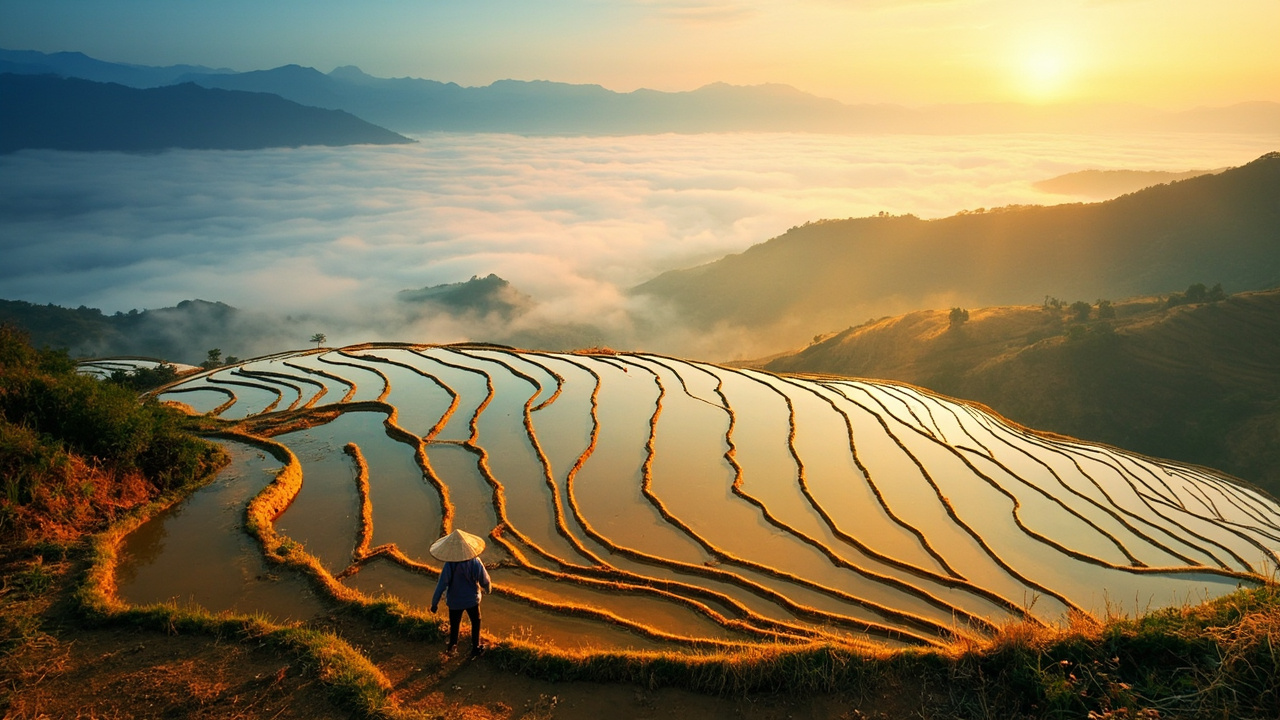
The Yuanyang Rice Terraces are the kind of place that photographs don’t do justice to, and I say that as someone who has taken hundreds of photos of them. Carved into the mountainsides by the Hani people over more than a thousand years, these terraces cascade down the slopes in an endless series of curves and steps, filled with water that reflects the sky like a thousand mirrors. During the “mirror season” from November to April, when the terraces are flooded and waiting for planting, they’re at their most spectacular.
The terraces are spread across a huge area, and the best way to see them is to base yourself in one of the small villages and explore at sunrise and sunset, when the light transforms the landscape. The sunrises here are worth the early wake-up, watching the light creep across the water-filled terraces while the mist rolls through the valleys below. It’s a landscape that feels almost supernatural, like something from a dream.
📍 Location: Yuanyang County, approximately 300km south of Kunming 🎫 Entry fee: Approximately $25 (¥180) for a multi-day pass covering the main viewpoints 🕒 Opening hours: Viewpoints open at sunrise; gates close at sunset 🚇 How to get there: Take a bus from Kunming South Station to Yuanyang (5-6 hours, approximately $25/¥180), then local transport to the villages 📅 When to visit: November-April for the mirror season; avoid the rainy summer months 💡 Insider tips: Stay in the village of Duoyishu for the best sunrise views. The viewpoints can get crowded, especially on weekends, so go early or late. Hire a local guide for a day, they know the best spots that aren’t on the tourist map. The Hani villages themselves are worth exploring, with their traditional mushroom-shaped houses. Bring a good camera and a tripod, you’ll want them.
I watched the sunrise at Duoyishu with a group of Chinese photographers who had driven six hours from Kunming for this exact moment. When the light finally hit the terraces, one of them let out a long breath. “Every time,” he said, “it’s like the first time.”
Songzanlin Monastery — The Little Potala Palace
Songzanlin is the largest Tibetan Buddhist monastery in Yunnan, and it’s the reason many people make the trip to Shangri-La. Perched on a hillside above the town, its white and gold buildings rise in tiers like a smaller version of Lhasa’s Potala Palace, and the view from the base looking up is genuinely awe-inspiring. The monastery was founded in the 17th century and has survived wars, revolutions, and a fire, and it remains a living center of Tibetan Buddhism.
The complex is home to hundreds of monks, and you’ll see them going about their daily routines, studying, praying, and chatting in the courtyards. The main temple is filled with elaborate murals, thangkas, and statues, and the atmosphere is thick with incense and the sound of chanting. It’s a place that feels sacred, even if you’re not religious, and it’s easy to spend a few hours wandering the halls and watching the monks’ daily life unfold.
📍 Location: Approximately 5km north of Shangri-La Old Town 🎫 Entry fee: Approximately $15 (¥110) including shuttle bus from the entrance 🕒 Opening hours: 8am-6pm; the main prayer hall is busiest in the morning 🚇 How to get there: Take a taxi from Shangri-La Old Town (15 minutes, approximately $5/¥35) or walk if you’re feeling energetic 📅 When to visit: May-October for the best weather; mornings are best for seeing the monks 💡 Insider tips: The monastery is still a working religious site, so dress modestly and be respectful. The shuttle bus from the entrance is mandatory, you can’t walk up the road. The view from the top of the complex, looking down on Shangri-La and the surrounding mountains, is worth the climb. The monks are used to visitors and many speak some English, so don’t be afraid to ask questions. The butter sculptures in the main temple are incredible and not to be missed.
I was wandering through the monastery’s courtyards when a young monk approached me and asked, in careful English, where I was from. When I said America, he smiled. “I want to go to New York,” he said. “But I think it’s too loud.” He was probably right.
FAQ summary
The Yunnan loop is best done in 8-12 days, moving clockwise from Kunming through Dali, Lijiang, and Shangri-La, with optional side trips to Tiger Leaping Gorge, Shaxi, and Yuanyang. The high-speed rail network connects Kunming, Dali, and Lijiang, making train travel the easiest option, while Shangri-La is best reached by a short flight or the newer rail line. Most travelers spend roughly $700-1,200 per person excluding international flights, and the best seasons are March-May and September-November. Western passport holders can visit China visa-free for up to 30 days through 2026, and the 240-hour visa-free transit policy covers many major cities.
FAQ
Q: Do I need a visa to visit Yunnan in 2026? A: Most Western passport holders can enter China visa-free for up to 30 days through 2026. If you’re transiting through a major city like Beijing or Shanghai, you may qualify for the 240-hour visa-free transit policy. Check the latest China visa policies before booking.
Q: How many days do I need for the Yunnan loop? A: Plan for at least 8 days, but 10-12 is more comfortable. A minimum itinerary would be 1 day in Kunming, 2 in Dali, 2 in Lijiang, 1 at Jade Dragon Snow Mountain, and 2 in Shangri-La. Add extra days for Tiger Leaping Gorge or Shaxi if you have them.
Q: What’s the best way to get around Yunnan? A: The high-speed rail network connects Kunming, Dali, and Lijiang, with trains running multiple times daily. For Shangri-La, you can fly from Kunming or take the newer rail line. Book train tickets through the official 12306 app or China train travel guides.
Q: How much money should I budget for the Yunnan loop? A: Expect to spend $50-80 per day for mid-range accommodation, food, and transport. A 10-day trip will cost roughly $700-1,200 per person excluding international flights. Budget options exist, but they’re not worth the savings in my experience.
Q: Is it safe to travel in Yunnan as a solo traveler? A: Yes, Yunnan is one of the safest regions in China for solo travelers. The main risks are altitude sickness in Shangri-La and getting lost in Lijiang’s maze of alleys, both of which are manageable. Just use common sense and keep your valuables close.
Q: Do I need to speak Mandarin to travel in Yunnan? A: English is limited outside the main tourist areas, so download a translation app like Pleco or Google Translate before you go. In Kunming, Dali, and Lijiang, you’ll find English speakers in hotels and tourist restaurants, but don’t count on it elsewhere.
Q: What should I pack for the Yunnan loop? A: Layers are essential, as temperatures can swing dramatically between day and night, especially in Shangri-La. Bring good walking shoes, a rain jacket, sunscreen, and altitude sickness medication if you’re prone to it. A SIM card with a VPN setup is essential for Google services.
The Honest Wrap-up
The Yunnan loop is the trip I recommend to anyone visiting China for the first time who wants to see something beyond the big cities. It’s got history, nature, culture, and food, and it’s a region that rewards slow travel. If you’re the kind of person who needs a beach and a cocktail to relax, this might not be your place. But if you’re willing to trade comfort for wonder, to wake up early for sunrises and walk a little further than your feet want to, Yunnan will give you memories that last longer than any souvenir.
My final advice is this: don’t try to see everything. The loop I’ve laid out is already ambitious, and you’ll be tempted to add more. Resist. Pick the places that speak to you, stay a little longer than you planned, and leave room for the unexpected. The best moments in Yunnan, I’ve found, are the ones you can’t plan for. The grandmother who walks you home, the monk who wants to visit New York, the sunrise that makes you forget you’re tired. Those are the reasons to come.
Topics
More guides you may like

Top 10 Bridges in China
China's bridges are engineering marvels spanning mountains, rivers, and seas. Here are 10 of the most spectacular, from ancient stone to modern steel.
8 min read

Top 10 Buddhist Sites in China
From the Leshan Giant Buddha to the Dunhuang Caves, these 10 Buddhist sites represent 2,000 years of China's spiritual heritage.
9 min read

Top 10 Day Trips from Beijing You Shouldn't Miss
Beijing is packed with history, but some of China's best experiences are just a few hours away. Here are 10 day trips that will transform your visit.
9 min read

Top 10 Hidden Gems in China Off the Beaten Path
Beyond the Great Wall and Terracotta Warriors, China has incredible hidden destinations few tourists ever reach. Here are 10 underrated gems worth the detour.
9 min read

Top 10 Markets and Shopping Streets in China
From Shanghai's Bund to Beijing's Silk Street - 10 markets where foreigners can haggle, explore, and bring home authentic Chinese goods.
9 min read

Top 10 Museums in China You Shouldn't Miss
China's museums span 5,000 years of civilization. These 10 - from the Palace Museum to Xi'an's terracotta gallery - are unmissable for culture lovers.
9 min read