
Kashgar Travel Guide
The call to prayer from the Id Kah Mosque hit me somewhere around the third cup of tea. I was sitting on a low stool at a Uyghur teahouse near the old city…
Kashgar Travel Guide
The call to prayer from the Id Kah Mosque hit me somewhere around the third cup of tea. I was sitting on a low stool at a Uyghur teahouse near the old city walls, watching an old man in a green doppa cap tear pieces of naan into his bowl. He caught me staring, grinned, and pushed the whole loaf toward me. No English. No shared language at all. Just bread.
That was my first morning in Kashgar, and it set the tone for everything that followed. This is a city at the far western edge of China, closer to Islamabad than to Beijing, where the dominant language on the street is Uyghur, the food is closer to Central Asian than Chinese, and the Sunday livestock market is one of the last great bazaars in Asia. If you’ve done Beijing and Shanghai and want to see the China that doesn’t fit the postcard, this is it.
This guide covers the ten things worth your time in and around Kashgar, with real prices, real transport details, and the kind of advice I wish someone had given me before I went. I’ve been to Kashgar three times over the past five years, most recently in autumn 2025. Some things have changed. The bones haven’t.
Quick answer
Kashgar (喀什, Kāshí) is a Silk Road city in China’s far western Xinjiang region, reachable by direct flight from most major Chinese cities (about 5 hours from Beijing) or by the new high-speed rail link from Urumqi (roughly 3.5 hours). Most Western tourists need a Chinese visa for Xinjiang, though visa-free transit doesn’t apply here the way it does to Beijing or Shanghai. Plan 3–4 days minimum, budget $60–120 per day, and go in September or October for the best weather.
The Short Version
Go for the Sunday livestock market, the old city at dusk, and the food. Skip it if you’re on a two-week first-China trip and want the greatest hits — Kashgar is a 5-hour flight from Beijing and deserves its own trip. Bring cash, download a translation app, and don’t expect much English. The tea is better than the coffee. Everything is cheaper than you think.
How I Picked These
I’ve been to Kashgar three times: once in 2019 on a whim after a Chengdu trip, once in 2022 during a quieter period, and most recently in October 2025. I stayed in the old city twice, in a hotel near People’s Square once. I ate at the same noodle stall on Seman Road all three visits. I’ve also talked to Uyghur guides, Han Chinese tourists from Shanghai, a Kazakh trader at the livestock market, and a hostel receptionist named Dilnur who gave me better advice than any guidebook. Everything below is stuff I’ve personally done, with prices I’ve personally paid. Where I’m unsure, I say so.
Comparison Table
| Rank | Place | Best For | Approx Cost (USD) | Time Needed | When to Go |
|---|---|---|---|---|---|
| 1 | Sunday Livestock Market | The real Silk Road | Free ($0 / ¥0) | 3–4 hrs | Sunday morning |
| 2 | Old City (Kashgar Ancient City) | Wandering, photos | Free entry ($0 / ¥0) | Half a day | Late afternoon |
| 3 | Id Kah Mosque | Architecture, atmosphere | $6 / ¥45 | 1 hr | Non-prayer times |
| 4 | Abakh Hoja Tomb | History, gardens | $4 / ¥30 | 1.5 hrs | Morning |
| 5 | Grand Bazaar | Souvenirs, chaos | Free ($0 / ¥0) | 2 hrs | Weekday morning |
| 6 | Handicraft Street | Copper, instruments | Free ($0 / ¥0) | 1–2 hrs | Afternoon |
| 7 | Karakul Lake (day trip) | Mountains, yaks | $50–70 / ¥360–500 | Full day | May–Oct |
| 8 | Tashkurgan (2-day trip) | Border country | $150+ / ¥1,080+ | 2 days | Jun–Sep |
| 9 | Uyghur Teahouses | Slow afternoons | $3–5 / ¥20–35 | 1 hr | Anytime |
| 10 | Sunday Bazaar (non-livestock) | Textiles, spices | Free ($0 / ¥0) | 2 hrs | Sunday |
1. Sunday Livestock Market — The Reason You Came
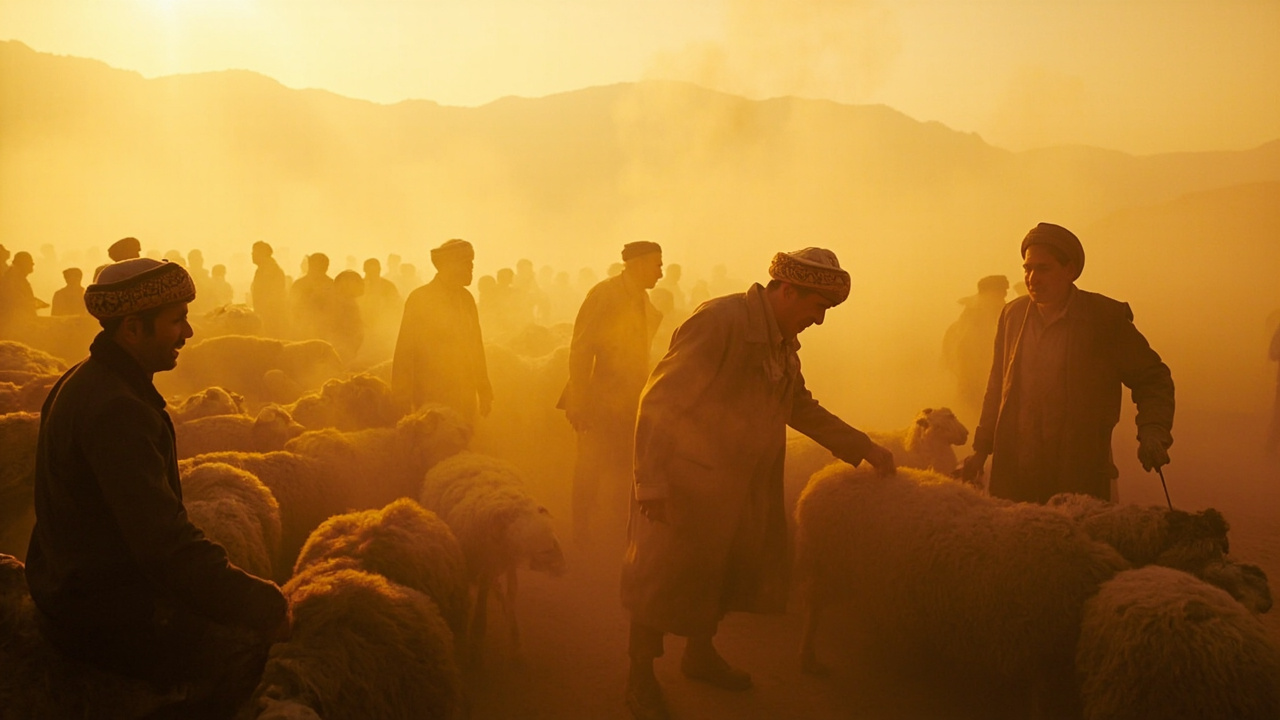
The first thing you notice is the noise. Not the animals — the men. Hundreds of them, in doppa caps and long coats, shouting prices at each other across a dusty lot the size of two football fields. Sheep, goats, cattle, a few camels. The smell hits you next: wool, dust, diesel from the trucks that brought them in.
This is the Sunday Livestock Market (Xīngǎ’ěr Xiāngchù Jiāoyì Shìchǎng), and it’s the single best reason to plan your Kashgar trip around a Sunday. It’s been running for centuries, and while it’s more commercial than it used to be, it’s still a working market — real herders buying real animals, not a tourist show.
Get there by 9 AM. By noon the good stuff is gone. The bargaining is theatrical: two men grip each other’s hands inside a sleeve to negotiate price, a tradition that goes back to the Silk Road. You can watch for hours. A few vendors will let you take photos for a small tip ($1–2 / ¥7–15). Ask first.
📷 Location: About 6 km northwest of the old city, off Xihuan Road (西环路). 🎫 Entry fee: Free ($0 / ¥0). Some unofficial “guides” will offer to walk you around for $10–15 / ¥70–110 — skip unless you want translation. 🕐 Opening hours: Sundays only, roughly 8 AM–2 PM. Arrive before 10 AM. 🚕 How to get there: Take a taxi from the old city — about $3–4 / ¥20–30, 15 minutes. Tell the driver “Xīngǎ’ěr xiāngchù shìchǎng” or show the Chinese characters 兴格尔牲畜市场. DiDi works here but drivers may cancel; taxis are easier. ⏰ When to visit: Sunday morning, ideally 8:30–11 AM. Avoid the last Sunday before Eid al-Adha (dates shift yearly) unless you want to see the sheep-buying frenzy — it’s intense. 💡 Insider tips: Bring small bills; nobody has change for ¥100. Wear closed shoes — the ground is uneven and not always clean. Don’t wear shorts; you’ll stick out. The food stalls at the entrance sell excellent lamb kebabs for $1 / ¥7 each. And if a man offers to let you hold a sheep, he’ll want $5 / ¥35 after.
I paid $2 / ¥15 for a bowl of yogurt from a woman near the entrance. It was the best yogurt I’ve ever had.
2. Kashgar Old City — Where You’ll Actually Spend Your Time
I got lost here on purpose for three hours and never once felt unsafe. The old city (Kāshí Gǔchéng) is a maze of narrow alleys, mud-brick walls, wooden doors painted in bright blues and yellows, and kids playing football in dead-end courtyards. Most of it was rebuilt after 2010, which bothers some travelers. It shouldn’t. The people living there are real, the tea is real, and the atmosphere at dusk — when the call to prayer echoes off the walls and the smell of grilling lamb fills the air — is unlike anywhere else in China.
Walk without a map. Turn left when you’d turn right. Stop when you smell something good. The old city is roughly 2 square kilometers, bounded by Id Kah Mosque to the south and the old walls to the north. You’ll find coppersmiths, hat makers, naan bakeries, and doorways leading to family courtyards where someone’s grandmother is making dumplings.
📷 Location: Central Kashgar, around Id Kah Mosque and extending north and east. 🎫 Entry fee: Free ($0 / ¥0). Some renovated sections charge $4 / ¥30 — skip those. 🕐 Opening hours: Always open. Best light is 5–8 PM. 🚶 How to get there: From People’s Square, walk south on Jiefang North Road for 10 minutes. You’ll hit the mosque. The old city starts behind it. ⏰ When to visit: Late afternoon into evening. Weekdays are quieter than weekends. 💡 Insider tips: Download an offline map — Google Maps is unreliable in Xinjiang. The translation app on your phone will be your best friend; almost nobody speaks English. Cash is king in the old city — many small shops don’t take WeChat Pay or Alipay, though larger restaurants do. Don’t photograph people without asking; a smile and a gesture toward your camera works.
A boy of about eight led me to his family’s naan shop after I got turned around. His mother gave me two fresh naan for free. I tried to pay. She refused.
3. Id Kah Mosque — The Heart of the City
Id Kah (Àitígǎ’ěr Qīngzhēnsì) is the largest mosque in China, and it anchors the whole old city. The yellow-tiled facade, the tall minarets, the courtyard full of old men sitting on carpets — it’s the visual signature of Kashgar. Non-Muslims can’t enter during prayers, and women should cover their heads and shoulders. The courtyard is worth the visit alone.
The mosque was built in 1442 and has been expanded many times since. It can hold around 20,000 worshippers for Friday prayers. If you’re there on a Friday around noon, you’ll see the square in front fill up — hundreds of men, all facing west. It’s a sight.
📷 Location: Id Kah Square, central old city. 🎫 Entry fee: $6 / ¥45. 🕐 Opening hours: Roughly 9 AM–5 PM, closed during the five daily prayers (each lasts about 30 minutes). Fridays are busiest. 🚶 How to get there: You can’t miss it. From People’s Square, walk south 10 minutes. ⏰ When to visit: Mid-morning on a weekday. Friday noon if you want to see the crowd (from outside the gate). 💡 Insider tips: Dress modestly — no shorts, no tank tops. Women should bring a scarf. Photography is allowed in the courtyard but not inside the prayer hall. There’s a small bookshop next door selling Uyghur-language Qurans; the owner speaks a little English.
I sat on the steps for an hour and watched a man feed pigeons. He didn’t say a word to me. Neither did I. It was perfect.
4. Abakh Hoja Tomb — The Quiet One
Most tourists skip this. Don’t. The Abakh Hoja Tomb (Āpákè Huòjiā Mù), sometimes called the Fragrant Concubine’s Tomb, sits in a walled garden about 5 km northeast of the old city. It’s a 17th-century mausoleum with a green-tiled dome, and on a clear day the contrast between the tiles and the blue sky is worth the taxi ride alone.
The story goes that this is the burial place of the Hoja family, a line of Naqshbandi Sufi leaders. One of the women buried here — Iparhan — became a consort of the Qianlong Emperor and is the subject of a famous legend. The tomb itself is beautiful but not huge. The gardens are the real draw: quiet, shaded, full of old trees and birdsong.
📷 Location: Haohan Village, about 5 km northeast of central Kashgar. 🎫 Entry fee: $4 / ¥30. 🕐 Opening hours: 9 AM–6 PM daily. 🚕 How to get there: Taxi from the old city, about $3 / ¥20, 15 minutes. Show the driver 阿帕克霍加麻扎. ⏰ When to visit: Morning, before the heat. Weekdays are nearly empty. 💡 Insider tips: Bring water — there’s nowhere to buy it on-site. The caretaker will sometimes unlock the inner chamber for a small tip ($2 / ¥15). There’s a small Uyghur restaurant 200 meters down the road that serves excellent polo (pilaf) for $3 / ¥20.
I went on a Tuesday morning and had the whole place to myself except for a groundskeeper sweeping leaves.
5. Grand Bazaar — Chaos, in a Good Way
The Grand Bazaar (Dà Bāzhā) is not the Sunday livestock market. It’s the everyday market in central Kashgar, and it’s been here for at least 2,000 years. Silk, spices, dried fruit, carpets, knives, jade, fake North Face jackets — it’s all here. The main hall is covered, which is a relief in summer.
I’m going to be honest: much of what’s sold here is tourist-grade. The “silk” is often polyester. The “jade” is often glass. But the food section is real, and the atmosphere is worth an hour. Go for the dried fruit — apricots, figs, raisins, mulberries — which is genuinely excellent and cheap.
📷 Location: East of Id Kah Mosque, along Aizirete Road. 🎫 Entry fee: Free ($0 / ¥0). 🕐 Opening hours: Roughly 9:30 AM–8 PM daily. 🚶 How to get there: Walk east from Id Kah Mosque for 5 minutes. ⏰ When to visit: Weekday morning. Weekends are packed. 💡 Insider tips: Bargain hard — start at 30% of the asking price. Buy dried fruit by weight, not by the bag. The knife shops in the back are legit but you can’t fly with them; shipping is available for about $15 / ¥110. Bring cash.
I bought a kilo of dried apricots for $4 / ¥30. They lasted the whole trip home.
6. Handicraft Street — Where the Real Makers Are
Kashgar’s Handicraft Street (Shǒugōng Yìpǐn Jiē) runs north from the old city, and it’s where you’ll find actual working artisans: coppersmiths hammering pots, instrument makers stringing rawap, hat makers shaping doppas. It’s not a museum. The men here are working, and they’ll let you watch if you’re respectful.
The copper work is the standout. Kashgar has been a copper-working center for centuries, and the workshops here still use hand tools. A small copper teapot runs $20–40 / ¥145–290. A hand-made rawap (Uyghur lute) is $80–200 / ¥580–1,450 depending on size and quality.
📷 Location: North of the old city, along Wusitangboyi Road. 🎫 Entry fee: Free ($0 / ¥0). 🕐 Opening hours: Roughly 10 AM–7 PM, but many shops close for lunch 1–3 PM. 🚶 How to get there: Walk north from the old city center for 10 minutes; ask for 手工艺品街. ⏰ When to visit: Mid-afternoon, after the lunch break. 💡 Insider tips: Ask before photographing. Many artisans will pose if you buy something small. Cash preferred. If you want a custom piece, most will take a week — plan accordingly.
An old coppersmith named Abdul let me try his hammer for two minutes. My pot looked terrible. He laughed for five minutes straight.
7. Karakul Lake — The Day Trip That Justifies the Whole Journey
This is the one. Karakul Lake sits at 3,600 meters on the Karakoram Highway, about 190 km southwest of Kashgar, right at the base of Muztagh Ata (7,509 m). The water is deep blue-green, the mountains are snow-capped year-round, and the silence is total. I’ve been to a lot of lakes. This one is in my top three.
You can do it as a long day trip or stay overnight in a yurt. I recommend overnight if you can handle the altitude. The sunrise on Muztagh Ata is worth the cold.
📷 Location: Karakoram Highway, about 4 hours by car from Kashgar. 🎫 Entry fee: $7 / ¥50 for the lake area. 🕐 Opening hours: Accessible year-round, but the road sometimes closes in winter. 🚗 How to get there: Hire a driver for the day ($70–100 / ¥500–720) or join a shared tour ($30–50 / ¥215–360). No public transport. Bring your passport — there are police checkpoints. ⏰ When to visit: May–October. July and August are warmest but busiest. September is ideal. 💡 Insider tips: Altitude sickness is real — don’t go straight from Kashgar to the lake and hike. Drink water, go slow. Yurt stays run $20–30 / ¥145–215 per person including dinner. Bring cash; there’s no ATM. The Kyrgyz herders here are not Uyghur — different language, different culture.
I stayed in a yurt with a Kyrgyz family. The grandmother made butter tea. I pretended to like it.
8. Tashkurgan — The Two-Day Border Trip
Tashkurgan (Tǎshíkù’ěrgān) is a Tajik town about 300 km south of Kashgar, near the Pakistani border. It’s high (3,100 m), remote, and feels like a different country. The Stone City ruins, the grasslands, the Pamir Mountains — this is the trip for travelers who want the far edge.
You need a permit to go (your hotel or tour operator can arrange it, about $15 / ¥110). The drive from Kashgar takes 6–8 hours, so plan two days minimum.
📷 Location: Taxkorgan Tajik Autonomous County, near the Karakoram Highway. 🎫 Entry fee: Stone City $4 / ¥30; grasslands free. 🕐 Opening hours: Daylight hours. 🚗 How to get there: Shared car or private driver from Kashgar. No train. Permit required. ⏰ When to visit: June–September. Winter is brutal. 💡 Insider tips: Bring your passport and permit at all times — there are multiple checkpoints. Cash only. The Tajik food (especially the bread and yogurt) is different from Uyghur food — try both. Cell signal is spotty.
I met a Pakistani trader at a roadside stall who’d crossed the border that morning. He sold me a small carved stone for $2 / ¥15.
9. Uyghur Teahouses — The Slow Afternoon
Kashgar runs on tea. The teahouses (chāguǎn) in the old city are where men gather to drink, argue, play chess, and nap. The most famous is the Old Teahouse near Id Kah Mosque, but the smaller ones down side alleys are better and cheaper.
You’ll drink milk tea or black tea with rock sugar, eat naan, and sit for hours. Nobody will rush you. A pot of tea is $2–3 / ¥15–20. Naan is $0.50 / ¥3.
📷 Location: Throughout the old city; the Old Teahouse is on Wusitangboyi Road. 🎫 Entry fee: Free ($0 / ¥0). 🕐 Opening hours: Roughly 9 AM–9 PM. 🚶 How to get there: Any alley in the old city. Look for men sitting outside. ⏰ When to visit: Mid-afternoon, 3–5 PM. 💡 Insider tips: Sit wherever there’s space — sharing tables is normal. If someone pours you tea, nod. Don’t tip; it’s not expected. Bring a phrasebook or translation app.
An old man at a teahouse taught me to say “rahmat” (thank you in Uyghur). I used it for the rest of the trip.
10. Sunday Bazaar (Non-Livestock) — The Other Sunday Market
If you’re in Kashgar on a Sunday, you’ll do the livestock market in the morning and this in the afternoon. The Sunday Bazaar (not the Grand Bazaar) is a sprawling open-air market selling everything from carpets to kitchenware to live chickens. It’s less touristy than the Grand Bazaar and more genuinely useful to locals.
The textile section is the highlight — hand-woven carpets, Atlas silk, embroidered doppas. Prices are negotiable and generally lower than the Grand Bazaar.
📷 Location: East side of the city, along Renmin East Road. 🎫 Entry fee: Free ($0 / ¥0). 🕐 Opening hours: Sundays only, roughly 9 AM–6 PM. 🚕 How to get there: Taxi from the old city, about $3 / ¥20. ⏰ When to visit: Sunday afternoon, after the livestock market. 💡 Insider tips: Bring cash and a bag. The carpet sellers will ship internationally for $30–60 / ¥215–430. Check the weave by looking at the back. Don’t buy the first thing you see.
I bought a small embroidered doppa for $8 / ¥60. I wear it at home. Nobody knows what it is.
FAQ summary
Kashgar is reachable by direct flight from most major Chinese cities and by high-speed rail from Urumqi (3.5 hours). Most Western tourists need a standard Chinese visa — the 144-hour visa-free transit does not apply to Xinjiang. The best time to visit is September–October. Budget $60–120 per day including accommodation, food, and transport. English is rarely spoken; download a translation app and carry cash, as many small shops don’t accept WeChat Pay or Alipay. The Sunday Livestock Market is the single best experience and requires planning your trip around a Sunday.
FAQ
Q: Do I need a visa to visit Kashgar? A: Yes, if you’re from the US, UK, EU, or most other countries. The 144-hour and 240-hour visa-free transit policies do not apply to Xinjiang. Apply for a standard Chinese tourist visa (L visa) in advance through your nearest Chinese embassy or visa center. Processing takes about 4–7 business days.
Q: Is Kashgar safe for foreign tourists? A: Yes. Violent crime against tourists is extremely rare. There are many police checkpoints, especially on the road to Karakul Lake and Tashkurgan, and you’ll need your passport with you at all times. The main practical concerns are altitude sickness on day trips and language barriers, not safety.
Q: How do I get to Kashgar from Beijing or Shanghai? A: Fly. Direct flights from Beijing take about 5 hours, from Shanghai about 6 hours, and cost $150–350 / ¥1,080–2,520 round-trip depending on season. There’s also a high-speed rail link from Urumqi (3.5 hours, $25–40 / ¥180–290). See the China train travel guide for booking tips.
Q: Can I use WeChat Pay or Alipay in Kashgar? A: Yes, at larger restaurants, hotels, and chain stores. But many small shops, teahouses, and market vendors only take cash. Bring at least $100 / ¥720 in cash for a 3-day trip. See the payment guide for setup.
Q: Do I need a VPN in Kashgar? A: Yes, if you want to use Google, WhatsApp, Instagram, or most Western apps. Install and test your VPN before you arrive — VPN apps are hard to download once you’re in China. See the SIM and internet guide.
Q: What’s the best time of year to visit Kashgar? A: September and October. The weather is mild (60–80°F / 15–27°C), the markets are active, and the mountain roads to Karakul Lake are open. Summer is hot and crowded; winter is cold and many mountain routes close.
Q: How many days do I need in Kashgar? A: Three days minimum: one for the old city and Id Kah Mosque, one for the Sunday Livestock Market (if your trip includes a Sunday), and one for Karakul Lake. Add two more days if you want to go to Tashkurgan.
The Honest Wrap-up
This guide is for travelers who’ve already done the China highlights and want something different. If it’s your first trip to China and you’ve only got two weeks, go to Beijing, Xi’an, and Shanghai first — Kashgar is a 5-hour flight and deserves its own trip. If you’re the kind of traveler who picks a place because it sounds strange, or because the food is different, or because you want to sit in a teahouse and not understand a word anyone says — book the flight. Go in autumn. Plan around a Sunday. Bring cash. And when someone offers you naan, take it.
More guides you may like

Top 10 Bridges in China
China's bridges are engineering marvels spanning mountains, rivers, and seas. Here are 10 of the most spectacular, from ancient stone to modern steel.
8 min read

Top 10 Buddhist Sites in China
From the Leshan Giant Buddha to the Dunhuang Caves, these 10 Buddhist sites represent 2,000 years of China's spiritual heritage.
9 min read

Top 10 Day Trips from Beijing You Shouldn't Miss
Beijing is packed with history, but some of China's best experiences are just a few hours away. Here are 10 day trips that will transform your visit.
9 min read

Top 10 Hidden Gems in China Off the Beaten Path
Beyond the Great Wall and Terracotta Warriors, China has incredible hidden destinations few tourists ever reach. Here are 10 underrated gems worth the detour.
9 min read

Top 10 Markets and Shopping Streets in China
From Shanghai's Bund to Beijing's Silk Street - 10 markets where foreigners can haggle, explore, and bring home authentic Chinese goods.
9 min read

Top 10 Museums in China You Shouldn't Miss
China's museums span 5,000 years of civilization. These 10 - from the Palace Museum to Xi'an's terracotta gallery - are unmissable for culture lovers.
9 min read