
Tibet Nepal Overland
The border guard at Zhangmu looked at my passport, then at me, then back at the passport. He said something in Tibetan to the guy next to him, laughed, and…
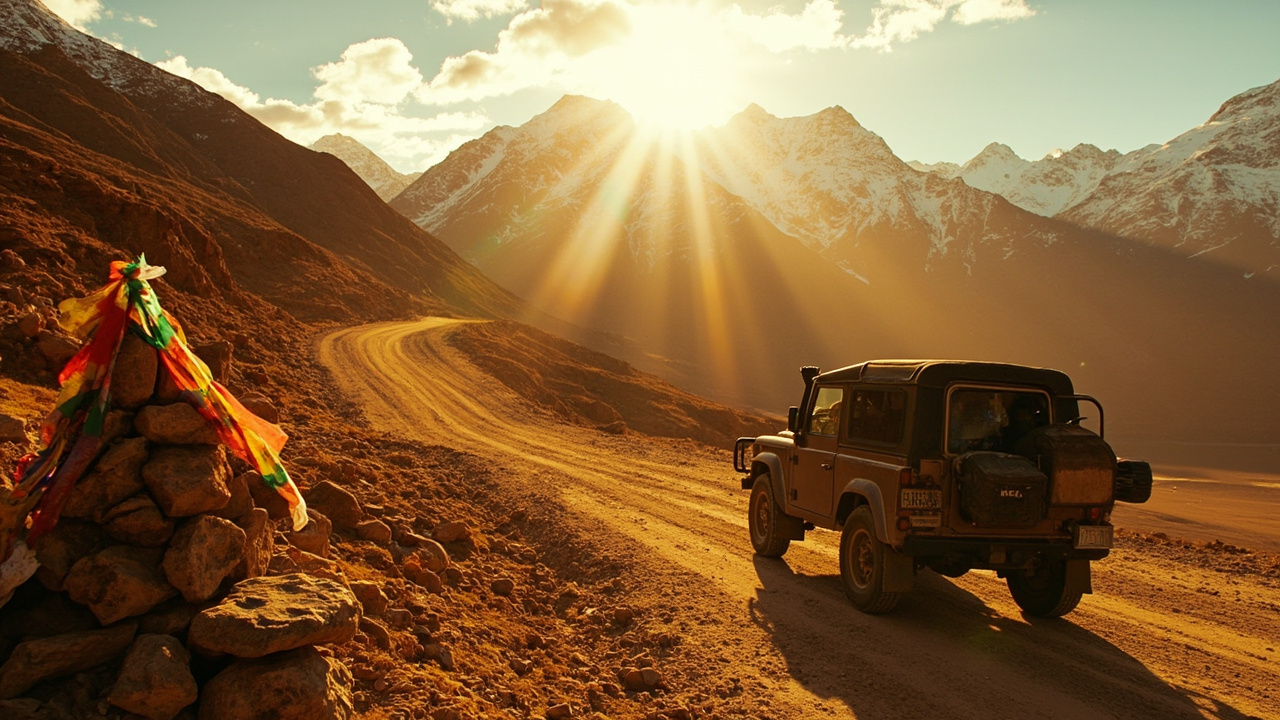
Tibet Nepal Overland
The border guard at Zhangmu looked at my passport, then at me, then back at the passport. He said something in Tibetan to the guy next to him, laughed, and stamped it anyway. That was hour nine of a day that started before dawn in Kathmandu and would end, eventually, in a guesthouse in Lhasa with a yak-butter smell I couldn’t get out of my jacket for a week. I’d come the wrong way round — most people do this route from Lhasa south to Nepal, not the reverse — and the confusion on everyone’s face at every checkpoint was worth the price of admission alone.
This is one of the great overland routes left in Asia. It crosses the Friendship Highway, 800-odd kilometers of switchbacks and 5,000-meter passes between Lhasa and the Nepali border, then drops 2,000 meters in a single afternoon into subtropical green. You go from prayer flags snapping in a wind that hurts, to banana trees and motorbike horns, in the space of a long lunch. There’s nothing else quite like it on the planet.
What follows is what I wish someone had told me before I booked it. Not the brochure version. The version with the altitude headaches, the permit paperwork, the guesthouse in Tingri with the worst mattress of my life, and the moment at Everest Base Camp North when the clouds pulled back and I forgot all of it.
Quick answer
The Tibet–Nepal overland route runs from Lhasa to Kathmandu (or reverse) along the Friendship Highway, takes 7–10 days by 4WD or organized tour, and costs roughly $1,500–2,500 per person all-in depending on group size and hotel tier. Foreigners cannot travel independently in Tibet — you must join a licensed tour with a Tibetan guide, arranged through an agency, and you need a Chinese visa plus a Tibet Travel Permit. The border crossing at Zhangmu/Kyirong reopened to foreign tourists in 2024 after years of COVID-era closure; confirm current status with your agency before booking. Best months are April–May and September–October.
The Short Version
If you only read one paragraph: do it Lhasa-to-Kathmandu, not the reverse. Acclimatization is easier, the scenery builds, and the descent into Nepal feels like a reward rather than a slog. Budget 10 days minimum. Book through a Tibetan agency at least 30 days ahead — permits are slow. Bring cash in USD or CNY; ATMs on the Tibetan plateau are unreliable and Nepali rupees aren’t accepted on the China side. And pack for four climates, because you’ll hit all of them.
How I Picked These
I’ve done this route twice — once in 2019 before the pandemic shut the border, once again in late 2024 after it reopened — and I’ve spent enough time in Lhasa and Kathmandu that I have opinions about which teahouses are worth the altitude headache. I talked to drivers, guides, a Tibetan woman running a guesthouse in Tingri, and a Nepali border fixer named Bikash who has been shepherding confused foreigners through the Zhangmu crossing for over a decade. Where I’m unsure about a 2026 detail, I say so. Prices move. Permits change. The mountains don’t.
Comparison Table
| Rank | Stop | Best For | Approx Cost (USD) | Time Needed | When to Go |
|---|---|---|---|---|---|
| 1 | Lhasa | Monasteries, acclimatization, culture | $80–150/day | 3–4 days | Apr–Oct |
| 2 | Yamdrok Lake | Turquoise water, photography | Included in tour | Half day | May–Oct |
| 3 | Gyantse | Kumbum stupa, quieter than Lhasa | $40–80/day | 1 day | Apr–Oct |
| 4 | Shigatse | Tashilhunpo Monastery, gateway city | $50–90/day | 1 day | Apr–Oct |
| 5 | Sakya | Remote monastery, fewer tourists | $30–60 | Half day | May–Sep |
| 6 | Tingri | Everest views, acclimatization base | $30–70 | 1–2 days | Apr–May, Sep–Oct |
| 7 | Everest Base Camp (North) | The mountain itself | $180 permit + tour | 1–2 days | Apr–May, Sep–Oct |
| 8 | Zhangmu / Kyirong | Border crossing | Border fees ~$30 | 1 day | Apr–Oct |
| 9 | Kodari to Kathmandu road | Descent into Nepal | $20–40 transport | 1–2 days | Oct–Apr |
| 10 | Kathmandu | Reentry to chaos, food, rest | $30–80/day | 3+ days | Oct–Apr |
Lhasa — Where You Acclimatize and Eat Too Much Yak
My first morning in Lhasa I woke at 4 a.m. with a headache like a vice and lay there listening to a dog bark somewhere in the Barkhor. By noon I’d drunk three cups of sweet tea at a hole-in-the-wall near the Jokhang and felt almost human. Lhasa is 3,650 meters up. Respect it.
The city is the cultural anchor of the whole route. The Jokhang Temple draws pilgrims who prostrate themselves on the flagstones outside from dawn until dark, and the Barkhor kora (the clockwise pilgrim circuit around it) is the best people-watching in Asia. The Potala Palace, that impossible white-and-red cliff of a building, is worth the timed-entry ticket even if you hate palaces. Sera and Drepung monasteries are alive — monks debating in courtyards, not museum exhibits.
📍 Location: Chengguan District, central Lhasa. Most hotels cluster around the Barkhor.
🎫 Entry fee: Jokhang ¥85 ($12); Potala Palace ¥200 ($28) high season, ¥100 low; Sera Monastery ¥50 ($7).
🕒 Opening hours: Jokhang 9am–5pm; Potala 9am–4pm with timed slots (book via your agency); Sera 9am–4pm, monk debates usually 3–5pm.
🚕 How to actually get there: Fly into Lhasa Gonggar Airport (LXA) — taxi to city center ¥200 ($28), 60–90 min. Or arrive by train from Xining on the Qinghai-Tibet Railway, 21 hours, hard sleeper ¥500 ($70). The train is the better acclimatization move.
⏰ When to visit: April–October. July–August is rainy and crowded with domestic tourists. Go in May or September.
💡 Insider tips: Buy bottled oxygen before you need it (¥30 at any pharmacy). Set up Alipay or WeChat Pay before you arrive — many Lhasa shops are cashless. Get a Chinese SIM at the airport; your home SIM will roam at brutal rates. A VPN is essential if you want Google, WhatsApp, or Instagram.
I ate yak momos at a place with no English menu and no name I could pronounce, and they were the best thing I ate in Tibet.
Yamdrok Lake — The One Everyone Photographs (For Good Reason)
We stopped at the pass above Yamdrok at maybe 4,900 meters and the wind was so strong I had to brace against the car to take a photo. Below us the lake was a color I’ve only otherwise seen in glacial ice — a flat, unreal turquoise that doesn’t look like water.
It’s a 250-kilometer drive from Lhasa and every tour stops here, so you won’t be alone. That’s fine. The lake is big enough to absorb a busload of tourists and still feel vast. There’s a viewpoint with the usual yak-photo hustle (¥20 to sit on a decorated yak, ¥10 if you negotiate), and a small monastery on a peninsula worth the short walk.
📍 Location: Nagarze County, 110 km southwest of Lhasa on the Friendship Highway.
🎫 Entry fee: ¥60 ($8) at the official viewpoint; the pass itself is free.
🕒 Opening hours: Daylight hours; the pass is accessible whenever the road is open.
🚗 How to actually get there: Only by tour vehicle or private car — no public transport. Usually a morning stop en route to Gyantse.
⏰ When to visit: May–October. The lake freezes in winter and the pass can close with snow.
💡 Insider tips: The altitude here hits harder than Lhasa because you’ve climbed 1,200 meters in a few hours. Walk slowly. The “best” photo is actually from the lower viewpoint, not the top pass — most tours skip it. Bring small bills for the yak photos; nobody has change for ¥100.
A Tibetan driver named Tashi handed me a thermos of butter tea at the pass and I pretended to like it.
Gyantse — The Stupa That Beats Everything in Lhasa
Gyantse is a small town with one absolutely world-class thing: the Kumbum, a 32-meter, 9-tiered stupa with 76 chapels spiraling up inside it. You climb through it like a shell. Each chapel has its own murals, its own smell of old butter lamps, its own tiny window onto the town.
Most tours blow through Gyantse in two hours. Don’t. The Pelkor Chode Monastery next to the Kumbum is quieter than anything in Lhasa and the old town around it has a walled-in feel that’s disappearing fast elsewhere in Tibet. There’s a fort on the hill above town (Gyantse Dzong) with a steep 20-minute climb and the best view of the valley.
📍 Location: Gyantse County, Shigatse Prefecture, 250 km from Lhasa.
🎫 Entry fee: Kumbum + Pelkor Chode combined ¥60 ($8); Gyantse Dzong ¥30 (~$4).
🕒 Opening hours: 9am–6pm, last entry around 5pm.
🚗 How to actually get there: On the Friendship Highway, ~5 hours from Lhasa by car. No useful public transport for foreigners.
⏰ When to visit: Late morning, before the tour buses from Lhasa arrive around noon.
💡 Insider tips: The Kumbum’s upper chapels are the best — most people stop at level 3. The old town has a decent Tibetan restaurant near the monastery gate; the momos are better than Lhasa’s. Cash only in most of Gyantse.
I got lost in the Kumbum’s spiral and ended up in a chapel with a monk who insisted I share his lunch.
Shigatse — Big City, Big Monastery, Good Bed
Shigatse is Tibet’s second city and the last place on the route with genuinely comfortable hotels. Tashilhunpo Monastery, home of the Panchen Lama, is the main draw — a sprawling complex with a 26-meter gilded Buddha that fills an entire hall.
I’ll be honest: after Lhasa and Gyantse, Tashilhunpo felt like more of the same to me. What I actually loved about Shigatse was the normalcy — a real city with a night market, a pedestrian street, and coffee that wasn’t Nescafé. If you’ve been eating tour-group food for four days, this is where you reset.
📍 Location: Samzhubze District, central Shigatse. 🎫 Entry fee: Tashilhunpo ¥80 (~$11). 🕒 Opening hours: 9am–5pm; the kora around the monastery is open all day and free. 🚗 How to actually get there: ~3 hours from Gyantse by car on the Friendship Highway. ⏰ When to visit: Any time in season. The monastery kora at sunrise is the best free thing in the city. 💡 Insider tips: The kora (pilgrim path) around Tashilhunpo takes about an hour and has zero tourists. Shigatse has the best-stocked pharmacies on the route — buy Diamox here if you haven’t already. There’s a decent Sichuan restaurant row near the main roundabout. A shopkeeper on the pedestrian street refused to let me pay for a bottle of water after I helped her close a shutter in the wind.
Sakya — The Detour Almost Nobody Takes
Sakya Monastery is a walled grey fortress of a place, 150 kilometers off the main highway, and the drive there is half the point. We went on a clear day and saw wild asses, a fox, and exactly two other vehicles in four hours.
The monastery itself is the seat of the Sakya school of Tibetan Buddhism, with a massive library of sutras behind glass and murals that are 700 years old. The grey walls give it a completely different feel from the white-and-gold places elsewhere — more fortress, less palace. It’s quieter. Fewer monks, fewer tourists, more time to just stand in a courtyard and look.
📍 Location: Sakya County, 150 km southwest of Shigatse.
🎫 Entry fee: ¥60 ($8) for the main hall; the outer walls are free.
🕒 Opening hours: 9am–5pm, but hours are flexible and can close for ceremonies.
🚗 How to actually get there: Only by private vehicle or a custom tour itinerary. Most standard tours skip it.
⏰ When to visit: May–September. The road can be rough in shoulder season.
💡 Insider tips: Ask your guide to arrange it in advance — it’s not a standard stop. The small guesthouse in Sakya town is basic but the family who runs it makes excellent thukpa. Bring cash; there’s no ATM.
Our driver got a flat tire on the way back and we ate lunch by the roadside while he fixed it, which turned out to be the best meal of the trip.
Tingri — The Worst Bed, The Best Sky
Tingri exists for one reason: it’s the last town before Everest Base Camp North and it sits at 4,300 meters, which makes it a useful acclimatization stop. The guesthouses are grim. My mattress had a visible history. The shared bathroom was a hole in the ground with a curtain.
And yet. The night sky at Tingri is the best I’ve ever seen. No light pollution, no clouds, just the Milky Way so bright it casts shadows. I stood outside for an hour in a down jacket and forgot how cold I was.
📍 Location: Tingri County, ~250 km from Shigatse on the road to the Nepal border. 🎫 Entry fee: None for the town. 🕒 Opening hours: N/A. 🚗 How to actually get there: By tour vehicle, ~5 hours from Shigatse. ⏰ When to visit: April–May or September–October. Winter is brutal. 💡 Insider tips: Bring your own sleeping bag liner. The guesthouses charge for hot water. There’s one decent restaurant in town — ask your driver which one. Don’t sleep flat if you’re struggling with altitude; prop up on your bag. I met a Belgian cyclist in Tingri who was riding the whole Friendship Highway and had been on the road for six weeks. He looked happier than anyone I’ve ever met.
Everest Base Camp (North) — The Reason You Came
You don’t actually see Everest from the Tibetan side until you’re almost at Base Camp, and then it’s just there, massive and brown and streaked with snow, and the tour groups all go quiet at the same time. I’ve seen a lot of mountains. This one is different.
The Tibetan EBC sits at 5,150 meters, higher than the Nepali side, and you reach it by tour vehicle on a paved road. There’s a tent camp with basic beds and a restaurant tent, and a small hill with prayer flags where everyone takes the same photo. The permit is expensive and the altitude is punishing, but I’d do it again.
📍 Location: North side of Everest, Tingri County.
🎫 Entry fee: ¥180 (~$25) for the EBC permit, plus a vehicle fee; usually bundled into tour cost.
🕒 Opening hours: Accessible daylight hours; overnight stays at the tent camp are allowed in season.
🚗 How to actually get there: By tour vehicle from Tingri, 4 hours on a paved road with switchbacks.
⏰ When to visit: April–May and September–October for clear views. July–August is clouded in.
💡 Insider tips: Bring a proper down jacket even in summer — it was -5°C when I was there in September. The tent camp beds are ¥100–150 ($14–21) and worth it for the sunrise. Altitude sickness is real here; if you’re struggling, descend.
I watched the clouds pull back from the summit at 7 a.m. and a French woman next to me started crying, and honestly, fair.
Zhangmu / Kyirong — The Border Crossing Nobody Explains Properly
The China–Nepal border has two crossings: Zhangmu (the classic one, reopened 2024) and Kyirong (further west, sometimes used when Zhangmu is closed). Both involve a lot of waiting, a lot of paperwork, and a no-man’s-land walk across a bridge where you leave China on one side and enter Nepal on the other.
Zhangmu itself is a strange, half-abandoned town built vertically into a cliff — it was evacuated after the 2015 earthquake and is only partially repopulated. The walk across the Friendship Bridge takes about 10 minutes and is one of the more surreal border experiences I’ve had.
📍 Location: Zhangmu (Nyalam County) or Kyirong, both in Shigatse Prefecture.
🎫 Entry fee: Border formalities ¥200 ($28) in various fees; usually handled by your agency.
🕒 Opening hours: Border typically open 10am–5pm, but hours shift. Confirm with your agency.
🚗 How to actually get there: By tour vehicle from Tingri or Shigatse. You cannot cross independently.
⏰ When to visit: April–October. Winter closures are common.
💡 Insider tips: Have your Chinese visa and Nepal visa sorted in advance. Bring USD cash for the Nepali side — no ATMs for the first 30 km. The shared jeeps from the border to Kathmandu take 6–8 hours and cost NPR 2,500–4,000 (~$18–30).
Bikash, the border fixer, charged me $20 to sort my Nepali entry paperwork and was worth every cent.
The Road to Kathmandu — The Descent
The drive from the border down to Kathmandu is the part nobody warns you about. You drop from 2,300 meters at the border to 1,400 meters in Kathmandu over about 120 kilometers of switchbacks, and the climate changes completely — pine forest to terraced rice paddies to subtropical jungle in the space of a few hours.
The road is rough. There are landslides in monsoon season. The shared jeeps are packed and the drivers are fearless. But the moment you come over the last ridge and see the Kathmandu Valley spread out below, smog and all, it feels earned.
📍 Location: Bagmati Province, Nepal. 🎫 Entry fee: Nepal visa on arrival $30 for 15 days, $50 for 30 days (USD cash only). 🕒 Opening hours: N/A. 🚗 How to actually get there: Shared jeep or private car from the border, 6–8 hours. ⏰ When to visit: October–April, dry season. 💡 Insider tips: Get your Nepal visa online in advance to skip the queue. Change money at the border, not in Kathmandu — rates are better. The road is genuinely rough; if you get carsick, take something before you start. I shared a jeep with a Nepali family who fed me sel roti the whole way down and refused to take money for it.
Kathmandu — Reentry to Chaos
After two weeks of Tibetan silence, Kathmandu hits like a wall of sound. Horns, generators, temple bells, someone selling momos on every corner. I loved it immediately.
Thamel is the tourist ghetto and it’s fine — good food, cheap beds, every trekking agency you could want. But the real Kathmandu is in the old city around Durbar Square, in the courtyards of Patan, in the smell of marigolds at Boudhanath. Give yourself at least three days here to decompress before flying home.
📍 Location: Kathmandu Valley, Bagmati Province.
🎫 Entry fee: Durbar Square NPR 1,000 ($7); Boudhanath NPR 400 ($3); Swayambhunath NPR 200 (~$1.50).
🕒 Opening hours: Most sites 6am–7pm.
🚗 How to actually get there: Tribhuvan International Airport (KTM) has direct flights to major Asian hubs.
⏰ When to visit: October–April. Avoid monsoon (June–September).
💡 Insider tips: Get a local SIM at the airport (Ncell or NTC, ~$5 for 30 days). Cash is king — many places don’t take cards. The momos at any hole-in-the-wall in Thamel are better than the ones at the tourist restaurants.
I ate dal bhat twice a day for a week and never got tired of it.
FAQ summary
The Tibet–Nepal overland route requires a licensed tour, a Chinese visa, a Tibet Travel Permit, and (for the Nepal side) a Nepali visa on arrival. Foreigners cannot travel independently in Tibet. The route takes 7–10 days minimum from Lhasa to Kathmandu, costs roughly $1,500–2,500 per person all-in, and is best done April–May or September–October. The Zhangmu border crossing reopened to foreign tourists in 2024; confirm current status with your agency before booking. Bring USD cash, set up Alipay or WeChat Pay before you arrive, and expect altitude sickness at some point.
FAQ
Q: Can I do the Tibet–Nepal overland route independently? A: No. Foreigners must travel in Tibet with a licensed tour guide and a Tibet Travel Permit arranged through an approved agency. You can travel independently in Nepal, but the China side requires a group tour, even if the “group” is just you and a guide.
Q: How much does the whole trip cost? A: Budget $1,500–2,500 per person for a 10-day Lhasa-to-Kathmandu tour including permits, transport, guide, and mid-range hotels. Add $200–400 for flights, $100–200 for meals and tips, and $30–50 for the Nepal visa.
Q: Do I need a visa for China and Nepal? A: Yes to both. Most nationalities need a Chinese tourist visa (L visa) — apply 4–6 weeks ahead. Nepal issues visas on arrival at the border or airport: $30 for 15 days, $50 for 30 days, payable in USD cash. Check current China visa rules before booking.
Q: Is the Zhangmu border crossing open in 2026? A: It reopened to foreign tourists in 2024 after years of closure and was operating through 2025. Status can change with little notice — confirm with your Tibetan tour agency at least 30 days before departure. Kyirong is the backup crossing.
Q: What’s the best time of year? A: April–May and September–October. July–August is monsoon on the Nepal side and rainy in Tibet, with cloud cover hiding Everest. Winter (November–March) is brutally cold at altitude and many passes close.
Q: How do I handle altitude sickness? A: Ascend slowly, drink water, and consider Diamox (acetazolamide) starting 24 hours before you reach Lhasa. Lhasa is 3,650 m; EBC North is 5,150 m. If you feel worse, descend — don’t push through. Most tour agencies carry oxygen.
Q: Can I use my phone and apps in Tibet? A: Chinese SIM cards work in Tibet but Google, WhatsApp, Instagram, and most Western apps are blocked. Set up a VPN before you arrive, or plan to use WeChat for communication. On the Nepal side, buy a local Ncell SIM at the border or airport.
The Honest Wrap-up
This route is not for everyone. If you want a relaxing vacation, book a beach. If you hate paperwork, group tours, and 5 a.m. starts, this will make you miserable. But if you want to cross one of the last great land borders in Asia, sleep at 5,000 meters under a sky that doesn’t exist anywhere else, and eat momos in three countries in one week, there’s nothing like it. Book through a reputable Tibetan agency, give yourself a buffer day on each end, and pack layers. The mountains will do the rest.
More guides you may like
Top 10 Bridges in China
China's bridges are engineering marvels spanning mountains, rivers, and seas. Here are 10 of the most spectacular, from ancient stone to modern steel.
8 min read

Top 10 Buddhist Sites in China
From the Leshan Giant Buddha to the Dunhuang Caves, these 10 Buddhist sites represent 2,000 years of China's spiritual heritage.
9 min read
Top 10 Day Trips from Beijing You Shouldn't Miss
Beijing is packed with history, but some of China's best experiences are just a few hours away. Here are 10 day trips that will transform your visit.
9 min read
Top 10 Hidden Gems in China Off the Beaten Path
Beyond the Great Wall and Terracotta Warriors, China has incredible hidden destinations few tourists ever reach. Here are 10 underrated gems worth the detour.
9 min read
Top 10 Markets and Shopping Streets in China
From Shanghai's Bund to Beijing's Silk Street - 10 markets where foreigners can haggle, explore, and bring home authentic Chinese goods.
9 min read
Top 10 Museums in China You Shouldn't Miss
China's museums span 5,000 years of civilization. These 10 - from the Palace Museum to Xi'an's terracotta gallery - are unmissable for culture lovers.
9 min read