
Wuhan Hot Dry Noodles
The first time I ordered reganmian in Wuhan, I made a fool of myself. I sat down at a plastic stool on a sidewalk off Zhongshan Avenue, watched the woman…
Wuhan Hot Dry Noodles
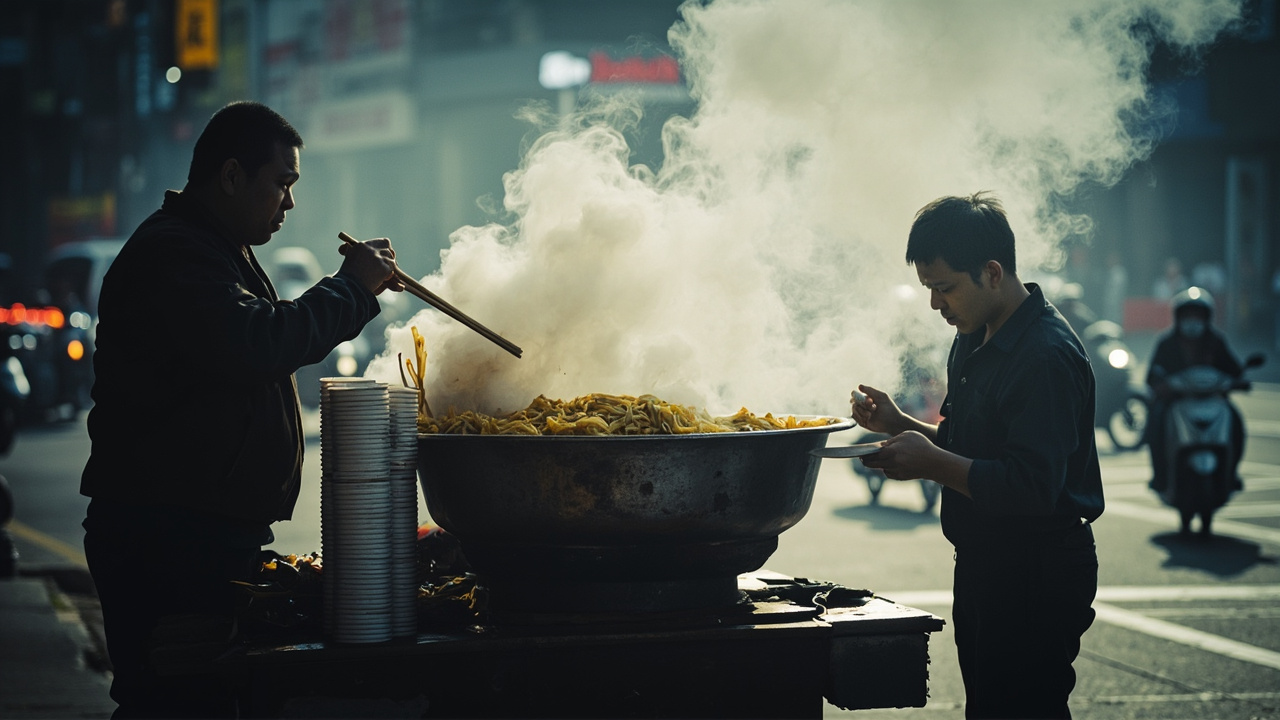
The first time I ordered reganmian in Wuhan, I made a fool of myself. I sat down at a plastic stool on a sidewalk off Zhongshan Avenue, watched the woman behind the counter pull a fistful of noodles from a steaming pot, toss them with a flick of her wrist, and hand me a paper bowl that looked almost dry. No soup. Barely any sauce. Just noodles the color of dark tea, flecked with sesame paste and something red. I asked for broth. She looked at me like I’d asked for ketchup on a steak.
That was 2019. I’ve been back to Wuhan four times since, and I’ve eaten this dish maybe sixty times. It’s the single most important thing to eat in this city, and it’s also the cheapest. A bowl costs 5 to 8 yuan (under $1.20). It takes about ninety seconds to make and about four minutes to eat, because if you let it sit, it turns into a brick.
Hot dry noodles are not a tourist dish. They’re a breakfast dish, eaten standing up, at 7 a.m., by people on their way to work. That’s the whole point. If you come to Wuhan and eat them at noon in a hotel restaurant, you’ve missed it. You need to be on a curb, holding a paper bowl, watching scooters swerve around you.
This guide is for first-time visitors to China who want to eat this properly. I’ll tell you where to go, what to pay, how to order without Mandarin, and which famous spots are actually worth the detour. I’ll also tell you which ones I think are overrated, because someone should.
Quick answer
Wuhan hot dry noodles (reganmian, 热干面) are a breakfast noodle dish of alkaline noodles tossed with sesame paste, soy sauce, chili oil, and pickled vegetables, costing 5–10 yuan ($0.70–$1.40) per bowl. The best bowls are served from 6:00 to 10:00 a.m. at street stalls and old neighborhood shops, not at tourist restaurants. Most foreign visitors can now enter China visa-free for up to 30 days (check your nationality against the current visa-free transit and entry rules), and Wuhan is a 4-hour high-speed train from Shanghai or 4.5 hours from Beijing.
The Short Version
If you only have one morning in Wuhan, go to Cai Lin Ji (蔡林记) on Hubu Alley for the classic version, or Mai Xiang Yuan (麦香园) if you want the local-favorite chain. Order at the counter, pay with WeChat or Alipay, add chili oil yourself, and eat within five minutes. Skip the hotel breakfast. Skip the airport version. Don’t ask for soup. Total cost: under $2. This is the best cheap meal in central China.
How I Picked These
I’ve eaten hot dry noodles in maybe 40 shops across Wuhan over six years, mostly because I kept getting dragged there by friends who grew up in Hanyang and Wuchang and had strong opinions about which district does it best. I talked to noodle vendors, taxi drivers, and a guy named Old Chen who runs a stall near Hankou Railway Station and has been making the same bowl since 1998. I also cross-checked against local food forums and asked three Wuhan-born friends to rank my list. Two of them disagreed with me. I’ve noted where.
Comparison Table
| Rank | Place | Best For | Approx Cost (USD) | Time Needed | When to Go |
|---|---|---|---|---|---|
| 1 | Cai Lin Ji (Hubu Alley) | First-timers, classic version | $1.00–1.40 (7–10 CNY) | 20 min | 7–9 a.m., weekdays |
| 2 | Mai Xiang Yuan | Locals’ everyday bowl | $0.80–1.10 (6–8 CNY) | 15 min | 6:30–9 a.m. |
| 3 | Old Chen’s Stall (Hankou) | Authentic no-frills experience | $0.70 (5 CNY) | 10 min | 6–8 a.m. |
| 4 | San Zhen Dou Pi (Wuchang) | Pairing with doupi | $1.40 (10 CNY) | 25 min | 7–10 a.m. |
| 5 | Hubu Alley general | Street-food crawl | $0.70–2.00 | 1–2 hrs | 8 a.m.–noon |
| 6 | Chang Di Jie Night Market | Late-night version | $1.10 (8 CNY) | 30 min | 8 p.m.–midnight |
| 7 | Cai Lin Ji (airport branch) | Emergency only | $2.80 (20 CNY) | 15 min | Any time |
| 8 | Hubei Provincial Museum area stalls | Museum + noodles combo | $0.90 (6.5 CNY) | 20 min | 11 a.m.–1 p.m. |
| 9 | Ji Qing Jie | Trendy neighborhood version | $1.40 (10 CNY) | 20 min | 8–10 a.m. |
| 10 | Your hotel buffet | Never | Free | — | Don’t |
Cai Lin Ji on Hubu Alley — The One Everyone Tells You to Try
I stood in line here on a Tuesday morning in March, behind a man in a delivery uniform who ordered three bowls and ate one while waiting for the other two.
Cai Lin Ji is the most famous name in hot dry noodles, founded in 1928, and it’s the version most Wuhan people will point a tourist toward. The noodles are slightly thicker than some competitors’, the sesame paste is ground fresh, and the balance of soy, chili, and pickle is consistent. It’s not the best bowl in the city, but it’s the most reliable one for a first-timer, and the Hubu Alley location puts you in the middle of a proper old street-food strip.
The line moves fast. You order at the counter, pay by scanning a QR code (set up Alipay or WeChat Pay before you arrive, because cash is awkward here), and take your bowl to a shared table or the curb.
📍 Location: Hubu Alley (户部巷), Wuchang District, near the Yangtze River bridge 🎫 Entry fee: Free to enter the alley; noodles $1.00–1.40 (7–10 CNY) 🕒 Opening hours: 6:30 a.m.–9:00 p.m. daily, but the best bowls are before 9 a.m. 🚇 How to actually get there: Take Metro Line 4 to Fuxing Road Station, Exit C, walk 8 minutes south toward the river ⏰ When to visit: Weekday mornings, 7–9 a.m. Weekends are packed with domestic tourists 💡 Insider tips: Ask for “shao la” (少辣, less chili) if you can’t handle heat. Add the pickled radish from the jar on the table. Eat standing if there’s no seat — that’s normal. Don’t ask for soup; it’s not a soup dish. I paid 8 yuan and ate it in four minutes flat, watching a grandmother next to me do the same.
Mai Xiang Yuan — The Bowl Locals Actually Eat
My friend Wei, who grew up in Hankou, told me Cai Lin Ji is for tourists and took me to Mai Xiang Yuan instead. She was half right.
Mai Xiang Yuan is a chain, which sounds like a red flag, but in Wuhan a chain that survives is a chain that’s good. The sesame paste here is looser, the chili oil is sharper, and the noodles have a bit more chew. It’s the bowl you’d eat if you lived here. There are dozens of locations, but the ones in older residential neighborhoods are better than the mall branches.
This is where I’d send you if you want to understand what hot dry noodles taste like to a Wuhan local, not to a visitor. The vibe is functional: fluorescent lights, plastic stools, a TV playing news, nobody smiling. That’s the point.
📍 Location: Multiple; best branches in Jiang’an and Hanyang districts 🎫 Entry fee: $0.80–1.10 (6–8 CNY) per bowl 🕒 Opening hours: 6:00 a.m.–2:00 p.m.; some branches close earlier 🚇 How to actually get there: Take Metro Line 2 to Jianghan Road Station, Exit A, and walk into the side streets — there’s usually one within 5 minutes ⏰ When to visit: 6:30–8:30 a.m. on a weekday 💡 Insider tips: Order “reganmian, jia la” (热干面,加辣) for extra chili. Pair with a cup of soy milk (doujiang) for about $0.40. Most staff don’t speak English; point at what the person ahead of you ordered. Wei ate two bowls and told me I was wrong about Cai Lin Ji being better. I still think I’m right.
Old Chen’s Stall Near Hankou Railway Station — The 5-Yuan Bowl
Old Chen has been making hot dry noodles since 1998, and he will not raise his price above 5 yuan. I asked him why. He shrugged and said, “People need to eat.”
His stall is a cart, a pot, and two folding tables on a side street about ten minutes’ walk from Hankou Railway Station. There’s no sign in English, no menu, no QR code — you pay cash or WeChat. The bowl is simple: noodles, sesame paste, a splash of soy, chili, and a pinch of chopped scallion. It’s the best 5 yuan I’ve spent in China.
This is not a destination. It’s a thing that happens to you if you’re in the right neighborhood at the right hour. If you’re arriving in Wuhan by high-speed rail in the early morning, this is your first stop.
📍 Location: Side streets west of Hankou Railway Station, Jianghan District 🎫 Entry fee: $0.70 (5 CNY) 🕒 Opening hours: 6:00–8:30 a.m., Monday–Saturday; closed Sundays 🚇 How to actually get there: Metro Line 2 to Hankou Railway Station, Exit D, walk west 10 minutes into the residential blocks ⏰ When to visit: Before 8 a.m.; he sells out 💡 Insider tips: Bring small cash as backup. Don’t expect a seat. If you don’t speak Mandarin, hold up five fingers and say “yi wan” (one bowl). Old Chen asked where I was from, nodded when I said America, and handed me an extra bowl without charging. I tried to pay. He waved me off.
San Zhen Dou Pi in Wuchang — The Combo Meal
Hot dry noodles are usually eaten alone, but in Wuchang, the move is to pair them with doupi — a sticky rice and egg dish wrapped in bean curd skin. San Zhen is the shop that made doupi famous, and their noodle bowl is solid.
I came here on a rainy Saturday and ate both, which is roughly 900 calories before 9 a.m. Worth it.
The noodles here are a touch softer than Mai Xiang Yuan’s, and the sesame paste is heavier. If you like a richer bowl, this is your spot. The doupi is the real draw, but the noodles hold their own.
📍 Location: Wuchang District, near the Yellow Crane Tower area 🎫 Entry fee: Noodles $1.40 (10 CNY); doupi $1.40 (10 CNY) 🕒 Opening hours: 6:30 a.m.–8:00 p.m. daily 🚇 How to actually get there: Metro Line 4 to Fuxing Road Station, Exit B, walk 6 minutes ⏰ When to visit: Weekday mornings; weekends have a 20-minute line 💡 Insider tips: Order both dishes — they’re meant to be eaten together. The doupi is very filling; split one between two people if you’re not big eaters. English menu available at the counter. A woman at the next table saw me struggling with chopsticks and handed me a fork. I used it. No shame.
Hubu Alley as a Whole — The Street-Food Crawl
Hubu Alley is touristy, and I’ll say that plainly. But it’s also the single easiest place in Wuhan to try five different breakfast dishes in one hour, and hot dry noodles are just one of them.
Come here if you have one morning and want the full Wuhan breakfast sampler: noodles, doupi, fried dough, rice wine, and mianwo (a savory donut). Skip it if you hate crowds.
📍 Location: Wuchang District, along the Yangtze 🎫 Entry fee: Free; dishes $0.70–2.00 each 🕒 Opening hours: 6:00 a.m.–10:00 p.m. 🚇 How to actually get there: Metro Line 4, Fuxing Road Station, Exit C ⏰ When to visit: 7–9 a.m. on a weekday; avoid weekends 💡 Insider tips: Prices are 20–30% higher than neighborhood stalls. Bring small bills or set up mobile payment. The alley gets very crowded after 10 a.m. with tour groups. I watched a French couple order noodles and then ask for a fork, a spoon, and hot water. The vendor just laughed.
Chang Di Jie Night Market — The Late-Night Version
Hot dry noodles are a breakfast food, but Chang Di Jie serves them at night, and the late-night version is a different animal: spicier, greasier, and usually eaten after a few drinks.
I came here at 11 p.m. on a Friday and it was packed. The noodles were good, not great, but the atmosphere was worth it.
📍 Location: Chang Di Jie, Wuchang District 🎫 Entry fee: $1.10 (8 CNY) per bowl 🕒 Opening hours: 6:00 p.m.–2:00 a.m. 🚇 How to actually get there: Metro Line 2 to Zhongnan Road Station, Exit C, walk 7 minutes ⏰ When to visit: 9 p.m.–midnight 💡 Insider tips: The night version is spicier by default — ask for “bu la” (不辣, no chili) if you’re sensitive. Cash is fine here. It’s loud and smoky. I met a group of university students who insisted I try their bowl. It was better than mine.
Cai Lin Ji Airport Branch — Emergency Only
I’m including this so you don’t make the mistake I made. The Tianhe Airport branch of Cai Lin Ji exists, and it’s fine, but it’s three times the price and half the flavor. If you’re stuck on a layover, fine. Otherwise, wait.
📍 Location: Wuhan Tianhe International Airport, Terminal 3, departures level 🎫 Entry fee: $2.80 (20 CNY) 🕒 Opening hours: 6:00 a.m.–9:00 p.m. 🚇 How to actually get there: Metro Line 2 to Tianhe Airport Station ⏰ When to visit: Only if you have no other option 💡 Insider tips: The noodles sit in a warmer, so they’re already slightly soggy. Ask for fresh ones if you can. I ate here once. I won’t again.
Hubei Provincial Museum Area Stalls — The Museum Combo
The Hubei Provincial Museum is free and worth three hours. The noodle stalls outside are decent and cheap. This is a solid half-day plan: museum in the morning, noodles at lunch.
📍 Location: Donghu Road, Wuchang District 🎫 Entry fee: Museum free; noodles $0.90 (6.5 CNY) 🕒 Opening hours: Museum 9 a.m.–5 p.m. (closed Mondays); stalls 11 a.m.–1 p.m. 🚇 How to actually get there: Metro Line 8 to Hubei Provincial Museum Station, Exit A ⏰ When to visit: Weekday late morning 💡 Insider tips: Museum requires advance booking on WeChat. Bring your passport. Stalls are cash and mobile pay only. The guard at the museum entrance told me the noodles outside were “not real Wuhan noodles.” He was mostly right.
Ji Qing Jie — The Trendy Neighborhood Version
Ji Qing Jie is where young Wuhan goes for coffee and brunch, and the hot dry noodles here are the gentrified version: organic sesame paste, artisanal chili oil, 10 yuan a bowl. It’s fine. It’s not better.
📍 Location: Ji Qing Jie, Jiang’an District 🎫 Entry fee: $1.40 (10 CNY) 🕒 Opening hours: 8 a.m.–2 p.m. 🚇 How to actually get there: Metro Line 1 to Huangpu Road Station, Exit A ⏰ When to visit: Weekend brunch 💡 Insider tips: English menus available. Card payment accepted. Good for a photo, less good for authenticity. A barista there told me she’d never eaten the traditional version. I believed her.
FAQ summary
Wuhan hot dry noodles are a breakfast dish costing 5–10 yuan ($0.70–$1.40), best eaten before 10 a.m. at street stalls or neighborhood chains like Mai Xiang Yuan, not at hotel restaurants or airport branches. Most foreign visitors can now enter China visa-free for up to 30 days depending on nationality, and Wuhan is reachable by high-speed rail from Shanghai (4 hours) or Beijing (4.5 hours). Set up Alipay or WeChat Pay before arrival, since most noodle stalls don’t handle cash well, and expect no English at the best spots.
FAQ
Q: What exactly are Wuhan hot dry noodles? A: They’re alkaline wheat noodles tossed with sesame paste, soy sauce, chili oil, and pickled vegetables, served without soup. The texture is chewy and slightly dry, which is intentional. A bowl costs 5–10 yuan ($0.70–$1.40).
Q: Do I need to speak Mandarin to order them? A: No, but it helps. At most stalls you can point at what someone ahead of you ordered, hold up one finger, and pay by QR code. Learn two phrases: “yi wan” (one bowl) and “bu la” (not spicy). Translation apps work fine as backup.
Q: What time of day should I eat them? A: Between 6:30 and 9:30 a.m. This is a breakfast dish. Some night markets serve a version after 8 p.m., but the classic experience is early morning, standing at a stall.
Q: Are they vegetarian? A: Usually yes, but ask. The base is noodles, sesame paste, soy, chili, and pickles. Some vendors add a splash of meat broth or lard, so say “wo chi su” (I eat vegetarian) if it matters to you.
Q: How spicy are they? A: Mildly spicy by default, but you control the chili oil at most stalls. If you’re sensitive, ask for “bu la” or “shao la” (less spicy). The sesame paste tempers the heat.
Q: Can I eat them if I have a gluten allergy? A: No. These are wheat noodles and there’s no gluten-free version. If you have celiac disease, avoid them entirely and look for rice noodle dishes instead.
Q: Where’s the best single place for a first-timer? A: Cai Lin Ji on Hubu Alley for the classic tourist-friendly version, or Mai Xiang Yuan for the bowl locals actually eat. Both are under $1.50 and easy to reach by Metro.
The Honest Wrap-up
This guide is for travelers who want to eat the real thing, not the hotel version. If you’re the kind of person who needs air conditioning, an English menu, and a chair with a back, this list will frustrate you — go to Cai Lin Ji’s airport branch and be done with it. If you’re willing to stand on a curb at 7 a.m. with a paper bowl and no idea what you’re doing, you’re going to have one of the best meals of your trip for less than a dollar.
One last thing: eat fast. Hot dry noodles are not a dish to linger over. They’re a dish to inhale while a scooter nearly clips you and a grandmother nods approvingly. That’s the whole experience. Book the flight.
More guides you may like
Top 10 Bridges in China
China's bridges are engineering marvels spanning mountains, rivers, and seas. Here are 10 of the most spectacular, from ancient stone to modern steel.
8 min read

Top 10 Buddhist Sites in China
From the Leshan Giant Buddha to the Dunhuang Caves, these 10 Buddhist sites represent 2,000 years of China's spiritual heritage.
9 min read

Top 10 Day Trips from Beijing You Shouldn't Miss
Beijing is packed with history, but some of China's best experiences are just a few hours away. Here are 10 day trips that will transform your visit.
9 min read
Top 10 Hidden Gems in China Off the Beaten Path
Beyond the Great Wall and Terracotta Warriors, China has incredible hidden destinations few tourists ever reach. Here are 10 underrated gems worth the detour.
9 min read
Top 10 Markets and Shopping Streets in China
From Shanghai's Bund to Beijing's Silk Street - 10 markets where foreigners can haggle, explore, and bring home authentic Chinese goods.
9 min read
Top 10 Museums in China You Shouldn't Miss
China's museums span 5,000 years of civilization. These 10 - from the Palace Museum to Xi'an's terracotta gallery - are unmissable for culture lovers.
9 min read