
Hotpot Chengdu vs Chongqing
The first thing I noticed in Chongqing wasn't the skyline or the monorail threading through an apartment block. It was the smell. At 11pm on a Tuesday,…
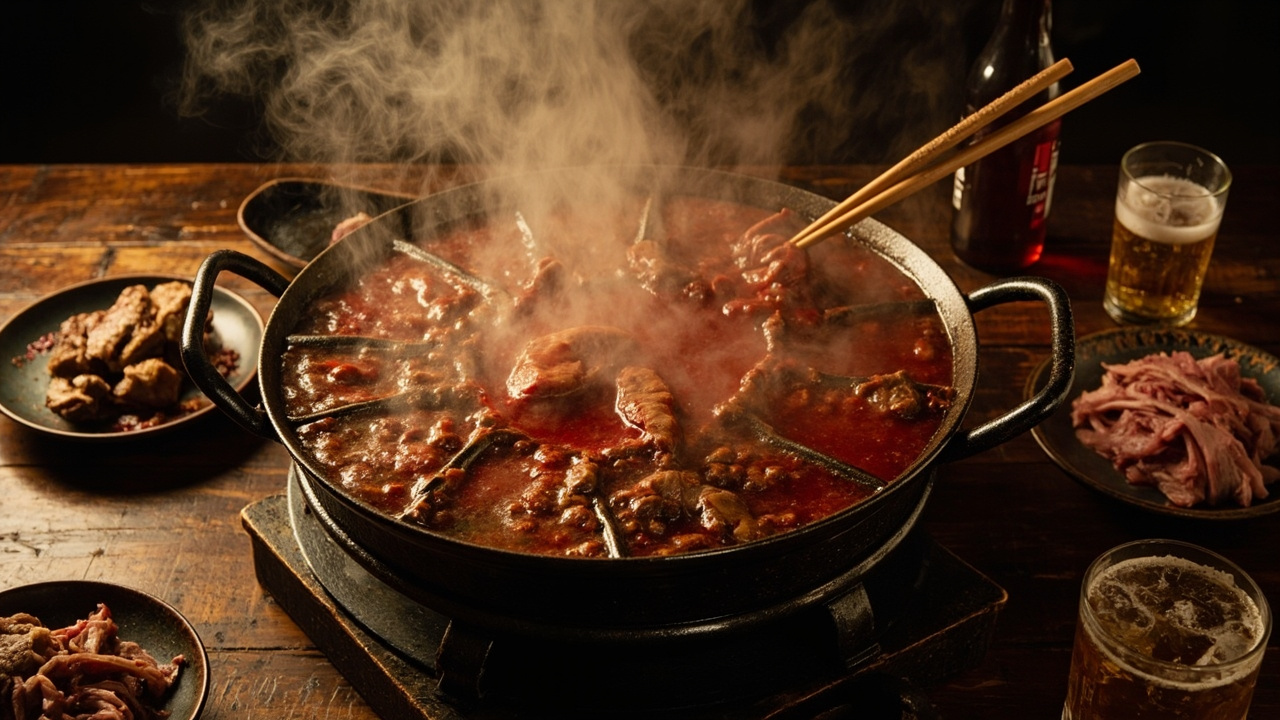
Hotpot Chengdu vs Chongqing
The first thing I noticed in Chongqing wasn’t the skyline or the monorail threading through an apartment block. It was the smell. At 11pm on a Tuesday, walking uphill from the Jiaochangkou metro exit, the whole street smelled like beef tallow and dried chilies hitting a boiling pot. My eyes watered before I even sat down. Two days later in Chengdu, the smell was different — gentler, more herbal, with something green underneath the heat. Same country. Same dish on paper. Completely different bowl.
That’s the thing nobody tells you before you go. “Hotpot” is not one thing. Chengdu and Chongqing are 300km apart, both in Sichuan Basin territory, and both will claim hotpot as their own. Chongqing says it invented it — the dockworkers boiling tripe in spicy broth along the Yangtze. Chengdu says it perfected it. They’ve been arguing about this for a century and they will keep arguing after you leave.
Here’s what this guide actually does: it tells you which one to eat, where to sit, what to order, how much you’ll pay, and how to survive your first meal without embarrassing yourself. I’ve eaten hotpot in both cities more times than my stomach would like to admit. I’ve made the mistakes so you don’t have to.
Quick answer
Chongqing hotpot is the original — beef tallow (牛油) base, numbing and heavy, cooked in a nine-grid pot, and it’s the more intense experience. Chengdu hotpot is clearer, slightly less oily, more herbal, and easier for a first-timer. Expect to pay $12–$25 (¥85–¥180) per person at a mid-range spot in either city, and both are best eaten in autumn or winter (October–February). If you only have time for one, pick the city you’re already visiting — the difference is real but not worth a detour.
The Short Version
If you have 90 seconds: eat hotpot in both cities if you can, because they genuinely taste different. If you must choose, Chongqing is the pilgrimage — the older, rougher, more famous version. Chengdu is the friendlier one, better for a nervous first-timer, and the city around it is easier to love. Order the 鸳鸯锅 (half-spicy, half-mild) your first time. Nobody will judge you. Order a bowl of sesame oil and garlic, not peanut sauce. And don’t wear anything you like — you will smell like hotpot for two days.
How I Picked These
I’ve eaten at roughly 30 hotpot restaurants across the two cities over seven years, ranging from ¥40-per-person neighborhood joints with plastic stools to ¥400 tasting-menu spots with reservations. I asked taxi drivers, hostel receptionists, and a Chengdu friend’s grandmother where they eat — not where tourists eat. I went back to my top picks a second time to check they weren’t a fluke. I also ate at several “famous” places that I’m deliberately not recommending, because they’ve become tourist conveyor belts. Every price below is what I actually paid or what a local friend confirmed in late 2025.
Comparison Table
| Rank | Place | Best For | Approx Cost (USD) | Time Needed | When to Go |
|---|---|---|---|---|---|
| 1 | 珮姐老火锅 (Peijie), Chongqing | The full Chongqing experience | $20–30 (¥140–210) | 90 min | Oct–Feb, weekday 6pm |
| 2 | 蜀大侠 (Shu Da Xia), Chengdu | First-timers, groups | $18–28 (¥125–195) | 90 min | Any cool month |
| 3 | 小龙坎 (Xiao Long Kan), Chengdu | Reliable chain, English menu | $15–22 (¥105–155) | 75 min | Weekday lunch |
| 4 | 赵二火锅 (Zhao Er), Chongqing | Old-school, local, cheap | $10–15 (¥70–105) | 60 min | Any night, go early |
| 5 | 大龙燚 (Da Long Yi), Chengdu | Spice tolerance test | $18–25 (¥125–175) | 90 min | Cool evenings |
| 6 | 渝宗老灶 (Yuzong), Chongqing | Nine-grid purists | $16–24 (¥110–170) | 90 min | Weekday 5:30pm |
| 7 | 电台巷 (Dian Tai Xiang), Chengdu | Retro vibe, photos | $20–30 (¥140–210) | 90 min | Book ahead |
| 8 | 洞子火锅 (Dongzi), Chongqing | Cave setting, novelty | $14–20 (¥100–140) | 75 min | Any day |
| 9 | 马路边边 (Ma Lu Bian Bian), Chengdu | Skewer-style hotpot | $12–18 (¥85–125) | 60 min | Late night |
| 10 | 牛华八婆 (Niuhua Bapo), Chengdu | Mala tang, not hotpot | $8–12 (¥55–85) | 45 min | Lunch |
珮姐老火锅 (Peijie) — The One That Made Me Sweat Through My Shirt
I went to Peijie on a rainy Thursday in November, waited 70 minutes for a table, and would do it again. The broth arrived black-red and bubbling, a slab of beef tallow melting into it like a slow-motion car crash. By the third piece of tripe my lips were buzzing and my shirt was wet. That’s the point.
Peijie is what people mean when they say “Chongqing hotpot.” It’s not subtle. The base is beef tallow, not vegetable oil, which gives it a heavier mouthfeel and a flavor that coats your tongue. The nine-grid pot isn’t decoration — the center grid is hottest and fastest, the corners are gentler, and locals use them for different ingredients. Watch what the table next to you does and copy it.
- 📍 Location: Multiple branches; the Jiefangbei (解放碑) branch is the most convenient for tourists
- 🎫 Entry fee: No entry fee; meal cost only
- 🕒 Opening hours: 11am–2am daily, no rest days
- 🚇 How to actually get there: Take Metro Line 2 to Linjiangmen (临江门) Station, Exit A, walk 4 minutes toward the river. Look for the queue.
- ⏰ When to visit: Go on a weekday before 6pm or after 9pm. Weekends are 2+ hour waits.
- 💡 Insider tips: Ask for 微辣 (mild spicy) if you’re unsure — it’s still hot. Order 毛肚 (tripe), 鸭肠 (duck intestine), and 黄喉 (aorta). Dip everything in sesame oil + garlic, not peanut sauce. Bring tissues; the restaurant charges for napkins.
- The waiter, a guy in his 20s named Chen, laughed at me when I asked for a fork, then brought me one anyway.
蜀大侠 (Shu Da Xia) — The Chengdu One I’d Send My Mom To
Chengdu hotpot is a different animal. The broth is clearer, uses less tallow and more vegetable oil, and there’s a green herbal note underneath the chili — sometimes star anise, sometimes a hint of medicinal herbs. It’s still spicy. It’s just not trying to hurt you.
Shu Da Xia is a chain, which normally makes me suspicious, but this one earns it. The broth is balanced, the ingredients are fresh, and the staff are used to foreigners. They have picture menus and some English. I brought a friend from Berlin here on her first night in China and she made it through the whole meal without crying, which is more than I can say for her Chongqing experience two days later.
- 📍 Location: Multiple; the Kuanzhai Alley (宽窄巷子) branch is the most tourist-friendly
- 🎫 Entry fee: Meal cost only
- 🕒 Opening hours: 11am–midnight daily
- 🚇 How to actually get there: Metro Line 4 to Kuanzhai Alley Station, Exit B, walk 3 minutes. The restaurant is on the second floor, look for the red lanterns.
- ⏰ When to visit: Lunch is quieter and cheaper. Dinner after 7pm on weekends means a wait.
- 💡 Insider tips: Order the 鸳鸯锅 (half-mild half-spicy) if you’re with anyone who can’t handle heat. The 冰粉 (ice jelly dessert) at the end is not optional — it saves your mouth. Ask for 麻酱 (sesame paste) if you want a non-oil dip, though purists will side-eye you.
- I watched a Chengdu family of five share one pot for two hours, grandparents included, and nobody rushed. That’s the pace here.
小龙坎 (Xiao Long Kan) — The Safe Bet That’s Actually Good
I’m usually wary of chains that have expanded to 500 locations. Xiao Long Kan is the exception. It started in Chengdu in 2014 and somehow kept the quality up. The broth is a middle ground between Chongqing’s heavy tallow and Chengdu’s lighter style — spicy but not punishing.
This is where I send people who are nervous. The menu has English, the staff have seen a thousand foreigners, and the spice level is adjustable without judgment. It’s not the most authentic experience in either city, but it’s a genuinely good meal and a soft landing for your first hotpot.
- 📍 Location: Chunxi Road (春熙路) branch is the most central
- 🎫 Entry fee: Meal cost only
- 🕒 Opening hours: 11am–2am daily
- 🚇 How to actually get there: Metro Line 2 or 3 to Chunxi Road Station, Exit D, walk 2 minutes. It’s on the third floor of the mall — take the escalator.
- ⏰ When to visit: Lunch specials (11am–2pm) are 20–30% cheaper than dinner
- 💡 Insider tips: The 番茄锅 (tomato broth) half is genuinely good if you want a break from spice. Download the menu via QR code — it works with WeChat scan. If you don’t have Alipay or WeChat Pay set up, ask the staff to help you pay with cash; they will.
- My mistake here: I ordered “extra spicy” on my first visit and spent the next morning regretting it. Don’t.
赵二火锅 (Zhao Er) — The One Locals Actually Eat At
A Chongqing taxi driver named Liu took me here. He said, “Don’t go to the famous ones. Go to Zhao Er.” He was right. It’s a hole in the wall in the Jiulongpo district, plastic stools, fluorescent lights, no English menu, no pictures. The broth is the real thing — beef tallow, dried chilies, Sichuan peppercorn, nothing else. It cost me ¥78 ($11) for two people.
This is what hotpot was before it became a tourist attraction. The owner, a woman in her 50s, doesn’t speak English but will point at what you should order. The tripe is fresh, the beef is sliced thin, and the whole meal takes 45 minutes because there’s no performance to it.
- 📍 Location: Jiulongpo District (九龙坡区), near Yangjiaping
- 🎫 Entry fee: Meal cost only
- 🕒 Opening hours: 5pm–midnight, closed Mondays
- 🚇 How to actually get there: Metro Line 2 to Yangjiaping (杨家坪) Station, Exit B, walk 8 minutes. Bring the Chinese name 赵二火锅 in your translation app.
- ⏰ When to visit: Any weeknight, arrive by 6pm
- 💡 Insider tips: Cash is easier here than cards. No English, so have your translation app ready. Order 老肉片 (old meat slices) — it’s the house specialty. Don’t expect air conditioning in summer.
- Liu refused to let me pay for the taxi. “You’re a guest,” he said. I still think about that.
大龙燚 (Da Long Yi) — For People Who Think They Can Handle Spice
I’ll be honest: I don’t love Da Long Yi. It’s loud, it’s crowded, and the spice level feels like a dare rather than a flavor decision. But if you’re the kind of person who orders the hottest wing at a bar to prove something, this is your place.
The broth is Chongqing-style but turned up. The 特辣 (extra spicy) option is genuinely painful. I watched a table of Chinese university students tap out after 20 minutes. The ingredients are good quality and the service is fast, but the whole experience feels like a competition.
- 📍 Location: Multiple; the Taikoo Li (太古里) branch is the most central
- 🎫 Entry fee: Meal cost only
- 🕒 Opening hours: 11am–1am daily
- 🚇 How to actually get there: Metro Line 2 or 3 to Chunxi Road Station, Exit C, walk 5 minutes toward Taikoo Li
- ⏰ When to visit: Avoid weekends entirely
- 💡 Insider tips: Order 微辣 even if you think you want 中辣. The 冰粉 here is the best I’ve had in Chengdu. Ask for a bowl of plain rice — it’s the only thing that resets your mouth.
- I made the mistake of ordering 特辣 once. Once.
渝宗老灶 (Yuzong) — The Nine-Grid Purist’s Choice
If you want to understand why the nine-grid pot exists, come here. Yuzong uses a traditional 老灶 (old stove) setup, and the staff will actually explain which grid is for what if you ask. The center is for quick-cook items (tripe, duck intestine). The corners are for slow-cook items (potato, lotus root). The edges are for things that need to stay warm.
The broth is Chongqing classic — heavy, dark, tallow-based. The restaurant is in a converted old building and feels like it’s been there for 40 years, because it has. This is a meal, not a photo op.
- 📍 Location: Yuzhong District (渝中区), near Jiaochangkou
- 🎫 Entry fee: Meal cost only
- 🕒 Opening hours: 11am–11pm daily
- 🚇 How to actually get there: Metro Line 1 or 2 to Jiaochangkou (较场口) Station, Exit 5, walk 6 minutes uphill
- ⏰ When to visit: Weekday 5:30pm is the sweet spot
- 💡 Insider tips: Ask the staff to show you the grid system — they’re proud of it. Order 酥肉 (crispy pork) to eat while you wait. The house 酸梅汤 (sour plum drink) cuts the spice better than water.
- The owner’s daughter, who was maybe 12, translated for us and then corrected my pronunciation of 毛肚. I appreciated it.
电台巷 (Dian Tai Xiang) — The One That Looks Like 1985
Dian Tai Xiang is designed to look like a 1980s Chengdu hotpot joint, and it works. Tiled walls, old radios, wooden benches, staff in retro aprons. It’s a bit of a performance, but the food is real and the broth is solidly Chengdu-style — lighter, herbal, still spicy.
This is the place to bring someone who wants the aesthetic of old China with the comfort of modern service. It’s more expensive than the neighborhood spots, but you’re paying for the room as much as the food.
- 📍 Location: Wuhou District (武侯区), near the Wuhou Shrine
- 🎫 Entry fee: Meal cost only
- 🕒 Opening hours: 11am–11pm daily
- 🚇 How to actually get there: Metro Line 3 to Gaoshengqiao (高升桥) Station, Exit D, walk 7 minutes
- ⏰ When to visit: Book ahead via Dianping (大众点评) — walk-ins wait 90+ minutes on weekends
- 💡 Insider tips: The 酥肉 here is excellent. Order the 红糖糍粑 (brown sugar rice cake) for dessert. Photos are encouraged, but don’t block the aisles.
- I came here with a friend who’d been living in Chengdu for a year. She said it was “touristy but worth it,” which is exactly right.
洞子火锅 (Dongzi) — The Cave One
Chongqing has a thing for caves — the city is built into hills and there are old air-raid tunnels everywhere. Some of them are now hotpot restaurants. Dongzi is one of the better ones, and eating hotpot in a literal cave is a novelty that doesn’t wear off.
The broth is standard Chongqing — beef tallow, spicy, heavy. The cave is cool in summer, which is a genuine advantage in a city that hits 40°C in July. The service is basic, the tables are cramped, and the whole thing feels slightly illegal in a fun way.
- 📍 Location: Yuzhong District, near the Shibati (十八梯) area
- 🎫 Entry fee: Meal cost only
- 🕒 Opening hours: 11am–midnight daily
- 🚇 How to actually get there: Metro Line 1 or 2 to Jiaochangkou Station, Exit 4, walk 10 minutes. Ask your hotel to write the address in Chinese.
- ⏰ When to visit: Summer, specifically, because the cave stays cool
- 💡 Insider tips: It’s humid inside — wear something you don’t mind sweating in. The ventilation isn’t great, so if you’re sensitive to smoke, skip it. Order the 鸭血 (duck blood) — it’s fresher here than most places.
- The woman at the next table saw me struggling with my chopsticks and wordlessly handed me a fork. No judgment. Just kindness.
马路边边 (Ma Lu Bian Bian) — Skewer Hotpot, Which Is a Different Thing
Okay, this isn’t technically hotpot. It’s 串串香 (chuan chuan xiang) — skewer hotpot, where you grab raw skewers from a fridge and cook them yourself in a shared pot. It’s cheaper, faster, and honestly more fun than traditional hotpot.
Ma Lu Bian Bian is a Chengdu chain that does it well. You pay by the skewer (roughly ¥1–3 each, or $0.15–0.45), so you can try 30 different things for under $15. The broth is spicy but lighter than Chongqing style, and there’s no ceremony to it. You just eat.
- 📍 Location: Multiple; the Yulin (玉林) branch is the most local
- 🎫 Entry fee: Meal cost only
- 🕒 Opening hours: 11am–2am daily
- 🚇 How to actually get there: Metro Line 3 to Yulin Road (玉林路) area — take a taxi from the station, it’s a 5-minute ride
- ⏰ When to visit: Late night, after 10pm, when the crowd thins out
- 💡 Insider tips: Count your skewers before you sit down — you pay per stick, and it adds up. The 牛肉 (beef) and 鹌鹑蛋 (quail egg) skewers are the best value. Dipping sauce is self-serve; mix sesame oil, garlic, and a little vinegar.
- I ate 47 skewers here once. I’m not proud of it, but I’d do it again.
牛华八婆 (Niuhua Bapo) — The Mala Tang Detour
This isn’t hotpot either. It’s 麻辣烫 (mala tang) — a bowl of ingredients you pick yourself and the kitchen boils for you in spicy broth. It’s the lunch version of hotpot, cheaper, faster, and arguably the most common everyday spicy meal in Chengdu.
Niuhua Bapo is a Chengdu institution. You grab a bowl, pick your ingredients from the fridge (vegetables, tofu, meat, noodles), hand it to the counter, and they bring it back cooked in 5 minutes. It costs ¥30–50 ($4–7) for a full meal. This is what locals eat on a Tuesday when they don’t have time for hotpot.
- 📍 Location: Multiple; the Wuhou branch is reliable
- 🎫 Entry fee: Meal cost only
- 🕒 Opening hours: 10am–9pm daily
- 🚇 How to actually get there: Metro Line 3 to Wuhouci (武侯祠) Station, Exit A, walk 4 minutes
- ⏰ When to visit: Lunch, weekdays
- 💡 Insider tips: Pick more vegetables than you think — they shrink. The 宽粉 (wide noodles) are the move. Ask for 微辣 if you’re unsure; the default is medium-hot.
- I eat here at least once a week when I’m in Chengdu. It’s not fancy. It’s just right.
FAQ summary
Chongqing hotpot is the original and the more intense experience — beef tallow base, heavier, numbing, traditionally served in a nine-grid pot. Chengdu hotpot is lighter, more herbal, and easier for first-timers. Both cost roughly $12–$30 (¥85–¥210) per person at mid-range restaurants, and both are best in cool months (October–February). If you only have time for one, choose the city you’re already visiting. Order the half-mild half-spicy 鸳鸯锅 your first time, dip in sesame oil and garlic, and don’t wear anything you like.
FAQ
Q: Is Chongqing hotpot or Chengdu hotpot better for a first-timer? A: Chengdu, almost always. The broth is lighter, the restaurants are more used to foreigners, and the spice is more forgiving. Chongqing hotpot is the more authentic experience, but it’s also the one that will make you sweat through your shirt.
Q: How much does hotpot cost in Chengdu and Chongqing in 2026? A: Mid-range restaurants run $12–$30 (¥85–¥210) per person, including drinks. Cheap local spots can be $8–$12 (¥55–¥85). High-end chains and tourist-area restaurants can hit $40+ (¥280+). Prices have risen about 10% since 2024.
Q: Do I need to speak Chinese to eat hotpot? A: No, but it helps. Chain restaurants like Shu Da Xia and Xiao Long Kan have picture menus and some English. Local spots like Zhao Er have neither — bring a translation app (Pleco or Google Translate with offline Chinese downloaded). Pointing works fine.
Q: Can I pay with a foreign credit card at hotpot restaurants? A: Rarely. Most hotpot places only accept WeChat Pay or Alipay, which you should set up before you arrive. Some accept cash, but small local spots may not have change. Set up both apps and link a foreign card before your trip.
Q: What should I order at my first hotpot meal? A: Start with 毛肚 (tripe), 鸭肠 (duck intestine), 肥牛 (fatty beef), 土豆片 (potato slices), and 豆皮 (tofu skin). Dip everything in sesame oil + garlic + a splash of vinegar. Order 冰粉 (ice jelly) for dessert — it cools your mouth.
Q: Is hotpot safe for vegetarians or people with allergies? A: Vegetarian hotpot is possible (the 鸳鸯锅 lets you cook in the mild side), but the broth often contains meat or bone stock — ask before ordering. Peanut and sesame allergies are harder; sesame oil is the standard dip. Bring a translated allergy card.
Q: Do I need a VPN or special SIM card to use translation apps in China? A: Yes, if you want Google services. Google Translate, Maps, and Gmail are blocked without a VPN. Download Pleco (works offline) and a Chinese offline language pack before you arrive. For connectivity, see our China SIM card and internet guide. Most tourists now enter visa-free for 30 days — check the current visa-free transit rules if you’re routing through a third country.
The Honest Wrap-up
This guide is for the person who wants to eat hotpot properly, not just check it off. If you’re the kind of traveler who wants a quiet, air-conditioned, English-menu experience, skip the local spots and stick to the chains — you’ll still eat well. If you want the real thing, go to Zhao Er in Chongqing or Ma Lu Bian Bian in Chengdu, bring a translation app, and accept that you’ll smell like beef tallow for two days.
One last thing: don’t overthink the Chengdu vs Chongqing debate. Both cities make excellent hotpot. The argument is mostly civic pride. Eat in both if you can. If you can’t, eat where you are. And order the 冰粉 at the end. Always order the 冰粉.
More guides you may like

Top 10 Bridges in China
China's bridges are engineering marvels spanning mountains, rivers, and seas. Here are 10 of the most spectacular, from ancient stone to modern steel.
8 min read

Top 10 Buddhist Sites in China
From the Leshan Giant Buddha to the Dunhuang Caves, these 10 Buddhist sites represent 2,000 years of China's spiritual heritage.
9 min read

Top 10 Day Trips from Beijing You Shouldn't Miss
Beijing is packed with history, but some of China's best experiences are just a few hours away. Here are 10 day trips that will transform your visit.
9 min read

Top 10 Hidden Gems in China Off the Beaten Path
Beyond the Great Wall and Terracotta Warriors, China has incredible hidden destinations few tourists ever reach. Here are 10 underrated gems worth the detour.
9 min read

Top 10 Markets and Shopping Streets in China
From Shanghai's Bund to Beijing's Silk Street - 10 markets where foreigners can haggle, explore, and bring home authentic Chinese goods.
9 min read
Top 10 Museums in China You Shouldn't Miss
China's museums span 5,000 years of civilization. These 10 - from the Palace Museum to Xi'an's terracotta gallery - are unmissable for culture lovers.
9 min read