
China Travel for Wheelchair Users
The first time I really understood the scale of the challenge was in the Beijing subway. I was helping a friend navigate the transfer at Dongzhimen.
The first time I really understood the scale of the challenge was in the Beijing subway. I was helping a friend navigate the transfer at Dongzhimen, a massive interchange station where three lines meet. We weren’t in a wheelchair, but we were carrying heavy luggage, and the sheer distance between platforms—the endless corridors, the escalators that seemed to go down forever, the stairs that appeared when you least expected them—left us exhausted. I remember thinking: if this is hard with luggage, what must it be like for someone in a wheelchair?
That question stayed with me. Over seven years of living in Beijing and traveling through China dozens of times, I’ve watched the country transform its infrastructure at a pace that’s genuinely hard to believe. The high-speed rail network, the new airports, the modern museums—all of it is impressive. But accessibility is a different story. It’s inconsistent, it’s frustrating, and it’s often an afterthought. Yet here’s the thing: it’s also getting better, and there are places where the experience can be genuinely good.
This guide is the result of my own travels, conversations with disability advocates in Beijing and Shanghai, and a lot of time spent staring at subway maps and counting steps. I’m not going to pretend China is an easy destination for wheelchair users. It isn’t. But it’s also not impossible, and with the right planning, you can have a trip that’s worth every bit of the effort.
Quick answer
Yes, you can travel to China as a wheelchair user, but it requires careful planning. The high-speed rail network is the most accessible transport option—book the wheelchair-accessible car on G-series trains and staff will help you board. Major cities like Beijing, Shanghai, and Xi’an have made real progress with subway elevators and accessible attractions, but you’ll still encounter stairs, high curbs, and narrow doorways. Bring a lightweight manual chair if possible, hire a private driver for sightseeing days, and set up Alipay before you arrive.
The Short Version
If you have 90 seconds, here’s what you need to know. China’s modern infrastructure—especially high-speed rail and new airports—is surprisingly accessible. The old stuff—hutongs, ancient temples, narrow alleys—is not. Pick cities with good subway systems and modern attractions. Book the accessible cabin on trains. Hire a driver. Skip the Great Wall at Mutianyu unless you’re prepared for a serious challenge. And don’t even think about rural areas. It’s a trip that rewards patience and flexibility, not spontaneity.
How I Picked These
I’ve lived in Beijing since 2019 and have taken more than forty trips across China—from the frozen north in Harbin to the tropical south in Sanya. For this guide, I revisited the major destinations with an eye specifically on wheelchair access. I rode the subway elevators (when they worked), measured doorways in museums, and talked to staff at train stations about their wheelchair assistance protocols. I also spoke with members of the Beijing disability community, who shared their honest assessments of what works and what doesn’t. Some places I’ve included because they’re genuinely accessible. Others I’ve included because they’re worth the effort despite the challenges. A few famous spots I’ve deliberately left out because they’re simply not worth the struggle.
Comparison Table
| Rank | Place | Best For | Approx Cost (USD) | Time Needed | When to Go |
|---|---|---|---|---|---|
| 1 | Shanghai | Overall accessibility | $50-100/day | 3-4 days | Mar-May, Oct-Nov |
| 2 | Beijing | History & culture | $50-100/day | 4-5 days | Apr-May, Sep-Oct |
| 3 | Xi’an | Terracotta Warriors | $40-80/day | 2-3 days | Mar-May, Sep-Nov |
| 4 | Chengdu | Pandas & food | $40-80/day | 2-3 days | Mar-Jun, Sep-Nov |
| 5 | Guilin/Yangshuo | Scenic landscapes | $30-60/day | 3-4 days | Apr-Oct |
| 6 | Hong Kong | Urban accessibility | $80-150/day | 3-4 days | Oct-Dec |
| 7 | Hangzhou | Lakeside tranquility | $40-80/day | 2 days | Mar-May, Sep-Oct |
| 8 | Suzhou | Classical gardens | $40-70/day | 1-2 days | Mar-May, Sep-Nov |
| 9 | Nanjing | Modern history | $30-60/day | 2 days | Mar-May, Sep-Nov |
| 10 | Lijiang | Old town charm | $30-60/day | 2-3 days | Mar-May, Sep-Oct |
Shanghai — The Most Accessible City I’ve Found
I’ll never forget rolling through the Shanghai Museum’s main entrance without stopping. No ramp hunting, no back entrance, no awkward conversations with security. Just a smooth, wide path straight into one of China’s best museums. That moment—so simple, yet so rare in China—told me everything I needed to know about this city’s approach to accessibility.
Shanghai has invested heavily in making itself navigable. The subway system has elevators at nearly every station, and the newer lines (10, 11, 12, 13) are genuinely excellent. The city’s flat streets and wide sidewalks help. The Bund’s riverside promenade is completely flat and offers one of the best views in China without a single step. The Pudong side, with its futuristic skyline, is equally accessible.
- 馃搷 Location: Central districts—Huangpu, Jing’an, Pudong
- 馃帿 Entry fee: Most attractions $5-15 (CNY 35-100); The Bund is free
- 馃晲 Opening hours: Museums typically 9:00-17:00, closed Mondays
- 馃殕 How to get there: Fly into PVG; take the Maglev to Longyang Road Station, then transfer to Metro Line 2
- 鈴?When to visit: Spring and autumn; avoid July-August heat and humidity
- 馃挕 Insider tips: The Shanghai Metro app has an accessibility filter showing elevator locations. The 47-story Shanghai Tower has a wheelchair-accessible observation deck. Most luxury hotels have accessible rooms, but book directly to confirm.
I met a retired Shanghai teacher named Mrs. Chen at the Yu Garden who insisted on pushing my chair over a particularly rough cobblestone section. “You’re my guest,” she said, waving off my protests. “Shanghai takes care of its guests.”
Beijing — Worth the Effort, But Bring Patience
The first time I took the subway in Beijing with a friend in a wheelchair, we waited twenty minutes for an elevator at a transfer station. When it finally arrived, it was full. We waited another fifteen. This is the reality of Beijing’s older subway lines—they have elevators, but they’re often slow, small, and located far from the platforms. The newer lines (like Line 16 and the airport express) are better.
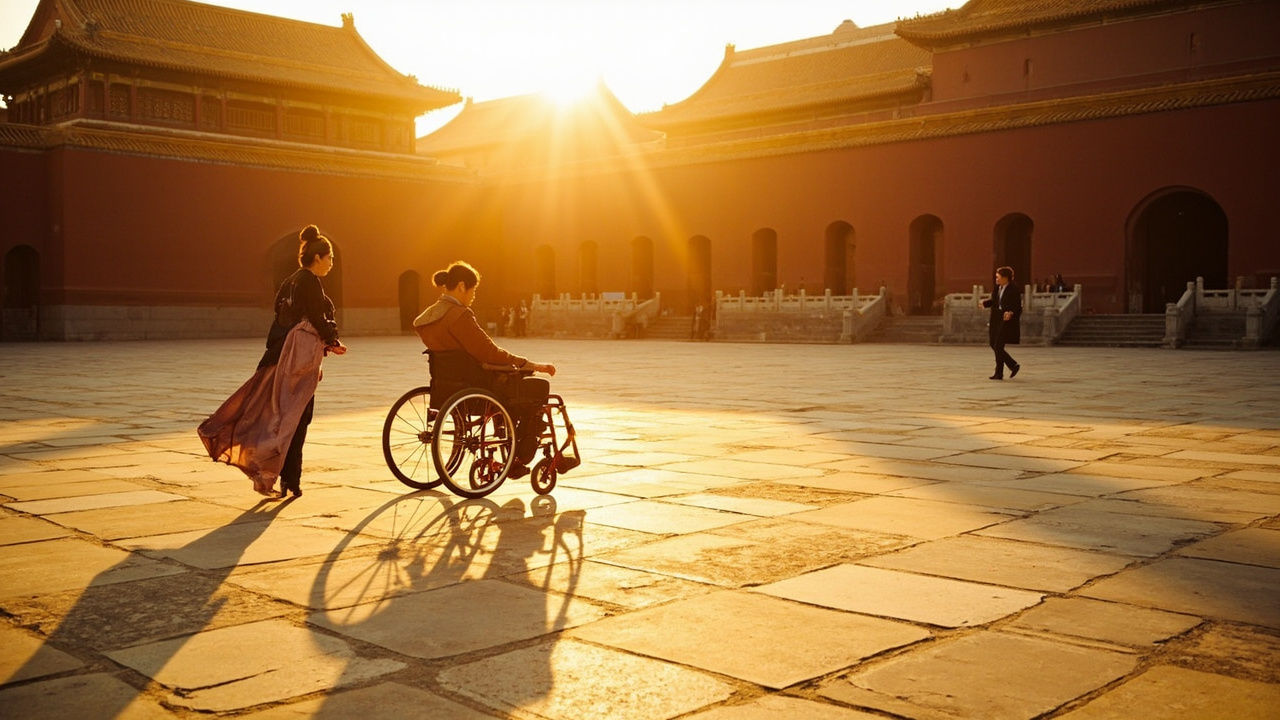
But here’s what makes Beijing worth it: the Forbidden City. The main axis from Meridian Gate to the Imperial Garden is flat, paved, and genuinely accessible. You’ll need to show your wheelchair at the entrance and staff will escort you through a side gate. The Temple of Heaven’s main park is similarly manageable. The Great Wall is another story entirely—skip Mutianyu unless you’re prepared for a serious challenge; the cable car helps, but the ramps are steep and uneven.
- 馃搷 Location: Dongcheng and Xicheng districts for most attractions
- 馃帿 Entry fee: Forbidden City $10 (CNY 60); Temple of Heaven $5 (CNY 35); Great Wall $6-10 (CNY 40-70)
- 馃晲 Opening hours: Forbidden City 8:30-17:00, closed Mondays; book tickets online a week ahead
- 馃殕 How to get there: Take Line 1 to Tiananmen East Station, Exit B, then follow the accessible path to the Meridian Gate
- 鈴?When to visit: April-May and September-October for pleasant weather; avoid Chinese holidays when crowds are overwhelming
- 馃挕 Insider tips: The Forbidden City’s wheelchair loan program is free but limited—arrive early. The Beijing subway’s accessibility map is available in English on the official app. Hire a private driver for Great Wall day trips; public buses are not accessible.
I once watched a group of Beijing retirees help a young woman in a wheelchair navigate the steep ramp at the Jingshan Park entrance. They didn’t speak her language, but they didn’t need to. They just lifted, pushed, and smiled.
Xi’an — The Terracotta Warriors Are Worth the Effort
The Terracotta Warriors are one of those places that feels like a pilgrimage. And I’ll be honest: getting there in a wheelchair is not easy. The site is about an hour outside the city, and the access routes involve ramps that are steeper than they should be and distances that are longer than they look. But once you’re inside Pit 1, standing at the edge of that vast underground army, none of it matters.
The warriors themselves are visible from a raised platform with good sightlines. The site management has improved access in recent years, with wheelchair loans available at the entrance and staff willing to help with the steeper sections. The rest of Xi’an—the ancient city wall, the Muslim Quarter—is more challenging. The city wall has a ramp at the South Gate, but it’s a workout. The Muslim Quarter’s narrow alleys are packed and uneven.
- 馃搷 Location: Lintong District, about 40 km east of Xi’an city center
- 馃帿 Entry fee: $20 (CNY 150) for the Terracotta Warriors
- 馃晲 Opening hours: 8:30-18:00 (March-November), 8:30-17:30 (December-February)
- 馃殕 How to get there: Hire a private car or take a tour; the public bus (Line 5 from Xi’an Railway Station) is not wheelchair accessible
- 鈴?When to visit: Weekday mornings are best; avoid Chinese national holidays at all costs
- 馃挕 Insider tips: The site has a free wheelchair loan program, but they’re basic models—bring your own cushion. The museum’s accessible restrooms are near the main entrance. Book a driver who knows the accessible route; some entrances are blocked by construction.
The driver who took me to the warriors, a man named Mr. Wang, had a foldable ramp he’d made himself for his taxi. “Not many people ask,” he said. “But when they do, I’m ready.”
Chengdu — Pandas and Flat Streets
Chengdu surprised me. I expected a sprawling, chaotic city, but the center is surprisingly flat and walkable. The Panda Base, the city’s main draw, is genuinely accessible—wide paths, gentle slopes, and viewing platforms at the right height. Watching a giant panda munch bamboo from eye level is one of those moments you’ll remember forever.
The city’s teahouses are also accessible, and sitting in one with a cup of jasmine tea while the world slows down is the perfect antidote to travel fatigue. The Jinli Street area is more challenging—it’s a reconstructed old street with uneven paving and crowds—but the main thoroughfare is manageable if you go early.
- 馃搷 Location: Chenghua District for the Panda Base; central Qingyang District for teahouses
- 馃帿 Entry fee: Panda Base $8 (CNY 55); teahouses $3-10 (CNY 20-70)
- 馃晲 Opening hours: Panda Base 7:30-18:00; arrive before 9:00 to see pandas active
- 馃殕 How to get there: Take Metro Line 3 to Panda Avenue Station, then a 10-minute accessible shuttle ride
- 鈴?When to visit: March-June for mild weather; mornings are best for pandas
- 馃挕 Insider tips: The Panda Base has a wheelchair loan program at the main entrance. The Chengdu Museum is excellent and fully accessible. Skip the hotpot if you can’t handle spice—but if you can, it’s a religious experience.
I shared a table at a teahouse with an elderly Sichuan man who spent an hour teaching me the proper way to drink jasmine tea. He didn’t speak English, I didn’t speak Sichuanhua, but we communicated through gestures and laughter.
Guilin and Yangshuo — The Landscape Makes You Forget the Struggle
The karst mountains of Guilin and Yangshuo are among the most beautiful landscapes I’ve ever seen. The Li River cruise between the two is the classic way to experience it, and the boats have accessible lower decks with good views. But the cruise itself involves steps to board, and the dock at Yangshuo is a steep climb.
Yangshuo town itself is a challenge—narrow streets, uneven paving, and crowds. But the countryside around it is flat and beautiful, and hiring a driver to take you through the rice paddies and past the limestone peaks is worth every yuan. The Yulong River bamboo raft rides are not accessible, but the views from the banks are just as good.
- 馃搷 Location: Guilin city center and Yangshuo County
- 馃帿 Entry fee: Li River cruise $40-60 (CNY 280-420); countryside tours $30-50 (CNY 200-350)
- 馃晲 Opening hours: Cruises run 9:00-14:00; book a day ahead
- 馃殕 How to get there: Fly into Guilin Liangjiang International Airport; hire a private driver for the 1.5-hour trip to Yangshuo
- 鈴?When to visit: April-October; avoid summer weekends when the river is crowded
- 馃挕 Insider tips: The Li River cruise boats have accessible cabins on the lower deck—request one when booking. Yangshuo’s West Street is a nightmare on weekends; go early morning. The view from the top of Xianggong Hill is worth the effort, but the climb is steep—skip it if you’re not confident.
The woman who ran our guesthouse in Yangshuo insisted on carrying my luggage up three flights of stairs herself. “You’re on vacation,” she said. “I’m not.”
Hong Kong — A Different World
Hong Kong feels like a different country from mainland China, and in many ways, it is. The accessibility here is on par with any Western city—elevators everywhere, wide sidewalks, accessible public transport. The MTR subway system is a model of accessibility, with level boarding on most lines and staff who genuinely help.
The city’s attractions are mostly accessible too. The Peak Tram has wheelchair spaces, the Star Ferry has level boarding, and the museums are excellent. The only challenge is the hills—Central and Mid-Levels are steep, and even the flat areas can feel like a workout. But if you’re looking for a city where you can just relax and not think about accessibility, Hong Kong is it.
- 馃搷 Location: Central, Tsim Sha Tsui, and Causeway Bay
- 馃帿 Entry fee: Peak Tram $8 (CNY 56); most museums $3-10 (CNY 20-70)
- 馃晲 Opening hours: MTR runs 6:00-1:00; attractions typically 10:00-18:00
- 馃殕 How to get there: Fly into HKG; the Airport Express has level boarding and wide aisles
- 鈴?When to visit: October-December for pleasant weather; avoid typhoon season (July-September)
- 馃挕 Insider tips: The MTR’s accessibility map is excellent—download it before you arrive. The Peak Tram’s accessible carriage is at the front; ask staff when boarding. Hong Kong’s Octopus card works on all public transport and is a must-have.
I rode the MTR from Central to Mong Kok and watched a station attendant help a woman in a wheelchair onto the train with genuine care and efficiency. It was the first time in China I didn’t have to worry about the next step.
Hangzhou — The Lake That Keeps You Calm
Hangzhou’s West Lake is one of those places that feels like a painting come to life. The lakeside promenade is flat, wide, and completely accessible—you can roll for hours along the water, past willow trees and pagodas, without encountering a single step. The lake’s causeways are similarly accessible, and the views are worth the trip alone.
The city itself is manageable, with a decent subway system and flat streets near the lake. The Lingyin Temple, one of China’s most famous Buddhist sites, is more challenging—the main hall requires climbing steps—but the surrounding forest and the Flying Peak carvings are visible from accessible paths.
- 馃搷 Location: West Lake Scenic Area, central Hangzhou
- 馃帿 Entry fee: West Lake is free; Lingyin Temple $6 (CNY 45)
- 馃晲 Opening hours: The lake is always open; temples typically 7:00-17:30
- 馃殕 How to get there: Take Metro Line 1 to Longxiangqiao Station, Exit C, then a 5-minute roll to the lake
- 鈴?When to visit: March-May for spring blossoms; September-October for autumn colors
- 馃挕 Insider tips: The lakeside path is best in the early morning before the crowds arrive. The Hangzhou Museum near the lake is free and fully accessible. Rent a boat with a ramp for a different perspective on the lake.
I sat by the lake for an hour one afternoon, watching a group of elderly locals practicing tai chi. One of them, a woman in her seventies, came over and offered me a piece of candy. “You look tired,” she said in broken English. “The lake helps.”
Suzhou — Gardens That Test Your Patience
Suzhou’s classical gardens are UNESCO World Heritage sites, and they’re beautiful beyond words. But they’re also a challenge. The gardens were designed for able-bodied scholars, with stone bridges, steep steps, and narrow paths. The Humble Administrator’s Garden, the largest and most famous, has made some improvements—there’s a ramp at the main entrance and the primary paths are paved—but you’ll still encounter steps at key viewpoints.
The city itself is flat and manageable, and the Pingjiang Road area along the canal is accessible if you go early. The Suzhou Museum, designed by I.M. Pei, is modern and fully accessible, with wide galleries and elevators.
- 馃搷 Location: Gusu District, central Suzhou
- 馃帿 Entry fee: Humble Administrator’s Garden $10 (CNY 70); Suzhou Museum free
- 馃晲 Opening hours: Gardens typically 7:30-17:30; museum closed Mondays
- 馃殕 How to get there: Take the high-speed train from Shanghai (30 minutes), then Metro Line 4 to Beisita Station
- 鈴?When to visit: Spring and autumn; avoid summer heat and weekend crowds
- 馃挕 Insider tips: The Humble Administrator’s Garden has a wheelchair loan program, but the chairs are basic. The Suzhou Museum is a masterpiece of modern architecture and completely accessible. The canal boats are not accessible, but the views from the bridges are just as good.
A garden attendant at the Humble Administrator’s Garden saw me struggling with a step and appeared with a portable ramp. “We get many visitors,” he said. “We try to help.”
Nanjing — History Without the Crowds
Nanjing is often overlooked by first-time visitors to China, which is a shame. The city has a deep history—it was the capital of several dynasties and the site of the tragic Nanjing Massacre—and its modern attractions are surprisingly accessible. The Nanjing Massacre Memorial Hall is sobering and fully accessible, with wide halls and gentle ramps.
The city wall, one of the best-preserved in China, has an accessible section at the Zhonghua Gate with a ramp to the top. The Sun Yat-sen Mausoleum is a challenge—it requires climbing hundreds of steps—but the surrounding Purple Mountain area has accessible paths and beautiful views.
- 馃搷 Location: Xuanwu and Qinhuai districts
- 馃帿 Entry fee: Memorial Hall free; city wall $6 (CNY 40); Mausoleum free
- 馃晲 Opening hours: Memorial Hall 8:30-16:30, closed Mondays
- 馃殕 How to get there: Take the high-speed train from Shanghai (1.5 hours), then Metro Line 2 to Muxuyuan Station for Purple Mountain
- 鈴?When to visit: March-May for cherry blossoms; September-November for autumn colors
- 馃挕 Insider tips: The Memorial Hall’s exhibits are in Chinese and English, with accessible audio guides. The city wall’s accessible ramp is at the Zhonghua Gate’s east side. The Nanjing Museum is excellent and fully accessible.
I met a history professor at the Memorial Hall who spent an hour walking me through the exhibits. “This is not just Chinese history,” he said. “This is human history.”
Lijiang — Beautiful but Brutal
I’m including Lijiang with a warning. The old town is one of the most beautiful places in China—UNESCO-listed, with cobblestone streets, traditional Naxi architecture, and snow-capped mountains in the distance. But those cobblestones are a nightmare in a wheelchair. The streets are uneven, the ramps are steep, and the crowds are relentless.
If you’re determined to visit, stay in the new town (which is flat and modern) and take a wheelchair-accessible van to the old town’s edge. The Black Dragon Pool Park, just outside the old town, is flat and offers stunning views of Jade Dragon Snow Mountain. The mountain itself has a cable car, but the boarding process is challenging.
- 馃搷 Location: Lijiang Old Town and the surrounding countryside
- 馃帿 Entry fee: Old town maintenance fee $7 (CNY 50); Black Dragon Pool $5 (CNY 35)
- 馃晲 Opening hours: Old town always open; parks typically 8:00-18:00
- 馃殕 How to get there: Fly into Lijiang Sanyi Airport, then a 40-minute accessible taxi ride to the new town
- 鈴?When to visit: March-May and September-October; avoid summer rains and winter cold
- 馃挕 Insider tips: The old town’s cobblestones are brutal—bring a chair with large wheels. The new town’s hotels are modern and accessible. Hire a driver for the day to explore the countryside, which is flat and beautiful.
I watched a young couple carry their friend’s wheelchair up the steps of a bridge in the old town. They were laughing, but it was hard work. “Worth it,” the woman in the chair said. “But never again.”
FAQ summary
China is a challenging but rewarding destination for wheelchair users. The high-speed rail network is the most accessible transport option, with wheelchair-accessible cars and staff assistance available at major stations. Beijing, Shanghai, and Hong Kong have the best urban accessibility, while ancient sites like the Great Wall and Lijiang Old Town present significant challenges. Book accessible hotels directly, hire private drivers for sightseeing days, and set up Alipay before arrival. The 240-hour visa-free transit policy applies to many nationalities, making short trips easier to plan.
FAQ
Q: Is China accessible for wheelchair users? A: Major cities like Shanghai, Beijing, and Hong Kong have made significant progress, with accessible subway stations, museums, and attractions. However, accessibility is inconsistent—ancient sites, rural areas, and older buildings often lack ramps and elevators. Plan carefully and expect challenges.
Q: Can I take the high-speed train in a wheelchair? A: Yes. Book the wheelchair-accessible car on G-series trains, which has wider doors and a dedicated wheelchair space. Station staff will assist with boarding if you request help at the ticket counter or through the China train travel guide.
Q: Do I need a visa to visit China as a wheelchair user? A: Many nationalities qualify for the 240-hour visa-free transit if they’re passing through to a third country. Otherwise, you’ll need a standard tourist visa. Check the China visa guide for the latest requirements.
Q: Are there accessible restrooms in China? A: Modern attractions, malls, and train stations have accessible restrooms, but they’re often locked or used as storage. Carry a universal key or ask staff for help. In older areas, accessible restrooms are rare—plan your route around places with known facilities.
Q: How do I pay for things in China as a wheelchair user? A: China is nearly cashless. Set up Alipay or WeChat Pay before you arrive and link your international card. Some places still accept cash, but you’ll be limited without mobile payment.
Q: Do I need a VPN for internet access in China? A: Yes. Google, Facebook, Instagram, and WhatsApp are blocked. Download a reliable VPN before you arrive, and consider getting a Chinese SIM card for data. Translation apps like Google Translate won’t work without a VPN.
Q: What should I pack for a wheelchair trip to China? A: Bring a lightweight manual chair if possible, a portable ramp for curbs, a universal restroom key, and a repair kit. Pack medication in your carry-on, and bring a printed copy of your hotel’s address in Chinese for taxi drivers.
The Honest Wrap-up
China will test your patience. There will be moments—waiting for an elevator that never comes, staring at a flight of stairs, trying to explain “accessible” to someone who doesn’t understand—when you’ll wonder why you came. But there will also be moments that make it all worth it: rolling through the Forbidden City’s gates, watching pandas from eye level, sharing tea with strangers who become friends.
This list is for travelers who are flexible, patient, and willing to adapt. It’s not for anyone who expects the same accessibility they’d find in London or New York. But if you’re willing to work for it, China will reward you with experiences you’ll never forget.
My final advice? Book the flight. Plan carefully, but book the flight. The Great Wall might be too much, but the Forbidden City is waiting. The old towns might be brutal, but the lakes and museums are accessible. China is a country of contrasts, and if you’re willing to navigate them, you’ll find a destination that’s unlike anywhere else on earth.
Topics
More guides you may like
Top 10 Bridges in China
China's bridges are engineering marvels spanning mountains, rivers, and seas. Here are 10 of the most spectacular, from ancient stone to modern steel.
8 min read

Top 10 Buddhist Sites in China
From the Leshan Giant Buddha to the Dunhuang Caves, these 10 Buddhist sites represent 2,000 years of China's spiritual heritage.
9 min read

Top 10 Day Trips from Beijing You Shouldn't Miss
Beijing is packed with history, but some of China's best experiences are just a few hours away. Here are 10 day trips that will transform your visit.
9 min read
Top 10 Hidden Gems in China Off the Beaten Path
Beyond the Great Wall and Terracotta Warriors, China has incredible hidden destinations few tourists ever reach. Here are 10 underrated gems worth the detour.
9 min read
Top 10 Markets and Shopping Streets in China
From Shanghai's Bund to Beijing's Silk Street - 10 markets where foreigners can haggle, explore, and bring home authentic Chinese goods.
9 min read
Top 10 Museums in China You Shouldn't Miss
China's museums span 5,000 years of civilization. These 10 - from the Palace Museum to Xi'an's terracotta gallery - are unmissable for culture lovers.
9 min read