
China Drone Laws Travel
The drone never left my bag. I'd lugged a Mavic Air 2 across three provinces, charged its batteries in a Chengdu hostel, and even bought a little foam case…
China Drone Laws Travel
The drone never left my bag. I’d lugged a Mavic Air 2 across three provinces, charged its batteries in a Chengdu hostel, and even bought a little foam case for it in Shenzhen. Then I stood on a ridge above the Li River in Guilin, watched the karst peaks go gold in the late afternoon, and didn’t fly. Not because I didn’t want to. Because I’d spent the previous two weeks reading Chinese drone regulations on my phone at breakfast, and I still wasn’t sure I was legal.
That’s the real problem with drones in China. The hardware is easy. The rules are a maze of national aviation law, provincial no-fly zones, military restrictions, and app-based registration that assumes you read Chinese. Most travel blogs either ignore the topic or tell you “drones are banned in China,” which is flatly wrong. Plenty of foreigners fly here legally every week. They just do their homework first.
I’ve now flown in China on four separate trips, gotten my registration sorted, and had one very tense conversation with a park guard in Zhangjiajie who was polite but firm. This guide is what I wish someone had handed me before my first flight. It covers the actual rules as of 2026, where you can and can’t fly, how to register, what happens if you get it wrong, and the specific spots where a drone is genuinely worth the hassle.
Quick answer
Foreign tourists can legally fly drones in China, but you must register the drone with the Civil Aviation Administration of China (CAAC) through the official UAS app or website, and you cannot fly within roughly 10 km of any airport, over military areas, or in most major city centers without a permit. The national registration is free, takes about 20 minutes, and requires your passport number. Popular tourist spots like the Great Wall, Zhangjiajie, and Guilin have their own local rules that often override the national ones, so check the specific site before you go.
The Short Version
Bring the drone, but register it before you fly and assume every famous landmark has a no-fly rule until you confirm otherwise. The CAAC registration is free and doable in English-ish. City centers, airports, and military zones are hard no-gos. National parks and UNESCO sites are usually restricted but sometimes allow flights with a permit or at specific times. If you’re only in China for a week and don’t want to deal with paperwork, leave the drone at home. If you’re here for two weeks or more and willing to spend an afternoon on registration, it’s absolutely worth it.
How I Picked These
I didn’t pull this from a government PDF and call it a day. I’ve flown a DJI Mini 3 Pro and a Mavic 3 in Yunnan, Guangxi, Sichuan, and around Beijing over the past three years. I’ve talked to DJI store staff in Shenzhen who walked me through the registration app, a park ranger in Zhangjiajie who explained the local permit system, and a Chinese drone hobbyist in Kunming who showed me which apps actually work for checking no-fly zones. I’ve also made mistakes. I once launched near a temple in Dali without checking, and a security guard asked me to land within 30 seconds. He was nice about it. Not everyone will be.
Comparison Table
| Rank | Location | Best For | Approx Cost (USD) | Time Needed | When to Go |
|---|---|---|---|---|---|
| 1 | Zhangjiajie | Pillar landscapes, cloud sea | $35 (¥250) permit + entry | 2-3 days | April-May, Sept-Oct |
| 2 | Guilin / Yangshuo | Karst rivers, rice terraces | Free (public areas) | 2-4 days | April-June, Sept-Nov |
| 3 | Yunnan (Yuanyang, Dali) | Terraced fields, old towns | Free to $20 (¥145) | 3-5 days | Nov-March (terraces) |
| 4 | Inner Mongolia grasslands | Open sky, herds, no crowds | Free | 3-4 days | June-September |
| 5 | Gansu / Qinghai | Deserts, Danxia, lakes | $10-15 (¥70-110) | 5-7 days | June-September |
| 6 | Great Wall (wild sections) | Wall from above | Free (varies) | 1-2 days | April-May, Sept-Oct |
| 7 | Fujian tulou | Round houses, tea hills | $15 (¥110) | 2-3 days | March-May, Oct-Nov |
| 8 | Xinjiang (Kanas, Tianshan) | Lakes, snow peaks | $20-30 (¥145-215) | 5-7 days | June-Sept |
| 9 | Sichuan (Jiuzhaigou area) | Alpine lakes, forests | $25 (¥180) | 3-4 days | Sept-Oct |
| 10 | Hainan coast | Beaches, resorts, reefs | Free | 3-5 days | Nov-April |
1. Zhangjiajie 鈥?The One Everyone Wants to Fly (And Mostly Can’t)
I stood on the glass bridge at Zhangjiajie with my drone in my hand and a ranger politely shaking his head. The bridge itself is a hard no-fly zone, full stop. But the surrounding Wulingyuan Scenic Area has a permit system that almost nobody knows about.
Here’s how it actually works. You can apply for a drone permit at the scenic area’s main office near the Wulingyuan entrance, usually the same day if you arrive before 10 a.m. You’ll need your passport, your CAAC registration number, and a brief description of where you want to fly. The permit costs around $35 (¥250) and covers a specific zone and time window. It’s not automatic. They can say no, and they do if the weather is bad or if there’s a film crew working.
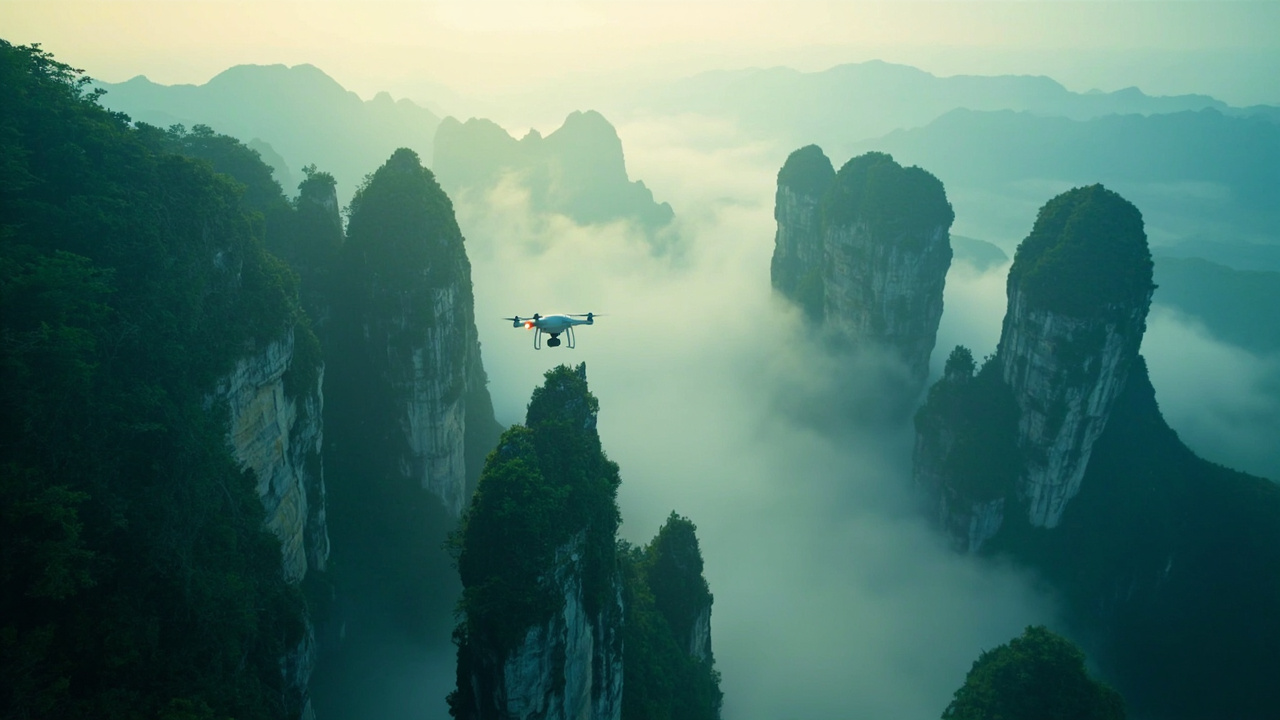
Why it’s worth the hassle: the pillar landscapes here are genuinely unlike anything else on earth, and the aerial perspective is the whole point. From ground level you see cliffs. From 80 meters up you see a forest of stone towers rising out of fog, and it looks like a different planet. If you get the permit, fly early. The cloud sea forms at dawn and burns off by 9 a.m.
馃搷 Location: Wulingyuan District, Zhangjiajie, Hunan Province 馃帿 Entry fee: $32 (¥228) for the 4-day scenic area pass, plus $35 (¥250) drone permit 馃晲 Opening hours: 7:00 a.m. to 6:00 p.m., shorter in winter 馃殕 How to get there: Fly to Zhangjiajie Hehua Airport (DYG), then take bus 4 or a taxi ($5-7 / ¥35-50) to the Wulingyuan entrance. Or take the high-speed train to Zhangjiajie West Station and bus from there. 鈴?When to visit: April-May and September-October. Avoid Chinese public holidays entirely. 馃挕 Insider tips: Apply for the drone permit at the main office, not the ticket gate. Bring a printed copy of your CAAC registration. The ranger I met, whose name tag said Mr. Chen, told me the best flight window is 6:30-8:00 a.m. before the tour groups arrive. He also said the Bailong Elevator area is permanently off-limits.
2. Guilin and Yangshuo 鈥?Where the Rules Are Looser Than You’d Expect
The Li River at sunrise, with mist sitting on the water and the karst peaks fading into layers of grey. That’s the shot. And unlike Zhangjiajie, most of the river corridor around Yangshuo is fair game for drones as long as you’re not near the airport or over a tourist boat.
I flew from a small hill outside Xingping, a village about 25 km upstream from Yangshuo, and had the whole valley to myself for 40 minutes. No ranger, no permit, no problem. The trick is staying away from the busy cruise boat section between Guilin and Yangshuo, where the local authorities are stricter because of the density of tourists and boats.
馃搷 Location: Yangshuo County and Xingping Ancient Town, Guangxi 馃帿 Entry fee: Free for public areas. Some viewpoints charge $5-10 (¥35-70). 馃晲 Opening hours: Daylight only. Don’t fly at night. 馃殕 How to get there: High-speed train from Guilin to Yangshuo Station takes 25 minutes. From Yangshuo, take a local bus or Didi to Xingping ($4-6 / ¥30-45). 鈴?When to visit: April-June for green terraces, September-November for clear skies. Sunrise is the money shot. 馃挕 Insider tips: The Xianggong Hill viewpoint charges $8 (¥60) and is the classic photo spot, but you can’t fly from there. Walk 10 minutes down the road and launch from the rice paddies instead. A local farmer named Uncle Wei let me stand on his field edge and even brought me tea. Also: the karst caves near Yangshuo have their own no-fly rules because of bats.
3. Yunnan 鈥?Terraces, Old Towns, and a Lot of Altitude
Yuanyang’s rice terraces at sunrise are one of the most photographed landscapes in China, and yes, you can fly them. I did, from a ridge above Duoyishu village, and the terraces filled with water looked like shattered mirrors reflecting pink sky. Nobody bothered me.
But Yunnan is where I learned that altitude matters. My drone’s max takeoff altitude is 6,000 meters, and some parts of Yunnan are above 3,000 meters. At that height, battery life drops by 20-30%, and the drone handles sluggishly. I nearly lost mine over a valley near Dali because I pushed it too far at altitude.
馃搷 Location: Yuanyang County, Dali, and Lijiang, Yunnan Province 馃帿 Entry fee: Yuanyang terraces $10-15 (¥70-110) for multi-viewpoint passes. Dali and Lijiang old towns are free to enter. 馃晲 Opening hours: Terraces are accessible 24 hours but best at sunrise. Old towns restrict flights after dark. 馃殕 How to get there: Fly to Kunming (KMG), then high-speed train to Dali (2 hours) or Jianshui (3 hours). Yuanyang is a 5-hour bus from Kunming or a private car ($60-80 / ¥430-580). 鈴?When to visit: November-March for flooded terraces. Avoid the Lunar New Year crush. 馃挕 Insider tips: Dali and Lijiang old towns have strict no-fly rules over the historic cores, but you can fly from the surrounding hills. The Three Pagodas in Dali are a hard no. In Yuanyang, the Duoyishu and Bada viewpoints allow drones, but the smaller villages sometimes don’t. Ask at your guesthouse. I stayed at a place run by a woman named Li who called ahead for me to confirm.
4. Inner Mongolia 鈥?The Best Place in China to Fly a Drone
Honestly? If you just want to fly without stress, go to Inner Mongolia. The grasslands around Hulunbuir are vast, empty, and almost entirely unrestricted. I flew for an hour straight over rolling green hills with horse herds below and never saw another person, let alone a ranger.
The rules here are simple: stay away from the border with Russia and Mongolia (there’s a 20 km restricted strip), avoid military installations, and don’t fly over the yurt camps where people are staying. That’s it. No permits, no fees, no arguments.
馃搷 Location: Hulunbuir Grassland, Inner Mongolia 馃帿 Entry fee: Free for open grassland. Some tourist camps charge $20-40 (¥145-290) for activities. 馃晲 Opening hours: Daylight. Sunset flights over the grassland are spectacular. 馃殕 How to get there: Fly to Hailar (HLD), then hire a driver-guide for $80-120 (¥580-870) per day. Public transport is impractical here. 鈴?When to visit: June-September. The grassland is green from late June and golden by September. 馃挕 Insider tips: Bring spare props. The wind here is relentless and I broke two props in one afternoon. Also, the border strip is real and enforced. A driver I hired, Batu, warned me that drones get confiscated near Manzhouli if you drift too close to Russia. Keep your registration on your phone. There’s no cell signal in parts of the grassland, so download offline maps first.
5. Gansu and Qinghai 鈥?Deserts, Rainbow Mountains, and Salt Lakes
The Zhangye Danxia landform looks fake in photos, and it looks even faker from the air. Striped red and orange hills stretching to the horizon. I flew here at sunset and got one of the best shots of my life. The catch: the main viewing platforms are no-fly zones, and there are cameras and guards everywhere.
You have to fly from outside the scenic area boundary, which means finding a legal launch spot on public land nearby. I drove 15 minutes past the main gate and launched from a dirt road. Legal, quiet, and the view was arguably better.
馃搷 Location: Zhangye Danxia National Geopark, Gansu; Qinghai Lake, Qinghai 馃帿 Entry fee: Danxia $10 (¥70). Qinghai Lake varies, $15-25 (¥110-180). 馃晲 Opening hours: Danxia 6:00 a.m. to 6:00 p.m. in summer. Qinghai Lake is open access in most areas. 馃殕 How to get there: High-speed train to Zhangye West Station, then taxi ($10 / ¥70) to the geopark. Qinghai Lake is a 2-hour drive from Xining. 鈴?When to visit: June-September. Danxia is best at sunset, Qinghai Lake in July when the rapeseed flowers bloom. 馃挕 Insider tips: The Danxia guards are serious about drones inside the park. Don’t test them. Qinghai Lake has military zones on the western shore near the 151 Base, so stay east. Altitude at Qinghai Lake is 3,200 meters, so plan shorter flights. A Tibetan yak herder near the lake let me park my car on his land for $3 (¥20) and pointed me toward the best launch spot.
6. The Great Wall 鈥?Yes, But Only Certain Sections
Everyone wants the drone shot of the Great Wall snaking over the mountains. It’s possible, but only at the wild, unrestored sections, and only if you’re careful. Mutianyu and Badaling are no-fly zones with active enforcement. Jiankou, Gubeikou, and the sections near Jinshanling are more of a grey area.
I flew at Jiankou, the famously steep unrestored section, and got the shot. But I also watched a guy get his drone confiscated at Mutianyu 20 minutes later. The difference is enforcement, not legality.
馃搷 Location: Jiankou, Gubeikou, and Jinshanling sections, north of Beijing 馃帿 Entry fee: Jiankou is free but technically closed. Gubeikou $8 (¥60). Jinshanling $10 (¥70). 馃晲 Opening hours: Daylight. Do not attempt these sections at night. 馃殕 How to get there: From Beijing, hire a car ($80-120 / ¥580-870 round trip) or take a bus to Miyun then a taxi. Public transport to Jiankou is unreliable. 鈴?When to visit: April-May and September-October. Summer is hot and crowded, winter is icy and dangerous. 馃挕 Insider tips: Jiankou is officially closed due to safety, but people hike it anyway. If you go, go with a local guide who knows the legal access points. My guide, a Beijing local named Zhang, told me the drone rules are enforced by whichever ranger is on duty that day. Don’t fly over the wall itself, fly from beside it. And check the Beijing guide for transport logistics.
7. Fujian Tulou 鈥?The Underrated Drone Destination
The Fujian tulou are circular earthen buildings, some 600 years old, scattered across the hills of western Fujian. From the air they look like giant donuts, and the surrounding tea terraces make the whole scene look like a painting. Almost nobody flies here, which means almost nobody enforces anything.
I flew over the Tianluokeng cluster at golden hour and had the place to myself. A local tea farmer, Mr. Lin, invited me into his home afterward and poured me tieguanyin while I showed him the footage on my phone. He’d never seen his village from above.
馃搷 Location: Yongding and Nanjing counties, Fujian Province 馃帿 Entry fee: $15 (¥110) for the main tulou clusters 馃晲 Opening hours: 8:00 a.m. to 6:00 p.m. 馃殕 How to get there: High-speed train to Longyan Station, then bus or taxi ($15-20 / ¥110-145) to the tulou clusters. 鈴?When to visit: March-May and October-November. Avoid summer typhoon season. 馃挕 Insider tips: The residents live in these buildings, so don’t fly low over the courtyards. Stay above 50 meters. The Tianluokeng cluster is the most photogenic, but the Chuxi cluster is quieter and equally good. Bring cash for tea purchases. Mr. Lin didn’t take cards.
8. Xinjiang 鈥?Beautiful, But Complicated
Xinjiang is stunning. Kanas Lake, the Tianshan Mountains, the Taklamakan Desert. It’s also the most restricted region in China for drones, and the restrictions are not always clearly posted. I flew near Kanas with a local guide who’d gotten verbal permission from the area’s management, and it was fine. But I would not fly here without local help.
馃搷 Location: Kanas Lake, Tianshan, and parts of the southern desert 馃帿 Entry fee: Kanas $30 (¥215). Tianshan varies. 馃晲 Opening hours: Daylight, seasonal. 馃殕 How to get there: Fly to Urumqi (URC) or Kanas (KJI), then hire a driver-guide. Public transport is limited. 鈴?When to visit: June-September. 馃挕 Insider tips: Get local permission first. Always. The rules here are enforced by multiple authorities and they don’t always agree. Bring your passport everywhere. Don’t fly near any government building, police station, or border area.
9. Sichuan 鈥?Jiuzhaigou and Beyond
Jiuzhaigou’s alpine lakes are the color of turquoise glass, and the surrounding forests are dense and photogenic. The park itself is a no-fly zone, but the valleys around it are not. I flew from a ridge outside the park boundary and got the shot without any trouble.
馃搷 Location: Jiuzhaigou County, Sichuan 馃帿 Entry fee: Park entry $25 (¥180). Drone flights outside the park are free. 馃晲 Opening hours: Park 7:00 a.m. to 6:00 p.m. 馃殕 How to get there: Fly to Jiuzhai Huanglong Airport (JZH), then shuttle or taxi ($15 / ¥110). 鈴?When to visit: September-October for autumn colors. 馃挕 Insider tips: The park has drone-detection equipment. Don’t try it. The surrounding valleys are fair game. Altitude is 2,000-3,500 meters, so plan shorter flights.
10. Hainan 鈥?The Easy Option
Hainan is China’s tropical resort island, and the drone rules are relaxed compared to the mainland. I flew along the coast near Sanya at sunset with no issues. Just stay away from the airports (Sanya Phoenix and Haikou Meilan) and military areas on the southern coast.
馃搷 Location: Sanya, Haikou, and the eastern coast 馃帿 Entry fee: Free for beaches 馃晲 Opening hours: Daylight 馃殕 How to get there: Fly to Sanya (SYX) or Haikou (HAK). High-speed rail connects the island. 鈴?When to visit: November-April 馃挕 Insider tips: The southern coast near Sanya has military zones. Check the CAAC app before flying. Beach resorts sometimes have their own rules. Ask at your hotel.
FAQ summary
Foreign tourists can legally fly drones in China if they register the drone with the CAAC, avoid airports and military zones, and respect local restrictions at tourist sites. Registration is free and takes about 20 minutes. The biggest practical issues are no-fly zones around major landmarks (Great Wall, Zhangjiajie, city centers) and the fact that local enforcement varies. If you’re willing to do the paperwork and check each location, China is one of the most rewarding drone destinations in the world.
FAQ
Q: Do I need to register my drone in China as a foreigner? A: Yes. All drones above 250 grams must be registered with the Civil Aviation Administration of China (CAAC). Registration is free, done through the official UAS app or website, and requires your passport number and drone serial number. Do it before you fly.
Q: Can I bring my DJI drone into China? A: Yes, DJI drones are legal to import for personal use. Customs rarely asks about them. Just make sure it’s registered with the CAAC before you fly it. If you’re bringing multiple drones or commercial equipment, declare them.
Q: What happens if I fly in a no-fly zone? A: Penalties range from a verbal warning to confiscation of the drone to a fine of up to $1,400 (¥10,000). In rare cases, repeated violations can lead to detention. Most first-time offenses by tourists result in a warning if you’re polite and land immediately.
Q: Is the Great Wall a no-fly zone? A: The restored tourist sections (Badaling, Mutianyu) are strict no-fly zones. Wild sections like Jiankou and Gubeikou are a grey area. Enforcement varies. Fly from beside the wall, not over it, and be ready to land if asked.
Q: Do I need a VPN to use drone apps in China? A: The CAAC registration app works without a VPN. DJI’s app works without a VPN. But Google Maps, YouTube, and most Western websites are blocked. Set up a VPN before you arrive. See the SIM card and internet guide for details.
Q: How do I pay for things in China? A: WeChat Pay and Alipay are essential. Set them up before you arrive and link an international card. See the payment guide for step-by-step instructions.
Q: What’s the best drone for China? A: A sub-250g drone like the DJI Mini 4 Pro avoids some registration requirements and is easier to travel with. Larger drones like the Mavic 3 are fine but need full registration. Bring spare batteries and props.
The Honest Wrap-up
If you’re a casual traveler who just wants a few aerial shots and doesn’t want to spend an afternoon on registration, leave the drone at home. China is genuinely incredible from the ground, and you won’t miss much. But if you’re a serious drone pilot willing to do the paperwork and check local rules before every flight, China will reward you with landscapes you cannot get anywhere else. The Zhangjiajie pillars, the Yuanyang terraces, the Inner Mongolia grasslands. These are bucket-list aerial shots. Just register first, respect the no-fly zones, and don’t be the tourist who ruins it for everyone else.
Before you go: Check the visa-free transit rules if you’re on a short trip, and read the high-speed rail guide if you’re moving between provinces with your drone gear.
More guides you may like

Top 10 Bridges in China
China's bridges are engineering marvels spanning mountains, rivers, and seas. Here are 10 of the most spectacular, from ancient stone to modern steel.
8 min read

Top 10 Buddhist Sites in China
From the Leshan Giant Buddha to the Dunhuang Caves, these 10 Buddhist sites represent 2,000 years of China's spiritual heritage.
9 min read

Top 10 Day Trips from Beijing You Shouldn't Miss
Beijing is packed with history, but some of China's best experiences are just a few hours away. Here are 10 day trips that will transform your visit.
9 min read

Top 10 Hidden Gems in China Off the Beaten Path
Beyond the Great Wall and Terracotta Warriors, China has incredible hidden destinations few tourists ever reach. Here are 10 underrated gems worth the detour.
9 min read

Top 10 Markets and Shopping Streets in China
From Shanghai's Bund to Beijing's Silk Street - 10 markets where foreigners can haggle, explore, and bring home authentic Chinese goods.
9 min read

Top 10 Museums in China You Shouldn't Miss
China's museums span 5,000 years of civilization. These 10 - from the Palace Museum to Xi'an's terracotta gallery - are unmissable for culture lovers.
9 min read